Leaning Into My Presuppostions

Atheism, Communities of Unbelief, Critique of Apologetics, Humanism, Naturalism, Philosophy, Secular Grace

Conversely inspired by presuppositional apologetics and continuing my Watershed Presuppositions series I thought it time to write down what my presuppositions are.

Presuppositions are truths you accept without justification. They are accepted a prori and may or may not have evidence to prove them. They are your starting point and the basis upon which everything you believe in is built.

It is important to note that everyone has presuppositions whether they are aware of them or not. Much of the difficulty in having a dialog with those you disagree with is the unstated incongruous presuppositions that you and your interlocutor hold.

My Presuppositions

Ontological and Epistemological

  • The universe exists and has patterns which are to varying degrees discoverable.
  • Conscious minds are a product of the patterns of the universe.
  • Logic and mathematics abstracted from the discoverable patterns of the universe by conscious minds are sound and reliable.
  • The scientific method which uses logic, mathematics and observation is a reliable method for discovering the patterns of the universe.
  • Truth is that which can be tested and verified to conform to reality.

Moral

  • Human beings have value and inalienable rights.
  • Human beings are fallible.
  • Human beings are meaning makers.

These are the truths that I hold axiomatically. Some, even most, can be justified, meaning they have evidence. But, for our purposes here, what are the implications of these statements when held true?

You may find yourself saying, “but I don’t believe one or more of these.” No problem. These are my presuppositions not yours. The reason they are useful is for you to understand how I come to certain conclusions and not others. If you can accept them purely for the sake of argument you can begin to understand my worldview. If you cannot accept them even solely for the sake of argument then we have nothing further to discuss.

The universe exists

This one seems pretty obvious. If it seems as obvious to you as it does to me, you have probably never hung out with philosophers.

The purpose of this axiom is to do away with the interesting yet tiresome arguments of solipsism, that the only thing that can be proven to exist is our consciousness. Do we live in a hologram or a matrix? Are we just brains in a vat? So boldly and arrogantly I assert, the universe exists!

photo of galaxy

Photo by Pixabay on Pexels.com

Even more boldly I assert that at least to some extent it has patterns which are discoverable. These patters are observable and ultimately knowable to varying degrees of certainty. The old trite saying, “as surely as the sun will rise in the East and set in the West,” is an example of observing a pattern of the universe and gaining certainty that it is true.

Conscious minds are a product of the patterns of the universe

This one is more of an assertion. Fewer people may agree with me here. But I take this as a given. Consciousness is not made of a mysterious non-natural substance. We may not understand consciousness in its entirety … yet. Therefore,  I assert consciousness is a product of the patterns of the universe we find ourselves conscious in.

This axiom is important to do away with the idea that consciousness is something other than natural. The idea of a soul dies hard.

Logic and mathematics are sound

Again, if you find this one obvious, you have not spent much time with either philosophers or presuppositional apologists.

Logic and mathematics are abstractions from the patterns of the universe by conscious minds. There are a few hidden assertions in here that I will point out.

Logic and mathematics do not exist in the platonic sense. We have discussed dualism in this series before it is a difficult one to escape. What I am saying here is logic and math do not have their own existence they are the product of human intellect based on observed patterns in the universe: abstractions. In philosophic language this is an epistemological claim not an ontological claim.

We as conscious human beings observe the patterns of the universe and we abstract “rules” that describe those patters. If I have two sheep and then I get two more I have four sheep. It does not matter if “sheep” are woolly mammals who chew the cud or blocks, or rocks, or anything. We have abstracted the rule 2 + 2 = 4 by observation and human intellect. From basic arithmetic to number theory we have abstracted rules from these patterns.

person holding a chalk in front of the chalk board

Photo by JESHOOTS.com on Pexels.com

The most important assertion here is that logic and mathematics are sound and reliable. It is a feature of logical and mathematical proofs that each step taken relies on the proofs that came before it. If one of the foundational mathematics axioms were not true the proofs built upon it would not “work” as they do.

Don’t believe this one? Then throw out the magic device in your pocket that gives you access to the near sum total of human knowledge. That device, the network it uses and literally the information itself is all built on logic and mathematics.

Mathematics is the language of the universe.

— Neil Degrasse Tyson

The scientific method is a reliable method to gain knowledge

The scientific method is simply a process by which an idea is tested by gathering evidence. If there is strong evidence more credence is given to the idea, if there is little evidence credence goes down and if there is contradictory evidence the idea may be abandoned altogether.

My assertion here is that this is a reasonable and reliable epistemological method, a way to gain knowledge.

The scientific method leads toward truth in major part by discarding bad ideas. Finding true ideas is hard. Validating that an idea is true is just as hard. But by discarding false ideas the options are narrowed down toward true ones.

Science is self-correcting. If tomorrow credible evidence is discovered contracting any of the deeply held scientific theories credence in that theory would drop. Not only that the discoverer of the contradicting evidence would be lauded.

Science tends to assume naturalistic metaphysics. If that bothers you, then you need to account for science’s unreasonable, wild and fantastic success. The entirety of the modern age depends upon the successes of science from medicine to space exploration to binge watching your favorite TV series on demand.

Truth is that which can be tested and verified to conform to reality

Adding to the common definition of truth as that which conforms to reality and adding a bit of the scientific method. I assert that truth is that which can be tested and verified to conform to reality where reality is the product of the patterns of the universe. We should have more credence in something that has been tested and has evidence than something that has neither.

Evidence, testing and validation are important because these are the only tools to convince the skeptic. Einstein was famously not a fan of quantum theory in the early days. But he was won over by the evidence.

If I make a claim, you can believe me or not. But if I make a claim and tell you how to test for yourself and that test validates my claim it is harder to ignore.

I expect the accusations of scientism, materialism and empiricism. Fine. It is certainly true that there are vast areas where science just doesn’t know. And in fact this is a feature: to humbly acknowledge all that we don’t know.

Focusing on the gaps in knowledge misses the point, keep in mind all that we do know. Evolutionary theory explains the vast complexity of life on planet Earth. Theories within cosmology can model the universe back to fractions of a second after the big bang. Gravity waves just recently verified were predicted by Einstein’s general theory of relativity. The baffling quantum field theory explains nature’s behavior at the microscopic level which turns out to be deeply counter intuitive.

Even for those things which we cannot measure directly we use inference. We have inferred dark matter and dark energy. These two account for 96% of the material in the universe and yet we cannot detect them directly.

Human beings have value and inalienable rights

This is the basis of my morality: human beings have value and inalienable rights. I assert it thus, and then try to live out the implications. As sentient beings we recognize each other’s great value in the otherwise empty vastness of the universe we find ourselves in. We are not alone. We have each other.

I am a humanist as I have written before. This simply means that people are more important than ideologies of any kind. We ought to treat each other with Secular Grace.

woman carrying baby at beach during sunset

Photo by Pixabay on Pexels.com

I appreciate the need to expand this concept to conscious creatures. This has vast implications on how we treat animals and potential artificial intelligences. However, as recent political history has shown we are not very good at treating each other with respect and valuing each other’s rights. So human beings are my focus.

Human beings are fallible

Just as important as recognizing the value human beings pose we must also acknowledge human fallibility. Although, I reject the concept of sin it would be foolishness not to recognize people can be destructive to themselves and others.

Human beings are neither all good nor all bad. If those terms are too loaded, they are neither completely selfish nor completely altruistic. Our motivations are complex and varied and they very rarely reduce to simple identifiable sources.

We are very good at fooling ourselves. We are susceptible to a vast array of cognitive biases. In fact, much of the process of the scientific method is to avoid human fallibility and our ability to find what we want to be true.

However, just because human beings are fallible or imperfect does not mean we are not of great value. Sentience being an exceedingly rare commodity in the universe we find ourselves in, we need to love each other.

Human beings are meaning makers

We humans are the conscious observers who abstract the patterns of the universe. We experience awe and mystery and give them meaning. We define human morality  I assert there may not be inherent meaning in the universe but we humans make meaning.

We are the universe aware of itself.

— Carl Sagan, Julian Huxley, Neil Degrasse Tyson all have said some variation on this quote.

I tend to agree with Hume that you cannot get an aught from an is. Rather than exhausting ourselves looking for external objective truth, morality and meaning we should take it upon ourselves to work together toward greater understanding of human truth, morality and meaning. Though all human moral systems are incomplete, taken together they point toward respect for human value.

Magic feathers and sugar pills

Deconstruction, Deconversion, Humanism, Secular Grace

Many months ago Neil Carter, Godless in Dixie, wrote an article about the Evangelical mind warping perspective on Philippians 4:13. (I particularly like the comment about his kids noticing the clock reading 4:13 as apposed to 4:20.) He also uses a cute analogy about Dumbo and the magic feather.

It is his follow on comment that I want to explore further:

In one sense Dumbo never needed a magic feather, but it sure was helpful at the beginning. Maybe the same thing can be said of religion.

I responded by saying that “This kind of sneaks up on you as subtly true.” And over the intervening months this idea has haunted me.

The reason Neil’s suggestion that religion might be helpful in the beginning struck me as true because that was my experience. Right at the time when I was most “lost” is when I became a Christian. That may actually be trite to say. Isn’t that true for everyone? This is going to sound like a religious testimony, but I have a point to make. So bear with me.

I grew up in a nominal Christian home. There were occasional references to God but he was never at the forefront of conversation. So much so, that I was curious about what the adults all seemed to know that I did not quite get. If I can quote Douglas Adams, my position on God as a kid went something like this:

Who is this God character, anyway?

The other pertinent piece of information is that I grew up in an alcohol and drug addicted family, specifically my mom. After years of broken promises and heartache when I was 17 my mom came to me and said, “Jesus told me to stop drinking.” “Sure, mom, whatever,” was my response. But she was clean and sober that day. And the next. And the next. She claimed God had given her a choice, “stop drinking or die,” and she chose to live.

This had a rather profound impact on me, as you can imagine. My mom did not push religion on me. After going to rehab and being clean and sober for a couple of months she bought me my first bible and gently suggested, if I was interested, to read one of the gospels. Which I did. Over the next year, I read it cover to cover.

With mom suddenly acting like an adult, this was my cue to fall apart. This was my junior year in high school. I had already had problems with school, mostly due to skipping class. But I was also dealing with what I now understand was depression and anxiety. I was panicked about projects where I had to speak in front of the class. So I did not go to school. Which made it harder to go the next day. Which made it harder still. The pressure and anxiety snowballed. I felt like I had a mountain of anxiety on my back every day.

So, I dropped out.

This is when I became a Christian. I had just watched my mother transform literally overnight. I had dropped out of high school. I was 17 years old, poor, with no prospects for the future. I had no idea what I was going to do with my life. All while I was reading the bible which was presented to me as having answers. And it claimed there was a God who cared. I needed help. Of course, I reached out to God.

Here is the point where my secular readers are jumping up and down at the manipulative nature of religion preying upon the vulnerable at there weakest. This is, of course, true, but not the main point I want to make. I need you to feel how lost I felt: on the cusp of adulthood, with no education and no plans on how to make a living, nor any hope for a meaningful life. Because the rest of the story gets to the point.

I had the odd experience of reading through the bible before I went to church. Which means that upon arrival at church I was constantly wondering, “Where did they get that idea?” I was 18 and the church had no idea what to do with me. So, the youth pastor asked me if I could help out with their youth group. Turns out not everyone in the church has read their bibles, so I was pretty good at preaching and teaching it very early on.

Here is the critical point in the story. One day the youth pastor says to me, “you should go to bible college.” Now, I was a high school drop out, I had gotten my GED and was playing about at community college with no particular plan. But suddenly, the idea of going to college was not out of reach. At least one person believed I could do it.

I wound up going to bible college and graduated Cum Laude. I met my future wife there. I briefly became a youth pastor. On at least a few occasions, I spoke and preached in front of thousands. This was the same kid who dropped out of high school because he was afraid of speaking in front of the class.

You know there is a rest to the story. This entire blog is the rest of the story. There were dark days for my mom. There were problems with bible college. There were certainly problems with ministry. And ultimately, my recognition that none of it was based on reality.

So what is my point?

I wouldn’t be here writing this today. I wouldn’t have my life. I wouldn’t have my career. I wouldn’t be married to the woman I love (I am still not in my wife’s league but I really wasn’t before college). None of these things would exist had I not been given that little bit of hope when I was at my lowest point.

I was dumbo. I was holding the magic feather of religion. And I could fly.

New perspective

One day, I discovered the magic feather was not actually magic. It was the people in my life who had lifted me up. But that does not mean the magic feather was not useful for a time.

Do I think God delivered my mother from drugs and alcohol? No, I do not. But the idea of God gave her hope to not drink that day. And the next. For ten years. Until it didn’t.

Do I think God took an anxious and scared kid and made him a public speaker? No, actually, I think it was the relationships with people in my life. That youth pastor who legitimately cared about me but just happened to be in the church. My grandparents who paid for half of my college. And even my mom who, despite all her flaws, let me know how much she believed in me. People believed in me, supported me and got me through very difficult times and allowed me to succeed.

Placebo Effect

The placebo effect in medicine is a well understood phenomenon. When people are given inactive sugar pills but they believe they are medicine they get better. The mind is a powerful thing and it has influence over the body (to an extent). The point is even though pills made of sugar have zero medicinal value people physically got better when they believed the sugar pills where going to heal them.

The point Neil makes above and the point I am extending here is that religion has a placebo effect. It can be helpful for some people some of the time. My mother’s belief in a deliverer (and not coincidentally one who watches over you and knows all) helped her overcome an addiction. My belief in the “Father to the fatherless” and a God who providentially guided me helped me overcome my anxiety and analysis paralysis and get on with my life.

Why in the world would would I (the Graceful Atheist) make the argument that religion could be helpful? A few reasons. But first let me clarify.

What I am not saying:

I am not saying that the magic feather of religion is actually magic. There are perfectly natural explanations for all of one’s religious experiences. In fact, that is the point, it is a placebo.

I am not saying that one should stay in religion. The point I am trying to make is a humanistic one: one’s own humanity and one’s relationships with other human beings are the magic. Not the religion.

I am not saying that religion is an unqualified good. It is more harmful than helpful because it isn’t true.

What I am saying:

What I am saying is that in some circumstances for some people some of the time religion can be a “crutch” or a talisman that helps a person get through difficulties.

Further, we in the secular community need to keep in mind that taking the magic feather away from someone by force leads to a crash. Placebos stop working when one becomes convinced that the pills are just sugar. But if someone else tries to externally convince, one is more likely to become defensive.

One of the reasons why I am not an anti-theist actively trying to disabuse the faithful of the magic of their feathers, is that this can be more harmful than good. When bubbles burst it can be painful. People self-delude sometimes for good reasons. Maybe they need that at the time. I tend to believe that when a person is ready they will start asking questions of their own volition.

We in the secular community should argue against bad ideas wherever they are found. Sometimes in public. But there is a tendency, particularly online, to see it as one’s mission to destroy religion at all costs. Not only do I think this is wrong, I think it is counter productive.

I have not actively tried to convince my believing family to give up their beliefs. Partly because, I perceive they are not ready. The magic feather is still keeping them in the air. Taking it away by force will just make them crash, not help them thrive as human beings.

We have to have something to give people to replace the magic feather. Something that will give them hope. Something that will carry them through dark times. As things stand today, I think this is the greatest failure of the secular community. Why would I yank the crutch out from underneath someone when I have nothing to offer but pure self-reliance? That just isn’t enough for many many people.

Avoiding the crash

After the deconversion process the single most important thing is finding community. Finding the relationships that keep one afloat. It is a secular community of caring people that needs to replace religious ones.

I consider myself a pathologically independent person. I decided at age 12 no one would be taking care of me but myself. The idea of a God who had my back was deeply attractive. It turned out I was still on my own. I tell you this to point out my greatest character flaw. I find it very difficult to ask for help even when I need it desperately.

A consequence of this is that when I deconverted, I did my thing. I did it alone. I read a pile of books. I got online and studied humanism, science and philosophy. I listened to hours of podcasts. I came to understand I was not alone. I was actually a part of a long line of history of doubters. I learned how to live life gracefully without God.

But here is the thing. Most people aren’t like that. Most people need more. If all we have to offer is “Good luck, you are on your own,” most people will reject that.

We need to do better at creating safe, welcoming and caring communities for the doubting, for the deconstructing and for the deconverting. We need to provide Secular Grace. We need to provide a replacement for the magic feather. It is we human beings who can do that.

What do you now see was a placebo?

I asked a few online secular communities I am a member of what they now thought of as placebo that they once believed was magic.

The overwhelming response reminded me (and you, dear reader) of the privileged position I have as a white(ish) cis-gendered heterosexual man in this society. Not everyone had positive experiences with religion. See the #ChurchToo. Some have experienced nothing positive at all.

I got pithy responses like: “All of it,” “None of it” and “Thoughts and prayers.”

There was a common theme of parents having transformed, angry fathers becoming loving caregivers and drug addicted mothers getting clean and sober.

Prayer was the big one people recognized as a placebo. Prayer feels like you are doing something when things are most out of your control. It is a tough one to get over post-deconversion.

In a mirror image of my argument for caring community, one person pointed out the false sense of community as placebo. They found out that the religious community who said they loved them and would always support them suddenly abandoned them as soon as they rejected the faith.

Also in juxtaposed from my experience of hope, one person talked about false hope. They talked about how devastating it was to feel hopeless when God did not come through for them.

I got strong push back from the spiritual but not religious who argued that the positive effects (“feel-good hormones) are not placebo but a direct result of spirituality.

What do you look back on now as a placebo that felt very real while you were in your faith?

Conclusion

There can be some positive effects from religion. It is OK to look back fondly on them post-deconversion even while you grow out of the need for magic feathers. Forcibly trying to dissuade believers is counter productive. Even if we could convince them we still need to do better at providing a safe and welcoming community for them to replace what they are losing.

Most importantly, you can be the magic part of a secular community that can replace the impotent feathers and pills filled with inactive sugar for the believers in your life.
Review: Grace Without God

Book Review, Humanism, Secular Grace

One of the things I love most about books is that while reading you uncover the author’s thinking and sometimes you find that it matches your own. And as is often the case for me, the author is able to articulate that thinking in a much more precise and engaging way. Katherine Ozment’s Grace Without God: The Search For Meaning, Purpose, And Belonging In A Secular Age is just such a book. While reading it the experience was like recognizing a new friend who has thought through the same problems and come to very similar conclusions.

This is a great segue into describing the book. Grace Without God is about the human need for belonging. Just because we do not have a faith in a god does not mean we do not need to connect and belong with other human beings. Ozment describes her “spiritual”* journey from a nominal Christian upbringing; to leaving religion and faith behind; to an honest and heartfelt search for how secular people find meaning and connection. The subtitle describes it succinctly: The Search For Meaning, Purpose, And Belonging In A Secular Age.

The book is the result of her quest to answer her son’s simple question, “What are we?” At the time he was watching a Greek Orthodox Good Friday procession out the window.

“What are they doing?” my son asked.
“It’s a ritual,” I said, thinking it must be their Good Friday.
“Why don’t we do that?” he asked.
“Because we’re not Greek Orthodox,” I said.
“Then what are we?”

What an insightful, deep and difficult question. Her initial response: “Nothing.” The book traces her rigorous and heartfelt search for a better answer.

Voice of the Nones

With Grace Without God Ozment has tapped into something vital for our moment in history. She is expressing the voice of the Nones. As Pew research has pointed out the Nones are the fastest growing “religious” group in the United States. People are choosing not to affiliate with religious institutions for a variety of reasons. The Nones include a wide spectrum from “spiritual but not religious” to dyed in the wool atheists.

I too sense this is a vast group of people who are essentially “spritually”* homeless but who are honestly seeking meaning, purpose and belonging. Grace Without God is a response from one of our own describing a path forward.

One surprise for me while reading the book, was how much I related to Ozment’s description of her nominal Christian upbringing. Although unlike Ozment, I went on to become an Evangelical for far too long before deconverting, I grew up in a nominal Christian environment. I remember the curiosity I felt hearing others describe some nebulous faith in God. A la Douglas Adams I would ask “who is this God character anyway?” and never got a sufficiently satisfying response. This too may be an expression of the Nones’ curiosity and need to answer the big questions.

Skeptical Chops

In the atheist community there is a natural distrust of anything that sounds too spiritual even up to and including humanism. So I suspect Grace Without God is not the first book on the atheist’s reading list. This is a shame as I think the book has much to offer those of us who identify as atheists. This post an argument for atheists to read the book.

I recently described to Steve Hilliker on the Voices Of Deconversion podcast the resistance I experience from my moniker Graceful Atheist. I chose the moniker because it reminds me that people matter. It is very easy to slip into believer bashing as an atheist pastime. I am also interested in “redeeming” the word grace from a its religious context. But the atheist part of the moniker is just as important. I don’t believe in god(s) and it is import to me to be open about this. Similarly, don’t miss the “Without God” bit by being distracted by the “Grace” bit. Ozment uses it in the truly secular sense.

I am a natural skeptic. I can’t help it. Even when I was a Christian I felt I was an internal critic. So when I read Grace Without God, even though I tended to agree with Ozment from the start, I did not leave my skeptic’s hat on the sidelines.

What struck me most about Grace Without God is how well researched it is. The book is full of interviews with professors, researchers and community leaders. The book can fairly be described as a research project but much more engaging. This is not a book of platitudes by some self described spiritual guru, but rather a skeptics attempt to ask the hard questions and grapple with the lack of answers. Ozment has skeptical chops.

Ozment is not prescribing anything. She certainly doesn’t come off as preachy. In fact, she poses more questions than she answers. In the book, Ozment is descriptive, giving account of how others in the secular community have attempted to solve the need for meaning and purpose.

A non-exhaustive list of topics she tackles:

  • Being good without God.
  • The failure of some secular communities to survive for the long haul and not having the same binding effects as traditional religion.
  • The need for ritual. (Yes, really, read the book)
  • Dealing with death from a secular perspective.
  • The new hotness, philosophical Buddhism. (This is the one I was most nervous about, but true to form it is descriptive not prescriptive)

Heart, Humanism and Secular Grace

Ultimately, I think Ozment would identify herself as a humanist. She describes taking the Beleif-O-Matic online quiz and getting 100% humanist. I also consider myself a humanist, which is probably why I identify so much with the book. After acknowledging lack of belief, humanism is an attempt to answer, “now what?” It is about “being for something” not just “against something.”

In my Why I Am A Humanist post I point out how difficult it is to avoid cloying platitudes when attempting to describe Humanism. Happily Grace Without God (dare I say) gracefully avoids this. Ozment acknowledges the real struggles to build secular community. The elements that bind religious communities together can sometimes be missing in secular communities. But secular communities are needed just the same.

Ozment visits Sunday Assemblies and humanist student groups. She visits secular parent groups and death cafes. She is reporting on the myriad ways secular people are attempting to recapture secular grace. But rather than coming across as dry or distant Ozment’s writing is full of heart and pops off the page. One cannot help but relate to her honest questioning and searching. She is telling my story … our story.

I appreciated, as well, that she expresses a lack of satisfaction in the answers. It is not that this or that solution is the right way or only way but rather that they are all pointing at something significant. And the continued search for that significance is the point.

I have written about Secular Grace and my attempts to use the term to describe the human need for connection. Ozment takes it one step further and tries to capture something deeper and for a lack of a better term “spiritual.”*

Ozment poses a provocative question:

I had felt a bit of what I thought of as grace—an abundance of gratitude for something freely given—that day gazing at my tulip and, later, at my family from across the street. But it wasn’t related to God. It was a wholly secular experience. What was it I was feeling? Could I train myself to recognize and prepare for such moments of secular grace—not to just wait for them to wash over me, but to create them myself?

Is it possible that rather than just passively waiting for moments of grace, we can actively seek grace out?

Conclusion

This is the type of book that I wish I were capable of writing. And to be clear, I am not. I recognize it as a is a bit of grace to come across a book and an author that articulates my thinking better than I can. My biggest problem with the book was not trying to highlight the whole thing. The hardest part of reviewing it is not plastering quote after quote.

The book is worth its price just for the epilogue, “A Letter To My Children.” In which Ozment describes her own 10 “commandments” of how to live life and seek out meaning.

Grace Without God is well worth a read.


* I am using the word spiritual here for lack of a better term. I don’t think I am alone in struggling with terminology in the secular community. I mean the term in the naturalistic sense of human beings need for meaning, purpose and belonging. No supernatural implications are intended, thus the scare quotes.

Why I am a Humanist

Deconversion, Humanism, Naturalism, Secular Grace

This blog has primarily been about what I do not believe and what I am not. The entire premise of the blog is about my deconversion and letting go of faith. But as has been said before by myself and others, saying “I am an atheist,” tells you almost nothing about me. In technical terms it tells you one and only one thing: I lack a belief in god(s). My recent (poorly named) series Communities of Unbelief has focused on ways I do not identify myself with titles like “Why I Am Not …”

This blog post, however, is about what I do believe in and how I do identify myself. I am a humanist. First and foremost, this means that people are more important than ideologies: religious, political or otherwise. It means the thing I  believe in is quite down to Earth: people. I believe in humanity. I believe that human connection is the most precious commodity in the universe.

Confession

It is quite easy to slip into cloying platitudes when attempting to describe humanism. I’ll do my best to avoid this, but feel free to call me out if I fail in this endeavour.

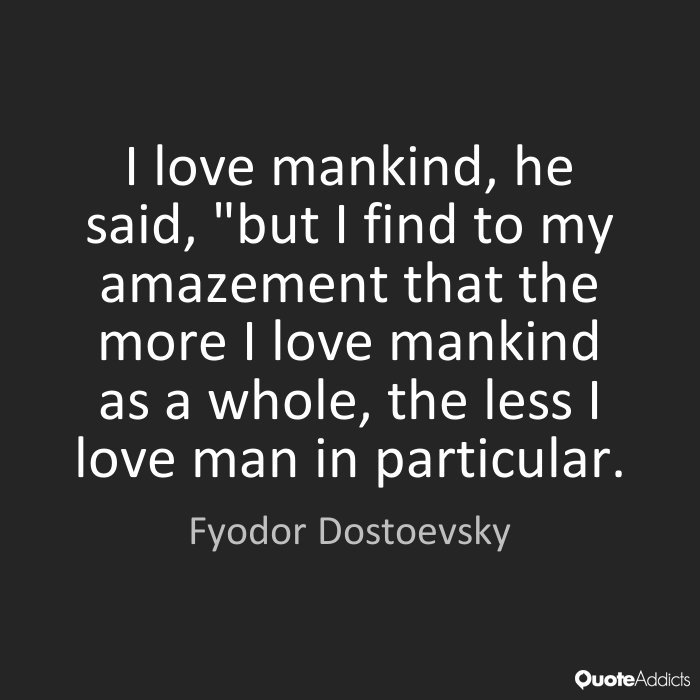
How about this for a start, I have always said, even in my Christian days, that all moral or ethical discussions should begin with confession. So, I’ll start by saying, that I am not a very good humanist. I aspire to have the needs of others in mind. I aspire to empathy for those outside of my tribe. But I often fall short of these ideals. I can tend toward the misanthropic and the local. I relate, probably more than is healthy, with the character of the doctor in The Brothers Karamozov:

mankind-in-general

I would state it like this:

The problem with humanism?
People.

People are difficult. People are fallible. People may break your heart. As a Christian professor of mine rightly used to say:

Love necessarily involves pain

How is that for cloying platitudes?

Basis for morality and ethics

Who on Earth would base their morals, ethics and source of meaning on human beings? We already do.

Humanism is not new. Humanism is actually the basis of all religious moral frameworks. The evolution of religious and moral  philosophy can be traced back to evolution itself. There was some benefit to homo sapiens (and our ancestors) cooperating. Beginning with the small family unit. Just like modern families there were rules of behavior. As families grouped together into tribes, more behavioral rules needed to be established for the benefit of the whole group. This process continues growing and expanding as groups got bigger and bigger. The concept of an observer helped enforce the rules when group members were out of sight. God becomes an extremely effective concept to keep group members in line. Eventually we get formal religions. Over time religions add on dogma and doctrine to ensure no rules are broken. Leading ultimately to the complicated religious structures of today.

From this short description you can see a god and religion do not come into play until late in the game. We have developed our moral and ethical codes based on how we treat each other as humans. How we treat each other IS morality.

people-all-along

What religions do really well is facilitate community and a sense of belonging and the creation of a moral tribe. Is it the supernatural or the connection with other people that causes that sense of belonging and purpose? My argument is that it is the connection with people. This is what I call Secular Grace. The concept of Secular Grace acknowledges that there is nothing more valuable, moral or ethical than people loving and accepting one another.

The world is shrinking by the day. With modern communications borders are becoming weaker and weaker. We must learn to work with each other across national, cultural and religious boundaries. We must work with each other as people united in humanity.

If one of the most significance aspects of religion is morality, it is worth noting the utter failure of religious morality in the modern world. Attempting to apply the first century (and older) morality of the Judeo Christian scriptures is a futile effort. This form of morality has been on the wrong side of history time and time again.

There is a simple reason this is true. Any moral system that looks backward in history without evolving with the present environment will fail. We are not first century Aramaic speaking Jewish fishermen from a small town. We are a vast complex web of humanity that is coping with 21st century moral and ethical challenges.

Humanism recognizes this and focuses on human dignity. Regardless of one’s gender, sexual orientation, cultural background or nationality, one deserves respect, dignity and care just for being human. Inalienable rights are grounded on common humanity and not from a mythical god.

Humanism encompasses all the best of the social gospel without the supernatural and archaic moral baggage. Much of what attracted me to the Jesus of the New Testament was how he treated people. I am still attracted to that. If Jesus existed today, he would be a humanist.

We are meaning makers

Why are we here? The big question. We want desperately for there to be an external answer to that. There may not be one, in fact, if I am being honest, I do not think there is. But since we are here, maybe not the answer, but an answer is to be with each other.

There may be no meaning or purpose to the universe.
But my purpose is to make meaning and purpose.
That is the most human thing to do.

To be homo sapien is to make meaning. It may be the quintessential human activity. Rather than looking for meaning from an external source like a god, we must recognize the creation of meaning is the essence of humanity.

meaning-makers

The Copernican principle has taught us that we are not the center of the universe. We live on an average planet, next to an average star, in an average arm of the spiral galaxy, in an average part of the universe.

Though this is true, it is also true that consciousness is exceedingly rare in the universe. As far as we know, we are the only conscious beings in the universe. To paraphrase Carl Sagan, “humanity is the cosmos aware of itself.”

Consciousness is so painfully rare that even if you were stuck on a deserted island thinking your thoughts in isolation your consciousness would be the most precious thing in the universe.

But most of us are not stranded on a deserted island. We have the great privilege to experience relationship with other conscious human beings. And that is meaningful.

Humanism’s focus on people allows us to derive meaning from each other. I do not know why we are here, but since we are here we should enjoy each other.  We have everything we need for meaning, purpose and awe in nature and each other.

No supernatural confusion

Humanism rejects supernatural explanations for phenomenon. It embraces science and a naturalistic view of reality. Free from the need to justify belief without evidence humanism can focus on rationality, evidence and the scientific method. I have written about how freeing an epistemology based on evidence rather than faith can be.

I have also written in this series about why I am not a liberal Christian. To summarize that article, more of Christianity has to be thrown away than kept. Using terms like god that can be defined a thousand ways is more confusing than it is helpful.

The ABCs of secular “spirituality”
Awe, belonging, connection

It is much simpler to say I am a humanist. It conveys both that I care about people and that I reject the supernatural. I particularly love Jennifer Michael Hecht’s term, humanism is a “graceful life philosophy.”

What next?

For me, humanism was the answer to the question, “what next?” after I deconverted from Christianity and became an atheist. It gave me a way to ground my morality, ethics and purpose.

I have started the hashtag #HumanismIsPeople to highlight people who exemplify humanism. It is also a reminder that people do miracles not myths.

A few years after deconversion I am still asking what next? As in what can I do that is good for the world? I am currently obsessed with trying to figure out what unites us as a secular community. Many have died on this particular hill before me. Atheists, skeptics, free thinkers and humanists are not joiners by nature. It is like herding cats trying to get everyone in the same room, let alone on the same page.

However, just because you have walked away from religion, does not mean you no longer need human connection and belonging. These are fundamental hard wired human needs. These needs often were met in the past by religion and now need a replacement.

What would bring us together and unite us with a sense of belonging?

I am particularly concerned for those leading up to, going through and recently passed through the deconversion process. It can be incredibly isolating and lonely when you first realize you no longer believe. It may cost you your entire social support structure. What can we do as a community to ease that process and provide opportunities for all of us to have a sense of belonging?

I am interested in building community. I am considering ways to bring people together online. There is no substituent for in person connectivity, but for many that is not always possible. The secular community can be sparse in some areas of the country.

Face to face hangouts would be a possible substitute that would allow people to tell their stories and grow a support group of humanists. Let me know if you are interested by commenting or emailing me at gracefulatheist at gmail dot com.

Why I Am Not An Anti-Theist

Atheism, Communities of Unbelief, Deconversion, Humanism, Secular Grace

The original title for this post was “Why I Am Not a New Atheist,” but I found there is so much confusion about that term and what it means that this was more misleading than helpful. I settled on “Why I Am Not An Anti-Theist,” as this gets to the point more directly without the confusion.

No more sacred cows

In fact, I am starting this post defending new atheism. By new atheism, I mean the kind of outspoken atheism represented by the “Four Horsemen”: Richard Dawkins, Sam Harris, Daniel Dennett and Christopher Hitchens. These four have written books which were notable for their unabashed critiques of religion. There are many others who are what I would call professional atheists making a living writing, speaking and podcasting. For their unvarnished candor they have been vilified by the religious and ironically deified by atheists.

The problem is for some time it has been considered impolite to critique religious beliefs. In many Western societies, religious views are considered private and unassailable. The old adage “never bring up politics or religion in polite company,” exists for a reason. People hear critiques about their religious beliefs as attacks against them as a person. Suddenly in the mid 2000s here were atheists who did not keep their irreligious thoughts to themselves. They had the audacity to publicly call out the flaws in religious beliefs and point out their detrimental effect on society. How dare they!

Atheists present a challenge to the faithful. The reason there are so many false stereotypes taught about atheists is that our existence is a threat. The existence of people who have in fact heard the gospel, understood it and still reject it cuts at a core understanding of the world for the believer. This is one of the reasons believers often quote their sacred text to atheists, because they cannot fathom someone could understand it and yet not believe it. It must be a lack of knowledge. “If only they understood the real gospel.“

So, the reaction to new atheism was predictable. The apologists came out in droves to disprove their arguments. And by ad hominem attacks assure the faithful these angry apostates could be safely ignored. The term new atheist was originally derogatory (even from other atheists). Even though there is nothing particularly new about doubt, atheism or the critique of religion. What was new was the lack of deference to religion and a certain level of audacity.

Atheists have long been telling us that we can be good without God.
The new atheism says that we can be better without God.
— Victor Stenger

For being outspoken and giving cover for doubters everywhere to come out of the closet these new atheists are to be commended. The sacred cow of religious ideas being beyond reproach is dead.

Anti-theism

But (you knew there would be a but), if we are being honest sometimes they can be assholes. Sometimes they can attack the believer and not the belief and engage in their own ad hominem attacks. Sometimes they can come across as … well … religious in their fervor. In fact, these are the most often cited critiques against new atheism. Much ink has been spilt defending new atheists against these critiques and yet the critiques persist because of a kernel of truth in them.

Worse still, is the wave of followers who came after. To be clear, I consider myself one of these. Social media amplifies the most vocal obnoxious and angry voices amongst us. It is very easy to be hostile on social media and some have made a career of this. Negativity gets rewarded with shares, likes and retweets. I have certainly been guilty of this myself.

This is what I would term anti-theism, which implies an active attempt to convince believers to abandon their faith. There is a tendency on social media for anti-theism to come to prominence which can start to look like trollling the trolls. It can start to look like an anti-evangelism.

Who is trolling whom?

Let me be very clear, as the position I am trying to convey is nuanced. I whole heartedly believe in secularism. Secularism protects the freedom of religion and freedom from religion. I also believe that religion has had many detrimental effects on society particularly when it gains political power. Religion should rightly be criticized.

However, believers themselves do not deserve our scorn. Most believers were born into it. It takes a tremendous amount of self reflection and honesty to overturn ones deeply held beliefs. If you feel like taking on the professional apologists, go for it. But leave the believers who have not asked for a fight alone.

If the goal is a more secular society

Are there times when believers troll atheists? Of course. I am not suggesting we not defend ourselves. I am arguing that ridiculing believers and calling them stupid is not the most effective way of convincing them.

Even when we use very cool rational logic and reason the backfire effect can stop the believer from hearing the evidence. Let me give you an example. I read Sam Harris’ The End of Faith in 2007 years before my deconversion. My motivated reasoning at the time went something like this:

He sounds angry.
Atheists must all be angry.
But I have peace.

It wasn’t until years later, I read Greta Christina’s blog about why atheists have a right to be angry, and realized I agreed with most of what she was saying. I just happened to be open to rational argument at the time.

If you add to the backfire effect, defensiveness from being insulted, the task for the believer to overcome their indoctrination is insurmountable. If we atheists, either out of exasperation or contempt, come across as mocking we are defeating our own purposes.

I am acutely aware that anti-theist arguments would not have worked on me when I was a believer. I am even more acutely aware that my many family members who are still believers would not respond to this style of argumentation. It takes investment in time, patience and, in all likelihood, the relationship, to provide a safe and comfortable space for the believers in our lives to express their doubts.

Why I Am Not an Asshole

Do I really need to expound on this? People deserve respect regardless of their beliefs. People are more important than belief or non-belief.

dmczuhyvaaa36q

If you really want to change the world and change peoples’ minds, love people.  I think I heard that from somewhere.

This post is a part of the series Communities of Unbelief. I’ll be writing more about communities of unbelief, some I choose not to be a member of, some I identify with and others I have yet to explore.

Review: Doubt: A History

Authors, Book Review, Naturalism, Philosophy, Secular Grace

I have just finished Jennifer Michael Hecht‘s Doubt: A History. It has been around for some time but as I am new to atheism it is new to me. I would suggest this is an extremely important book for modern atheists to provide perspective on where we have come from and direction on where we are going. There is something wonderful about history. It places our ideas in context. It draws lines between what would appear to be disparate ideas. This book provides that context and draws those lines in a valuable way.

After my deconversion I had a number of ideas I was desperate to express. You will find them throughout this blog. Interestingly, however, I was mildly disappointed to find that none of my ideas were particularly original. Come to find out my experience of deconversoin was rather typical in fact. Average.  I titled my first blog post “A very common message” after this realization.

After reading Hecht’s book I am even more disappointed to realize that my ideas are not only not original for today but not particularly original for 2600 years ago. It is quite a humbling experience. But it does provide a sense of unity with doubters throughout history. And for that I am grateful.

Hecht’s book is dense with quotes from doubters and moves at break-neck speed from 600 BCE to the turn of the millennium. Attempting to review the book in the traditional sense could never do it justice. If I were to start quoting this post would be as long as the book. (Take note meme creators, this book is a rich quarry of quotes). Instead, I will write about the reactions I had reading the book and how they apply to the modern doubter.

I had the chance to interview Jennifer Michael Hecht about “Doubt: A History” on the Graceful Atheist Podcast

In praise of Doubt

The book is not titled Atheism: a History and this is significant. For one thing, the original usage of the term meant something closer to heretic rather than the way we use the term today as a complete lack of belief in any god(s). In fact, a common theme in the book is the deep and profound doubt expressed throughout history that none the less defaulted to some distant conception of god, from Aristotle’s prime mover to Spinoza’s  (and Einstein’s) pantheistic god and  what feels like capitulation in Kierkegaard’s fideism. Those who took doubt to its logical conclusion of true atheism were few and far between until the time of the enlightenment. And even those who did were wary of releasing this truth upon the masses for fear of the collapse of social norms.

The book could easily be titled Skepticism: a History. In many ways it is philosophical skepticism that is the line one can draw through the history of doubt. The Epicureans and the skeptics really began to rigorously question theism. Questioning everything especially that which comes from authority is a common theme. Decendants of these philosophies often refer back to the ancient Greeks in solidarity during their own times. Including our own time, we owe a debt to the skeptics.

However the book is titled Doubt: a History. There is something deeply moving about the word doubt. It implies one cares enough to question. Doubters have skin in the game. Doubters question not purely for the sake of questioning but for the sake of knowledge and truth.

Taking one’s place in the line of history

I am a doubter and I am proud to be a part of its history. After getting over my disappointment in the lack of originality of my ideas, I found great comfort in having historical precedent.

Reading Hecht’s book one can see the cumulative effect of the writings of doubt through history. Each generation is emboldened by the writings of their predecessors. The fear of expressing one’s opinions which are contrary to popular belief is widdled away bit by bit. There is a wonderful scene described in the book when Hume sits down in a room with 15 other atheists for the first time. That is what you call a historic moment.

The freedom we in the West experience to express our doubt up to and including atheism is due not only to the enlightenment philosophers but all those who went before them as well. Today we are dazzled with Dawkins, Harris, Dennett and the inimitable Hitchens. But there would not be four horsemen today if not for Diogenes, Epicurus, Cicero and Lucretius.

The doubter’s perspective

Hecht spends a fair amount of time reading between the lines of history to find doubt’s story. By this I mean there were time periods and cultures which attempted to repress doubters. As is often noted history is written by the victors. But wonderfully we have doubter’s stories as imprints in the counter-arguments of the prevailing ideologies. Like a cast mold the negative space of doubt can be inferred (or directly quoted) by the diligent ways it is argued against by the true believers.

I personally enjoyed reading the stories I am familiar with from my own prior faith tradition delightfully told upside down from the doubter’s perspective.

The Jewish flirtation with Greek culture and the reaction as told in Maccabees and the story of Hanukkah. This is the pull of cultural assimilation and the conservative reaction against it.

I have always appreciated the book of Job for its brutal honesty. Job accuses God of being unjust. Hecht points out God makes a “heap” argument to Job for faith. Meaning, how can Job account for all of creation without appealing to God. Interesting take. Job’s wife steals the scene by encouraging Job to “Curse God and die” and may be the true hero of the story.

I have also always loved Ecclesiastes. But relieved of the burden to make pious sentiments from this wisdom one can hear the bitter exhaustion and resignation for what it is.

“Might as well have a good time because the universe is unjust and uncaring.”

Others have pointed out the doubt of Jesus in the garden of Gethsemane but Hecht portrays Jesus as a world class doubter. He seems to be reliant on his followers’ belief in him and is practically begging them to do believe in him. He has moments where he seems unsure of himself and the Father. This all culminates on the cross with

“Why have you forsaken me.”

The key insight of the book is that Christianity, particularly as described and defined by Paul, forever makes doubt a feature not a bug by requiring faith alone. Not just faith but faith without evidence.

“Blessed are those who believe but have not seen.”

Hope and discouragement

My favorite term in the book is graceful-life philosophies. As you may know I have a particular regard for the word grace in a secular setting. This wonderful term describes the philosophies of Socrates to Epicurus. And it means seeking the answer to the question:

How does one live well?

This question seems particularly poignant to our times. We must seek a secular pluralistic society as the world grows smaller and smaller. Rather than beating the dead horse of if one can be good without god, we should be asking how can we thrive and work with each other. We need graceful-life philosophies to unite us in this task.

In reading the history of doubt there is hope that even in oppressive environments rational voices remain. Regardless of the culture or particular religion there are those who express their doubt giving encouragement to future travelers.

The flip side of this coin is that humans have a tendency toward superstition and religion.  People do not like feeling out of control so they fabricate stories which explain the phenomenon around them. Again we can see this by reading between the lines in the negative image of the prevailing ideologies. In the Old Testament all the idolatry that gets systematically stamped out is an indication of people  not only seeking gods but very localized micro-cultural gods. In the early Catholic church the attempts to rid itself of heresy eventually get worn down and the use of votive candles and individual saints indicate the same phenomenon.

Ultimately, the hardest take away from the book is that forward progress toward reason is not a given. The hard-fought for knowledge of reason, logic, mathematics and the beginnings of science collected by the Greeks and represented in the library in Alexandria can and was burned down figuratively and literally. Though the flame of reason moved to the Muslim world rather than going out during the “dark” ages there is still a sense of opportunity cost. Where would the world be if the pursuit of science had been unbroken from the time of the Greeks until now?

This too is especially poignant for our times. As I write this in the US at the begining of 2017, there is a sense of loss of forward progress for the voice of reason. We have a responsibility to protect this forward progress and stand up for truth.

We have been having the same arguments for millennia

I started out this post by acknowledging my ideas about my new-found atheism are not new. That is the understatement of the century. While reading the history of doubt one comes to the inescapable conclusion that there is “nothing new under the sun.” The arguments for and against theism have been hashed and rehashed over and over again.

What was exciting to discover is that these debates have occurred in many cultures throughout history. They are not unique to the Abrahamic religions in any way.

What is a little depressing to discover is that we are still having the same arguments. As science has moved the gaps in knowledge literally to tiny fractions of a second after the big bang, apologetic arguments have moved further into the abstract.

As a relatively young atheist what I am struck by is the evasiveness of apologetic arguments against doubt. Apologists always have an answer. Those answers rarely deal with the questions straight on and at least in my experience are never satisfying.

All apologetic arguments tend to reduce to god-of-the-gaps (what we do not yet know) arguments or the epistemological black holes (how can we know anything without God?)  of the Cynics. This feels like a thoroughly beaten dead horse. Doubt has won. The history has been written.

What is next?

The question I have been asking myself from minutes after acknowledging my own doubt and becoming an atheist and the question I find myself contemplating after reading this history of doubt is “what is next?” What do we do with the hard-fought for knowledge? Keep beating a dead horse?

I’ll be writing about that in the coming months. In the meantime, thank you to Jennifer Hecht for a comprehensive look back at where have come from and how we got here.

The Beginning of Religion is Death

Atheism, Deconversion, Humanism, Philosophy, Secular Grace

Philosophy of religion has much to say about the origins of religion. Under no compunction to accept religious claims as fact, philosophy of religion can look at the root causes. In vernacular terms, the explanation tends to be that religion evolved due to early humanity’s attempt to explain that which they did not understand. The list of confusing phenomenon included everything from the weather to death itself. The idea of an unseen agent observing one’s actions helped keep group mores enforced. The priests, shaman and spiritual leaders likely enjoyed the recognition and power it brought and began to use said power to overtly control others by enforcing orthodoxy (right thought) and orthopraxy (right action).

While the above explanation is a good one it does not capture the pathos of why religion is so tempting to humans. I will argue the driving force for the evolution of religion is death itself. The soul (if you will permit me the term) of the continuing appeal of religion today is the fear of one’s own death and the need to understand the death of our loved ones.

Lest you think this discussion is in the abstract, I would like to make this personal. I am writing this within arms reach of my mother’s ashes. Eight months after my loss of faith my mother somewhat unexpectedly succumbed to the disease of alcoholism and drug addiction. I had to face the stark reality of her death without the comfort of my previous faith. She is gone. She will not one day be resurrected with a body impervious to addiction. I will not be seeing her again.

It is from this perspective that I would like to discuss how powerful a motivator the need to explain death can be. In my early not-a-Christian state I will admit it was tempting to fall back to the comforting self-delusion that I would get to see her again some day. Worse than that was dealing with the rest of my believing family showering me with similar platitudes that rang profoundly shallow to my ears. Not to mention, the misplaced attention on me by the family pastor who knew I was an atheist during my mother’s funeral.

We humans have a number of psychological defense mechanisms regarding death. We have the amazing capacity to ignore its inevitability until it is thrust in front of us. When we are young we are invincible. The understanding of our mortality slowly grows on us as we age. Some handle this gracefully, others rail against it until the end.

I am sympathetic to those who still believe and even more so to the early humans living in a hostile world they did not understand. The idea of our loved ones living on after death is a powerful one. Our minds take evasive action in order to protect ourselves from the grim reality that not only will we not see our loved ones again, but one day we too will cease to be. It is so much easier to tell ourselves a beautiful story about heaven, and easier still to ignore the evidence to the contrary.

Our cognitive goal is not one of truth but of validation. Opposition results in cognitive dissonance, a psychological conflict that is seldom resolved by the abandonment of belief. Consonance is restored through refutation, support, and proselytism. — Neil Brown

Accepting the truth that there is no life after death and the inevitability of one’s mortality has benefits beyond just being true. For one, I was able to truly grieve my mother’s loss without the pressure to “Buck up, because you’ll see her again someday,” I could allow myself to feel the pain of her loss, to weep with all of my being and to be inconsolable without the guilt of not having enough faith piled on top of my grief. This allows the eventual and even inevitable acceptance to feel freer and more complete. She is gone but the love that we had for each other continues on in me for a time.

Understanding at a deep level that this is the only life I get to live makes each moment more poignant. My time with my wife and children is invaluable to me precisely because it is finite. To be a mortal human is a glorious and terrifying thing.

As we as atheists* interact with and debate theists we must keep in mind the many powerful motivators pushing people toward faith. Our logic may come up short against the visceral need to believe life continues after this one. We need a bit of Secular Grace for them in our interactions.

Have you lost a loved one? Are you worried about facing death as an atheist? Need a bit of Secular Grace yourself? Tell me about it in the comments or on Twitter.

Secular Grace

Deconversion, Humanism, Secular Grace

Secular grace is a proactive acceptance, love and caring for our fellow human beings person to person.

Secular humanism has a ways to go to catch up to religious organizations in regards to building community and facilitating deep human connection. Religion has had centuries and sometimes millennia to fine-tune their strategies. Some of their strategies have been manipulative and others have been genuine. One of the manipulative strategies is easy to induce guilt in the guise of sin against a deity. One of the more effective and genuine strategies is simply loving acceptance sometimes called grace.


Find out more about Secular Grace. Looking for Secular Humanist Graces (saying grace)?

Secular Grace is a major theme of the Graceful Atheist Podcast

When I was a Christian I was a grace junkie. I became a Christian because of grace and I stayed a Christian much longer than I would have without my understanding of grace. I understood on a deep level my need for acceptance. I saw it as equally important to give grace to other people. I still do.

Many atheists hate the term grace for a number of reasons.  For one, the implications of both substitutionary punishment and substitutionary atonement are offensive. The idea that someone can be punished for another’s crimes is heinous as are the implications of human sacrifice.  Atheists also don’t like the term because it implies people are broken in some way and are in need of fixing.  The very idea of sinfulness has dark implications about how one feels about oneself. Lastly, atheist balk at the idea that people can do anything immoral and then just repent/confess and all is forgiven. Is that really moral?

Christians will argue atheists are reacting to the “offense of the cross,” without really thinking through the implications because to them atheists are actively rebelling against God. They cannot begin to comprehend how someone would reject such a wonderful offer sometimes while simultaneously condemning atheists to hell.

So let’s remove the theological implications of grace for a moment.  At its best, grace is about being accepted and loved for who you are as you are. I believe there is a deep human need for this kind of acceptance and love. One of the great draws to religion is becoming a part of a community that cares for you. Our need for human connection does not go away when we discard belief. In fact, that may be the time of our greatest need.

So is grace about being forgiven by an omniscient, omnipresent and omnipotent god? Or is it at its heart people caring for people? I realized after deconverting that it is very much about the latter. And since then I have noticed more and more that religious organizations are leveraging their communities to bring people into their doors. It is the people and not a deity that provide meaning and connection.

Humanism is the idea of being good and ethical without the need for a god. I propose an addition to humanism: secular grace. Secular grace is a proactive acceptance, love and caring for our fellow human beings person to person. Humanists being human to other humans.

The concept of Secular Grace acknowledges that there is nothing more valuable, moral or ethical than people loving and accepting one another.

It is summed up succinctly in the South African term, ubuntu:

“I am because you are.”

Secular grace does not assume people are broken. It does not assume punishment is required substitutionary or otherwise. Neither does it necessarily condone peoples’ poor decisions. It does attempt to understand them. But most of all Secular Grace attempts to empathize with people without requiring them to conform to an ideal. This simple act of human kindness is quite powerful.

You do not have to look far for the opposite of secular grace. Many atheists and theist online see it as their personal mission to disabuse each other of their respective positions. I’ll admit debate and argument are a lot of fun. But it rarely actually changes someone’s mind.

I am much more interested in interacting with people who are questioning, deconstructing, on their way to deconverting or have recently deconverted. It is clear to me that this is the group of people who could benefit most from secular grace. People in these positions are in the greatest need of human connection and community.

When a person is considering giving up their belief structure, it is not just their beliefs they are losing. They may be risking relationships with family, careers and their concept of meaning. That is a fragile place to be. They need a listening ear more than cold hard logic.

I am looking for ways to create humanist community. And to help those who are doubting, deconstructing and deconverting through the process.

We need each other and each other is all we need.

You can follow my journey and further discussion of Secular Grace on the Graceful Atheist Podcast.

Listen on Apple Podcasts