My guest this week is Sarah. Sarah is a co-author of the book “Still Unbelievable!” She is a regular poster on the Unbelievable? discussion boards. Sarah has a unique blend of down to earth perspective and an intellectual rigor.
In some respects, it is like being skinned alive layers of belief are being pulled away.
Sarah grew up a Christian. She was a part of the Shepherding Movement which is now considered a cult. She has moved from the Anglican church, to (British) Baptist, and then to Charismatic Vineyard churches. Until she began to research her own faith. What she found was an utter lack of evidence and a confusing morass of conflicting information.
You are giving god CPR. You really are trying to keep it alive with the best intentions
She describes her search for validation as “going forensic” as she studied apologetics, philosophy, cosmology and evolution. Ultimately, she could not keep god on “life support” and she is now an agnostic.
Love is a good way to live your life. Love is the point. We’ve only got this present moment. That is all we know for certain.
For small creatures such as we, the vastness is bearable only through love.
Ann Druyan and Carl Sagan from Contact
Sasha and the book she has written embodies Secular Grace and carries on the graceful life philosophies of her parents. Sasha has a galaxy spanning perspective on life that only the child of physicist can have. Sasha has an infectious joy about life. Listening to her or reading her work it is hard not to share in this joy.
In her book, Sasha argues that we as human beings need ritual in our lives to mark the passage of time, to celebrate the momentous moments in our lives and to mourn the loss of loved ones.
[Ritual] is really important to us. Sometimes, when people are not religious or were religious, there’s an urge to throw the baby [ritual] out with the bath water. We still need these [rituals] even if we do them in a secular way.
We discuss secular grief in the face of the loss of her father, Carl Sagan, when she was 14 years old. Sasha shares the wise parting words he had for her and the ongoing impact he has had on her and the world.
Seeing life itself as worthy of celebration, For Small Creatures Such as We is part memoir, part guidebook, and part social history, a luminous exploration of all Earth’s marvels that require no faith in order to be believed.
“Waves” track written and produced by Makaih Beats
Transcript
NOTE: This transcript is AI produced (otter.ai) and likely has many mistakes. It is provided as rough guide to the audio conversation.
David Ames  0:11
This is the graceful atheist podcast. Welcome, welcome to the graceful atheist podcast. My name is David and I am trying to be the graceful atheist. Well, as usual, I'm going to ask you to go to the Apple podcast store and rate and review the podcast. This really helps other people discover the podcast. If you found value or entertainment in the podcast, please tell somebody about the graceful atheist podcast. On today's show, I spent a fair amount of time talking about deconversion and interviewing people who have gone through the transition of a loss of faith. But actually, my favorite topic is what I call secular grace, or putting humanity into humanism is the answer to what now post deconversion. After you've left your faith, what do you do? That's actually the impetus that drives me to continue to do the podcast. So it is a treat for me when I get to interview somebody who is also a humanist who is concerned with putting humanity into humanism, and that is my guest today. Sasha Sagan. Saucer is a writer, a television producer, a filmmaker and an editor. She is an essayist, she has now written a book called for small creatures, such as we, which is actually a quote from her very famous parents, Andrew Yan and Carl Sagan, in the book contact. The full quote, that the title comes from is for small creatures such as we, the vastness is bearable only through love, which may be the most secular Grace quote I've ever heard. Sasha has book incorporates her parents graceful life philosophies. And she focuses on the rituals that we as human beings come back to over and over again, for those of you who may have D converted or deconstructed, the idea of a ritual might be terrifying, actually. And that's okay. But Sasha points out that cultures throughout history and all over the globe tend to come up with rituals around the same time periods. for the same purposes. The obvious examples are births, weddings, and funerals. And so this is not necessarily something to be frightened of. saucers book is beautiful, and beautifully written. And I recommend it to everyone. There'll be links in the show notes. And now I give you my conversation with Sasha saying

Sasha Sagan, welcome to the graceful atheist podcast.

Sasha Sagan  3:02
Thank you so much for having me. I'm delighted to be here.

David Ames  3:05
Well, thank you for coming. So Sasha, you are a writer, you've done television production, you're a filmmaker, you're an editor, you've been in major newspapers, you're an essayist. And now you've written a book called for small creatures, such as we rituals for finding meaning in our unlikely world. It also turns out that you have very famous parents. So can you tell us a little bit about yourself about your work and about your book?

Sasha Sagan  3:31
Yeah, um, I was very lucky to grow up in a household where wonder and awe for the universe, as revealed by science was part of our daily life and dinner table conversation. And part of the way I was raised to see things. So I'm sort of goes hand in hand with that, but maybe not necessarily, is also a secular household. And so what I became really interested in over the course of my life, I lost my dad when I was 14. And then as I grew up, and got married and got ready to start a family of my own, I started thinking about, well, how do we celebrate and mourn and do the daily or weekly rituals that make up life in a way that is a reflection of our modern understanding of where we are in the universe, and how we got here, when the infrastructure for that kind of thing historically has been religion. And, you know, I think that those of us who don't believe are still entitled to mark time and have weddings, and have funerals and we still need those things. So combination of the way I was raised, and then what I experienced and just being generally kind of an outgoing social person who likes parties and celebrations led me to just talk Fact. And I've found that, you know, it's something really relevant to a lot of people, especially when you get to those points in life where you have to really examine these questions, whether it's when you plan a wedding, or you have a little kid who has a lot of questions about why things are the way they are, or when you lose someone, and you have to sort of really examine what that means. If if you don't believe that there's anything beyond what we have evidence to support.

David Ames  5:29
Exactly. So my podcast, just very briefly, is on the subject of what I call secular grace. And really, that is simply just putting the humanity into humanism. I love that, and focusing on the fact that we still need each other even though we don't have a faith. But yes, it is, in fact, the human interaction our relationships with each other, that is the meaningful thing in life. So. So I have to tell you the just a brief story of the kind of emotional arc that I went through, yes, please, as I discovered you and your work. So I'm on the lookout for authors, writers, bloggers, podcasters, that are on the subject of humanism. And so when you began promoting your book, I just saw that the title, I didn't make the connection. And I thought, Oh, that looks really great. I'm definitely going to get that book and read it. And, you know, a little time passed, and I started following you on Twitter. And then I realized, Oh, you are that Sagan. I did not realize that you were Carl Sagan daughter and and Julian's daughter. And then I read the book. And I've got to tell you, Sasha, I just was really profoundly moved. Oh, thank you. By the time I was, I have the book in hand, I knew that we would eventually have this conversation. And part of what I wanted to do was to say, really focus on you and your work, and not exploit the fact that you're famous parents, but your dad is just in virtually every page. It's in Yeah. And the grief that is present there is just both poignant and beautiful. And so the first thing I just wanted to say to you, I know you speak Spanish is, is Lucia, anto I feel it, I feel it, I like it, just every page, it left it left off the page for me. So your your ability to convey the emotion and depth was just really profound. And I just thank you for writing this book.

Sasha Sagan  7:32
Thank you so much. That's really kind. And you know, it's funny, because it's like, there's, of course, some part of me that's like, oh, I want to do my own thing or whatever. But like, because of the way my parents raised me and their work, and lots of my job like that, those are the major cornerstones of my identity, you know, yeah. And so I've gotten to a place where I'm like, This is me carrying on what I can have their legacy and their work, right. My mother's work continues. And she's an amazing science communicator, also and writer and producer. But I think that's who I am. And I think if I can sort of extend some of those things that they taught me that really were impactful, and maybe in my own way, continue that on, I'm comfortable with that. You know, it's I don't mind that at all. And I'm very proud to be their daughter, and very lucky.

David Ames  8:31
Well, I do want to talk about secular grief a bit as we move forward. But first, let's just start with the title of the book actually comes from the book contact. And it turns out that your your mom wrote that line. So tell us about the meaning behind that. Yes.

Sasha Sagan  8:45
So my parents started out with the idea of the story as a movie. And they worked on screenplays and you know, movies, there's a lot of moving parts, and it takes a lot to get a movie made. And this one took 18 years. And during the time, when they were trying to develop that and trying to get it made, they wrote it as a novel. And I parents collaborated on everything. And the line that the title of my book comes from is for small creatures, such as we the vastness is bearable, only through love. And I think that there's something about that that really sums up what you were just talking about as well. And it's sort of the antidote to the existential crisis. You know, that feeling of like, we're tiny, the Universe is big, we're gonna die. We're here for a second matter, like, you know, all this stuff that you're really concerned you off the deep end quickly. Yeah. And it's like, well, how do you get through to the other side? You know, the existential crisis that's real and sometimes you have to just freak out. But when you get through that part I think that it's like, well, then what do we have? When it's one another, and we're here right now. And this is the moment where we're here. And it's not forever, but at least, we have this moment, and we're in it together. And the farther out we see ourselves in the universe, it's tiny our planet is, the larger the cosmos is, it's makes it all the more precious that we have one another. Otherwise, it would be really, really hard. And so I think I think that there's something to that where you can find some of the comfort that doesn't always get associated with the really scientific worldview. And that perspective?

David Ames  10:42
Well, I like what you just said that the existential crisis is real, I sometimes feel like I, you know, I hit the genetic lottery, and I have a predisposition to see the wonder, in life, even from a purely naturalistic scientific point of view, it's still totally awe inspiring to me. And I don't work at that. It just happens. And I just wonder how can we bottle this up? What your parents represented what you are carrying on, you know, how can we bottle this up and give it out to other people?

Sasha Sagan  11:12
It's such a good question. I mean, I think the first step, if we were really doing it on like a grand scale would be to just like, pay public school teachers a lot of money and get people who are really enthusiastic about not just I mean, science, but math and history and all these things. I have the utmost love and respect for public school teachers, but it's really hard job. And it's a really hard job to do for very little money. And I can't imagine not getting jaded at some point. But if you have a couple of great teachers in your life, who are like, This is amazing. Look at this thing. And, you know, we stop sort of maligning facts as like cold and hard. And we have this a way of teaching children that there's beauty in what is real, and like, my daughter is like, almost two and a half. And like when she sees the moon, she freaks out. All excited. It's like, Mardi Gras. And like, we talked about it, and it's orbiting us, and we were at the sun. And it's so amazing. And we like make a really big deal about it when we see the moon. Yeah. I mean, it's easy to be like really blase. Yeah, Simone, congratulations. It's like, that's sort of really natural in a way. But there's something about once you learn something, and once it becomes really matter of fact, it's like you lose some of the stunning astonishment that you felt when you first discovered it as a child. And I think if we can preserve that, I mean, the example that I always want to give, and the thing that I still cannot get over is like, if we told children like, there is a secret code in your blood that connects you to your ancestors, to your relatives, and to everyone on Earth, and everyone who ever lived, and the earliest humans and the first one celled organisms, and like it's in there, and whether you believe in it or not, it, you can send a little bit of your blood or saliva off somewhere, and it will tell you who you are like, that's like out of a fairy tale. And by the time you're like, in middle school, and you have like a worksheet about alleles, and chromosomes, it's like, none of that. Astonishment is there, right. So I think it's really a matter of presentation. And if we could get some of the skill sets and enthusiasm that you so often find in religious settings, you know, as like a really like, a preacher who is just like, totally giving their all to what they're saying. And we could have some more of that in, in the sciences, among other areas of learning. I think we could make a dent.

David Ames  13:59
Yeah. I'm trying to resist the desire to just quote you back your book. But I loved that quote you just described about, you know, if we taught science and math in the same way that a good preacher does, yeah. The other quote is that somewhere along the line, and I'm probably not recording it well, but that as we get scientific and naturalistic explanations that we've lost the wonder we've lost that. Yeah. And so I think people like yourself, can bring that to the subject, and it's such a vital role.

Sasha Sagan  14:33
Thank you. I think you I think we have it in there. But it's like, I don't know the feeling of like a thunderstorm or something like that. It's like we innately being sometimes it's our experience of nature is fear, especially like a natural disaster. Oh, yeah. But that feeling of, Wow, this is enormous and majestic. And I think even when you understand it deeply, and I think you do this especially with weather like on the news like the meteorologists like when there's a hurricane like they are, they have a reverence and awe, and they understand it from a totally scientific point of view, right? Right think there are moments where we have this, we just sort of have to extend it a little bit, pull it out a little bit, dry it out a little bit in in society.

David Ames  15:26
So one of the things that I think I have struggled with quick history I was a was a person of faith for many, many years. And that faith dissipated on me. And here I am today doing this. But one of the things I thought was interesting about your book is you don't shy away from words like spiritual or magic. And I find myself always using scare quotes, when I use those words. How can we recapture those words or redefine them?

Sasha Sagan  15:57
It's such a good question. I'm like, Adam, logically they do come for me, even magical comes from the Magi. Right? These are like religious words, sacred holy, but I can't help but not use them, because they also illustrate how I feel about Nietzsche. And I think, you know, those words, developed in a language that was majority believers, you know, majority Christians. And so they have that history in that connotation. But words evolve and mutate also. And I think that as our understandings change, I think that those words can change, too. And I, you know, I use quotes too. And like, I've definitely gotten questions in the last few months, as I've been doing press for this book about like, well, how can you describe yourself as spiritual? I wouldn't use that word. But, you know, do you consider yourself spiritual even though you don't believe? And how can that be? And I think it's, you know, there are nuances that are missing in our vocabulary. You know, and that's true. So often, there are words, this thing and our language often, and we have trouble describing things sometimes because of that. But I think that those words are still the closest we can get because it evokes this feeling that I think we all really crave of like the just like the chill in your spine, and like feeling part of something enormous. And whether that is a theological concept, or a scientific concept, that like pit of your stomach, like sparkly feeling is something that I really think that we want, and that we almost can't avoid, because every time we understand something more deeply, or have an experience or you know, something scary happens, or something amazing happens. There is that sense. And I think as time goes on, we'll figure out what to call it. But yeah, just seek it.

David Ames  18:05
Yes, yes. Really, it was a compliment that you went out ahead on didn't hesitate. I find myself hesitating all the time. Can I use this word? Because when I say often woman for me is soul when I say yes. Oh, it has evocative, profound meaning. And, you know, I mean, the core of my being, I don't write, I don't mean something other than my body. I'm sorry. Anyway, I just think that we need to just redeem those words. There's another religious term.

Sasha Sagan  18:34
I know I mean, either. So many theistic expressions that I love, and you mean also, like when I like drop something, like I say, like Jesus Christ. Like, oh, my God, I mean, how many times do I say Oh, my God, and I'm like, I can't like I what am I going to do like make up something to explain that's like about, like, trials. Oh, my double helix. Like, I'm totally nervous. Like, it would be way too weird. Like, or like a one of my favorite expressions. And I wish I had a secular version of it is God willing, and like to say, like, oh, well, when we go do this, or whatever. What I really mean is, I hope it works out, right? No, or like, you know, people talking about like, a job or planning for a baby or like, all these things. And it's like that idea that like, well, we don't know how things are gonna shake out. We're terrible at predicting the future. But this is what we're planning at the moment. Yes, it's like, I wish there was a two word way to say that. But I don't have one yet. So sometimes I say that and they're like, what are you what are your whole thing is and I'm like, I know.

David Ames  19:51
I find it charming. I think that's. So the book is primarily about rituals. So I'd like you to talk about Some of them that you described, but also, why are rituals important to human beings?

Sasha Sagan  20:05
It's a great question. And it's so amazing because we're so all over the world and disparate cultures that had no contact with one another, we all decided we need some rituals, and a lot of them happen around the same time, same times of year solstices and equinoxes. And same times of life, verse coming of age death, you know, we all like these are really important. And we do them in really different ways. But and it's not every culture doesn't have exactly the same landmarks in terms of when when they but there's a lot of overlap. And I think it's really my mom always says, there's no refuge from change in the cosmos. Yeah. And I think that's really what it's about, we are on this planet, and the seasons change, and it gets cold and hot, or wet and dry, depending where you live. People appear, you know, out of other people's stomachs, and, and they grow up and they're kids, and then they're adults. And that's really weird. And then we go away. And we don't know where or what it is. And there's just so much to wrap our minds around that. We have to process all these changes. And I think the rituals, in the most basic sense, like a funeral, like, Well, why do we have that? Because we're like, Oh, my goodness, this person was just here. And now they're not here. What do we do? Yeah. And I think that, you know, no matter what the rituals are, we're like, Okay, this is the framework. This is what we've been doing for generations. This is how we handle this very difficult thing. Yeah. I mean, sometimes it's how we handle a really wonderful thing, like people getting married or something like that, you know. And I just think that it's, it's really important to us. And I think what happens is sometimes when people are not religious, or were religious, and then veer away from it, really, there's an urge to like, throw the baby out with the bathwater, right? But I, which is understandable, and I get it. But I think that we still need these things, even if we do them in a secular way. And that's what I'm really interested in is how, how we can do that. And sometimes how we can still honor our ancestors and what they did, or something you loved growing up. Without necessarily subscribing to the theology that it came from.

David Ames  22:36
Definitely, I think that when a person goes through, particularly a faith transition, where they had faith in and then lose that faith, kind of the first thing that you see online is the much harder kind of debate culture or style of that loses all the wonder that loses all the awe and there's a trepidation for being a part of a group being apart. Being part of a community, in even the word ritual might be terrifying to some people. for that. I think I came through that and realize that, you know, it's a very natural explanation to say that human beings need rituals, and that every culture, as you have mentioned, throughout history and time, has had rituals for these life stages, and that we derive something from that we derive some meaning from that. And so on the other side of faith, or if you're secular from birth, you still need these moments, to mark time, as you say,

Sasha Sagan  23:35
Yeah, and just I think it's like, in many cases, it's to like, increase joy. I mean, you know, when it's cold, and the days are really short. And the weather's really bad. You know, it's like, oh, well, we should make things really nice and like decorate them and make them be more light and have like delicious food and a party. Maybe that's like, seems so natural, and it's such a good call. Yes, that is a really like around the winter solstice is a really good time to try to cheer ourselves up with like, cookies and cookies and presents. Yeah, totally. Oh, yeah, definitely. Let's

David Ames  24:19
do that some

Sasha Sagan  24:20
more. Yeah. And I think that that kind of stuff. Once you peel back the specifics of the lore, or the mythology or the theology, you end up with the same throughlines and so much of them are rooted in nature. There are about astronomical Meteor illogical or biological changes, and that doesn't require belief.

David Ames  24:45
One of my favorite different authors, Jennifer, Michael Hecht, and she talks about a graceful life philosophies, and I definitely feel like that is something that you are conveying here of just a joy in life. But one of the things I was struck By in your book is that you'll be in the description of just a very human event. And then the scientist and you will just jump through there one that just literally made me laugh out loud was you were describing, being in the same the same position around the sun, you know, in a year and then taking the scope out and saying, Yeah, but that sun is actually orbiting the center of the galaxy as well. So we're really not in the same place. And I just, I literally started laughing out loud. This is a scientist as well. So how do you blends that scientific knowledge that scientific exploration with kind of this graceful life philosophy,

Sasha Sagan  25:39
I think it's like, the more we understand, I mean, if you get pleasure from like, learning, you know, the more we understand, and you know, it's always more amazing reality, when we just like really use the scrutiny of the scientific method, it is always more astonishing and more amusing than our than what we came up with, as human beings. And I think that that is really a source of joy. And think, wow, we couldn't possibly have imagined, you know, the scale of the Universe, or, you know, all these things that are so beautiful, or even like how the solar system works before we have the information to measure it, and all these other things that are so breathtaking. And that brings me a lot of joy. And I think that there's just something about the connectedness, the our desire to feel connected, and then realizing the thing we're connected to, you know, we're part of, it's in us we're in it is so much larger than, you know, 100 years ago, 1000 years ago, we imagined it to be and it's like, it kind of just puts a smile on my face this idea that, like, we're so bad at predictions. I mean, it's kind of like the god willing thing. But we have this system, where we can test things and try to figure them out. And we still know very little, but we're on the right track. And we will know a lot more than we used to. And it's like, there's just an endless number of, again, a sort of religious word revelations ahead of us, and we're gonna find out more and more, and, you know, we won't live to find out everything and but there's so much around the corner that will just take our breath away. And we live in a time where there's a lot of new information available, which is just so lucky. I mean, you know, if you're a really curious person who was interested in our place in the universe, and you lived, you know, in the year 1000, it would be like kind of a drag.

David Ames  27:49
Very much. So yeah, I often wonder how useless I would have been at any other moment in history.

Sasha Sagan  27:58
Right, where it's like, each of us is a both a product of our time. And we have these like anything's and but ya know, it's so true. It's like, another 1000 years, they'll say, Oh, my goodness, can you imagine if you lived in 2020? It would have been horrible, you know?

David Ames  28:18
This question kept coming to me as I was reading it, and I want to pose it properly. There are times where I wondered, are there times in your life where you are reluctantly, a skeptic? Are there times where you wish there was something bigger?

Sasha Sagan  28:34
Oh, that's interesting. Well, I don't feel that way. To me. The secular worldview is bigger. In my view, even though there is not a person like creature looking after us. I think it would be actually harder to try to understand why terrible things happen if there is a very good god who is taking care of everyone, then it is to be like, it is random and chaos. And the fact that anything ever works out is amazing. But, you know, like, that's sort of my do the way in which I am sometimes maybe not reluctant, but I feel that internal conflict is we all have these experiences, like really unlikely coincidences, where it's so hard not to be like, Wait Is race Raizy I write about that a little bit in the book happens all the time. I mean, little, like, cliche, is you think about someone and they call and like, of course when that happens, I'm like, holy

David Ames  29:47
Yeah, but

Sasha Sagan  29:48
I think and I have that like innate reaction of like, this is like a clue into the inner workings of everything. But when I really think it is So is that we are really good pattern recognizers, we love patterns. That's why you can understand the random sounds I'm making right now to be words and ideas. It's a huge advantage as far as our species, but we're so good at it that we see patterns where there aren't any. And it would be impossible. Like if you think about how many random thoughts you have in the course of a day, and how many people you run into, or call or get a text from, over the course of your life, it would be impossible that they wouldn't line up once in a while, right? But I still think it's amazing and worthy of like celebration on my big freakout when it does happen, because it's like, Well, someone does win the lottery, you know what I mean? Like, like, the chances are slim, but sometimes it lands and you whenever you get the jackpot or whatever, and you're like, Oh, amazing, you know,

David Ames  30:52
statistically unlikely things happen all the time.

Sasha Sagan  30:56
So, so cool, but I don't, even though they have moments where I'm like, you know, the Twilight Zone theme in my head is like, I still I still think that it totally statistical explanation is still like, fantastic.

David Ames  31:15
Yeah, that's a great answer, though, that the scientific answers are the are the bigger perspective than magic?

Sasha Sagan  31:21
I think so i That's the way I see it. And they're intrinsically beautiful to me, too. And I think there's like this idea that it's like, oh, this emptiness of space is like, so scary and negative. Whereas I still find it beautiful and comforting in a way that, that in all that we're here, I'm this little evolved perfectly to, like breathe the air and drink the water and feel the light of the star. I mean, that's, that's amazing.

David Ames  31:51
Yeah, one of the ways that I tried to express this, this is back kind of back to the existential crisis. But that, you know, we learned the Copernican principle that we are not the center of the universe, we're not the center of the solar system that we have no special place in the cosmos. Right. And I would say the flip side of that is as, as far as we know, we are the only sentient creatures in this cosmos. And that makes us incredibly rare and incredibly precious. And the fact that we can communicate with each other, yeah, builds profound meaning and profound comfort. I just watched the movie Ad Astra. Oh, yeah. I don't know if you watch that. But

Sasha Sagan  32:30
I haven't seen it. I have a toddler. So I don't get Yeah,

David Ames  32:33
exactly. Sorry. Yeah.

Sasha Sagan  32:36
Do you have a movie reference from before?

David Ames  32:41
I feel yeah, I've got teenagers now. So I remember. Very quickly, I won't bore you with this. But the premise is the father has gone out looking for proof of, of extraterrestrial life. And he's obsessed with that to the exclusion of everything else, and that the son grows up and is also an astronaut and goes out to find him. And the son learns the lesson the father didn't, that it's humanity, that we are not alone. We have each other. Right. Anyway, it was just deeply profound. It was very, very slow movie I don't recommend everybody is going to love that movie. But anyway. But I couldn't I couldn't help but walk away. Like what a deeply humanist message.

Sasha Sagan  33:21
Oh, wow. Yeah.

David Ames  33:24
So your book from literally the introduction? I think I tweeted this right after I read it. The first tear was shed, you know, in the introduction.

Sasha Sagan  33:34
Slash sorry.

David Ames  33:35
Yeah, exactly. And I mean, that is a very high compliment that there's so much pathos, there's so much of yourself vulnerability in the book is deeply profound. Just very quickly, I lost my father when I was three or four, I don't really have a lot of I don't like to have a lot of conscious memories of him. I'm so sorry. Thank you. And then I lost my mother in 2015, shortly after my deconversion, so a lot of Oh, wow, a lot of grief. You know, right, as I was also experiencing the loss of so I, you know, and I think I've spent a lot of time processing that that's not a raw emotion. I'm not trying to elicit anything here.

Sasha Sagan  34:22
I feel for you. And I'm that's really hard. And it's complicated, I'm sure. Yes. Yeah.

David Ames  34:28
It's very complicated. But so again, thank you for the book and for the rawness of the grief that comes out on on the pages. And I think one of the topics that I'm most interested in is this idea of how do we grieve in a secular way? Right. I think you mentioned when people come up to you and they don't realize that your father has passed away. And they'll say, Hey, tell them how much his work meant to me. Yeah, you have to be the bearer of bad news. It's like, like, oh, just crushed my heart. Like I couldn't believe that. What You must have to go through. So one of my first questions is having so much of your father be a part of the culture and including things like on audiobook. And early your mom and dad's voice on Voyager that's just left. I mean, it's inescapable Is that does that make that grieving process harder? Or easier?

Sasha Sagan  35:21
Oh, no, it makes it easier. I mean, I'm so lucky. First of all, because of, and I write about this a little bit, because of the nature of my dad's work. I have like all this footage of him talking in his voice and like audio book on like, his Cosmos, but also, like him on The Tonight Show, and like, all this stuff. And still, I mean, there's like video of him I've never seen that I know is still out there that I can like, look forward to 23 years after his death, so that I feel like so lucky. And that especially because, I mean, now everybody has video of everybody in their family, you know, whatever, opening presents, or whatever. But like, in 1996, it wasn't like that. And just because of the nature of his work, I have this, which is so lucky, and the love that people still feel for him and like, you know, once in a while, like the flip side of the, oh, tell him I love his work. And I have to be like, Oh, actually, he's not here anymore. And it's like, so awkward, partly because people are just generally so uncomfortable with death that like it's like, you know, we don't know how to talk about it. We don't especially and not in a secular way we don't know how to. We don't know what the right thing to say is there's all of that those experiences are really hard. But what I get much more often, which is the flip side is people saying, I just discovered him four years ago, and I've read 10 books, or I was born after he died. And I love him. He's my favorite writer, or you know, that kind of stuff where I'm like, wow, this really is, in a secular way. It's an extension, you know, he lives on a little longer in this non literal way. And I'm so grateful for that. And that makes it so much easier. And like, I feel like, what's really hard about grieving is being alone, um, you know, and isolated. And when I think other people miss him, too. And they still think about him and read his work and talk about him. I'm like, Well, that is extremely comforting. That's what really like, he honestly just like, helps me enormously so. So I feel like the majority of my experiences to do with him and his work and his legacy are extremely positive. But then once in a while, there's ones where I'm like, Oh, this is excruciating. But that's okay, too.

David Ames  37:50
Well, I again, one of the more touching moments in the in the book is you're describing him apologizing to you near the end, and that he understood what you couldn't at the moment that this would be a life defining moment for you that everything would be affected by it.

Sasha Sagan  38:08
Yeah, yeah. And I was 14, and I just didn't understand. At the same time, I'm like, What does anyone on Earth, like if I was, you know, 50? What I understand what I mean, like, we don't get it, and it's really hard, but like, I just didn't understand that this would be, in many ways, the defining event in my life. And that he, he understood that, that this would be a lot harder than I think I understood at that time, or for many years afterwards. And it was so but it was it may it was like the kind of the end he was very ill obviously. And so it was like the kind of thing that like made no sense, right? Of course, as the years went on, it became very clear why it was a really loving, thoughtful, true thing to say. And it's like a, almost like a riddle. You know, it's something that takes a long time to unravel to really understand, but it was really loving. And it was really, I mean, it's I still feel love from the last, you know, days and hours, even though more than two decades has gone by.

David Ames  39:25
Well, that's short, an incredible amount of wisdom on his part. Yeah, there's no one will doubt or two have that kind of foresight to pass that along to you. Yeah. The other thing I think is beautifully told in the book is this idea of that those that we have lost live on in our memories. You refer back to a culture that has a distinction between ancestors and the living dead, that they live on in our memory and you quote your mom is saying she recognized that there's there's almost a second death When the last person who knew you dies, yeah. Can you talk about that? Just

Sasha Sagan  40:05
yeah, I think about that a lot in the book I talked about someone we knew had a toddler. And they came by the house. They had, you know, my dad had met the toddler many times. And then they came by the house at some point in the months after my dad died. And and when they left me, this little boy was the youngest person, I think my dad, you know, knew, right. And my mom said, after they left, my mom said, you know, it's like, you win you, Oh, will you die again, when the last person knew you dies. And there is something about that there's, it makes me think of there's this. There's this record, somebody heard Abraham Lincoln give a speech, and then ran home and phonetically wrote down how he spoke, like, what his syntax and intonation was. And it was like, of course, this is so changed by technology now, like I was saying about, like having, you know, video of your friends now. And it's like, this idea that like, well, you know, now everybody who ever heard Abraham Lincoln speak is gone, too. And it's like, that's another way in which were done. And some people very, very small handful of people, you know, if your profile is on a coin, or there is a statue to you, or, you know, the most smallest, smallest percentage of people who ever lived, or we just know their name, even if we don't know really anything about them, the century when they lived the part of the world. But other than that, we go away. And that is something that, you know, there's two approaches to that, or three, maybe one is to deny it, you know, and if you say, Okay, well, that's not your belief system. If you believe that we don't go away, we just go somewhere else. And we continue on. Okay, that's one approach. Another approach is to sort of try to fight it with like, you know, I don't know, like cryogenically freezing, like, you know, all the things that we come up with to deny that in another way, and that's okay, too, you know, but the third way is to say, Okay, well, that's how this works. And we'll be gone at some point. And even if we figure out the, you know, whatever technology, you know, the sun's gonna burn out and 5 billion years, the Earth is, you know, maybe we can emigrate to some other planet, maybe. But things that we hold dear and the world, literally and figuratively that we exist, and now is not forever. And so, I think there's really something valuable. The third way way I would approach it is to face that and say, Okay, that's real. But we're here right now. And so let's do what we can to make the world better to find joy, to experience, love, give love, all these things that will make it so that when the time does come, it'll not feel as bad. I think.

David Ames  43:19
I've described kind of a parallel concept of giving up the idea of the soul. Where there's this psychological need to believe that we go on, I think, as well to believe that our loved ones

Sasha Sagan  43:36
Yes, I mean, more. So almost. Yeah, almost more so. Yeah, yeah.

David Ames  43:42
Yeah. And you know, and I would love to believe that I would get to see my mom and my, well, yeah, like, I'd love to be able to believe that. But I recognize that, you know, having again, for me personally haven't gone through that transition. That part of the reason that was so difficult was coming to grips with the finiteness of of life that Yeah. On the other side of it now, and I'm not this is not original in any way. But the idea that it is finite gives everything poignance there's Yeah, every moment with my my family, my loved ones, my daughters, my wife, friends is, is valuable, precisely because it is rare and fleeting.

Sasha Sagan  44:24
Absolutely, absolutely. If we lived forever, and there was no urgency to anything, it would be, first of all, it would be a totally different existence, people would operate in a totally different way. And there would be nothing unique or valuable or special about each moment. There's no beginning and no end. And I think that it's really easy to see that as a really painful thing, but I think it's also the source of all the positive things,

David Ames  44:55
right. And then just lastly, a concept that you hint at in That is just being lucky to have lived at all. You just I think you say we were we, you know we existed. That fact that we are alive today is its own profound miracle.

Sasha Sagan  45:13
Yeah. And I think that that's like a lot of what at the beginning of the book is about is like an all the different things that had to happen for you to be alive right now. And all your different ancestors who had to cross paths, and all this unbelievable plagues and invasions and wars that somebody had to survive, to get to the point where right now in the present, your you know, listening to this podcast, you know, is really astonishing. And I think that maybe there would be some other version of each of us, but we would have different ancestors with different combinations of qualities and idiosyncrasies and allergies, all sorts of other things. And I think the idea that, like you being exactly you at this moment happened, like if we can find a way to celebrate that. And I think the way that we find it the most is when we fall in love, because then you're like, wow, you're you and you're so amazing. And you have all these qualities that are so wonderful. And it's like that we sort of can glean it when it's an another person or when you have a new baby, and you're like, Oh, my goodness, you're this. Oh, I see my great uncle's funny expression. And like all these things, yeah. And so we get it like at the best moments of our lives, we get these little glimpses into that. And I think if we can find a way to to extend that into other parts of our lives, I think it would be really worthwhile.

David Ames  46:48
Absolutely. Yeah, that's beautiful. I'm sorry. I said Lastly, and really, I've got one another. One more, one more question. Again, on this on this side of faith, or those of us who were believers, church or synagogue or provides this community this built in Yes, community. I really love the story you tell you tell about your your girlfriend's getting together. Yeah, regular basis to talk about how you have built community in your life.

Sasha Sagan  47:15
Yes, I definitely. I mean, I strongly feel that the hardest part about being secular for me is that you have to like really put an effort to congregate, and I'm very social. And I like being in group situations. And it's just if I was really devout, I would have that in my life and all these different ways built in. And I because I'm not I have to make it. So one of the things that I did, sort of second half of the years, I lived in New York, I lived in New York for a long time, we moved to London for two years, and then came back and all of a sudden, I realized I miss my girlfriends so much. And that like seeing them one or two at a time was not enough. And I that I had all these interesting, amazing women who they would like each other it wasn't you know, and that together, we could really sort of form this like little tribe. And so it wasn't anything. I mean, it's totally doable. You can try this at home, just once a month, we had a dinner, we picked a restaurant, and I would send out an email. And sometimes it would be five or six of us. And sometimes it would be 12 or 13 of us. And the restaurant was extremely accommodating when we were constantly running away and being really loud, and all these things. So that was good. And we would once a month have like dinner and cocktails and talk and what was so for me rewarding was all these other friendships bloomed between women who, you know, someone I grew up with, or someone I went with, to college with, or someone you know, had worked with. And then after a lot of people started to move away from New York, which just happens, you know, and then and then I moved to Boston, and these friendships went on and all these different cities and people started doing ladies don't we call it the ladies dining society in other places. And even though I wasn't doing it anymore, it carried on and I that is something that I feel really grateful for. And I think there's something there is a real like you see it, there is a need in society for this kind of thing. And you see it as like there's, I mean, these things could be co ed or for men or whatever show seemed like these women's workspaces popping up in different cities. And you see like these will, you know, different groups where you're like, people want kind of a home base and like something in their life that's regular and steady and feeds them intellectually, emotionally in some way. Literally, dinner party. And I think that a lot of people crave that and I think if you're secular you know sometimes it's a little bit more of a drag and you got to put it together yourself, but I think it's worth it.

David Ames  49:59
You I think that the lesson from that chapter in particular is just being intentional about building friendships. And yeah, maybe setting a time and setting a place and making that happen. So yeah, in effect to ritualizing.

Sasha Sagan  50:14
And having a group to go through the ups and downs with

David Ames  50:18
absolutely, yeah, somebody there just to hear the good times and the bad. Yeah, exactly. Well, if it's not obvious, I love the book. So much the book is, for small creatures, such as we are rituals for finding meaning in our unlikely world. And the author is Sasha Sagan, Sacha, how can people get in touch with you? How can they find your book?

Sasha Sagan  50:40
Oh, it's sold wherever, wherever you get your books, you can find it. And I'm on Instagram and Twitter at Sasha Sagan. My website is Sasha sagan.com. And you can email me there. Tell me what you think I'd love to hear from you.

David Ames  50:56
Fantastic. Thank you so much for your time and.

Final thoughts on the episode? Wow. All I can say is again, it was a joy to speak with Sasha. I find it wonderfully fulfilling to talk to another person who has the same sense of gratitude, awe and wonder at the world, while also holding purely naturalistic and scientific ideas about the world. And she so beautifully tells those both in the book and in this episode, about how her parents pass those things along to her. And now she's passing them along to us. I loved her answer when I asked about whether she was a reluctant skeptic. And she pointed out that the scientific answers tend to be bigger and more awe inspiring than any magical or theistic answers ever could be. That was a profound answer. I think in my interview, when we discussed her father, Carl Sagan, I often focused on the grief, I want to highlight here as well, the joy that comes across in Sasha's book, and in the podcast episode. Clearly, he has had a tremendous impact on her and the impact on the world continues to reverberate in her life. I just really appreciate Sasha, his willingness to share both the grief and her joy in her relationship with her father. I still can't get over the quote that the book title comes from, for small creatures such as we, the vastness is only bearable through love. And it turns out that it was Andrew Yang, who wrote that particular line that encapsulates so much of secular grace. And another theme that Sasha and I hit in the episode of she quotes her mom is saying there is no refuge from change in the cosmos. And Sasha talks about having to face the reality that everything will cease, including the sun burning out and the heat death of the universe. But we're here now. And let's do what we can to make the world a better place that to encapsulates secular grace. I want to thank Sasha for coming on the program for giving me her time and for sharing with us, her book and her insights and her graceful life philosophies. I will have links in the show notes for finding her online on Twitter and as well as links for her book, I highly encourage you to go out and get the book and read it. As the chaos and randomness of the cosmos would have it. Sacha also did an interview with Bart Campolo on the humanized me podcast. And I think it's a great discussion. And I highly encourage you to go and listen to that as well, especially if you can't get enough of Sasha Sagan. Are you still here? Oh, good. I've got a couple more announcements for you. One is that I have recently done an episode of the relationship podcast from long distance to marriage with Andrea and rich. You might ask why would I do that episode while they were doing a series on secular relationships or inter faith relationships, I went on with my friend Alice Gretchen from dare to doubt, Alice from the perspective of being very choosy about the partners that she chooses and what their faith positions might be in me from the perspective of being in a relationship with my wife, who is a believer, and D converting and middle of marriage, and trying to focus on the love that we have for one another and our shared set of values. Anyway, I highly recommend that you check out from long distance to marriage in the next week or so. I think that was a fascinating conversation. And then the second thing I wanted to bring up is that I occasionally do a call or a Hangout with people who are not interested in publicizing their story, but they need to tell it to somebody. And I generally will do a 15 or 30 minute call with people just to let them tell me their deconversion stories. And a common theme that I hear from them often is, what can I do? How can I give back? I just wanted to highlight that you can do many things, you can start a blog, you can start your own podcast, you can find groups with meetup.com. You can start your own book club, any secular activity of any kind that build some community is a great way to go. But I'm gonna highlight one more thing. I haven't pushed it very often. But I need to reiterate again, how much better I think this podcast could be if I had a bit more community support. So this is a call out to you if you have a talent in any area, graphic design, audio engineering, marketing, social media expertise, website, design, anything that could help make this podcast better, help more people. I'm gonna just put out the call to the community. If you're interested, please get in touch with me. Send me an email at graceful atheist@gmail.com I'm gonna slightly alter my typical sign off and say my name is David, and I am trying to be the graceful atheist. Please join me and be graceful in your lives. It's time for some footnotes. The song has a track called waves by mkhaya beats, please check out her music links will be in the show notes. If you'd like to help support the podcast, here are the ways you can go about that. First help promote it. Podcast audience grows it by word of mouth. If you found it useful or just entertaining, please pass it on to your friends and family. post about it on social media so that others can find it. Please rate and review the podcast wherever you get your podcasts. This will help raise the visibility of our show. Join me on the podcast. Tell your story. Have you gone through a faith transition? You want to tell that to the world? Let me know and let's have you on? Do you know someone who needs to tell their story? Let them know. Do you have criticisms about atheism or humanism, but you're willing to have an honesty contest with me? Come on the show. If you have a book or a blog that you want to promote, I'd like to hear from you. Also, you can contribute technical support. If you are good at graphic design, sound engineering or marketing? Please let me know and I'll let you know how you can participate. And finally financial support. There will be a link on the show notes to allow contributions which would help defray the cost of producing the show. If you want to get in touch with me you can google graceful atheist where you can send email to graceful atheist@gmail.com You can tweet at me at graceful atheist or you can just check out my website at graceful atheists.wordpress.com Get in touch and let me know if you appreciate the podcast. Well this has been the graceful atheist podcast My name is David and I am trying to be the graceful atheists. Grab somebody you love and tell them how much they mean to you.

This has been the graceful atheist podcast

Transcribed by https://otter.ai
My guest today is Andrew Knight. Andrew is the host of the Still Unbelievable podcast and co-host of the Ask an Atheist Anything podcast. He is a contributing author to the book Still Unbelievable. Andrew has been a Recovering From Religion peer support agent helping others through their questioning. He promotes the message:
Let’s talk about human problems from a human perspective. Human problems have human solutions.
Andrew states flatly the faith tradition he was raised in, Church of Christ, is a cult. After attending bible college and working for an apologetics publishing company he began to be disillusioned with apologetics. He came to recognize the foundational claims of Christianity were not true. Andrew takes it a step further, even if the miracles of the bible were true this would not be proof of the core claims of Christianity: an infinite, all knowing, all powerful god.
My conversation with Andrew is wide ranging as we cover his deconversion story and the work he now does. He talks about his disfellowship from the Church of Christ. He describes the difficulty in telling a friend who turned out to be going through the same deconversion process. We talk about deconverts being the most dangerous counter-apologetic of all.
Truth is a process of successive approximations
Andrew’s friend Sean
Changing the notion of truth to something that can be investigated and that we can get better at.
Note: Both the Still Unbelievable book and podcast are responses to Justin Brierley’s Unbelievable podcast and book. Justin’s podcast brings atheists and theists together for debate. Justin is considered an honest moderator. His book’s subtitle is Why After Ten Years of Talking with Atheists, I’m Still a Christian. Matthew’s and his colleagues’ responses take aim at those reasons.
My guest today is Jennifer Michael Hecht. Jennifer is a poet, an author, an award winning academic and an intellectual historian. She has written numerous books from a secular perspective. I asked Jennifer to come on the show to discuss her book Doubt: A History and its profound effect on me post-deconversion. She is one of my intellectual heroes.
It is hard to express how much this book has influenced other secular writers and thinkers. This book has strongly influenced my other two favorite books Greg Epstein’s Good Without God and Katherine Ozment’s Grace Without God. Both of which quote Doubt throughout.
Jennifer proved to be as profound a thinker as her reputation makes her out to be. It was my privilege to attempt to keep up with her in this interview.
I am indebted to Jennifer for coining the term “graceful life philosophy.” My concept of Secular Grace is an attempt to live a graceful life philosophy.
Great believers and great doubters seem like opposites, but they are more similar to each other than to the mass of relatively disinterested or acquiescent men and women. This is because they are both awake to the fact that we live between two divergent realities: On one side, there is a world in our heads— and in our lives, so long as we are not contradicted by death and disaster— and that is a world of reason and plans, love, and purpose. On the other side, there is the world beyond our human life—an equally real world in which there is no sign of caring or value, planning or judgment, love, or joy. We live in a meaning-rupture because we are human and the universe is not.
NOTE: This transcript is AI produced (otter.ai) and likely has many mistakes. It is provided as rough guide to the audio conversation.
David Ames  0:11
This is the graceful atheist podcast Welcome welcome. Welcome to the graceful atheist podcast. My name is David and I am trying to be the graceful atheist. If you've ever thought to yourself, I really want to hear David be less graceful and more mean and catty. Well then I have a podcast recommendation other than my own. I'd like to recommend the deconversion therapy podcast the hosts Karen and Bonnie ticket comedic look at the deconversion process and in particular the silliness of evangelical life. They're often read listener submitted stories and so I submitted a story from my experience as a youth pastor back in the 90s. If you want to hear my story about attempting to be a hip, young, long haired youth pastor in the 90s, check out the May 9 episode of The deconversion therapy podcast on today's show. My guest today is one of my intellectual heroes. One of the great things about doing this podcast is getting to interview people whose work has had a profound impact on my thinking, and deconversion. My guest, Jennifer Michael Hecht is a poet, a historian and a commentator, and author of numerous books. And she literally wrote the book on doubt. She's also an award winning academic, she wrote the end of the soul scientific modernity, atheism and anthropology. Her current book is called stay a history of suicide and the arguments against it. It's a secular argument against suicide. But I asked Jennifer to be on the podcast to talk about her 2004 book doubt, a history and its profound impact on my thinking, post deconversion. There are three books that have had a major impact on my thinking. Catherine cosmonauts Grace without God, Greg Epstein's good without God. And Jennifer Michael Hecht's doubt a history. All three of these books have been important for different reasons. Jennifer's doubt a history really helped me understand the intellectual history that we inherit as secular people. I highly recommend this book for anyone who is going through either deconstruction or deconversion to help ground yourself in the history of others who have doubted before you. It is amazingly comforting to realize that not only are my doubts not particularly original for today, my doubts are not particularly original for 2500 years ago, and that is the kind of context that a book like doubt a history can give you. As you will hear Jennifer and I talk about how old these questions are and that humanity has been wrestling with the concept of doubt and belief. For most of our history. The book is a crash course in philosophy, ethics and religious thought. It encompasses multiple millennia, and circumnavigates the globe, including cultures from around the world. What could be a dry and potentially boring subject I found riveting. Page after page I came face to face with my own ignorance and the wisdom of humanity. Over the centuries. Jennifer has written a book that contextualizes the modern moment of secularization in the West. And for that she is my intellectual hero. And now I give you Jennifer Michael Hecht.

Jennifer Michael Hecht, welcome to the graceful atheist podcast.

Jennifer Michael Hecht  3:58
Thanks so much. Glad to be here.

David Ames  4:00
Jennifer, you're a poet, you're an author, you have a PhD in History of Science, you're called an intellectual historian. And you've literally written the book on doubt. I want to just give a quick moment for you to talk about some of your current work I understand your previous book was called stay history of suicide and a secular argument against it. And that you're working on a current book now, the wonder paradox, a guide to using poetry to find meaning in folk ah, and rest in some clarity of mind.

Jennifer Michael Hecht  4:33
Yeah, we're still working on the subtitle on that one. But yeah, paradox is what I'm working on now. And, and yeah, the The truth is that the books are very different, but in a lot of ways they do all cohere around the question of how people live it outside of religion, or having moved on from it or not. having, you know, come into their own in a culture that isn't, that doesn't find it as their focal point. And there's all different ways that people have structured meaning the, the modern sense that, that without religion, you don't have a lot of these things is very temporally local. It's a very, it's a very momentary and historically specific experience. And so when I start looking outside the present moment, to see how people deal with certain kinds of things that we associate with religion, I always find a wealth of, of ideas and lives lived generations lived under different conceptions of, of all these types of religious ideas. So the Wonder paradox right now is, is a direct response with poetry, seeing how how ritual and wise words that sound good and feel good and that you've returned to have influenced people's lives outside of religion within religion, but without belief with religion with belief, but without all sorts of other kinds of configurations. And as you said, the the anti-suicide book stay was really an investigation into how people who weren't going to just answer that question with God says know, how they respond to what it could mean to to each other and to ourselves to to ask questions about whether it was morally straightforward. Whether or not you could take your own life.

David Ames  6:44
Right. Right. I think that's an important book for our time as the as we see a movement of secularization. Yeah. And suicide is always an ever present danger. So yeah, I terrible podcast hosts, I have not yet written those. That book, I plan to read it very shortly. You've graciously come on the podcast to talk about a book that you wrote in, it's 2003. Right? It's a long, long time back. I appreciate you taking that time. One of the selfish goals of the podcast for me is to just become a little less ignorant. And just to TSF, a little bit, I've read your book, doubt a history a couple of years after my deconversion. And I just found it so profoundly important. And mainly because of my own ignorance. I came from an evangelical background where my ignorance of history and in particular, secular history, philosophy, philosophical history, was just profound. And on top of that, to make matters worse, there's this sense of hubris like, you know, well, I probably I understand these things already. And then even going through the deconversion process, oh, I have these original experiences, it must just be me. And reading through the book was not only recognizing my ideas are not particularly original for today, they are not particularly original for 2500 years ago. And I find like this is just a really useful thing for people to to be grounded in to recognize our place in history. Before we jump into some of the specifics of the book, would you like to tell us about your particular spiritual or faith journey? Where are you at? Where did where was your background growing up?

Jennifer Michael Hecht  8:37
My background growing up was a, I was raised, you know, Jewish household we were practicing. But what's called conservative Judaism at the time, all the names have sort of shifted a little bit, but my dad's a physicist, and so he didn't believe, but also came from the same world of Brooklyn, Jews, second generation. And so third generation in some cases. And so, I grew up on Long Island and in around New York City, so I do a lot of Catholic kids, and I suppose more than you would in the middle of the country. But yeah, for me, the my personal history of secularism, so I decided that that is I came to my own understanding that there is no god or anything supernatural at about age 12. I mean, I know I was age 12. And it did hurt at first. But, but not for that long. It really was literature though. It took me a while to realize that's what it was but this beautiful quote, by Rainer Maria Rilke saying, to live the questions. Mm. like that, we can't come to the answers that even if the answers were handed to you now, you couldn't, you couldn't really know them not only couldn't really know that you couldn't know them at all, he compares them to to, you know, wisdom in a language in a book in a language you don't understand. And the book is worth something, but you really can't understand it yet. And to me, at 12, it was a revelation that, that you could live the questions that you could, that you didn't have to believe, now that there were no answers, because what you thought of as the source of answers previously, no longer holds, holds good. The idea that wisdom is indeed something that you have to work through both in living and through a long process of learning. That was very emancipatory, for me that that meant that whatever I couldn't figure out now was not a closed door. On the other hand, I? Well, I was gonna say that I've had a pretty solid sense of what I thought in terms of believability, the notion that there that I could conduct my metaphysical investigations the same way I conduct my life investigation, so no evidence, really no reason to tolerate the proposition. Right. Right. And, and that worked, okay. But, again, one grows and one learns. So Buddhism became something that was very fascinating to me to figure out, to what extent millions upon millions of people across, you know, 10s, of hundreds of generations were living without supernatural ideas. And what what you find is that it's a little divided. So there's Theravada Buddhism, where you really do strict, strictly state without supernaturalism Mahayana Buddhism, which, as I explained in doubt, they come to the idea that you could believe in the weird and absurd and unprovable through a kind of rational progression, about what you can't know. And when rationalism gets to its edges, where it breaks down a little bit, there are paradoxical problems with being a human being trying to understand the world. Right? Not problems anyone can get anywhere past. And so some, some of the, the Buddhist world also goes into this world of irrationalism, on the good faith of so the world's irrational. But yeah, again, also looking, looking into Confucianism, how much how much of the non supernatural, non theistic religion that is essentially set out there was influenced by local customs and religions that were superstitious, right. And what I found was a tremendous amount of people all over the place throughout all different periods of times, specifically banishing the supernatural, and saying, well, then what do we make of life without it? So for me, I processed through taking on certain amounts of all these different religions to the point where I am now, I have a great deal of respect for all of them, and also a great deal of concern about how much how much everyone who talks about these different religions, is promoting their own point of view. And so we have to be, we can't say that they really are atheistic, because atheism as we understand it now, is very historically specific to this moment. I rambled a bit, but I personally came from a position until 12. I believed to some degree, then I stopped and was a pretty standard kind of atheist very scientistic. Until Yeah, I guess at Columbia, doing my PhD in history and reading about different cultures, atheists, cultures, in history, and finding out just beginning to get the sense that there was more to be understood there and coming to understand that instead of scientism, I really find more truth in what I'll call poetic realism, right? A commitment to realism, but with an understanding that there's more truth in some of the connections we glean through beauty and feeling and surmise. And so that lands me in a rather odd place.

David Ames  15:00
Well, I think I can identify, I think one of the things that I tried to talk about on this show is that we are human beings and not Vulcans. And one aspect of the modern version of atheism is kind of a pure rationality, that kind of tries to ignore the three dimensionality of human beings. We are emotional, we are whatever you want to term spiritual, for lack of a better term, right? We have, we have these feelings, these things are important. And so I was familiar with your concept of, of poetic atheism. And I think that's a really good way of putting it. So

Jennifer Michael Hecht  15:36
yeah, I've sort of moved to calling as to saying poetic realism. In the same breath, I think quite a gazhams. Important still, because I personally think it's important in this moment in America. And it started with Bush, I remember telling interviewer as well, I wanted to, I wanted to use very neutral words, so as to not stop conversation before it started, right. But but as the evangelical started rising up, I started to feel like well, if I'm appreciating other people coming out and saying the word atheist, then I'm going to do it too. And I still have no problem with it whatsoever. And I also think it's important that I keep saying it, but it is. It's just a word that is first of all negative as so many of our words are, and also hung up on Abrahamic theism. The idea of one God, the the Judeo Christian education that everyone in the West receives tilts towards the notion that monotheism and theism itself is a very ordinary aspect, a very ordinary way for human thought to go and it isn't, it just isn't the way they argued it without the evidence was to say that everyone else was primitive, and they were headed there. Right. And that is patently absurd now. But it's what a lot of our whole subconscious notion of what standard normal human religion is. So saying you're an atheist is ignore is sort of separating yourself from all these people who didn't believe in God without having ever heard of them without having ever entertained the notion of an afterlife. And so, realism is a terrifically complicated word you, right, everyone thinks they're being realistic. But still, I felt that it was it was intelligible enough. So I tend to use them both both phrases, that I'm a poetic realist come up poetic atheists to make the point of the atheism but also to, to open it up and ask, well, you know, in what traditions this all falls in?

David Ames  17:57
Yes, I again, relate a lot to that I could very easily use the moniker graceful humanists, but I keep graceful atheists, because I think it's important to be out and allow to help others to come to that as well. But my focus is very much about humanism, and how do we connect with one another and live life? Well. I do want to circle back really quickly. The title of the book is doubt a history and not necessarily atheism history. I understand that it's somewhat of a historical accident. But I find that it's a a serendipitous one, I believe that the word doubt is so evocative. And, you know, doubt leads to questioning and questioning leads us maybe in circles, but eventually to some truth. evokes, in me the idea of somebody who has skin in the game, the doubt or cares about? Yeah. Tell me about your conception of doubt. And what led you to want to research it?

Jennifer Michael Hecht  18:56
Yeah, exactly. You reminded me that in the Introduction to Data, I say the the, the strong believer in the strong atheist in a way have more in common than the great mass of people who don't think about these rights. Yeah, who are sort of hypnotized by, by life enough, my daily life enough to and the concerns that you see in daily life and television and commercials that, that world, that world, you know, it would be hard to argue against it if it went on forever, and it was always happy. But it doesn't tend to serve people that well. And even if it does, it ends and it ends for other people in your life before it ends for you. That is if you try to ignore the situation we're in, it will come crashing in and the if you're not familiar with it, it will destroy you. So we have always known or from the beginning of human records that that we try to prepare ourselves a little bit with by remembering the pain that how happened in the past. And by putting it into some kind of conceptual structure. Yeah, everybody. It doesn't last very long periods of history where people aren't trying to figure out the best way to live, we are living in a very strange, multifocal moment and and that really just means we have to do that extra little bit of work of looking for the material that will save us. In some periods in time, it's handed to you in a little bit more of a coherent way, even at the worst. But we're in a very, very complicated moment, because we've just human beings from different local contained groups have never been able to speak to each other the way they can't today. And so we're all overwhelmed with choice.

David Ames  20:53
It's an information dealers, and half of the problem with the internet is not necessarily finding something to learn, but rather to figure out which things are true. Right filtering processes, the new chat, the modern challenge, that's also

Jennifer Michael Hecht  21:11
you know, that depth of knowledge. So, as you were saying before, the notion that look, I, I can see the world, I'm smart, I talk to people every day who seem like they know less than I do. So I probably have a pretty good handle on this. And then to, yeah, what's located in doubt, and of course, there's a million things I left out of that giant. To see that. If you look for this stuff through history, you will be surprised at every turn. I already had a PhD in history, I had been teaching Western Civ and world history and then history of medicine for years already, when I started to write down, I thought I knew the story. I thought I had picked up as I went along, reading all sorts of history, little stories of atheists and religious doubters, everywhere I looked. Yeah. And yet, when I looked at any overall survey of history, or even of any period, or place, the atheists were gone. And people were still there, but they were being celebrated for other things they did. And if you were only an atheist, you only showed up if if, you know, if you if the big movement came up against you. So they were there, they were still the names were still in the books. But to a remarkable degree. Only when I looked up real close, when some historian had looked closely at a little period, they didn't find it. They didn't leave out the atheist. So I knew about them. I also thought of certain periods of time in certain places as being totally, totally encompassed by religion. But I thought I would just sort of put a sign Here Be Dragons and and we go back to you know, the civilized places where there was culture and sophistication. So like I said, I was already a historian, I had already co authored a Western Civ textbook I, and I thought I had the material. When I brought up the proposal, I had the material laid out. But when I went and did the research, the wealth of personalities and ideas and different takes on things, ideas that seemed like they had to be modern, that showed up in medieval Spain that showed up in Syria, I mean, that, that real color, real flavor, really understanding the ways that different people process these, these ideas about life that are in religion and outside religion. I mean, it certainly blew my mind to the point where I saw that I wasn't writing a story that was a minor story within the larger story of history. I was rather, again, a metaphor I use in in the preface to the book or the introduction. That was it was like looking at a map upside down. It was the same story I learned, but celebrating the times of confusion, which are actually times when people are asking questions and people are suggesting different answers. And people are tolerating the possibility of several answers without a desperate need to pick one and march with it. Those incredibly sophisticated, complex, distressing periods, they tend to make us feel a little ill at ease when we live in them, which makes us write literature which means we have we have the record. And so there, there was just a tremendous The amount of stuff that even as a historian who cared about these things, until I did the research, and really looked up close, I didn't know and was quite astounded, and quite, in some ways you feel better, because you see, you don't have to make all these points there in the world. Right? Like, you're not alone, even if you're alone when you're in a football stadium, and no one else agrees with you. There's millions of people who do agree with you, right? That's a good feeling. A bad feeling is to realize that coming up with some of these answers doesn't save the world. They come out, they help, they can make a wonderful period of time, but there are opposing forces. In in each of us even of just fear and weariness, and, and despair, which can, can put you in other places. But the, the hard part also Well, one thing was I realized by the end of the book, that the reason that we didn't know these stories, as well as we should have was partially the Cold War. It took me a while to really see this, I really had to do some research, some of which, you know, just sort of the highlights ended up in the book, but to really come to understand that in this country, in the United States, during the Cold War, it's in the 50s in response to this fresh, godless, calm animosity with the USSR. That yeah, that not just communism, but atheism because because they were associated with each other became a taboo because it was downright treasonous. The same way Catholicism is treasonous in a in a, you know, during the the age of religious wars, when a country turns Protestant, these kinds of existential belief systems. And so all these books that used to be on the shelves everywhere, came off the shelves. It's remarkable of the extent to which the history of atheism gets shut down in the 50s. And, yeah, there was research I did for a while on, on what I was calling the lightbulb years saying that the first half of the 20th century in the United States was the single greatest period of atheism, including today, that is, before the Cold War, we still haven't gotten back to that level of, of, of certain kinds of freedom. So that, you know, Edison says, you know, in in the, you know, the teens, I think it's 1913, says two New York Times on the front page of the times they asked him about, about the afterlife. And he says, No, of course not. I'm a person of proof and science and mechanism, proof that, of course, there's no afterlife. They'd asked him because William James, up at Harvard had said that just in case, he will try to contact people in case he was so curious about the afterlife. So he had died. And you know, when is your new him said they were contacted. So they went around. And now I don't think somebody who was primarily a maker, the way Edison was, would feel quite as comfortable saying that to the New York Times as in the teens, I'm just saying, even out we can look back and say, Wow, there were many famous men and women famous for other things not famous for their atheism, who were publicly avowed atheists. You know, Sam Barnhart, you know, like, actresses just coming out early part of the 20th century. So, so that was a one of the big parts of realizing the differences with doubt.

David Ames  28:56
Yeah. And again, I think one of the things that just strikes me about particularly looking at a overview the way you do in the book, I'm just seeing various cultures and various times in history, where we've been wrestling with this as humanity from the beginning, these are old questions. And I think he said something very insightful. Near the beginning about even if we hand you the answers, it's almost like we each individually as a society have to go through that process of asking those questions. Even though again, in history, these questions have been grappled with already.

Jennifer Michael Hecht  29:35
Right? And, and we will always have to, which is kind of the wonderful, terrible thing about being human art is not going to get old. Because we're because it's, it's not just that each individual has to go through the story on their own, but that each individual is responding to a new world in a way If they're the culture that's around them, and where they are, in their moment of history makes all the words they're using special.

David Ames  30:10
I mean, right? The context matters.

Jennifer Michael Hecht  30:12
It matters so much. And I think we forget that if, if, if you want went to read Newton right now, you'd be way better off trying to read a book written in this century, about Newton, then reading Newton. And one of the reasons for that is that he's, it's long enough go of course, Principia, a Roman Latin, but, but is the last great work written in Latin in that way. But but the the point is, even John Locke, you know, get closer up to the moment, the words don't mean the same thing. So if you just pick a paragraph and read it, right, you know, 911 people were posting this poem by Whitman, called the firemen, because they were so grateful to the firemen. I'm a New Yorker, I was here and we were feeling very grateful for, indeed, you know, someone I knew who was in the force, passed away that day. And but yeah, the Whitman poem was about the guy in the train, who keeps the fire going back in steam locomotives, there were guys who just had to keep shoveling the coal and keep it going. So yes, it was a hard working man, sacrificing himself, but it was the completely wrong fire man. And I know it's a bit of a digression. But I'm saying that the words means so many such different things. And, indeed, what Americans made up out of Christianity is found nowhere else in history, this very direct relationship with this almost male friend, Jesus character. That's, that's a very American invention. And so an atheist, now, you now are responding to a different religion than anybody else has, and you lost a different thing. Now, there are other things that religious people in the past as they became atheist sloths that you don't have to worry about, because you never had them. There are, you know, the, the ancient Greeks expected to be able to follow their heart and their feelings, but sometimes a Damon sometimes a spirit of one sort or another, or a god would take you over and have you either get in a fight, or fall into a romantic situation, or write something you didn't know you believed in, or do all sorts of things that are out of character, or in, in any case, when they decided, oh, that's all not true. And that did happen. They felt bereft of that, right, but they didn't sit around saying, I don't believe in the gods anymore. Now, I won't live forever, because the gods never offered eternal life for human beings in ancient Greece. So. So yeah, each of us come, each of us comes into the problem in our own moment, in our own way, and then yes, to process through. And, you know, there, there are these beautiful realities of being a natural creature, who has, who has feelings and, and observations of a world happening on many different levels, all at the same time. And comprehending one's vastness and one's limitations, realizing the extent to which you're part of a web of things, right, and your place in it, and the complexity of all of that, that there's something in there. Well, Emily Dickinson says that the brain is wider than the sky for put them side by side, the one the other will consume. And you besides So, the sky the universe is much bigger than you. But you know, the universe and the universe doesn't know you. So who is really the the point of this strange, beautiful, real reality? Yeah, so we are stuck in these mortal beings in these mortal situation but there's something that happens between us and something that happens within us, that is beyond words. And that leaves us the, the great adventure of living our lives. Attempting to speak from What we're actually experiencing to put that into words or colors or shapes to communicate to reach someone else, or at least to reach ourselves to say, yes, I've made something that pleases me in the way that the universe does and to have that communion. But the greatest is the one between other human beings and the way that something real happens in our relation to each other. That is, all the magic you need more than anything else.

David Ames  35:29
Yeah, the two things I wanted to say. One is, and this ties back to the topic of suicide, as well as that, I think we've taken the Copernican principle too far, where we've, we've, you know, we've said, man, we're just a tiny speck in this massive universe, and we're totally pointless. And the flip side of that is what you describe, right? That we are conscious beings, we are observers of the universe. And so I would say, even if you are alone on a desert island, thinking, your thoughts that is so rare and so precious, those thoughts, those conscious thoughts, that there's meaning in that, and we are meaning makers. And I could not agree with you more that one of the primary ways that we make meaning is by interacting with one another, it's our relationships with family, with friends, with our community, and with the wider world. And I one of the things I talk about on the podcast a lot is that as people go through a faith transition of one kind or another, they might be very angry. And, and one of the dangers of that is you've got this all this newfound knowledge, this, you know, the sledgehammer of, of argumentation, and and you're angry, and the most dangerous thing that can happen is you burn bridges to the people that you actually care about. Oh, right. Sure. And so one of the things I just tried to convey is that, yes, you're angry that anger is valid. But sometimes we have to be the bigger person, and the people that we love, really, ultimately is the meaning in our lives. And and, and that's what we need to find precious.

Jennifer Michael Hecht  37:11
Yeah. I agree entirely. And it's a very interesting perspective. I have certainly had many consequences about from being a vocal atheist. But coming from a New York Jewish background. It wasn't, I certainly didn't have to lose friends, I certainly did have some struggles there. And continue to in certain ways, but But I certainly know what most Americans who are coming out of, you know, in fact, for many, many years, I would attend a lot of atheist conventions, because I was invited to speak. And, yeah, the people that you meet there, who who is going to go, why would you choose that as your vacation? And so it is people who very often are coming from a world that that treated them with a lot of hostility as they started to ask questions. So they needed this, this other community. And, yeah, I was very moved to see I bought the book. A boy erased that they made the movie about recently. I purchased it before I saw that I was quoted in it. Oh, there's, you know, a blank page between parts and little quote from Foucault and a quote for me, I was delighted to see but the quote was, it was moving because I wouldn't have thought of this as what my quote was just outside the turf war between religion and science, more nuanced arrangements may be made. You know, what this person is saying is he came out of a world that was very religious, and it was sort of trying to stomp him out, in his very being right. But he loved those people. And he did negotiate, you know, his mom goes with him now to these readings and stuff. And so they, when you love the people, and they love you, you can get past things, even if it takes years sometimes. But if the atheist world around you tells you that the only way to be an atheist is to hate all religion, and not all of them do, right, their atheist crowds where they are very friendly to religion, but very, very strictly atheist, others who are very anti religious, but okay, about a certain amount of supernaturalism. Right? So it's not even a coherent category, but still to just realize that everything that we think of as part of religion has been part of non religious human culture at one time or another, and so you don't actually have to throw out anything that doesn't fit. The the many of the ideas and feelings and rituals that are that we think of as attached to superstition or theism detach very easily. And it feels like you're doing something either hypocritical or offensive if you've never seen it before, that's one of the greatest things about knowing the history of this thing. You just realize how many thoughtful brave permutations of belief and, and ritual and life and getting along with the people around you? How many indeed there have been and, and it's hidden from us for a lot of reasons, including the belief that atheism either didn't exist, ever, right? Or that it was so dangerous, that no one spoke it out loud because you get killed. That isn't true, either. So there's definite hiding, and we have to, we have to do our research with that notion. But yeah, the things that we think we have to hate, because they came along with, with ideas that were oppressive to us, we can end up living in very small box, if we don't do the simple history of looking around and seeing what's been there. And again, what's so great about that, you know, research and writing of doubt for me, what were the characters, these amazing men and women, I mean, the women running around 19th century America, living off giving speeches where they would get chased out of town afterwards for their atheism, wearing you know, the petticoats and like, the whole thing, but managing, and some of them getting invited to the White House. And all these stories are still around, you can go to where the building was where there was a church of science, and there's a plaque on the wall. The stuff is, I always tell everyone, there are atheist screens in every religious person's library, because they just don't know that that's what that book is. You know, even the Leviathan people think of Hobbes Leviathan as just a political work, but it's goes on and on about what he finds ridiculous. sanity,

David Ames  42:25
right. Can we talk briefly about you have a chapter on women in in the history of doubt? I want to just bring it to a modern question. There are times where I want to just relish in the concept of doubt, because I, again, I think that it leads ultimately to truth. But there is a dark side, there's a flip side to that, and the idea of the Dunning Kruger effect. And in particular, I think very highly competent women in our modern society can also have a negative side of doubt where they they doubt their own abilities as yourself being a very highly competent woman or in our society. How do you distinguish between doubt that is good self evaluation and doubt that is debilitating?

Jennifer Michael Hecht  43:14
Ah, well, it's a good question. I guess the, the doubt that I'm talking about in the book is almost always doubt in received knowledge. And the question of doubting oneself is you know, that's an eternal balance. Because if you don't, you're just going to be an ass. Yes. And so anyone who's too successful tends to stop being able to do this balancing work. Which means that you know, all these things that make us doubt ourselves all these you know, and if anyone looks and says oh, she's got seven books and a couple more we for every success for most people I know certainly writers there are so many failures for every success you know, a rejection times 10 You just That's why they say don't do it unless you you really can't not because they've so the the self doubt part the world the world make sure that most people take a couple of real intellectual body blows now and again, you know, and and I find it remarkable watching the great you know, was watching up Fossey Verdun on on FX right now. He's just incredibly celebrated artists. You see it everywhere, when they have one small reversal want, you know, one On batch of critics, that doubt comes back in and it can be debilitating to the point where you can't do anything. But and I don't know, I don't I don't know how anyone. All I know is to do good work and to actually finish anything that that double need is predicated on a balance between self doubt, and a kind of dumb courage. Yeah.

David Ames  45:29
I feel that if I can jump in here, I feel that way about the podcast, right? I have to have a certain level of cognitive biases to even do the work. Who's going to listen to this? Who are you listening out there? I don't, I can't hear it. It's amazes me that anybody is listening. But when you create something, and when you put it out into the world, and other people identify with it, that's an amazing thing. And so there does have to almost be dumb courage to just just put things out there.

Jennifer Michael Hecht  45:59
Yeah, I think so. I think so. Indeed. I just reading out, Antonin Otto talking about Vincent van Gogh and saying, nothing has ever been done. No great work, but also No, almost small work, nothing gets done, nothing new gets done without it being driven by, by an almost crazy kind of anguish, pain or need. So it's not it's like, yes, it's, it's a little dumb courage, but the courage of moving forward, but there also is almost has to be something chasing you from behind some feeling that you that you need to, to, to try in this direction that you need to do it. And because what else could overcome the tremendous, you know, frustration of trying to do anything? And the feeling of who am I? Why should I bother? Right? But we have to always just juxtapose that with the there are people throughout history have changed the world, practically on their own, you know, on their own standing there and being fierce enough to gather a small group around them. And that group standing there and being fierce enough so that other people see, there's an option for it. So, you know, Maslow's pyramid of of needs, yeah, you have to have some of your needs, taken care of in order to do these daring things, like the podcast. On the other hand, if you were really completely settled, I'm not sure you would try a new skill, right? Why not enjoy the things you're already doing. So this thing really is complicated, because I think as you become more mature, in some ways, you have fewer needs to that what being more mature is certainly in our culture, and in many others, to act to not have the need to be celebrated. And to get the attention and to to be applauded. Now. So if maturity means being able to sit quietly, when are we going to hear from these people? When are we going to hear from the wise, right? So it has to be this endless adjustment of what you, you know, an assessment of what you really have to offer of what would feel good to try of your motives, all of these things. And there are going to be times when just feeling bad about yourself, it's going to be enough to make you paint every day. Because you need to do something right. Other times, you're going to feel great about yourself. But if everybody stops painting, when they're in love, we're not going to have any love paintings. Right? Right. So it's a it's it is very complicated. And we do I think all have to trust ourselves. I guess you and I are sort of in the same ballpark age wise, but when you know, when you're in your 20s, you're just trying so hard. And as you get older, you do start to be able to get get the kind of perspective that that allows you to maybe try some things without quite the same desperation. And that allows you to I think, sometimes get work done that you couldn't when you were younger.

David Ames  49:29
Yeah, absolutely. I mean, and I look back on, you know, in my youth was when I was I went to Bible college, I did mastery for a few years. But you know, I look back on that not only from the secular perspective, but just the, the lack of wisdom at that time in my life period, you know, that, that, you know, you've I've lived a few more years. I've got a few more experiences. Yeah, give me give me some perspective.

Jennifer Michael Hecht  49:53
I mean, I guess I evaded the question a little bit about the the, the female extra burden. And I have to say it's, it's it's frustrating is the the way that the culture uses women philosophers, women thinkers as compared to their male peers. I, I have found it distressing and mostly managing it by trying to think about other things. I'm not really at peace with it and I'm not feeling terribly hopeful. And I'm not sure I would advise a woman or young woman I cared about to necessarily put themselves in this position,

David Ames  50:49
right? Well, I can tell you that I'm incredibly grateful that you have. Thanks. I want to just quickly tell the listeners, you have to read this book, or just doing the research for today I looked at I've read it on Google Play Books. And so I can I can capture the notes, the highlights of that I have 230 highlights. There was no way there's no way to summarize the book without reading it out loud, right. It's just it's a huge summary. And if you are a person who makes memes, this is just a wealth of quotes, you can just mine quotes all day there. I do want to hit just a couple more themes. One of the one of the things that really spoke to me, was this idea of doubt as a feature and not a bug of Christianity, and you specifically highlight Pauline Christianity. Yeah. And I think that's absolutely true of the modern era, in particular Evangelical Church, if it's truly faith alone, if it's trading, just the belief, then the the natural flip side of that is, is doubt. Can you expand on that idea? A bit?

Jennifer Michael Hecht  52:02
Sure. Yeah, that's a fascinating territory and a lot of different ways. The truth is the idea of doubt, in religion and doubt, in God's disbelief and belief was really never central to any religion, I can find any record of before Jesus, the reason it happens is because Christianity is a crash of two streams of culture, the Judaic Hebraic, one and the Greek idea, and by the time of the Common Era, the Greeks have a whole, you know, they have libraries full of atheism, and religious doubt built along all sorts of different scientific or psychological or philosophical lines, we divide them up in those ways. And, you know, in the, in the Republic, so, Plato is, is we're talking about, at least, he's, he's talking about fourth century BC, right BCE, and he's saying all the youth are atheist,

David Ames  53:18
right? Kids these days?

Jennifer Michael Hecht  53:20
That's right. Because Because there have been all these different, there are lots of different ways that that the gods have been dissected and seem to be cultural ideas. And so the religion of the Jesus sect of Judaism, which is what Christianity is, for its first 100 years is a request to believe in not just the Judaic God, which had gotten huge in the sense of being all powerful, all knowing, omnipresent, but gotten so small in terms of anything you could say about him, right? Can't say anything about him. He doesn't look like anything. There's never been a God that didn't look like anything that wasn't a stipulation of Gods before. It was a very weird thing that the Jewish temple had an empty place where the god usually would be at the Sanctum Sanctorum you know, so. So this god that doesn't have features was tolerable by rationalism, in a way that when the Jesus cult goes with Paul, as you said, the Paul line changeover that this isn't a religion about Jesus's critique of contemporary Judaism. And what it really was, was Jesus wanting to kick the Romans out of Jerusalem It was now there's a regular political message and all of that. But when you when you get to Paul, and the religion is now mostly about his death and revival then from that point on the, the, you require a leap of faith and that's when that phrase gets invented because the Emperor's until Constantine it you know In, in what 325 AD, the common error that's what they you see before before the Roman Empire makes Christianity no longer illegal it doesn't make it the religion of the of Rome but it makes it no longer illegal 300 years we had to not get killed or choose to be martyred, right? So had to find a way to get along with the Romans. And that had to be in a philosophical language that accepted that they were talking about a God who was eternal, but who had a face and a mommy. And you know, what a spleen? Does he have an appendix? All of this had been laughed at by by Greek skeptics already looking at their own gods, right? So really took this idea that there was that religion was about a leap into belief over disbelief. Again, yeah, you can even nowadays you can search online, any Bible and just look for the word belief in the Hebrew Bible. And it's really only a you know, I believe it was Thursday when I mean, it's not usually right. And then look, search for it in, in the Christian Bible, and there it is, in this, you know, it'll show up in red, all like a big chrysanthemum around Jesus this and and that goes with the magic as well, all of this notion of let's believe, despite reason. So Christianity is it's a brilliant idea. It's an it's an it's a marvelous theater for human experience, right? This coming towards and away from a belief in a kind of ideal, not everyone wants the ideal that's in this box. And the closer you look at it, do I want to live forever with my family really? Loud worshipping, like, what is that? There's no image of that, that really meant. But if you say it's an ideal, still, there's very localized ideal. It's a kind of pretty human activity, I think I think there's a beauty to that, imagine the ideal, and then attempt to believe it, there's a beauty to it. It's not my thing, unless the reason I believe it, is because I have evidence, it's just elusive. And that I, I have incorporated into my life and my work, the notion that there are things that we believe that we have evidence for, but they're elusive, like love, like justice. And that, though, I'm always very careful when I use words that seem religious, I think the notion of faith, that we can have human faith in ideas that are not measurable the same way, you know, evaporation and condensation are measurable, and yet, are demonstrably real outside one's own self. They're real within the human group, right. And sometimes we can look at things that are elusive, but real within the human group and say, I want to work on my own ability to have faith in say, that I am part of a world of feeling that that I can relate to and how I can be moved by and that I can move that that requires faith, it requires faith to feel that all of this matters without anyone watching. How do I work on that phase? One thing is by asking myself, why would help if anyone was watching? You know, if there was a God out there, what taking notes? Why would that be more satisfying, but I was raised in the West in the Judeo Christian world, and it does feel like I'm sure it feels like if we were being watched and recorded somehow, that we could say, well, you know, that's why it's worth it. But that's a mistake. Right? It doesn't mean it doesn't hold up to scrutiny. So. So yeah, I didn't remember that question.

David Ames  59:33
No, no, no worries. Let me let me ask a quick history question that I legitimately am just curious about personally, and then we'll hit my last theme, and we'll, we'll start to wrap up. Great. So I'm fascinated my tiny amount of, of education in was in Christian church history. And we studied things like Gnosticism and you know, we have the Nicene Creed, that's really a risk. response to narcissism. And I kind of trace it back a little bit to and tell me if I'm incorrect in doing so. It to Plato, and these ideas of, of, you know, the Platonic forms this idea of these things are, are more real in their abstract ideas than then the natural world around us. Is Plato the first to come up with dualism? How does that play out in history? What's your opinion on that?

Jennifer Michael Hecht  1:00:30
Yeah, I guess it's an interesting question. And the way you're phrasing it, I guess. I guess Plato definitely stands out as having described the problem for us in a way that we didn't see before. And that was sufficient to, you know, basically set up the playing field. You know, up until this point, to some degree, the truth is, I guess, in most cases, what we see, is that kind of conversation happening about language. So how is it that we know what a chair is, since all the chairs are different, right, is that that's the sort of obvious version of it. There's, there are ways that all of this floats in and out of kind of all science and, and all poetic description of the world. So that, you know, just in the way we came up with atoms before the electron microscope, it's, it's a kind of metaphorical extension, in part of the same notion of, you know, an ocean wave is not a thing. It's the ocean waving. And, and, you know, an apple that comes into the universe, you know, first it's a flower and it comes out, and then it it shrinks back and, and ends up withered and disappears, again, was for a moment the universe appaling in the same kind of way. Yeah. And following Alan Watts, the great Buddhist teacher, You are the universe Ewing, for a moment. And, and that aspect, where we're recognizing that the whole world is in flow, I think interacts in an interesting way with this idea of there being sort of Platonic forms of there being either these ideal forms, or the forms are not really so important. They're more the shapes that an underlying flow is, is taking out. But I want to ask you find more about your question. Tell me more about your interest in that specific Nexus.

David Ames  1:02:55
Yeah, I guess, I guess what I'm saying is a tremendous amount of problems come out of the concept of dualism. We're still debating that today, right? Is consciousness a function of the brain? Or is it something else? Right? So we're, you know, Descartes is asking, you know, I think therefore I am, he's got separation. Right? What is the physical and what is the conscious and we are still having that same debate. And to some degree, I just want to shake my fist at Plato and blame him.

Jennifer Michael Hecht  1:03:29
Interesting, right? Yeah, I don't. I don't see Plato, for one thing. I, he's a great philosopher. And I know that he was against poetry in certain ways. But I think he was just mostly against religious poetry. Those are the ones he names. But he's it for me as a poet, philosopher, so that for one thing he has to be because we don't know the order of his works. So we don't know. We don't know the order of his work. So he did very contradictory things across his life, sometimes very poetic things that if he was a poet, I wouldn't hold it against him at all, to hold two opposing positions in two different forms. So he, so he's, he, for me, what he actually believed even about these things, is up for grabs to some degree among them. So there's that. This other thing, I just want to say, look, when I think about the best reasons to believe in some of the most attractive or vontade of the consciousness can be separated ideas. I give it I give it straight thought. And I have to say that I think if there were no other animate life forms, I would say that consciousness is so different from rocks and even so different from trees, that I just don't know whether I would What I would make of it? I wouldn't say, I didn't know.

David Ames  1:05:04
Whereas, which is an honest answer. Yes, yeah. But I am now

Jennifer Michael Hecht  1:05:08
surrounded by ants and flies and cats and dogs and polar bears and chimpanzees and bonobo, and I can look at this planet. And even without looking at its history, where did we come from just looking around, as people throughout history have done and said, this consciousness thing is clearly part of matter. I don't know how conscious an ant is, but it is a lot more conscious than, than a rock, right? I have more in common with the ant, you know, then the rock and the ant have in common? We're doing stuff. Yeah. And to see consciousness on all these different levels of scale, to me, leaves no room for, for mysticism that this consciousness is extraordinary. It's poetic, but it is demonstrably part of the natural world. For me, if you're not going to assign a heaven or possible little, what an exhaust of energy from the death of an ant. Just as Ecclesiastes says, you know, a man dies like a dog, why should he die? Otherwise? Why should a dog dog spirit not go up? If you're believing that a man says so? For me, the idea that this consciousness is somehow inextricably bodily I just that just seems pretty bedrock for me. So the next question is, can I regularly convinced myself to be happy about that? Yes. You know, yes. Because if the content if consciousness was really separate from the body, then you could tell me stories about how maybe we're in a computer simulation, but we're not right. I mean, you you know the difference between watching a TV show you even know the difference between a dream and being awake, maybe not when you're dreaming. But when you're awake, you know? Right. And part of the reason you and I both know we're awake right now is because we can feel the weight of ourselves in our chair, the coolness of the air against our arms, also that we're hungry. Also the five thoughts that are flickering at the edge of consciousness, the birds, there's too much going on. Yeah, maybe stuff up fiction. It just doesn't have the detail. Yes. The detail is all from there's so much that's happening because I am an embodied creature. Yes. And this outrageous amount of information that is synthesized through this being that is me that I did not create. I can't think of a more delicious, strange position to be in. Yes. So as much as it's a it's a heavy burden. It's also one I wouldn't put down. Yeah,

David Ames  1:08:20
yeah, I have to I'll have to have a computer scientist on the podcast to talk about, to me that to even contemplate the idea of a simulation that would take the computational power of the size of the universe to compute, right, the detail level that we experienced, so it seems like that's a non starter for me personally. Like I'm I'm very cognizant of your time, but I've got one more theme that would just kill kill me if we didn't get to. And, and again, just to express my gratitude for you coined the term graceful life philosophy, and I just need to set up briefly why that's, that's meaningful for me, I am on a fool's errand assistive physio task to try to redeem there's another religious word, the term grace, this idea. For me, what I call secular grace, is that people and we've talked about this throughout the podcast, so far, people need each other. We need to be we need to feel accepted by one another. We need to feel loved by one another. We need to feel belonging to your group. And you can do all of that all those things are available in a perfectly natural, naturalistic perspective. HUMAN humanity provides that and so that's that this idea of secular grace, but you've said it so beautifully, and it was the first time I'd kind of read someone else put it into words. And and then you go on to describe throughout history, the many graceful life philosophies that are strewn throughout the history. Can you tell me what that means to you? Maybe an example or two

Jennifer Michael Hecht  1:10:00
Yeah, I was delighted to hear you describe to me some of that. And, and it made me really happy because I think it's, it's such an important place to start from. And yeah, I wanted to share with you that I had to come up with the term graceful life philosophy, because not only were there not good enough terms, but the terms were a little negative. So, historically, they were often called Silver philosophers as opposed to the golden ones. And the difference is clear in the fact that it's the same insult that's in self help. Okay, the notion of the notion that the work of the work that we do on ourselves, I think it's because it's one of these things that everyone does a small version of, right, we advise our selves, we advise the people around us, and we come up with life hacks that we then tell other people, so self help seems like it can. Well, not just seems it can be this, this lower form of, of philosophy. And that's how it's been viewed through history. So even philosophers who did both the, you know, who studied either ontology, or eschatology or phenomenology, whatever specific metaphysical problems they took on that were about time, or, or cause and effect? Or what origins could mean? Or what endings could mean, the philosophical questions that we hold up, as, you know, as the golden questions, these are the questions about that are practically what was left when physics took everything else you could measure, but it's still physics kinds of questions, right? And then there's these other questions, a lower kind of philosophy, how should we live? Well, how come so many times the same people are doing it, or people in the same crowd are doing it? Because they actually aren't? Because graceful life philosophy isn't a lower form? It's a human version of the same question. And so it's the question of then. Okay, so given that we are separate, and yet, and yet commute communal, how shall I live? Given that time, is always moving? And yet, repetition is constant? So then how shall I live? And so these questions aren't separate, but they needed a name that didn't have to be defended with, you know, oh, this is ancient self help that would have denigrated it, if I called it that they kind of said, this is, you know, self help is really just silver philosophy. That's still denigrating it. So I did, it did make sense, just in terms of the conversation, to keep it as philosophy, but to separate it from the, how does the world work? Separate from our US question? This is the how does the world work? You know? And then how do we live within it? And how do we want to live? The point was, these people weren't saying, Oh, just, you know, just get all the plant and physical pleasure you can out of it, and then die, or just try to make a name for yourself, and then die, or, you know, get as much power as you can. Everybody knows these things. Don't make you happy forever. So there's always this voice that comes after and says, Well, look, if materialism or power or winning isn't working for you, then how do we live this thing that is graceful? Yes, I very much was thinking of the word grace in there that that we are talking about, not just how to live well, live well with others, but to live in tune with the most, the richest, most poetic aspects of being human. And the world we're in is constantly pulling us in both directions, right? There's this, you know, the beautiful trees and birds and this whole outside world right outside. And yet, we also have to get some dinner on the table and have to do all these mundane things in order to make that happen. And, and again, that's why I rehabilitate words like faith, with the same need and grace with the same need of, you know, putting into that category of things that take you know, when I talk about if you're talking about grace in a religious setting, no one thinks anybody's walking around always in a state of grace. So why Why does do do we philosophers and poets and humanists think that our philosophies should keep us in a state of happiness at all times? It can't possibly, it's going to require the same stoking of faith in hope and beauty and rebirth and the healing properties of time. Right? And keeping at bay, some of the more negative stuff and trying to build in ourselves the capacity to be of use.

David Ames  1:15:33
Yeah, absolutely. And find find meaning and purpose and something to, to drive your desire to live. Yeah.

Jennifer Michael Hecht  1:15:41
But also to know that it is, it would not be even normal to feel good all the time. It's not what you're looking for. You're nobody feels meaning all the time. Nobody's in love all the time. I mean, you know, everybody. The more real this stuff is, the more elusive it is. And yet, the struggle is, you know, is worth it. But we do have to help each other in that belief the same way. Any belief requires a certain amount of mutual shoring up. And but you know, that's the answer to your question. I mean, for me, done a lot of interviews, I, you know, I sort of started to say no to a bunch of them after a while, just because I had done so many. And, but you know, this conversation, it's, it's cool, it's good to hear your story. And, you know, I hope people listening, you know, feel feel moved as well. But I feel moved, you know, and it feels it's great to hear that the work that I've you know, all of this interaction after it is what keeps our heads above water.

David Ames  1:16:50
Yeah, no, and I, you know, I do the podcast for selfish reasons, right? Because I get to have these kinds of conversations. What I found was, you know, as an unbeliever, I was interested in asking these big questions. And now as an atheist, I'm still very much interested in asking the big questions, right, questions that don't have answers, right, and to connect with other human beings who are interested in the same questions is this very powerful thing to happen? Yeah.

Jennifer Michael Hecht  1:17:18
So powerful. And, you know, I hope you will hear from a lot of people because certainly, you know, it's not as strong as as you know, in maybe 510 years after doubt, just hearing from people a lot of the time I would get emails from people and it was, it really did show me that this work, you know, I think it makes you feel good. And actually, really, there's a world out there and that's how this conversation started. Right? That that, um, went to Twitter and and searched my name mentioned, you know, and that's, that's that little, you know, spider sort of just flicking the string and just trying just listening is, you know, is anybody out there and, and realizing that even one little response, just electrifies everything?

David Ames  1:18:04
Absolutely, absolutely. Jennifer, I could keep you here for hours upon hours. I hope you might consider coming back on the podcast, maybe when your next book comes out. I'd love to I think I have 1000 Other questions I could ask you. Tell people how they can get in touch with your work. What's the right websites to check out? What's your Twitter handle?

Jennifer Michael Hecht  1:18:25
I have a website, Jennifer Miko, hec.com. I'm also just Jennifer microtech@gmail.com. If you want to say hi, and and my books are on Amazon stay and as we've been talking about doubt history.

David Ames  1:18:39
Absolutely. And I will provide some links to Amazon in the show notes. Terrific.

Jennifer Michael Hecht  1:18:44
Thanks a lot. It was great talking.

David Ames  1:18:46
Yes. Thank you so much for being on the podcast. You're welcome.

Jennifer Michael Hecht  1:18:49
Bye bye.

David Ames  1:18:58
Final thoughts on the episode. I hope you enjoyed my conversation with Jennifer Michael Hecht as much as I did. The breadth of her knowledge and insight is incredible. And I really could have asked questions for hours upon end, many of which I didn't get the opportunity to do so due to time constraints. I would have liked to ask Jennifer about growing up Jewish, as well as subjects she touches on in the book about reinterpreting the stories in the Old Testament. She has a wealth of knowledge and I highly recommend the book, doubt a history because it gives one such a sense of context. And in our moment of secularization in the West, that's crucially important. As Jennifer mentioned, she has written several other books, I'll make sure I have links to her website, as well as Amazon links to her books. I want to thank Jennifer for being on the podcast and graciously sharing her time and wisdom. As a last thought, I just want to talk about the virtues of doubt itself. And here I want to distinguish between what we discussed in the podcast this Dunning Kruger effect where highly competent people doubt themselves, versus the kind of doubt that leads to self evaluation and self reflection. I believe that doubt leads to truth. I believe that doubt helps one to discard bad ideas. If you happen to be a believer and you are having the long dark night of the soul, rather than feeling guilty about this, lean into those doubts, explore what they are telling you. Go investigate. Read your favorite apologists. Does their argument make you feel better? To talk to wise counselors? Do they make you feel better? Ultimately, you may even want to read sources that disagree with you. For all of my time as a believer, I believed that if faith was worth anything that it could live up to scrutiny. So my one piece of suggestion is scrutinize your doubts scrutinize the answers that you get. Take time to evaluate what you accept as truth. Doubt leads to Time for some footnotes. The song has a track called waves by mkhaya beats, please check out her music links will be in the show notes. If you'd like to help support the podcast, here are the ways you can go about that. First help promote it. Podcast audience grows by word of mouth. If you found it useful or just entertaining, please pass it on to your friends and family. post about it on social media so that others can find it. Please rate and review the podcast wherever you get your podcasts. This will help raise the visibility of our show. Join me on the podcast. Tell your story. Have you gone through a faith transition? You want to tell that to the world? Let me know and let's have you on? Do you know someone who needs to tell their story? Let them know. Do you have criticisms about atheism or humanism, but you're willing to have an honesty contest with me? Come on the show. If you have a book or a blog that you want to promote, I'd like to hear from you. Also, you can contribute technical support. If you are good at graphic design, sound engineering or marketing. Please let me know and I'll let you know how you can participate. And finally financial support. There will be a link on the show notes to allow contributions which would help defray the cost of producing the show. If you want to get in touch with me you can google graceful atheist or you can send email to graceful atheist@gmail.com You can tweet at me at graceful atheist or you can just check out my website at graceful atheists.wordpress.com Get in touch and let me know if you appreciate the podcast. Well this has been the graceful atheist podcast My name is David and I am trying to be the graceful atheists. Grab somebody you love and tell them how much they mean to you.

This has been the graceful atheist podcast

Transcribed by https://otter.ai
Have you noticed on this side of faith, you cannot escape references to meditation? I have to admit I am a bit of a skeptic when it comes to mediation. So I decided to have my friend and colleague, Andrew McLeod, on the podcast to help me understand what the practice of insight meditation is all about.
Andrew McLeod has been practicing meditation for 20 years, he has been on multiple silent retreats and he has had the unfortunate task of trying to teach me meditation.
Andrew makes compelling arguments for the usefulness of insight mediation. It helps one become more accepting of oneself and not mired by emotional reactions. It encourages one to live in the moment. It helps jump start loving kindness for others.
Conversely inspired by presuppositional apologetics and continuing my Watershed Presuppositions series I thought it time to write down what my presuppositions are.
Presuppositions are truths you accept without justification. They are accepted a prori and may or may not have evidence to prove them. They are your starting point and the basis upon which everything you believe in is built.
It is important to note that everyone has presuppositions whether they are aware of them or not. Much of the difficulty in having a dialog with those you disagree with is the unstated incongruous presuppositions that you and your interlocutor hold.
My Presuppositions
Ontological and Epistemological
The universe exists and has patterns which are to varying degrees discoverable.
Conscious minds are a product of the patterns of the universe.
Logic and mathematics abstracted from the discoverable patterns of the universe by conscious minds are sound and reliable.
The scientific method which uses logic, mathematics and observation is a reliable method for discovering the patterns of the universe.
Truth is that which can be tested and verified to conform to reality.
Moral
Human beings have value and inalienable rights.
Human beings are fallible.
Human beings are meaning makers.
These are the truths that I hold axiomatically. Some, even most, can be justified, meaning they have evidence. But, for our purposes here, what are the implications of these statements when held true?
You may find yourself saying, “but I don’t believe one or more of these.” No problem. These are my presuppositions not yours. The reason they are useful is for you to understand how I come to certain conclusions and not others. If you can accept them purely for the sake of argument you can begin to understand my worldview. If you cannot accept them even solely for the sake of argument then we have nothing further to discuss.
The universe exists
This one seems pretty obvious. If it seems as obvious to you as it does to me, you have probably never hung out with philosophers.
The purpose of this axiom is to do away with the interesting yet tiresome arguments of solipsism, that the only thing that can be proven to exist is our consciousness. Do we live in a hologram or a matrix? Are we just brains in a vat? So boldly and arrogantly I assert, the universe exists!
Even more boldly I assert that at least to some extent it has patterns which are discoverable. These patters are observable and ultimately knowable to varying degrees of certainty. The old trite saying, “as surely as the sun will rise in the East and set in the West,” is an example of observing a pattern of the universe and gaining certainty that it is true.
Conscious minds are a product of the patterns of the universe
This one is more of an assertion. Fewer people may agree with me here. But I take this as a given. Consciousness is not made of a mysterious non-natural substance. We may not understand consciousness in its entirety … yet. Therefore, I assert consciousness is a product of the patterns of the universe we find ourselves conscious in.
This axiom is important to do away with the idea that consciousness is something other than natural. The idea of a soul dieshard.
Logic and mathematics are sound
Again, if you find this one obvious, you have not spent much time with either philosophers or presuppositional apologists.
Logic and mathematics are abstractions from the patterns of the universe by conscious minds. There are a few hidden assertions in here that I will point out.
Logic and mathematics do not exist in the platonic sense. We have discussed dualism in this series before it is a difficult one to escape. What I am saying here is logic and math do not have their own existence they are the product of human intellect based on observed patterns in the universe: abstractions. In philosophic language this is an epistemological claim not an ontological claim.
We as conscious human beings observe the patterns of the universe and we abstract “rules” that describe those patters. If I have two sheep and then I get two more I have four sheep. It does not matter if “sheep” are woolly mammals who chew the cud or blocks, or rocks, or anything. We have abstracted the rule 2 + 2 = 4 by observation and human intellect. From basic arithmetic to number theory we have abstracted rules from these patterns.
The most important assertion here is that logic and mathematics are sound and reliable. It is a feature of logical and mathematical proofs that each step taken relies on the proofs that came before it. If one of the foundational mathematics axioms were not true the proofs built upon it would not “work” as they do.
Don’t believe this one? Then throw out the magic device in your pocket that gives you access to the near sum total of human knowledge. That device, the network it uses and literally the information itself is all built on logic and mathematics.
Mathematics is the language of the universe.
— Neil Degrasse Tyson
The scientific method is a reliable method to gain knowledge
The scientific method is simply a process by which an idea is tested by gathering evidence. If there is strong evidence more credence is given to the idea, if there is little evidence credence goes down and if there is contradictory evidence the idea may be abandoned altogether.
My assertion here is that this is a reasonable and reliable epistemological method, a way to gain knowledge.
The scientific method leads toward truth in major part by discarding bad ideas. Finding true ideas is hard. Validating that an idea is true is just as hard. But by discarding false ideas the options are narrowed down toward true ones.
Science is self-correcting. If tomorrow credible evidence is discovered contracting any of the deeply held scientific theories credence in that theory would drop. Not only that the discoverer of the contradicting evidence would be lauded.
Science tends to assume naturalistic metaphysics. If that bothers you, then you need to account for science’s unreasonable, wild and fantastic success. The entirety of the modern age depends upon the successes of science from medicine to space exploration to binge watching your favorite TV series on demand.
Truth is that which can be tested and verified to conform to reality
Adding to the common definition of truth as that which conforms to reality and adding a bit of the scientific method. I assert that truth is that which can be tested and verified to conform to reality where reality is the product of the patterns of the universe. We should have more credence in something that has been tested and has evidence than something that has neither.
Evidence, testing and validation are important because these are the only tools to convince the skeptic. Einstein was famously not a fan of quantum theory in the early days. But he was won over by the evidence.
If I make a claim, you can believe me or not. But if I make a claim and tell you how to test for yourself and that test validates my claim it is harder to ignore.
I expect the accusations of scientism, materialism and empiricism. Fine. It is certainly true that there are vast areas where science just doesn’t know. And in fact this is a feature: to humbly acknowledge all that we don’t know.
Focusing on the gaps in knowledge misses the point, keep in mind all that we do know. Evolutionary theory explains the vast complexity of life on planet Earth. Theories within cosmology can model the universe back to fractions of a second after the big bang. Gravity waves just recently verified were predicted by Einstein’s general theory of relativity. The baffling quantum field theory explains nature’s behavior at the microscopic level which turns out to be deeply counter intuitive.
Even for those things which we cannot measure directly we use inference. We have inferred dark matter and dark energy. These two account for 96% of the material in the universe and yet we cannot detect them directly.
Human beings have value and inalienable rights
This is the basis of my morality: human beings have value and inalienable rights. I assert it thus, and then try to live out the implications. As sentient beings we recognize each other’s great value in the otherwise empty vastness of the universe we find ourselves in. We are not alone. We have each other.
I am a humanist as I have written before. This simply means that people are more important than ideologies of any kind. We ought to treat each other with Secular Grace.
I appreciate the need to expand this concept to conscious creatures. This has vast implications on how we treat animals and potential artificial intelligences. However, as recent political history has shown we are not very good at treating each other with respect and valuing each other’s rights. So human beings are my focus.
Human beings are fallible
Just as important as recognizing the value human beings pose we must also acknowledge human fallibility. Although, I reject the concept of sin it would be foolishness not to recognize people can be destructive to themselves and others.
Human beings are neither all good nor all bad. If those terms are too loaded, they are neither completely selfish nor completely altruistic. Our motivations are complex and varied and they very rarely reduce to simple identifiable sources.
We are very good at fooling ourselves. We are susceptible to a vast array of cognitive biases. In fact, much of the process of the scientific method is to avoid human fallibility and our ability to find what we want to be true.
However, just because human beings are fallible or imperfect does not mean we are not of great value. Sentience being an exceedingly rare commodity in the universe we find ourselves in, we need to love each other.
Human beings are meaning makers
We humans are the conscious observers who abstract the patterns of the universe. We experience awe and mystery and give them meaning. We define human morality I assert there may not be inherent meaning in the universe but we humans make meaning.
We are the universe aware of itself.
— Carl Sagan, Julian Huxley, Neil Degrasse Tyson all have said some variation on this quote.
I tend to agree with Hume that you cannot get an aught from an is. Rather than exhausting ourselves looking for external objective truth, morality and meaning we should take it upon ourselves to work together toward greater understanding of human truth, morality and meaning. Though all human moral systems are incomplete, taken together they point toward respect for human value.
This blog has primarily been about what I do not believe and what I am not. The entire premise of the blog is about my deconversion and letting go of faith. But as has been said before by myself and others, saying “I am an atheist,” tells you almost nothing about me. In technical terms it tells you one and only one thing: I lack a belief in god(s). My recent (poorly named) series Communities of Unbelief has focused on ways I do not identify myself with titles like “Why I Am Not …”
This blog post, however, is about what I do believe in and how I do identify myself. I am a humanist. First and foremost, this means that people are more important than ideologies: religious, political or otherwise. It means the thing I believe in is quite down to Earth: people. I believe in humanity. I believe that human connection is the most precious commodity in the universe.
Confession
It is quite easy to slip into cloying platitudes when attempting to describe humanism. I’ll do my best to avoid this, but feel free to call me out if I fail in this endeavour.
How about this for a start, I have always said, even in my Christian days, that all moral or ethical discussions should begin with confession. So, I’ll start by saying, that I am not a very good humanist. I aspire to have the needs of others in mind. I aspire to empathy for those outside of my tribe. But I often fall short of these ideals. I can tend toward the misanthropic and the local. I relate, probably more than is healthy, with the character of the doctor in The Brothers Karamozov:
I would state it like this:
The problem with humanism? People.
People are difficult. People are fallible. People may break your heart. As a Christian professor of mine rightly used to say:
Love necessarily involves pain
How is that for cloying platitudes?
Basis for morality and ethics
Who on Earth would base their morals, ethics and source of meaning on human beings? We already do.
Humanism is not new. Humanism is actually the basis of all religious moral frameworks. The evolution of religious and moral philosophy can be traced back to evolution itself. There was some benefit to homo sapiens (and our ancestors) cooperating. Beginning with the small family unit. Just like modern families there were rules of behavior. As families grouped together into tribes, more behavioral rules needed to be established for the benefit of the whole group. This process continues growing and expanding as groups got bigger and bigger. The concept of an observer helped enforce the rules when group members were out of sight. God becomes an extremely effective concept to keep group members in line. Eventually we get formal religions. Over time religions add on dogma and doctrine to ensure no rules are broken. Leading ultimately to the complicated religious structures of today.
From this short description you can see a god and religion do not come into play until late in the game. We have developed our moral and ethical codes based on how we treat each other as humans. How we treat each other IS morality.
What religions do really well is facilitate community and a sense of belonging and the creation of a moral tribe. Is it the supernatural or the connection with other people that causes that sense of belonging and purpose? My argument is that it is the connection with people. This is what I call Secular Grace. The concept of Secular Grace acknowledges that there is nothing more valuable, moral or ethical than people loving and accepting one another.
The world is shrinking by the day. With modern communications borders are becoming weaker and weaker. We must learn to work with each other across national, cultural and religious boundaries. We must work with each other as people united in humanity.
If one of the most significance aspects of religion is morality, it is worth noting the utter failure of religious morality in the modern world. Attempting to apply the first century (and older) morality of the Judeo Christian scriptures is a futile effort. This form of morality has been on the wrong side of history time and time again.
There is a simple reason this is true. Any moral system that looks backward in history without evolving with the present environment will fail. We are not first century Aramaic speaking Jewish fishermen from a small town. We are a vast complex web of humanity that is coping with 21st century moral and ethical challenges.
Humanism recognizes this and focuses on human dignity. Regardless of one’s gender, sexual orientation, cultural background or nationality, one deserves respect, dignity and care just for being human. Inalienable rights are grounded on common humanity and not from a mythical god.
Humanism encompasses all the best of the social gospel without the supernatural and archaic moral baggage. Much of what attracted me to the Jesus of the New Testament was how he treated people. I am still attracted to that. If Jesus existed today, he would be a humanist.
We are meaning makers
Why are we here? The big question. We want desperately for there to be an external answer to that. There may not be one, in fact, if I am being honest, I do not think there is. But since we are here, maybe not the answer, but an answer is to be with each other.
There may be no meaning or purpose to the universe.
But my purpose is to make meaning and purpose.
That is the most human thing to do.
To be homo sapien is to make meaning. It may be the quintessential human activity. Rather than looking for meaning from an external source like a god, we must recognize the creation of meaning is the essence of humanity.
The Copernican principle has taught us that we are not the center of the universe. We live on an average planet, next to an average star, in an average arm of the spiral galaxy, in an average part of the universe.
Though this is true, it is also true that consciousness is exceedingly rare in the universe. As far as we know, we are the only conscious beings in the universe. To paraphrase Carl Sagan, “humanity is the cosmos aware of itself.”
Consciousness is so painfully rare that even if you were stuck on a deserted island thinking your thoughts in isolation your consciousness would be the most precious thing in the universe.
But most of us are not stranded on a deserted island. We have the great privilege to experience relationship with other conscious human beings. And that is meaningful.
Humanism’s focus on people allows us to derive meaning from each other. I do not know why we are here, but since we are here we should enjoy each other. We have everything we need for meaning, purpose and awe in nature and each other.
No supernatural confusion
Humanism rejects supernatural explanations for phenomenon. It embraces science and a naturalistic view of reality. Free from the need to justify belief without evidence humanism can focus on rationality, evidence and the scientific method. I have written about how freeing an epistemology based on evidence rather than faith can be.
I have also written in this series about why I am not a liberal Christian. To summarize that article, more of Christianity has to be thrown away than kept. Using terms like god that can be defined a thousand ways is more confusing than it is helpful.
The ABCs of secular “spirituality”
Awe, belonging, connection
It is much simpler to say I am a humanist. It conveys both that I care about people and that I reject the supernatural. I particularly love Jennifer Michael Hecht’s term, humanism is a “graceful life philosophy.”
What next?
For me, humanism was the answer to the question, “what next?” after I deconverted from Christianity and became an atheist. It gave me a way to ground my morality, ethics and purpose.
I have started the hashtag #HumanismIsPeople to highlight people who exemplify humanism. It is also a reminder that people do miracles not myths.
A few years after deconversion I am still asking what next? As in what can I do that is good for the world? I am currently obsessed with trying to figure out what unites us as a secular community. Many have died on this particular hill before me. Atheists, skeptics, free thinkers and humanists are not joiners by nature. It is like herding cats trying to get everyone in the same room, let alone on the same page.
However, just because you have walked away from religion, does not mean you no longer need human connection and belonging. These are fundamental hard wired human needs. These needs often were met in the past by religion and now need a replacement.
What would bring us together and unite us with a sense of belonging?
I am particularly concerned for those leading up to, going through and recently passed through the deconversion process. It can be incredibly isolating and lonely when you first realize you no longer believe. It may cost you your entire social support structure. What can we do as a community to ease that process and provide opportunities for all of us to have a sense of belonging?
I am interested in building community. I am considering ways to bring people together online. There is no substituent for in person connectivity, but for many that is not always possible. The secular community can be sparse in some areas of the country.
Face to face hangouts would be a possible substitute that would allow people to tell their stories and grow a support group of humanists. Let me know if you are interested by commenting or emailing me at gracefulatheist at gmail dot com.
I am done with apologetics. I am done listening to debates between naturalists and theists. I am done giving apologetics the benefit of the doubt as a valid point of debate. Over the past few years, right before and since my deconversion, I have spent a significant amount of time listening to debates, reading articles and generally trying to understand the theists’ arguments for the existence of god. This includes attempting to remember what used to convince me. But now I am done.
What disappoints me about apologists is not that they are making arguments for Christianity.
I expect and encourage that.
What disappoints me is that the arguments are weak.
In Isaac Asimov’s Foundation, one story describes some characters using a fictional algorithm that filters diplomatic speak and reduces it to concrete information. It removes the flowery double speak and outputs the actual useful content, information that can be acted upon. In the story one ambassador’s lengthy comments reduced to no content whatsoever, many many words but no information.
While reading this fictional story it dawned on me that this is what has been bothering me about apologetics for years. Apologetic arguments reduce to nothingness. It is a shell game. There is no actual content, it is all assertions.
Here I have to acknowledge something. Let’s call it a confession. Even today when I read a new article or hear a new argument there is some part of me that hopes the argument will make sense, that it will be valid and that my metaphysics will be, if not overturned, at least challenged. My emotional reaction is one of deep disappointment. I do not mean to say that I want to be wrong, but maybe there is some lingering shame at having been gullible enough to believe the apologist arguments in the past. If their arguments were at least sound, then I might have an excuse for having stayed as long as I did.
Me reading a new apologist:
Interesting …
Maybe …
Maybe …
Maybe …
Nope same old argument.
Apologetic arguments no matter how sophisticated tend to reduce to a few well understood fallacies:
1) Begging the question
This is when the conclusion is baked into the question. My favorite(?) world class example of this is William Lane Craig’s Kalam cosmological argument. From my post What if I grant you that:
1. The universe has a cause;
2. If the universe has a cause, then an uncaused, personal Creator of the universe exists, who sans the universe is beginningless, changeless, immaterial, timeless, spaceless and enormously powerful;
3. An uncaused, personal Creator of the universe exists, who sans the universe is beginningless, changeless, immaterial, timeless, spaceless and enormously powerful.
… do you recognize that premise 2 is the definition of begging the question. That means the the desired outcome or conclusion is baked into the premise of the question. How did we get from a cause for the universe to “an uncaused, personal Creator of the universe exists, who sans the universe is beginningless, changeless, immaterial, timeless, spaceless and enormously powerful?” I need you to feel the vastness of this logical leap.
If I tell you to stand at the edge of the Grand Canyon and unassisted hop over to the other side, that starts to… No that is not enough. Stand at the East coast of the US and hop over the Atlantic Ocean … No that is not enough. Hop from the Earth to the moon? No, how about from the Earth to Alpha Centari? I am only beginning to express the vast void one needs to traverse between premise 1 and premise 2.
2) Semantic games:
The simplest example of this is the deliberate misrepresentation of terms. Such as abusing the term theory; suggesting that the theory of evolution is “just a theory.” I need you to see how post-modern this is. The post-modern relativism the Church has decried for decades is the bastion of the apologist. I acknowledge here that this simplistic version tends to be deployed by the less sophisticated average theist.
However, a more sophisticated version is deployed when apologists are challenged on logical inconsistencies. For example the problem of evil as expressed by Epicurus:
Is God willing to prevent evil, but not able?
Then he is not omnipotent.
Is he able, but not willing?
Then he is malevolent.
Is he both able and willing?
Then whence cometh evil?
Is he neither able nor willing?
Then why call him God?
Here the sophisticated apologist will assert God’s intentions:
God wants us to be free
God wants us to experience the consequences of our actions
God’s ways are above our ways
Or on divine on hidenness:
God loves us enough to withhold his power
God will not force us to believe
Miracles ended in the first century because the bible
How do you know what God intends if his ways are above yours? Rather than acknowledging the obvious inconsistencies semantic games are played to warp the common sense meaning and obfuscate the truth: there is no substance to the apologist’s arguments.
Assertion of my own:
All “known” attributes of god are themselves assertions.
Including, but not limited to, existence.
3) God of the gaps:
This is the beginning and the end for the apologist. Anything we do not yet understand is attributed to god. This is the big bucket into which most of apologetic arguments fall into.
In the beginning:
There was a time when humanity did not understand lightning. There was a time when we did not understand disease. There was a time when we did not understand evolution. During those times humanity credited these things to the gods.
Where we are now:
The god of the gaps argument is the rapidly shrinking space where science has yet to find answers. Don’t get me wrong, there are vast areas where we do not yet know. Some of them are hugely significant.
An incomplete list of things we do not know:
What happened “before” the big bang
The origin of life
How consciousnesses arises
But there are many many areas of knowledge that have been revealed by science. Areas that were once all assigned to god whether of the theist or of the deist kind. But now there is no reason to believe that our ignorance in a particular area will last forever.
The apologist uses our ignorance to insert a god to fill the gap. Those gaps have gotten smaller and smaller over time at an accelerated pace. At what point do they admit, there is no need of god?
Naturalist: The sum total of scientific, rational and empirical evidence suggests the natural world is all there is.
Theist: Yes, but people really feel like there is a god.
Moving on
To sum up: I am disappointed, bored and I am done. I am not mad at a non-existent god, I am mad at the apologists.
I acknowledge, this is not very intellectual of me. I am, in effect, dismissing arguments, out of hand, without considering them first. But this is the point. Apologetics, at least all of it that I have consumed, reduces to a few already refuted points. Until apologists have new information or evidence to present, the existing arguments can be safely dismissed.
One other complaint that could be leveled at me is that I am creating straw man arguments to knock down. Again, this is the point, the much more qualified scientists, philosophers and ethicists have exhausted themselves since the Enlightenment “steel manning” theists’ arguments and yet still refuting them. What more do I have to add to the argument? The burden is upon the apologist to bring new evidence.
This is sometimes called post-theism. The idea is that theism has had its time to make its arguments. Those arguments have been shown lacking. Therefore, it is time to move on.
It is not that there is no evidence for theism. Read any serious philosophical article on the subject and you will find some evidence for theism. However, the evidence is not compelling. The evidence is not strong enough to convince the skeptic. The evidence for theism is insufficient to sustain belief. At this point it is a waste of everyone’s, including the apologitst’s, time to continue to beat a dead horse. It is time to move on.
Built upon the sand
One reason for this insufficiency is the epistemology of faith has no objective basis. Epistemology is the study of how we know what we know. What is our basis for what is true and what is false. Faith is based purely on tautological assertions.
The god theists assert, asserts that he exists in the asserted divinely inspired scriptures that assert god exists.
It is a bit like a time travel movie where our hero travels to the distant past with an invention she created in the recent past. Say a time machine. She uses the invention to change something in the past. When she returns to the present everything has been changed. The past in which she created the time machine no longer exits. So where did the knowledge for the time machine come from?
I have written about this before. If you ask 100 believers about some point of doctrine or another, you will likely get 100 different answers despite the fact that they read the same scriptures. This is an order of magnitude worse with believers of different faiths. There is no epistemic basis to decide between competing faith positions. There is no way to know which is true and which is false. Because it all is based on subjective experience and assertion.
Solid Ground
I don’t know how to explain to you that evidence is important
Much more compelling is the epistemology in science. Science acknowledges as step zero, that human beings are capable of fooling themselves. Therefore, the scientific method takes great pains to prove a hypothesis wrong, to falsify. Even a well established scientific theory which has withstood this onslaught can be overturned given new evidence. The scientific method actually encourages peer reviewers to be skeptical, to work at disproving a given hypothesis.
Science is far from a perfect instrument of knowledge. It’s just the best we have.
— Carl Sagan
The difference between science and faith, is that rigorously obtained, peer reviewed and replicable data can change the mind of a skeptical scientist, but has no effect on the believer.
I am very open to being proven wrong. I am open to evidence. That would not be boring!
We are all scientists
Lest you think that only a few can be scientists, remember, that humans are natural Bayesians. Few of us understand orbital dynamics and Einstein’s General Relativity, and yet few of us doubt the sun will come up in the morning. We have seen it day after day for all of our lives. We have replicable evidence that the sun rises in the East and sets in the West. We can observe it just by looking up.
We don’t have to understand the warping of spacetime in order to know that objects fall to the ground. We have experienced it since childhood. Long before we could say the word gravity we had a visceral understanding of it.
This is Beysian thinking. We come up with an explanation for a phenomenon. We then we gather data. We experience. If the experiences reinforce the explanation we put more trust in it. If it contradicts it we throw it out. The trouble comes when things are inconsistent. Then we tend to fall prey to selection bias and motivated reasoning.
Take prayer as an example. We pray for something, usually something very likely to occur. When it happens, we attribute it to god. When it doesn’t we either forget the prayer all together or we come up with reasons why the answer was a “no.” That is motivated reasoning. When we think back about answers to prayer, we remember when we got what we asked for and forget when we didn’t. That is selection bias.
I want to make one last point clear. I am not saying that people’s experiences of god are not real. There are perfectly good natural explanations for people’s religious experiences. The experience is real the cause is misidentified. I have experienced this personally.
Being rigorous about what we accept as true is critical. A rigorous epistemology is quite possibly the most important resource of our times.
I am done with apologists and moving on. I’ll continue to seek knowledge and truth as rigorously as I can. Join me?
I have just finished Jennifer Michael Hecht‘s Doubt: A History. It has been around for some time but as I am new to atheism it is new to me. I would suggest this is an extremely important book for modern atheists to provide perspective on where we have come from and direction on where we are going. There is something wonderful about history. It places our ideas in context. It draws lines between what would appear to be disparate ideas. This book provides that context and draws those lines in a valuable way.
After my deconversion I had a number of ideas I was desperate to express. You will find them throughout this blog. Interestingly, however, I was mildly disappointed to find that none of my ideas were particularly original. Come to find out my experience of deconversoin was rather typical in fact. Average. I titled my first blog post “A very common message” after this realization.
After reading Hecht’s book I am even more disappointed to realize that my ideas are not only not original for today but not particularly original for 2600 years ago. It is quite a humbling experience. But it does provide a sense of unity with doubters throughout history. And for that I am grateful.
Hecht’s book is dense with quotes from doubters and moves at break-neck speed from 600 BCE to the turn of the millennium. Attempting to review the book in the traditional sense could never do it justice. If I were to start quoting this post would be as long as the book. (Take note meme creators, this book is a rich quarry of quotes). Instead, I will write about the reactions I had reading the book and how they apply to the modern doubter.
The book is not titled Atheism: a History and this is significant. For one thing, the original usage of the term meant something closer to heretic rather than the way we use the term today as a complete lack of belief in any god(s). In fact, a common theme in the book is the deep and profound doubt expressed throughout history that none the less defaulted to some distant conception of god, from Aristotle’s prime mover to Spinoza’s (and Einstein’s) pantheistic god and what feels like capitulation in Kierkegaard’s fideism. Those who took doubt to its logical conclusion of true atheism were few and far between until the time of the enlightenment. And even those who did were wary of releasing this truth upon the masses for fear of the collapse of social norms.
The book could easily be titled Skepticism: a History. In many ways it is philosophical skepticism that is the line one can draw through the history of doubt. The Epicureans and the skeptics really began to rigorously question theism. Questioning everything especially that which comes from authority is a common theme. Decendants of these philosophies often refer back to the ancient Greeks in solidarity during their own times. Including our own time, we owe a debt to the skeptics.
However the book is titled Doubt: a History. There is something deeply moving about the word doubt. It implies one cares enough to question. Doubters have skin in the game. Doubters question not purely for the sake of questioning but for the sake of knowledge and truth.
Taking one’s place in the line of history
I am a doubter and I am proud to be a part of its history. After getting over my disappointment in the lack of originality of my ideas, I found great comfort in having historical precedent.
Reading Hecht’s book one can see thecumulative effect of the writings of doubt through history. Each generation is emboldened by the writings of their predecessors. The fear of expressing one’s opinions which are contrary to popular belief is widdled away bit by bit. There is a wonderful scene described in the book when Hume sits down in a room with 15 other atheists for the first time. That is what you call a historic moment.
The freedom we in the West experience to express our doubt up to and including atheism is due not only to the enlightenment philosophers but all those who went before them as well. Today we are dazzled with Dawkins, Harris, Dennett and the inimitable Hitchens. But there would not be four horsemen today if not for Diogenes, Epicurus, Cicero and Lucretius.
The doubter’s perspective
Hecht spends a fair amount of time reading between the lines of history to find doubt’s story. By this I mean there were time periods and cultures which attempted to repress doubters. As is often noted history is written by the victors. But wonderfully we have doubter’s stories as imprints in the counter-arguments of the prevailing ideologies. Like a cast mold the negative space of doubt can be inferred (or directly quoted) by the diligent ways it is argued against by the true believers.
I personally enjoyed reading the stories I am familiar with from my own prior faith tradition delightfully told upside down from the doubter’s perspective.
The Jewish flirtation with Greek culture and the reaction as told in Maccabees and the story of Hanukkah. This is the pull of cultural assimilation and the conservative reaction against it.
I have always appreciated the book of Job for its brutal honesty. Job accuses God of being unjust. Hecht points out God makes a “heap” argument to Job for faith. Meaning, how can Job account for all of creation without appealing to God. Interesting take. Job’s wife steals the scene by encouraging Job to “Curse God and die” and may be the true hero of the story.
I have also always loved Ecclesiastes. But relieved of the burden to make pious sentiments from this wisdom one can hear the bitter exhaustion and resignation for what it is.
“Might as well have a good time because the universe is unjust and uncaring.”
Others have pointed out the doubt of Jesus in the garden of Gethsemane but Hecht portrays Jesus as a world class doubter. He seems to be reliant on his followers’ belief in him and is practically begging them to do believe in him. He has moments where he seems unsure of himself and the Father. This all culminates on the cross with
“Why have you forsaken me.”
The key insight of the book is that Christianity, particularly as described and defined by Paul, forever makes doubt a feature not a bug by requiring faith alone. Not just faith but faith without evidence.
“Blessed are those who believe but have not seen.”
Hope and discouragement
My favorite term in the book is graceful-life philosophies. As you may know I have a particular regard for the word grace in a secular setting. This wonderful term describes the philosophies of Socrates to Epicurus. And it means seeking the answer to the question:
How does one live well?
This question seems particularly poignant to our times. We must seek a secular pluralistic society as the world grows smaller and smaller. Rather than beating the dead horse of if one can be good without god, we should be asking how can we thrive and work with each other. We need graceful-life philosophies to unite us in this task.
In reading the history of doubt there is hope that even in oppressive environments rational voices remain. Regardless of the culture or particular religion there are those who express their doubt giving encouragement to future travelers.
The flip side of this coin is that humans have a tendency toward superstition and religion. People do not like feeling out of control so they fabricate stories which explain the phenomenon around them. Again we can see this by reading between the lines in the negative image of the prevailing ideologies. In the Old Testament all the idolatry that gets systematically stamped out is an indication of people not only seeking gods but very localized micro-cultural gods. In the early Catholic church the attempts to rid itself of heresy eventually get worn down and the use of votive candles and individual saints indicate the same phenomenon.
Ultimately, the hardest take away from the book is that forward progress toward reason is not a given. The hard-fought for knowledge of reason, logic, mathematics and the beginnings of science collected by the Greeks and represented in the library in Alexandria can and was burned down figuratively and literally. Though the flame of reason moved to the Muslim world rather than going out during the “dark” ages there is still a sense of opportunity cost. Where would the world be if the pursuit of science had been unbroken from the time of the Greeks until now?
This too is especially poignant for our times. As I write this in the US at the begining of 2017, there is a sense of loss of forward progress for the voice of reason. We have a responsibility to protect this forward progress and stand up for truth.
We have been having the same arguments for millennia
I started out this post by acknowledging my ideas about my new-found atheism are not new. That is the understatement of the century. While reading the history of doubt one comes to the inescapable conclusion that there is “nothing new under the sun.” The arguments for and against theism have been hashed and rehashed over and over again.
What was exciting to discover is that these debates have occurred in many cultures throughout history. They are not unique to the Abrahamic religions in any way.
What is a little depressing to discover is that we are still having the same arguments. As science has moved the gaps in knowledge literally to tiny fractions of a second after the big bang, apologetic arguments have moved further into the abstract.
As a relatively young atheist what I am struck by is the evasiveness of apologetic arguments against doubt. Apologists always have an answer. Those answers rarely deal with the questions straight on and at least in my experience are never satisfying.
All apologetic arguments tend to reduce to god-of-the-gaps (what we do not yet know) arguments or the epistemological black holes (how can we know anything without God?) of the Cynics. This feels like a thoroughly beaten dead horse. Doubt has won. The history has been written.
What is next?
The question I have been asking myself from minutes after acknowledging my own doubt and becoming an atheist and the question I find myself contemplating after reading this history of doubt is “what is next?” What do we do with the hard-fought for knowledge? Keep beating a dead horse?
I’ll be writing about that in the coming months. In the meantime, thank you to Jennifer Hecht for a comprehensive look back at where have come from and how we got here.
In Notes From The Underground Dostoyevsky’s underground man character is pitiful, spiteful and loathsome. Naturally, I relate to him very much. In the book the underground man is railing against 19th century rationalism, the growth of scientific explanations and the beginnings of psychology. Mostly he is railing against the idea that humans can be explained by scientific reduction. The underground man expresses a profound point about human nature. Human beings do not like being reduced to the sum of their parts and they will tell you about it in so many words.
Even if man were nothing but a piano key, even if this were proved to him by natural science and mathematics, even then he would not become reasonable, but would purposely do something perverse out of sheer ingratitude, simply to have his own way…then, after all, perhaps only by his curse will he attain his object, that is, really convince himself that he is a man and not a piano key! If you say that all this, too, can be calculated and tabulated…then man would purposely go mad in order to be rid of reason and have his own way.
Fyodor Dostoyevsky, Notes From Underground
Though this would naturally take us down the road to discuss free will and determinism, we will save those topics for another time. The topic for this post is consciousness, specifically, the way theists use consciousness as a god-of-the-gaps argument for the existence of God.
In the year before my deconversion I was going to write on this very topic with the title “In defense of the Soul.” Ironically, it was my thinking about the veracity of my soul that was the final straw to break my faith. Instead I wrote “The Death of a Soul” a year later.
The underground man expresses the theist’s abhorrence of materialism and what for them is reductionist account of humanity. “I am not a piano key,” one can hear them say, “I have a soul, I cannot be reduced to synapses and electrical firings.” How can an atheist materialist suggest that consciousness does not require a soul and ultimately the Animator of that soul? How can consciousness come from purely physical processes?
To be fair even some atheists admit that because theism entails consciousness and materialism does not, yet consciousness exists, this is evidence on the side of theism.
Sidebar: I deeply respect Jeffry Lowder from the above link, and clearly he is not suggesting that theism is correct. He is merely conceding consciousness is built into theism and is not in materialism. I have one rant about the form of the argument, my problem with attempting to quantify probabilities in philosophy is that one winds up only quantifying one’s biases. If I am an atheist I assume the probability that god exists approaches zero. If I am a theist I assume the probability that god exists approaches one. Therefore the conclusions derived no matter how technical the process used are still based on one’s presuppositions baked into the initial conditions.
Thoughts on consciousness
Let me begin to respond with a strange confession, by admitting my ignorance. Consciousness is such a wildly complex phenomenon and so poorly understood by the scientific community that I feel I am in good company by admitting my ignorance.
I have said before, one does not need to have a complete unassailable explanation to a problem to critique another proposed explanation. The three hardest problems or the largest gaps in scientific knowledge are how the universe began, what jump started organic molecules into living RNA and what causes consciousness. Interestingly, the theist’s answer to these is the same: god. From the atheist’s perspective these are all god-of-the-gaps arguments. Meaning, though we admit ignorance, the gap in knowledge, asserting a more complex solution, god, is not a satisfying solution to the problem. It begs more questions than it answers.
Emergence
So having admitted my ignorance, I’ll give some thoughts on the way I understand consciousness. I am most certainly a naturalist and a materialist. I have the audacity to say consciousness is not from a soul but rather biological processes.
The idea of consciousness as an emergent phenomenon in complex biological systems makes the most sense to me. When brains (in the case of our evolutionary past) reach a certain level of complexity consciousness emerges as phenomenon. Notice this is intentionally fuzzy. We think of ourselves as conscious of course. We include animals like elephants, dolphins and apes who demonstrate a self-awareness. What about fish? Or an amoeba? I don’t know. And because we don’t understand consciousness well it is difficult to draw a hard line.
Now, I am out on a limb. Others have argued that emergence is a non-answer, including neuroscientist Sam Harris:
Most scientists are confident that consciousness emerges from unconscious complexity. We have compelling reasons for believing this, because the only signs of consciousness we see in the universe are found in evolved organisms like ourselves. Nevertheless, this notion of emergence strikes me as nothing more than a restatement of a miracle. To say that consciousness emerged at some point in the evolution of life doesn’t give us an inkling of how it could emerge from unconscious processes, even in principle.
…
Consciousness—the sheer fact that this universe is illuminated by sentience—is precisely what unconsciousness is not. And I believe that no description of unconscious complexity will fully account for it. It seems to me that just as “something” and “nothing,” however juxtaposed, can do no explanatory work, an analysis of purely physical processes will never yield a picture of consciousness. However, this is not to say that some other thesis about consciousness must be true. Consciousness may very well be the lawful product of unconscious information processing. But I don’t know what that sentence means—and I don’t think anyone else does either.
…
At some point in the development of certain complex organisms, however, consciousness emerges. This miracle does not depend on a change of materials—for you and I are built of the same atoms as a fern or a ham sandwich. Rather, it must be a matter of organization. Arranging atoms in a certain way appears to bring consciousness into being. And this fact is among the deepest mysteries given to us to contemplate.
…
Every chain of explanation must end somewhere—generally with a brute fact that neglects to explain itself. Consciousness might represent a terminus of this sort. Defying analysis, the mystery of inner life may one day cease to trouble us.
So although Sam argues emergence is a non-answer, we do not currently have a better one. We currently cannot explain how consciousness emerges from synapses firing. But we can observe the fact that it does.
The Cloud Analogy
I like to think of emergence like “the cloud.” When you see advertisements about storing your data (music, movies, documents, etc) in the cloud, what do you think that means? It basically means you have no idea where or how that data is stored. It could be in the US, Europe or on the African continent. You don’t know and probably don’t care as long as you have access to it when you want it. In the networking world a cloud is a symbol for something we do not have information about. It is a place holder.
Similarly, explaining consciousness as emergent phenomenon is a bit of a place holder for something we do not yet fully understand. We suspect that someday we will have a theory that explains how consciousness can come from unconscious mater, but we don’t know what that will look like yet.
The reason I think this is a justifiable position to hold is that science knows very little not only about consciousness but also there is much science does not yet fully understand about complex biological systems such as ourselves.
Evolutionary biologist, Jerry Coyne, has written about how vastly complicated biological systems are. I don’t have the exact quote but he compares biology and physics and suggest that biology is “harder” due to the complex path evolution takes. In fact, in arguing against Intelligent Design rather than ducking the complexity of biology he leans into it, only evolution could explain how complex biological systems are.
Human beings are in effect the pinnacle of evolution, the most complex biological systems on the planet. No wonder we do not yet fully understand ourselves. In many ways we are at the beginning of studying the brain and consciousness.
Physical source of consciousness
Humans experience consciousness in Sam Harris’ words as “irreducibly subjective.” In some way we think of ourselves as something other than our bodies. The ‘I’ floating along with the physical body. Due to the influence of dualism on Western thought rather than analyse this we lean into it and suggest it is due to a soul.
But humans are physical. If a certain medication is administered to a human being, the light of consciousness goes out for a time. If the brain does not receive enough oxygen one becomes unconscious. Victims of brain injuries sometimes experience radical shifts in personality. Consciousness is affected by the physical world not a spiritual one.
Though our unconscious brain comes alive while we sleep there is a real way in which we experience the loss and regaining of consciousness on a daily basis. Our bodies are flooded with chemicals that immobilize us and stop us from being aware of our surroundings. We dream and sleep, awaking in the morning.
At death homeostasis in the body is stopped. The synapses stop firing. The physical body has stopped functioning. Consciousness ceases and unfortunately does not return.
It seems clear that consciousness is produced by the physical even if we cannot yet explain it.
Update: My new favorite blogger, Matthew Ferguson, writes on this very topic in his description of meta-physical naturalism. In it he quotes Keith Augustine who says that mental states are supervenient upon physical states. This means that the mind is dependent upon physical states but not identical to those physical states. In other words, emergent, more than the sum of the parts *but* dependent upon those parts.
The Underground Man’s Perspective
The underground man rightly asserts that we as humans are more than the sum of our parts. We rebel against attempts to reduce human beings to scientific objects. On this point I agree.
Is the answer to assert that we are souls traveling along in these physical bodies? No. Human beings are physical, this is an essential part of being human. That does not mean that we are only the sum of our physical parts.
Human sentience is painfully unique on Earth and as far as we know in the cosmos. We have value for far more than just the particular set of molecules that compose us. Our intellect and thoughts have great value particularly to one another. We live, we love, we give and this entails incomprehensible value. Secular Grace and humanism represents this well. The care, protection and advancement of human kind is of the utmost importance.

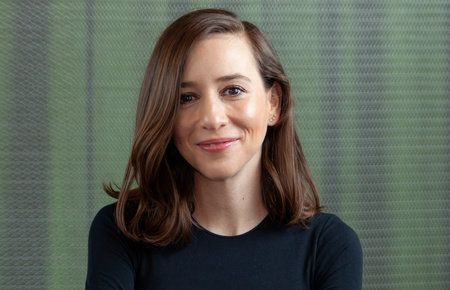




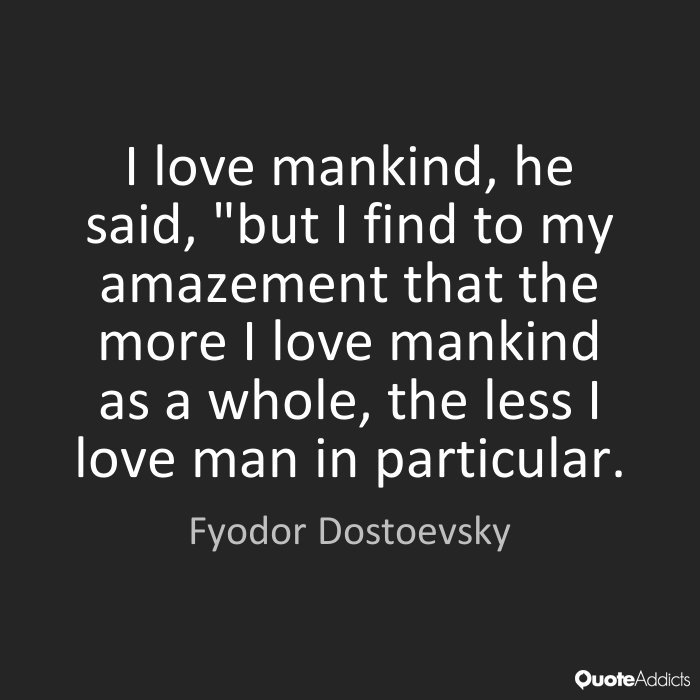



 gracefulatheist.com