This is the first of the Deconversion Anonymous episodes. In these episodes, people who have gone through deconversion or faith transitions tell their stories.
On this episode, Susan from Scotland tells us how she grew up Presbyterian but began to ask hard questions at a very early age. She felt empathy for those who were different from herself and recognized a lack of empathy in the church leaders. Ultimately, she deconverted in her twenties and now lives with intellectual honesty, empathy and compassion on the other side of faith.
Conversely inspired by presuppositional apologetics and continuing my Watershed Presuppositions series I thought it time to write down what my presuppositions are.
Presuppositions are truths you accept without justification. They are accepted a prori and may or may not have evidence to prove them. They are your starting point and the basis upon which everything you believe in is built.
It is important to note that everyone has presuppositions whether they are aware of them or not. Much of the difficulty in having a dialog with those you disagree with is the unstated incongruous presuppositions that you and your interlocutor hold.
My Presuppositions
Ontological and Epistemological
The universe exists and has patterns which are to varying degrees discoverable.
Conscious minds are a product of the patterns of the universe.
Logic and mathematics abstracted from the discoverable patterns of the universe by conscious minds are sound and reliable.
The scientific method which uses logic, mathematics and observation is a reliable method for discovering the patterns of the universe.
Truth is that which can be tested and verified to conform to reality.
Moral
Human beings have value and inalienable rights.
Human beings are fallible.
Human beings are meaning makers.
These are the truths that I hold axiomatically. Some, even most, can be justified, meaning they have evidence. But, for our purposes here, what are the implications of these statements when held true?
You may find yourself saying, “but I don’t believe one or more of these.” No problem. These are my presuppositions not yours. The reason they are useful is for you to understand how I come to certain conclusions and not others. If you can accept them purely for the sake of argument you can begin to understand my worldview. If you cannot accept them even solely for the sake of argument then we have nothing further to discuss.
The universe exists
This one seems pretty obvious. If it seems as obvious to you as it does to me, you have probably never hung out with philosophers.
The purpose of this axiom is to do away with the interesting yet tiresome arguments of solipsism, that the only thing that can be proven to exist is our consciousness. Do we live in a hologram or a matrix? Are we just brains in a vat? So boldly and arrogantly I assert, the universe exists!
Even more boldly I assert that at least to some extent it has patterns which are discoverable. These patters are observable and ultimately knowable to varying degrees of certainty. The old trite saying, “as surely as the sun will rise in the East and set in the West,” is an example of observing a pattern of the universe and gaining certainty that it is true.
Conscious minds are a product of the patterns of the universe
This one is more of an assertion. Fewer people may agree with me here. But I take this as a given. Consciousness is not made of a mysterious non-natural substance. We may not understand consciousness in its entirety … yet. Therefore, I assert consciousness is a product of the patterns of the universe we find ourselves conscious in.
This axiom is important to do away with the idea that consciousness is something other than natural. The idea of a soul dieshard.
Logic and mathematics are sound
Again, if you find this one obvious, you have not spent much time with either philosophers or presuppositional apologists.
Logic and mathematics are abstractions from the patterns of the universe by conscious minds. There are a few hidden assertions in here that I will point out.
Logic and mathematics do not exist in the platonic sense. We have discussed dualism in this series before it is a difficult one to escape. What I am saying here is logic and math do not have their own existence they are the product of human intellect based on observed patterns in the universe: abstractions. In philosophic language this is an epistemological claim not an ontological claim.
We as conscious human beings observe the patterns of the universe and we abstract “rules” that describe those patters. If I have two sheep and then I get two more I have four sheep. It does not matter if “sheep” are woolly mammals who chew the cud or blocks, or rocks, or anything. We have abstracted the rule 2 + 2 = 4 by observation and human intellect. From basic arithmetic to number theory we have abstracted rules from these patterns.
The most important assertion here is that logic and mathematics are sound and reliable. It is a feature of logical and mathematical proofs that each step taken relies on the proofs that came before it. If one of the foundational mathematics axioms were not true the proofs built upon it would not “work” as they do.
Don’t believe this one? Then throw out the magic device in your pocket that gives you access to the near sum total of human knowledge. That device, the network it uses and literally the information itself is all built on logic and mathematics.
Mathematics is the language of the universe.
— Neil Degrasse Tyson
The scientific method is a reliable method to gain knowledge
The scientific method is simply a process by which an idea is tested by gathering evidence. If there is strong evidence more credence is given to the idea, if there is little evidence credence goes down and if there is contradictory evidence the idea may be abandoned altogether.
My assertion here is that this is a reasonable and reliable epistemological method, a way to gain knowledge.
The scientific method leads toward truth in major part by discarding bad ideas. Finding true ideas is hard. Validating that an idea is true is just as hard. But by discarding false ideas the options are narrowed down toward true ones.
Science is self-correcting. If tomorrow credible evidence is discovered contracting any of the deeply held scientific theories credence in that theory would drop. Not only that the discoverer of the contradicting evidence would be lauded.
Science tends to assume naturalistic metaphysics. If that bothers you, then you need to account for science’s unreasonable, wild and fantastic success. The entirety of the modern age depends upon the successes of science from medicine to space exploration to binge watching your favorite TV series on demand.
Truth is that which can be tested and verified to conform to reality
Adding to the common definition of truth as that which conforms to reality and adding a bit of the scientific method. I assert that truth is that which can be tested and verified to conform to reality where reality is the product of the patterns of the universe. We should have more credence in something that has been tested and has evidence than something that has neither.
Evidence, testing and validation are important because these are the only tools to convince the skeptic. Einstein was famously not a fan of quantum theory in the early days. But he was won over by the evidence.
If I make a claim, you can believe me or not. But if I make a claim and tell you how to test for yourself and that test validates my claim it is harder to ignore.
I expect the accusations of scientism, materialism and empiricism. Fine. It is certainly true that there are vast areas where science just doesn’t know. And in fact this is a feature: to humbly acknowledge all that we don’t know.
Focusing on the gaps in knowledge misses the point, keep in mind all that we do know. Evolutionary theory explains the vast complexity of life on planet Earth. Theories within cosmology can model the universe back to fractions of a second after the big bang. Gravity waves just recently verified were predicted by Einstein’s general theory of relativity. The baffling quantum field theory explains nature’s behavior at the microscopic level which turns out to be deeply counter intuitive.
Even for those things which we cannot measure directly we use inference. We have inferred dark matter and dark energy. These two account for 96% of the material in the universe and yet we cannot detect them directly.
Human beings have value and inalienable rights
This is the basis of my morality: human beings have value and inalienable rights. I assert it thus, and then try to live out the implications. As sentient beings we recognize each other’s great value in the otherwise empty vastness of the universe we find ourselves in. We are not alone. We have each other.
I am a humanist as I have written before. This simply means that people are more important than ideologies of any kind. We ought to treat each other with Secular Grace.
I appreciate the need to expand this concept to conscious creatures. This has vast implications on how we treat animals and potential artificial intelligences. However, as recent political history has shown we are not very good at treating each other with respect and valuing each other’s rights. So human beings are my focus.
Human beings are fallible
Just as important as recognizing the value human beings pose we must also acknowledge human fallibility. Although, I reject the concept of sin it would be foolishness not to recognize people can be destructive to themselves and others.
Human beings are neither all good nor all bad. If those terms are too loaded, they are neither completely selfish nor completely altruistic. Our motivations are complex and varied and they very rarely reduce to simple identifiable sources.
We are very good at fooling ourselves. We are susceptible to a vast array of cognitive biases. In fact, much of the process of the scientific method is to avoid human fallibility and our ability to find what we want to be true.
However, just because human beings are fallible or imperfect does not mean we are not of great value. Sentience being an exceedingly rare commodity in the universe we find ourselves in, we need to love each other.
Human beings are meaning makers
We humans are the conscious observers who abstract the patterns of the universe. We experience awe and mystery and give them meaning. We define human morality I assert there may not be inherent meaning in the universe but we humans make meaning.
We are the universe aware of itself.
— Carl Sagan, Julian Huxley, Neil Degrasse Tyson all have said some variation on this quote.
I tend to agree with Hume that you cannot get an aught from an is. Rather than exhausting ourselves looking for external objective truth, morality and meaning we should take it upon ourselves to work together toward greater understanding of human truth, morality and meaning. Though all human moral systems are incomplete, taken together they point toward respect for human value.
Many months ago Neil Carter, Godless in Dixie, wrote an article about the Evangelical mind warping perspective on Philippians 4:13. (I particularly like the comment about his kids noticing the clock reading 4:13 as apposed to 4:20.) He also uses a cute analogy about Dumbo and the magic feather.
— Graceful Atheist (@GracefulAtheist) July 6, 2017
The reason Neil’s suggestion that religion might be helpful in the beginning struck me as true because that was my experience. Right at the time when I was most “lost” is when I became a Christian. That may actually be trite to say. Isn’t that true for everyone? This is going to sound like a religious testimony, but I have a point to make. So bear with me.
I grew up in a nominal Christian home. There were occasional references to God but he was never at the forefront of conversation. So much so, that I was curious about what the adults all seemed to know that I did not quite get. If I can quote Douglas Adams, my position on God as a kid went something like this:
Who is this God character, anyway?
The other pertinent piece of information is that I grew up in an alcohol and drug addicted family, specifically my mom. After years of broken promises and heartache when I was 17 my mom came to me and said, “Jesus told me to stop drinking.” “Sure, mom, whatever,” was my response. But she was clean and sober that day. And the next. And the next. She claimed God had given her a choice, “stop drinking or die,” and she chose to live.
This had a rather profound impact on me, as you can imagine. My mom did not push religion on me. After going to rehab and being clean and sober for a couple of months she bought me my first bible and gently suggested, if I was interested, to read one of the gospels. Which I did. Over the next year, I read it cover to cover.
With mom suddenly acting like an adult, this was my cue to fall apart. This was my junior year in high school. I had already had problems with school, mostly due to skipping class. But I was also dealing with what I now understand was depression and anxiety. I was panicked about projects where I had to speak in front of the class. So I did not go to school. Which made it harder to go the next day. Which made it harder still. The pressure and anxiety snowballed. I felt like I had a mountain of anxiety on my back every day.
So, I dropped out.
This is when I became a Christian. I had just watched my mother transform literally overnight. I had dropped out of high school. I was 17 years old, poor, with no prospects for the future. I had no idea what I was going to do with my life. All while I was reading the bible which was presented to me as having answers. And it claimed there was a God who cared. I needed help. Of course, I reached out to God.
Here is the point where my secular readers are jumping up and down at the manipulative nature of religion preying upon the vulnerable at there weakest. This is, of course, true, but not the main point I want to make. I need you to feel how lost I felt: on the cusp of adulthood, with no education and no plans on how to make a living, nor any hope for a meaningful life. Because the rest of the story gets to the point.
I had the odd experience of reading through the bible before I went to church. Which means that upon arrival at church I was constantly wondering, “Where did they get that idea?” I was 18 and the church had no idea what to do with me. So, the youth pastor asked me if I could help out with their youth group. Turns out not everyone in the church has read their bibles, so I was pretty good at preaching and teaching it very early on.
Here is the critical point in the story. One day the youth pastor says to me, “you should go to bible college.” Now, I was a high school drop out, I had gotten my GED and was playing about at community college with no particular plan. But suddenly, the idea of going to college was not out of reach. At least one person believed I could do it.
I wound up going to bible college and graduated Cum Laude. I met my future wife there. I briefly became a youth pastor. On at least a few occasions, I spoke and preached in front of thousands. This was the same kid who dropped out of high school because he was afraid of speaking in front of the class.
You know there is a rest to the story. This entire blog is the rest of the story. There were dark days for my mom. There were problems with bible college. There were certainly problems with ministry. And ultimately, my recognition that none of it was based on reality.
So what is my point?
I wouldn’t be here writing this today. I wouldn’t have my life. I wouldn’t have my career. I wouldn’t be married to the woman I love (I am still not in my wife’s league but I really wasn’t before college). None of these things would exist had I not been given that little bit of hope when I was at my lowest point.
I was dumbo. I was holding the magic feather of religion. And I could fly.
New perspective
One day, I discovered the magic feather was not actually magic. It was the people in my life who had lifted me up. But that does not mean the magic feather was not useful for a time.
Do I think God delivered my mother from drugs and alcohol? No, I do not. But the idea of God gave her hope to not drink that day. And the next. For ten years. Until it didn’t.
Do I think God took an anxious and scared kid and made him a public speaker? No, actually, I think it was the relationships with people in my life. That youth pastor who legitimately cared about me but just happened to be in the church. My grandparents who paid for half of my college. And even my mom who, despite all her flaws, let me know how much she believed in me. People believed in me, supported me and got me through very difficult times and allowed me to succeed.
Placebo Effect
The placebo effect in medicine is a well understood phenomenon. When people are given inactive sugar pills but they believe they are medicine they get better. The mind is a powerful thing and it has influence over the body (to an extent). The point is even though pills made of sugar have zero medicinal value people physically got better when they believed the sugar pills where going to heal them.
The point Neil makes above and the point I am extending here is that religion has a placebo effect. It can be helpful for some people some of the time. My mother’s belief in a deliverer (and not coincidentally one who watches over you and knows all) helped her overcome an addiction. My belief in the “Father to the fatherless” and a God who providentially guided me helped me overcome my anxiety and analysis paralysis and get on with my life.
Why in the world would would I (the Graceful Atheist) make the argument that religion could be helpful? A few reasons. But first let me clarify.
What I am not saying:
I am not saying that the magic feather of religion is actually magic. There are perfectly natural explanations for all of one’s religious experiences. In fact, that is the point, it is a placebo.
I am not saying that one should stay in religion. The point I am trying to make is a humanistic one: one’s own humanity and one’s relationships with other human beings are the magic. Not the religion.
I am not saying that religion is an unqualified good. It is more harmful than helpful because it isn’t true.
What I am saying:
What I am saying is that in some circumstances for some people some of the time religion can be a “crutch” or a talisman that helps a person get through difficulties.
Further, we in the secular community need to keep in mind that taking the magic feather away from someone by force leads to a crash. Placebos stop working when one becomes convinced that the pills are just sugar. But if someone else tries to externally convince, one is more likely to become defensive.
One of the reasons why I am not an anti-theist actively trying to disabuse the faithful of the magic of their feathers, is that this can be more harmful than good. When bubbles burst it can be painful. People self-delude sometimes for good reasons. Maybe they need that at the time. I tend to believe that when a person is ready they will start asking questions of their own volition.
We in the secular community should argue against bad ideas wherever they are found. Sometimes in public. But there is a tendency, particularly online, to see it as one’s mission to destroy religion at all costs. Not only do I think this is wrong, I think it is counter productive.
I have not actively tried to convince my believing family to give up their beliefs. Partly because, I perceive they are not ready. The magic feather is still keeping them in the air. Taking it away by force will just make them crash, not help them thrive as human beings.
We have to have something to give people to replace the magic feather. Something that will give them hope. Something that will carry them through dark times. As things stand today, I think this is the greatest failure of the secular community. Why would I yank the crutch out from underneath someone when I have nothing to offer but pure self-reliance? That just isn’t enough for many many people.
Avoiding the crash
After the deconversion process the single most important thing is finding community. Finding the relationships that keep one afloat. It is a secular community of caring people that needs to replace religious ones.
I consider myself a pathologically independent person. I decided at age 12 no one would be taking care of me but myself. The idea of a God who had my back was deeply attractive. It turned out I was still on my own. I tell you this to point out my greatest character flaw. I find it very difficult to ask for help even when I need it desperately.
A consequence of this is that when I deconverted, I did my thing. I did it alone. I read a pile of books. I got online and studied humanism, science and philosophy. I listened to hours of podcasts. I came to understand I was not alone. I was actually a part of a long line of history of doubters. I learned how to live life gracefully without God.
But here is the thing. Most people aren’t like that. Most people need more. If all we have to offer is “Good luck, you are on your own,” most people will reject that.
We need to do better at creating safe, welcoming and caring communities for the doubting, for the deconstructing and for the deconverting. We need to provide Secular Grace. We need to provide a replacement for the magic feather. It is we human beings who can do that.
What do you now see was a placebo?
I asked a few online secular communities I am a member of what they now thought of as placebo that they once believed was magic.
The overwhelming response reminded me (and you, dear reader) of the privileged position I have as a white(ish) cis-gendered heterosexual man in this society. Not everyone had positive experiences with religion. See the #ChurchToo. Some have experienced nothing positive at all.
I got pithy responses like: “All of it,” “None of it” and “Thoughts and prayers.”
There was a common theme of parents having transformed, angry fathers becoming loving caregivers and drug addicted mothers getting clean and sober.
Prayer was the big one people recognized as a placebo. Prayer feels like you are doing something when things are most out of your control. It is a tough one to get over post-deconversion.
In a mirror image of my argument for caring community, one person pointed out the false sense of community as placebo. They found out that the religious community who said they loved them and would always support them suddenly abandoned them as soon as they rejected the faith.
Also in juxtaposed from my experience of hope, one person talked about false hope. They talked about how devastating it was to feel hopeless when God did not come through for them.
I got strong push back from the spiritual but not religious who argued that the positive effects (“feel-good hormones) are not placebo but a direct result of spirituality.
What do you look back on now as a placebo that felt very real while you were in your faith?
Conclusion
There can be some positive effects from religion. It is OK to look back fondly on them post-deconversion even while you grow out of the need for magic feathers. Forcibly trying to dissuade believers is counter productive. Even if we could convince them we still need to do better at providing a safe and welcoming community for them to replace what they are losing.
Most importantly, you can be the magic part of a secular community that can replace the impotent feathers and pills filled with inactive sugar for the believers in your life.
Although everyone has a unique story, sometimes those stories can have striking similarities. Deconversion stories are no different. Sometimes they sound a lot like “I was born again” testimonies, “I was blind but now I see.” I love reading and especially listening to people’s deconversion stories and learning what was similar and what was different for each person. Deconversion stories are our origin stories.
This post will have two goals. One, to describe the similarities experienced by others who have deconverted and two, how to get the ball rolling if one wanted to proactively start the process. These proactive steps tend to be the causal steps that we took naturally unprompted.
I need to make clear up front, that the title is tongue in cheek. This post is really descriptive rather than prescriptive. Your experience may have been different, even radically so. Stages could be skipped, reordered or take longer or shorter than described. We are complex human beings and it is difficult to encapsulate the variety of human experience. This post is an attempt to describe the similarities during the process of deconversion.
I also hope this will be a living document. If you are reading this and have gone through the deconversion experience, please help me improve it. Please send me feedback. Send me any corrections or additions you might have. If you find it useful, please consider linking to it from you blog or site.
Note: The overwhelming initial feedback has been about the non-linear nature of deconversion. So, I will state this again. Your experience may be different and that is OK. This post is not to suggest this is the “right” way to experience deconversion it is merely an attempt to describe some commonalities.
Terms
First lets get some terms straight, as I see some confusion about the term deconversion. and this will help define the target audience. By deconversion I am referring to a person having had faith in a particular religion, and subsequently ceasing to be religious and rejecting faith of any kind.
It is significant that deconversion applies only to those people who once were religious. This seems obvious, but there are some unique experiences for those of us who were religious and then reject our faith. This is opposed to having been raised secular all of one’s life and becoming more activist in one’s secularism, humanism or atheism. Also opposed to, the probably more common, having been raised culturally of a particular religion but not having been an active participant. There just isn’t much to deconvert from in those cases.
Deconversion is also not just that we rejected our own faith, but all faiths. It is a unique experience to lose one’s faith and find oneself isolated from religious circles. In many cases, this can be the total loss of one’s social support system, as the newly deconverted loses relationships from the old faith and may have no one to replace those relationships.
Lastly, when I use the terms religion and faith, I am referring to the supernatural variety with a world view that presupposes something that transcends nature. I am well aware there are some non-supernatural religions out there. I like the term “graceful life philosophies” from Jennifer Michael Hecht’s book, Doubt, for these. We can debate, for example, whether humanism is a religion in another post. But these are the exception and not the rule.
What Deconversion is not
It might be helpful to contrast deconversion with what it is not.
Deconversion is not conversion. It is somewhat common for people to convert to a religion or from one religion to another religion. In the case of conversion, there is a new faith community that softens the loss of the old faith community. That is not the case with deconversion.
Deconversion is not just deconstruction. Deconstruction is often the process of becoming less fundamentalist in one’s faith. It usually entails the rejection of scriptures being inerrant or authoritative. Often, one’s theology is liberalized to accommodate the modern world. The key difference here is that typically (not always) the person is still a person of faith. This faith may be sophisticated and nuanced but it is faith none the less. It is very possible for deconstruction to be a step on the way to deconversion.
Before the process begins one is secure in one’s faith. The answers provided by the faith community and the sacred text(s) provide comfort and feelTrue. Sure, there may be a nagging question or two but that is for the theologians to debate up in their white towers.
At this point, cognitive dissonance is at a minimum, the avoidance or minimization of the problems are in full effect, and confirmation bias is at its maximum. There may be some questions best left unasked. Flat out denial is not out of the question.
Life comes at you fast. At this point, something, anything, can happen that makes you take a second look at some of your assumptions. Some deeply held belief might be invalidated. Something doesn’t quite feel right. The pat answers now sound pat. There has been a blip in the matrix.
For some the deep need for truth that led them to religion is the exact need that leads to doubt. It is not a coincidence that many who attain higher educational levels deconvert. Those with Masters in Divinity and PhDs in religion often go on to deconvert after learning just how the sausage gets made. In their quest for truth it is discovered that truth may lie somewhere outside of religion.
For some the precipitating events can be tragic: the loss of a loved one, hurt caused by the church or say half the country electing a demagogue in the name of god. For others it is the slow relentless grinding creep of doubt. But something causes you to start re-evaluating your beliefs.
This stage can be characterized by “calling out to god.” You might even feel guilty or to blame for these initial doubts even if they have arisen due to external circumstances.
“Lord, I believe; help my unbelief!”
–Mark 9:24
There may be an impetus to “double down.” You might redouble your efforts to pray more, read your scriptures more, rededicate yourself to god or pursue ministry with more dedication.
At this stage cognitive dissonance is starting to rise. Confirmation biases are just starting to show cracks. Precipitating events may cause brief periods of doubt but your faith tends to win out in the end and push the doubts away.
Proactive Steps
Read your sacred text(s). All of it. Even the boring parts. Read it without making excuses for what it literally states. Rather than wearing your rose colored glasses try reading it as an outsider.
Ask yourself the hard questions. Why is there suffering in the world? If god intervenes in the world, what does god’s silence mean?
Talk to a non-believer. Ask them to tell you honestly what they think about your beliefs and why.
At the critical mass stage, things are starting to pile up. Multiple precipitating events are happening at the same time. The doubts and questions are taking up a lot of mental energy to keep contained. Cognitive dissonance is becoming problematic. You find it difficult to keep the plates of faith spinning. Critical mass is death by 1000 paper cuts.
Believers call this “the dark night of the soul.” It is a time of serious doubt that threatens your faith. Believers assume this is a temporary stage. However, what if your doubts have validity?
The silence of god during this period can be deafening. Divine hiddenness begins to look strikingly similar to non-existence. The call out to god is increasingly desperate.
God, DO SOMETHING! ANYTHING!.
During this stage it is common to feel like you are doing something wrong. It can feel like you are not seeking god enough or not in the right way. The initial feelings of guilt from precipitating events can mount.
It is easier to blame yourself than to acknowledge the possibility that god is not real. A common response is the dreaded, “I must not be in god’s will,” as if “god’s will” were discernible. This will be particularly painful in religious traditions where many community members often claim to “know god’s will.”
As in the previous stage, there may be a renewed effort to “work harder,” but ultimately this is a delaying tactic. This is the beginning of the end. Cognitive dissonance is peaking. Confirmation bias is starting to fail. Doubt is a constant companion.
Proactive Steps
Make a list of all the things that are causing you to doubt.
Think about each item on the list and decide if it has validity.
Stop trying to keep the plates spinning and see what happens.
Answer the question, “What if it is not your fault?”
Up to this point the stages have been about things that happen to you not necessarily by choice. The permission to doubt stage is a proactive one. Consciously or subconsciously you give yourself permission to doubt. I particularly like the description of this stage from the ex-christian.net forum: Curiosity Killed The Cat.
The permission to doubt stage is a conscious acknowledgement that doubt is not your fault. It is the attempt at letting go of pent up guilt. It is the recognition that doubt cannot be denied or contained forever. Doubt must be addressed directly on its merits.
One description of deconversion is the gradual, even subconscious, raising of one’s standards of evidence until the weak, circumstantial, and special pleading nature of the faith tradition’s explanations becomes obvious.
At which point it all comes crashing down.
In “Letting Go of God”, Julia Sweeney describes this stage as putting on the “Not believing in God glasses.” What does the world look like if you do not assume god’s existence?
Depending on where you are at in this phase you may still identify as a believer. That is OK. But you are taking a more proactive examination of your faith. Or you may feel at this point things are going downhill fast and the outcome is a forgone conclusion. Either way you are taking active steps to learn and explore.
Doubt* is your subconsciousness telling you the truth.
*Religious doubt. I don’t think this is true for all non-religious cases. See for example the Dunning-Kruger effect.
Cognitive dissonance is either peaking at this point or already on the decline as you come to grips with the answers you discover. You may begin to recognize how confirmation bias has been fooling you.
Proactive Steps
Reverse the old believer’s advice to doubt your doubts and trust your doubts instead.
Can you find objective (non-subjective) reasons for your faith?
Can you find evidence that would convince a skeptic or yourself that god is real?
Let your curiosity guide you. Investigate the things you have been afraid or unwilling to explore. Read atheist books and blogs. Explore science that contradicts your faith like evolution and cosmology. What else has been off limits? Go check it out.
Deconstruction is the stage of the sophisticated believer and the liberal theologian. It is a rejection of puerile fundamentalism. At this stage you may actively start to reject elements of religious dogma without throwing the baby out with the bath water. It may be time to retire doctrines that no longer work in the modern world like inerrancy of scriptures, creationism or ancient social morality.
This stage is an embracing of science, education and modern ethics. It acknowledges the complicated world out there and the failure of fundamentalism to address that world. This stage can be a focus on the social gospel. People have become more important than religious dogma.
Often this stage is focused on reinterpreting the sacred texts. Escaping the tyranny of literal interpretation and exploring the metaphorical meaning to be found there. What are the supra-cultural truths these scriptures are pointing at?
Deconstruction may mean the complete redefinition of “god.” It may mean the move away from a theistic understanding of god to deism, pantheism or panpsychism. Rather than seeing god as a bearded angry man in the sky, she might be “the ground of all being,” or as in one famous example, the forces of nature themselves.
If the previous stage was permission to doubt, this stage takes doubt deadly seriously and is as far as one can go and still consider oneself a believer. This stage acknowledges that faith is an entirely subjective endeavor. It is possible to remain at this stage indefinitely at varying levels of faith and doubt.
In this stage and the next few I’ll use the analogy of a mathematical limit. As you approach the limit of unbelief, you probably still consider yourself a believer. Even while you are discarding elements of your faith, some kernel of faith remains when you are on this side of the limit. For the deconstructing believer the approach to that limit can be near infinite or take no time at all.
Proactive Steps
Take an inventory of your religious doctrines and determine which are literally true, which are figuratively true and which are completely false.
Answer the question for yourself, “who or what is god?”
Answer the question, “what parts of my religious beliefs apply to helping those less fortunate than myself?”
Ryan Bell describes the liminal stage as that between faith and unbelief. I have added this pseudo stage to acknowledged that faith is not always binary. There can legitimately be a time of in between.
Continuing with the mathematical limit analogy, this is the infinitesimal approach to the limit of unbelief. For those less mathematically inclined a better analogy is jumping off a diving board into a pool of water. The moment you lose contact with the diving board until you have hit the water is the liminal stage. Faith is gone at the loss of contact, but you are not wet (an unbeliever) yet until you hit the water.
Contrary to the analogies, some may waver back and forth in this in between state.
It may take years, months, days or just moments to come to the realization that you no longer believe. You may have been in denial for some time or it may hit you like lightning. At some point you are honest with yourself and admit to yourself you no longer believe.
The mathematical limit of unbelief has been crossed. Belief is not a choice. You are either convinced of the truth of a faith claim or not. At this stage, you are no longer convinced of the truth of god. You are a non-believer.
You may continue to go through the religious motions for some time after you have acknowledged your lack of faith either out of habit or necessity. Not a problem. You may find yourself starting to pray only to be jolted back to reality. Old habits die hard.
At this point you may be unable, unwilling or incapable of telling another human being. That is OK. You do not owe anyone anything.
Your safety is the highest priority. If you live in a culture where it is dangerous to be an non-believer, it is not your job to fix this by outing yourself and putting your safety in jeopardy. If you are young and living with parents who might possibly remove you from the home, you are not required to tell them. Keep it to yourself.
But you do owe it to yourself to be rigorously honest with yourself and no longer pretend internally. Recognize how confirmation bias has worked against you in the past. Notice that cognitive dissonance has flat lined after admitting this to yourself.
Ironically, the experience is not unlike being born again. The scales fall off the eyes so to speak. For me personally, I had a literal “Oh, shit” moment of realization.
Proactive Steps
Start enjoying your mental freedom and the peace of letting cognitive dissonance go.
Actively read other deconversion stories to recognize you are not alone in this process.
Begin making a plan. Can you tell anyone? Who are you going to tell first?
Deconversion is an emotional experience. It has been described by Brian Peck of the Healthy Deconversion Project as very similar to the grieving process of losing a loved one. You might experience any number of emotions as you grieve the loss of your god, your faith and your religious community. That is a lot of loss and can lead to a wide range of emotions. The point is there is no “right” way to feel and no emotion that is “wrong.” Give yourself permission to feel and take as much time as you need. This is a chaotic time. Give yourself some secular grace as you navigate new terrain.
Anger, depression, guilt and even bargaining with a non-existent god are all normal. What order and how long you experience these or any other emotions is an unknown. There is no need to rush and definitely no need to beat yourself up when it feels like you are starting all over again.
The above are all fairly well known emotions during loss of any kind. I want to highlight a few emotions that are specific to the deconversion process.
The first is the loss of the sense of control. As a believer, there was always something you could do when in need. You could pray. Regardless of distance or your own ability, you could respond to difficulty by calling out to your all powerful god. The first time a tragedy strikes during or after your deconversion, whether it is out in the world or close to home, the overwhelming feeling will be of powerlessness. In the short term, this is painful. In the long term, this is healthy. Learning what you can and cannot control is a part of facing the world as it is not as you wish it to be.
The second is the shame at your previous gullibility. (Maybe this is just me.) As you learn about science, philosophy and ethics, your previously held reasons for believing may become increasing distant. How could I have believed these things? How could I have been fooled by these poor arguments? Remember, that when you are in the bubble, everything seems to make sense. It is only now, outside the bubble, that you see clearly the logical mistakes.
Finally, the feeling of loneliness can be overwhelming. You may not be able to discuss your deconversion with your family or friends. Your social support structure may be off limits on this topic. If you do not happen to live in a larger city, there may be few opportunities for secular community. The main thing to remember is that you are not alone. I’ll say this again in all caps:
YOU ARE NOT ALONE!
Many have gone through this process before you. You do not have to go through it by yourself.
Proactive Steps
Reach out. If you have a non-believing friend. Run to them! If not, there are plenty of resources online as well as a large community of non-believers. Engage, ask questions and don’t hesitate to ask for help.
“I would rather have questions that can’t be answered than answers that can’t be questioned.”
You are a baby not-a-believer. Soak up knowledge like a sponge. All of the things that were off limits, considered “liberal” or “worldly” are now on the table for investigation.
This includes reexamining your religious texts and apologists. I re-read many apologists just to make sure I had not missed something. I had not. How were they convincing before? Are they now? I occasionally crack open the bible to re-read one passage or another to see it with new eyes. What does your religion’s sacred text sound like to your non-believing ears?
Discovering secular thinkers is a valuable process. It reminds you that you are not alone in your deconversion. It may also teach you ways of thinking and explanations for your new found lack of faith. You are not obligated to believe anything. What freedom! You decide for yourself what you believe and why.
You may still be in the closet at this stage. That is OK. Take your time and learn.
Proactive Steps
Learn some science. The scientific method and falsifiability are great tools for seeking truth.
Read. If you are a reader this is the time to go nuts. Read atheists. Read apologists for your religion. Read scientists, philosophers and ethical thinkers.
It may take a while but eventually you will probably tell someone about your deconversion. Admitting your lack of faith to another human being is immensely cathartic.
I’ll re-iterate here that safety is priority number one. There is no shame in staying in the closet indefinitely if your safety is an issue. But if you can safely do so, telling another person will be a beneficial step.
Consider carefully who you tell and how you tell them. You are not obligated to publicly post on Facebook for all the world to read. Even in places where non-belief is not a safety concern there may be employment, school or community implications. You also don’t owe an explanation to your third grade teacher or your second cousin once removed. Think carefully and take time during this process. Start with people you trust and tell only the people who need to know.
Oddly, sometimes the easiest first step is to talk to a stranger. Maybe someone you meet online who is not vested in your faith one way or the other.
When telling family members and close friends remember as Brian Peck has said, “They are at step zero.” Your deconversion process could have been years in the making. You have done the doubting, the questioning, the searching, the grieving and the information gathering. Your family member has not. They are starting from ground zero and this is going to hit them like a ton of bricks. They are likely to react defensively. Tread lightly.
Except in the case of abusive relationships you probably want to maintain the relationship. You may need to be the bigger more humble person in this process. This can be challenging on a number of fronts. You may still be angry. Your newly acquired knowledge mixed with a new disrespect or hostility for faith can be an intoxicating combination that may lead you to say things you might regret. Plan out what you want to say and expect push back and defensiveness from your loved one. Try to give them the secular grace you needed during your deconversion process.
It is a process. Particularly in the case of a spouse, this is unlikely to be a single conversation but rather a lengthy back and forth. Be patient and encourage your loved one to ask you questions. Try to remember how convinced you were when you were a believer and remember that is where they are at now.
Keep in mind it is not your job to convince them to abandon their faith. Your goal is to keep the relationship. There will be some natural tension. Remember that to the believer casting doubt on their beliefs is perceived as a direct attack on them and their identity. Love is hard.
Someday you might find that you do want the world to know. If it is safe to do so and you have considered the implications, knock yourself out, make that public Facebook post. If it is the right time write the email bcc to all. Tell the world. The more people who are “out” the easier it is for others to do the same.
Proactive Steps
Read other “coming out” stories. This includes the wisdom of the LGBTQ community.
Read “letter to my family” posts. Many deconverted have taken the time to write down their thoughts on what they want their family to know about their new lack of belief.
Write your own letter. This will allow you to plan out the things you want to say.
Be gentle. Try to show the kind of patient loving kindness you would want if the roles were reversed.
This is the big question. Ceasing to believe is really only the beginning not an end to itself. Just because you no longer believe in a god does not mean you do not need human connection and belonging. Your religion likely provided more than just doctrine and dogma it also provided community. One of your first tasks should be to find a secular community that meets the very human need to be a part of a group.
Religion does not own awe, wonder, gratitude or morality. You are the same person you were before deconversion. Likely your morality has remained mostly unchanged, other than having more freedom and less guilt. This is your chance to seek out and express where you find meaning. Ask yourself and try to answer:
What is my source of morality?
Where do I find meaning?
How can I experience awe?
How can I give back?
For me, secular humanism provides an answer to several of the above questions. You may or may not find humanism useful. That is not a problem. You get to discover and answer these questions for yourself.
Proactive Steps
Try the Belief-O-Matic online quiz. This will give you a quick feel for how your current beliefs line up with other organized religious, ethical and philosophical groups.
Study morality and ethics. There is a rich history of non-religious philosophy on ethics. Many times this has been off limits and is new information after deconversion.
Participate online. Twitter and Facebook are full of secular groups. This is an easy way to dip your toe in and see if a group is right for you. Try starting your own blog and documenting your deconversion process.
Give back. Find a way to give back to the world. Without a religious framework this one can easily slip through the cracks. Ethical societies are a good way to keep motivated to give back to the community. This is as much for you as it is for those served.
Conclusion
It goes without saying, that your experience may be different than what is described above. Great! You are a unique human being that is to be expected. Maybe things are out of order or you skipped multiple steps. Maybe you stayed in one stage for a long time. There is no right way to deconvert. We are all learning as we go. The purpose of this document is solely to provide some comfort in knowing that others have gone through this before you.
As I stated at the top, I would like this to be a living document. So, if I got something wrong or an important step is missing, please let me know and I’ll update this post. Your experience is valuable and might help others so don’t hesitate to send me update requests. If you think others will find it helpful, please consider linking to it from you blog or site.
Finally, I am interested in your deconversion story. If you need a random stranger to tell, I am here. If you need to write out your story, send it my way. And, if you are interested and willing, let me know and I will post your deconversion story to the blog.
To hear the deconversion stories of others checkout the podcast and Deconversion Anonymous episodes. In these episodes, people like you who have gone through a faith transition can tell their stories anonymously or for all to see. It is your choice. If you would like to tell your faith transition story anonymously or otherwise get in touch with me at gracefulatheist@gmail.com or @GracefulAtheist on Twitter.
One of the things I love most about books is that while reading you uncover the author’s thinking and sometimes you find that it matches your own. And as is often the case for me, the author is able to articulate that thinking in a much more precise and engaging way. Katherine Ozment’s Grace Without God: The Search For Meaning, Purpose, And Belonging In A Secular Age is just such a book. While reading it the experience was like recognizing a new friend who has thought through the same problems and come to very similar conclusions.
This is a great segue into describing the book. Grace Without God is about the human need for belonging. Just because we do not have a faith in a god does not mean we do not need to connect and belong with other human beings. Ozment describes her “spiritual”* journey from a nominal Christian upbringing; to leaving religion and faith behind; to an honest and heartfelt search for how secular people find meaning and connection. The subtitle describes it succinctly: The Search For Meaning, Purpose, And Belonging In A Secular Age.
Just because you have walked away from religion, does not mean you no longer need human connection and belonging.#Deconversion
The book is the result of her quest to answer her son’s simple question, “What are we?” At the time he was watching a Greek Orthodox Good Friday procession out the window.
“What are they doing?” my son asked. “It’s a ritual,” I said, thinking it must be their Good Friday. “Why don’t we do that?” he asked. “Because we’re not Greek Orthodox,” I said. “Then what are we?”
What an insightful, deep and difficult question. Her initial response: “Nothing.” The book traces her rigorous and heartfelt search for a better answer.
Voice of the Nones
With Grace Without God Ozment has tapped into something vital for our moment in history. She is expressing the voice of the Nones. As Pew research has pointed out the Nones are the fastest growing “religious” group in the United States. People are choosing not to affiliate with religious institutions for a variety of reasons. The Nones include a wide spectrum from “spiritual but not religious” to dyed in the wool atheists.
I too sense this is a vast group of people who are essentially “spritually”* homeless but who are honestly seeking meaning, purpose and belonging. Grace Without God is a response from one of our own describing a path forward.
Absolutely, I think you have tapped into something vital for our moment in history. You are expressing the voice of the Nones.
One surprise for me while reading the book, was how much I related to Ozment’s description of her nominal Christian upbringing. Although unlike Ozment, I went on to become an Evangelical for far too long before deconverting, I grew up in a nominal Christian environment. I remember the curiosity I felt hearing others describe some nebulous faith in God. A la Douglas Adams I would ask “who is this God character anyway?” and never got a sufficiently satisfying response. This too may be an expression of the Nones’ curiosity and need to answer the big questions.
Skeptical Chops
In the atheist community there is a natural distrust of anything that sounds too spiritual even up to and including humanism. So I suspect Grace Without God is not the first book on the atheist’s reading list. This is a shame as I think the book has much to offer those of us who identify as atheists. This post an argument for atheists to read the book.
I recently described to Steve Hilliker on the Voices Of Deconversion podcast the resistance I experience from my moniker Graceful Atheist. I chose the moniker because it reminds me that people matter. It is very easy to slip into believer bashing as an atheist pastime. I am also interested in “redeeming” the word grace from a its religious context. But the atheist part of the moniker is just as important. I don’t believe in god(s) and it is import to me to be open about this. Similarly, don’t miss the “Without God” bit by being distracted by the “Grace” bit. Ozment uses it in the truly secular sense.
I am a natural skeptic. I can’t help it. Even when I was a Christian I felt I was an internal critic. So when I read Grace Without God, even though I tended to agree with Ozment from the start, I did not leave my skeptic’s hat on the sidelines.
What struck me most about Grace Without God is how well researched it is. The book is full of interviews with professors, researchers and community leaders. The book can fairly be described as a research project but much more engaging. This is not a book of platitudes by some self described spiritual guru, but rather a skeptics attempt to ask the hard questions and grapple with the lack of answers. Ozment has skeptical chops.
Ozment is not prescribing anything. She certainly doesn’t come off as preachy. In fact, she poses more questions than she answers. In the book, Ozment is descriptive, giving account of how others in the secular community have attempted to solve the need for meaning and purpose.
A non-exhaustive list of topics she tackles:
Being good without God.
The failure of some secular communities to survive for the long haul and not having the same binding effects as traditional religion.
The need for ritual. (Yes, really, read the book)
Dealing with death from a secular perspective.
The new hotness, philosophical Buddhism. (This is the one I was most nervous about, but true to form it is descriptive not prescriptive)
Heart, Humanism and Secular Grace
Ultimately, I think Ozment would identify herself as a humanist. She describes taking the Beleif-O-Matic online quiz and getting 100% humanist. I also consider myself a humanist, which is probably why I identify so much with the book. After acknowledging lack of belief, humanism is an attempt to answer, “now what?” It is about “being for something” not just “against something.”
In my Why I Am A Humanist post I point out how difficult it is to avoid cloying platitudes when attempting to describe Humanism. Happily Grace Without God (dare I say) gracefully avoids this. Ozment acknowledges the real struggles to build secular community. The elements that bind religious communities together can sometimes be missing in secular communities. But secular communities are needed just the same.
Ozment visits Sunday Assemblies and humanist student groups. She visits secular parent groups and death cafes. She is reporting on the myriad ways secular people are attempting to recapture secular grace. But rather than coming across as dry or distant Ozment’s writing is full of heart and pops off the page. One cannot help but relate to her honest questioning and searching. She is telling my story … our story.
I appreciated, as well, that she expresses a lack of satisfaction in the answers. It is not that this or that solution is the right way or only way but rather that they are all pointing at something significant. And the continued search for that significance is the point.
I have written about Secular Grace and my attempts to use the term to describe the human need for connection. Ozment takes it one step further and tries to capture something deeper and for a lack of a better term “spiritual.”*
Ozment poses a provocative question:
I had felt a bit of what I thought of as grace—an abundance of gratitude for something freely given—that day gazing at my tulip and, later, at my family from across the street. But it wasn’t related to God. It was a wholly secular experience. What was it I was feeling? Could I train myself to recognize and prepare for such moments of secular grace—not to just wait for them to wash over me, but to create them myself?
Is it possible that rather than just passively waiting for moments of grace, we can actively seek grace out?
Conclusion
This is the type of book that I wish I were capable of writing. And to be clear, I am not. I recognize it as a is a bit of grace to come across a book and an author that articulates my thinking better than I can. My biggest problem with the book was not trying to highlight the whole thing. The hardest part of reviewing it is not plastering quote after quote.
The book is worth its price just for the epilogue, “A Letter To My Children.” In which Ozment describes her own 10 “commandments” of how to live life and seek out meaning.
Grace Without God is well worth a read.
* I am using the word spiritual here for lack of a better term. I don’t think I am alone in struggling with terminology in the secular community. I mean the term in the naturalistic sense of human beings need for meaning, purpose and belonging. No supernatural implications are intended, thus the scare quotes.
This blog has primarily been about what I do not believe and what I am not. The entire premise of the blog is about my deconversion and letting go of faith. But as has been said before by myself and others, saying “I am an atheist,” tells you almost nothing about me. In technical terms it tells you one and only one thing: I lack a belief in god(s). My recent (poorly named) series Communities of Unbelief has focused on ways I do not identify myself with titles like “Why I Am Not …”
This blog post, however, is about what I do believe in and how I do identify myself. I am a humanist. First and foremost, this means that people are more important than ideologies: religious, political or otherwise. It means the thing I believe in is quite down to Earth: people. I believe in humanity. I believe that human connection is the most precious commodity in the universe.
Confession
It is quite easy to slip into cloying platitudes when attempting to describe humanism. I’ll do my best to avoid this, but feel free to call me out if I fail in this endeavour.
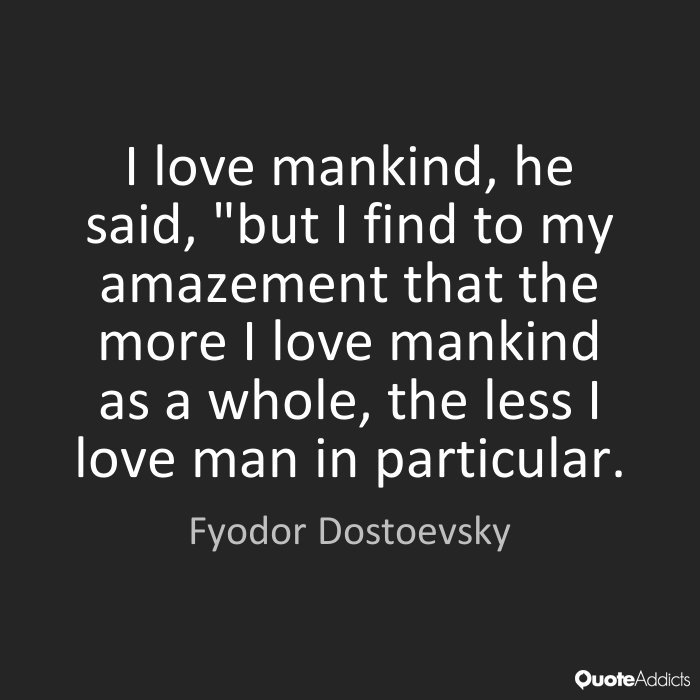
How about this for a start, I have always said, even in my Christian days, that all moral or ethical discussions should begin with confession. So, I’ll start by saying, that I am not a very good humanist. I aspire to have the needs of others in mind. I aspire to empathy for those outside of my tribe. But I often fall short of these ideals. I can tend toward the misanthropic and the local. I relate, probably more than is healthy, with the character of the doctor in The Brothers Karamozov:
I would state it like this:
The problem with humanism? People.
People are difficult. People are fallible. People may break your heart. As a Christian professor of mine rightly used to say:
Love necessarily involves pain
How is that for cloying platitudes?
Basis for morality and ethics
Who on Earth would base their morals, ethics and source of meaning on human beings? We already do.
Humanism is not new. Humanism is actually the basis of all religious moral frameworks. The evolution of religious and moral philosophy can be traced back to evolution itself. There was some benefit to homo sapiens (and our ancestors) cooperating. Beginning with the small family unit. Just like modern families there were rules of behavior. As families grouped together into tribes, more behavioral rules needed to be established for the benefit of the whole group. This process continues growing and expanding as groups got bigger and bigger. The concept of an observer helped enforce the rules when group members were out of sight. God becomes an extremely effective concept to keep group members in line. Eventually we get formal religions. Over time religions add on dogma and doctrine to ensure no rules are broken. Leading ultimately to the complicated religious structures of today.
From this short description you can see a god and religion do not come into play until late in the game. We have developed our moral and ethical codes based on how we treat each other as humans. How we treat each other IS morality.
What religions do really well is facilitate community and a sense of belonging and the creation of a moral tribe. Is it the supernatural or the connection with other people that causes that sense of belonging and purpose? My argument is that it is the connection with people. This is what I call Secular Grace. The concept of Secular Grace acknowledges that there is nothing more valuable, moral or ethical than people loving and accepting one another.
The world is shrinking by the day. With modern communications borders are becoming weaker and weaker. We must learn to work with each other across national, cultural and religious boundaries. We must work with each other as people united in humanity.
If one of the most significance aspects of religion is morality, it is worth noting the utter failure of religious morality in the modern world. Attempting to apply the first century (and older) morality of the Judeo Christian scriptures is a futile effort. This form of morality has been on the wrong side of history time and time again.
There is a simple reason this is true. Any moral system that looks backward in history without evolving with the present environment will fail. We are not first century Aramaic speaking Jewish fishermen from a small town. We are a vast complex web of humanity that is coping with 21st century moral and ethical challenges.
Humanism recognizes this and focuses on human dignity. Regardless of one’s gender, sexual orientation, cultural background or nationality, one deserves respect, dignity and care just for being human. Inalienable rights are grounded on common humanity and not from a mythical god.
Humanism encompasses all the best of the social gospel without the supernatural and archaic moral baggage. Much of what attracted me to the Jesus of the New Testament was how he treated people. I am still attracted to that. If Jesus existed today, he would be a humanist.
We are meaning makers
Why are we here? The big question. We want desperately for there to be an external answer to that. There may not be one, in fact, if I am being honest, I do not think there is. But since we are here, maybe not the answer, but an answer is to be with each other.
There may be no meaning or purpose to the universe.
But my purpose is to make meaning and purpose.
That is the most human thing to do.
To be homo sapien is to make meaning. It may be the quintessential human activity. Rather than looking for meaning from an external source like a god, we must recognize the creation of meaning is the essence of humanity.
The Copernican principle has taught us that we are not the center of the universe. We live on an average planet, next to an average star, in an average arm of the spiral galaxy, in an average part of the universe.
Though this is true, it is also true that consciousness is exceedingly rare in the universe. As far as we know, we are the only conscious beings in the universe. To paraphrase Carl Sagan, “humanity is the cosmos aware of itself.”
Consciousness is so painfully rare that even if you were stuck on a deserted island thinking your thoughts in isolation your consciousness would be the most precious thing in the universe.
But most of us are not stranded on a deserted island. We have the great privilege to experience relationship with other conscious human beings. And that is meaningful.
Humanism’s focus on people allows us to derive meaning from each other. I do not know why we are here, but since we are here we should enjoy each other. We have everything we need for meaning, purpose and awe in nature and each other.
No supernatural confusion
Humanism rejects supernatural explanations for phenomenon. It embraces science and a naturalistic view of reality. Free from the need to justify belief without evidence humanism can focus on rationality, evidence and the scientific method. I have written about how freeing an epistemology based on evidence rather than faith can be.
I have also written in this series about why I am not a liberal Christian. To summarize that article, more of Christianity has to be thrown away than kept. Using terms like god that can be defined a thousand ways is more confusing than it is helpful.
The ABCs of secular “spirituality”
Awe, belonging, connection
It is much simpler to say I am a humanist. It conveys both that I care about people and that I reject the supernatural. I particularly love Jennifer Michael Hecht’s term, humanism is a “graceful life philosophy.”
What next?
For me, humanism was the answer to the question, “what next?” after I deconverted from Christianity and became an atheist. It gave me a way to ground my morality, ethics and purpose.
I have started the hashtag #HumanismIsPeople to highlight people who exemplify humanism. It is also a reminder that people do miracles not myths.
A few years after deconversion I am still asking what next? As in what can I do that is good for the world? I am currently obsessed with trying to figure out what unites us as a secular community. Many have died on this particular hill before me. Atheists, skeptics, free thinkers and humanists are not joiners by nature. It is like herding cats trying to get everyone in the same room, let alone on the same page.
However, just because you have walked away from religion, does not mean you no longer need human connection and belonging. These are fundamental hard wired human needs. These needs often were met in the past by religion and now need a replacement.
What would bring us together and unite us with a sense of belonging?
I am particularly concerned for those leading up to, going through and recently passed through the deconversion process. It can be incredibly isolating and lonely when you first realize you no longer believe. It may cost you your entire social support structure. What can we do as a community to ease that process and provide opportunities for all of us to have a sense of belonging?
I am interested in building community. I am considering ways to bring people together online. There is no substituent for in person connectivity, but for many that is not always possible. The secular community can be sparse in some areas of the country.
Face to face hangouts would be a possible substitute that would allow people to tell their stories and grow a support group of humanists. Let me know if you are interested by commenting or emailing me at gracefulatheist at gmail dot com.
The original title for this post was “Why I Am Not a New Atheist,” but I found there is so much confusion about that term and what it means that this was more misleading than helpful. I settled on “Why I Am Not An Anti-Theist,” as this gets to the point more directly without the confusion.
No more sacred cows
In fact, I am starting this post defending new atheism. By new atheism, I mean the kind of outspoken atheism represented by the “Four Horsemen”: Richard Dawkins, Sam Harris, Daniel Dennett and Christopher Hitchens. These four have written books which were notable for their unabashed critiques of religion. There are many others who are what I would call professional atheists making a living writing, speaking and podcasting. For their unvarnished candor they have been vilified by the religious and ironically deified by atheists.
The problem is for some time it has been considered impolite to critique religious beliefs. In many Western societies, religious views are considered private and unassailable. The old adage “never bring up politics or religion in polite company,” exists for a reason. People hear critiques about their religious beliefs as attacks against them as a person. Suddenly in the mid 2000s here were atheists who did not keep their irreligious thoughts to themselves. They had the audacity to publicly call out the flaws in religious beliefs and point out their detrimental effect on society. How dare they!
Atheists present a challenge to the faithful. The reason there are so many false stereotypes taught about atheists is that our existence is a threat. The existence of people who have in fact heard the gospel, understood it and still reject it cuts at a core understanding of the world for the believer. This is one of the reasons believers often quote their sacred text to atheists, because they cannot fathom someone could understand it and yet not believe it. It must be a lack of knowledge. “If only they understood the real gospel.“
So, the reaction to new atheism was predictable. The apologists came out in droves to disprove their arguments. And by ad hominem attacks assure the faithful these angry apostates could be safely ignored. The term new atheist was originally derogatory (even from other atheists). Even though there is nothing particularly new about doubt, atheism or the critique of religion. What was new was the lack of deference to religion and a certain level of audacity.
Atheists have long been telling us that we can be good without God. The new atheism says that we can be better without God. — Victor Stenger
For being outspoken and giving cover for doubters everywhere to come out of the closet these new atheists are to be commended. The sacred cow of religious ideas being beyond reproach is dead.
Anti-theism
But (you knew there would be a but), if we are being honest sometimes they can be assholes. Sometimes they can attack the believer and not the belief and engage in their own ad hominem attacks. Sometimes they can come across as … well … religious in their fervor. In fact, these are the most often cited critiques against new atheism. Much ink has been spilt defending new atheists against these critiques and yet the critiques persist because of a kernel of truth in them.
Worse still, is the wave of followers who came after. To be clear, I consider myself one of these. Social media amplifies the most vocal obnoxious and angry voices amongst us. It is very easy to be hostile on social media and some have made a career of this. Negativity gets rewarded with shares, likes and retweets. I have certainly been guilty of this myself.
Twitter: Xians are idiots!: 👏👏👏 We ought to be good to each other as humanists: 🦗🦗🦗
This is what I would term anti-theism, which implies an active attempt to convince believers to abandon their faith. There is a tendency on social media for anti-theism to come to prominence which can start to look like trollling the trolls. It can start to look like an anti-evangelism.
Who is trolling whom?
Let me be very clear, as the position I am trying to convey is nuanced. I whole heartedly believe in secularism. Secularism protects the freedom of religion and freedom from religion. I also believe that religion has had many detrimental effects on society particularly when it gains political power. Religion should rightly be criticized.
However, believers themselves do not deserve our scorn. Most believers were born into it. It takes a tremendous amount of self reflection and honesty to overturn ones deeply held beliefs. If you feel like taking on the professional apologists, go for it. But leave the believers who have not asked for a fight alone.
If the goal is a more secular society
Are there times when believers troll atheists? Of course. I am not suggesting we not defend ourselves. I am arguing that ridiculing believers and calling them stupid is not the most effective way of convincing them.
Even when we use very cool rational logic and reason the backfire effect can stop the believer from hearing the evidence. Let me give you an example. I read Sam Harris’ The End of Faith in 2007 years before my deconversion. My motivated reasoning at the time went something like this:
He sounds angry. Atheists must all be angry. But I have peace.
It wasn’t until years later, I read Greta Christina’s blog about why atheists have a right to be angry, and realized I agreed with most of what she was saying. I just happened to be open to rational argument at the time.
If you add to the backfire effect, defensiveness from being insulted, the task for the believer to overcome their indoctrination is insurmountable. If we atheists, either out of exasperation or contempt, come across as mocking we are defeating our own purposes.
I am acutely aware that anti-theist arguments would not have worked on me when I was a believer. I am even more acutely aware that my many family members who are still believers would not respond to this style of argumentation. It takes investment in time, patience and, in all likelihood, the relationship, to provide a safe and comfortable space for the believers in our lives to express their doubts.
Why I Am Not an Asshole
Do I really need to expound on this? People deserve respect regardless of their beliefs. People are more important than belief or non-belief.
If you really want to change the world and change peoples’ minds, love people. I think I heard that from somewhere.
This post is a part of the series Communities of Unbelief. I’ll be writing more about communities of unbelief, some I choose not to be a member of, some I identify with and others I have yet to explore.
Since my deconversion I have spent a lot of time thinking and writing about why I no longer believe. Most of this expression has occurred online as this is the place where freedom of expression has few limits. A part of this process has been the search for a community to belong to. I have written before about the need to have secular replacements for community.
This search has turned out to be more difficult than I expected. The community of non-believers is a many splintered thing. In fact, the term community does not really apply and the word factions leaps to mind. There are many factions often competing and often hostile to one another:
Those who never believed
I know quite a few atheists and non-believers in real life but their experience is more like water to a fish. Belief and unbelief is not something they are interested in.
Those who are aggressively anti-theist and anti-religion
Think “new” atheists (fairly or unfairly). More so than the famous authors are the everyday twitter warriors that take it as their personal responsibility to disabuse believers of their faith.
Those who are focused on legal maters pertaining to secularism
These are the groups like CFI, FFRF, Secular Coalition that are doing work I agree with but have little to do with community building.
Those who reject the fundamentalism but not the faith
This is the new hotness, deconstruction, not throwing the baby out with the bath water. I have met many many new friends in this category.
I find I don’t quite fit into any of those categories. My experience and particular brand of unbelief will forever be informed by my former faith. I have no desire to convince believers to abandon their faith. I have mentioned I am still a bit angry at apologists but I am not interested in taking down the average theist. I believe in a secular society and I support those causes but they do not inspire me. I find no joy in them. And finally, though I have met new friends who are in the deconstructing crowd, if I am being honest, I don’t get it. When I let go of faith I felt no desire to hold onto the trappings of faith. In fact, it was freeing to abandon them.
I am starting a new series about communities of unbelief. I’ll be tackling the following ideas:
I believe as humans we need community. It is a basic need. Those of us who have walked away from our faith have often also lost community we relied on. Hopefully, the series can help answer: What now?
Let me know what communities or factions I have missed, where I am being unfair and most importantly which communities you are a member of.
Check back often to read my explanations for these important questions.
This past year, the movie Arrival hit theaters. I am an admitted geek with a particular weakness for time travel, linguistics and alien science fiction. So this movie was like crack cocaine for me. After watching the movie, I wanted more. I discovered the source material is a short story called “The Story of Your Life” by Ted Chiang. It can be found in his book titled “Stories of Your Life and Others” which is a collection of short stories.
The short story did not disappoint. Like all great science fiction, the subject is not actually aliens or technology but humanity and what it means to be human. In fact, this is a poignant story about a mother and her daughter. Because of the mother’s exposure to the alien language, she is able to “remember” the future. She knows the toddler bumps on the head and the teenage temper tantrums that will occur *before* her daughter is born. Ultimately the mother decides to have her daughter even after gaining foreknowledge of her daughter’s death at age 25. In the same way that many of us, given the chance to do life all over again, would say “I would do it the same way because it led to my significant other and my children” the mother chooses to do it the “same” way for the first time.
There is a humanist message here. Human relationships are what give us meaning in life even though human lifetimes are finite. The joy and love are worth any pain and heartache we may experience.
Hell on Earth
As good as “Story of Your Life” is, another of Chiang’s short stories stood out as more significant for an atheisthumanist such as myself. In his short story, “Hell Is The Absence of God,” the excellent premise is that a (generic) theistic god exists. One which, crucially, actually intervenes in the lives of modern humans in the form of angelic visitations that have both miraculous and disastrous effects. In short, no one in this world doubts the existence of god because there is physical evidence of his interventions.
There are still decisions to be made about this god. During the visitations, for example, one person may receive miraculous healing while another may be severely injured by the debris from a building destroyed by the divine presence. The devout in this world see the miraculous after effects of the visitations as proof of this god’s goodness and downplay the destructive elements, while others see the negative consequences as either negating the benefit of the miraculous or down right outweighing it. Sound familiar?
When this short story first came out, this was the main theme that caused controversy. Christians felt it was a direct attack on Christianity and a rehashing of the problem of suffering. Though the story never identifies a specific religion as its target, there are vague Jewish and Catholic overtones. Chiang did an excellent job of making it as generic as possible and not, in fact, specific to any extant religion.
For a critique from a theist along these lines see John C Wright. For a critique of that critique see this. Also check out a recent episode of Very Bad Wizards where David and Tamler take on the purposefulness/purposelessness of suffering in the short story which according to Ted Chiang’s notes on the story is much closer to Ted Chiang’s intention than what you find here.
Although there is much to unpack regarding the problem of suffering, that is not the most damning point of the story. I want to focus on the more obvious point: that this God actively intervenes in the world of the story. The subtle, or not so subtle, subversiveness of this story is an attack on divine hiddeness in the real world. In particular, this god continued to intervene in the world even in the modern scientific age. In the story, the visitations were studied scientifically, statistics were gathered and evaluations were made about those who benefited and those who suffered. In our world, where are the emperor’s new clothes?
Any straight forward reading of the bible (insert the usual apologies for focusing on Christianity) suggests a god who interacts with his creation, and yet that is not the world we find ourselves in. This highlights, as I have pointed out before, not that theists take religion too seriously but that they don’t take it seriously enough. If they really believed what the bible describes, they would be in sack cloth and ashes every day crying out for god to *DO* something … anything.
In the notes on the story Chiang quotes Anne Dillard as saying:
If people had more belief they would wear crash helmets when attending church and lash themselves to the pews.
If you believe in Divine Hiddenness, fine. If you believe in Divine Hiddenness and the God of the Bible, I have bad news for you.
If God is real what would we expect to observe in the universe?
We would expect to see evidence that god created the universe. Instead we see a universe that behaves according to the laws of physics. And we can model the evolution of the universe from near the Big Bang until now. There is also a common theory among liberal theists that god guided evolution of life on Earth. Yet we see no evidence of tampering in the DNA record. Asserting that a god created the universe is not the same as evidence.
We would expect to see that believers experience statistically significant better quality of life from non-believers. But we see that believers and non-believers experience about the same positive and negative life experiences. The divorce rate is not significantly different. Cancer rates are the same.
We would expect to see miracles. Really, this is the big one that this story highlights. The god of most theistic religions is an interventionist yet miracles mysteriously disappeared in the modern scientific age. I have always, even as a Christian, felt the explanations from believers for why miracles ceased were very weak tea. Their explanations would seem to be describing a change in character in their unchanging god. Double blind tests researching the effects of intercessory prayer on healing diagnosed sick people showed no effect beyond the placebo effect.
We would expect to see prophets accurately speaking for god. Today if a person says they are speaking for God we quietly call the authorities to have the person institutionalized. Where are the prophets who predict a god’s intervention before a natural disaster occurs rather than pontificating after the fact?
We would expect to see justice. Returning to the topic of the problem of suffering, we would expect to see the righteous victorious and the unrighteous punished.
This list of reasonable expectations is not even approaching exhaustive. One could go on and on about the expected results of an interventionist god participating in the world vs the deafening silence that we actually experience.
Angelic advise for the real world
In the story we learn that the fallen angels are rather rational creatures who tell the humans to “Make up their own minds.” Hell turns out to be … well … not much different than the world we find ourselves in minus the visitations of angels. This highlights that Reality is the absence of god. In short, this fictional story allows one to viscerally feel the disparity between what a reasonable person would expect and what actually happens in our world.
Does the character, Neil, experience god’s grace?
Another theme of the story to explore is the very human reaction when others experience miracles but you do not.
Both in the story’s world and in ours there is a tendency to equate success in life with god’s favor. How easy is it for those who are born comfortably ensconced in the middle class to avoid questioning whence their success came from? With a simple answer close at hand, “god loves me,” it takes a very self reflective person to recognize the privileges that are the more likely reasons.
Neil is born with a birth defect that affects his leg. He is ambivalent about his condition but resents that others take it as sign of god’s disfavor. The story highlights our tendency to see those less fortunate than ourselves as “deserving” it somehow.
Even worse, when his wife dies as a result of a visitation, those who experienced miracles push him to become devout. This is a painful reminder of the well intentioned but ultimately destructive pat answers believers give to those suffering (whether those suffering are believers themselves or not).
Neil’s reaction to such attempts at persuasion depended on who was making it. When it was an ordinary witness, he found it merely irritating. When someone who’d received a miracle cure told him to love God, he had to restrain an impulse to strangle the person. But what he found most disquieting of all was hearing the same suggestion from a man named Tony Crane; Tony’s wife had died in the visitation too, and he now projected an air of groveling with his every movement. In hushed, tearful tones he explained how he had accepted his role as one of God’s subjects, and he advised Neil to do likewise.
While Chiang’s one weakness is a tendency toward dues ex machina, in this story it is fitting: a literal shinning of the divine light on his main character, which sets up the last stinging critique. Neil, the main character, has been “blinded by the light” (his goal all along so he could join his devout wife in Heaven) which allows him to “love” God despite his bitterness. And yet when he dies shortly after, God chooses to send him to hell instead. Such that Neil is the one person in hell who actually experiences it as a hell. He loves God (he can’t help it) but will never experience his nearness. This is a stinging critique of the devout in our world who most yearn to experience the closeness of an absent god.
Unconditional love asks nothing, not even that it be returned.
— Neil
Neil still loves Sarah, and misses her as much as he ever did, and the knowledge that he came so close to rejoining her only makes it worse. He knows his being sent to Hell was not a result of anything he did; he knows there was no reason for it, no higher purpose being served. None of this diminishes his love for God. If there were a possibility that he could be admitted to Heaven and his suffering would end, he would not hope for it; such desires no longer occur to him.
Neil even knows that by being beyond God’s awareness, he is not loved by God in return. This doesn’t affect his feelings either, because unconditional love asks nothing, not even that it be returned.
And though it’s been many years that he has been in Hell, beyond the awareness of God, he loves Him still. That is the nature of true devotion.
The point is that Neil having experienced the blinding of the light and finding himself sitting in hell loving a god who neither sees him nor loves him back represents believers in our world on Earth. They are dedicated to a god who, at best, is indifferent and more likely is non-existent.
Is this grace?
My opinion: no. This is the opposite of grace. This is the cruelty of religious claims. The strong implication that if one does not experience god’s graces in one’s life it is somehow the fault of the believer.
Linda LaScola over at the Rational Doubt blog asked me a series of insightful questions trying to get at what precipitated not just my deconversion but my willingness to listen to my doubts in the first place. I failed miserably at trying to answer her questions. I have had some time to reflect on it and this my attempt to further answer her questions.
I have tried to explain the why of my deconversion in a few other posts. I have written about my deconversion story before and also a series about presuppositions (not to be confused with presuppostional apologetics) that lead one to believe or disbelieve. The more I think about it the more I am convinced these cultural norms are what contribute to wide spread belief and it takes analysis to overcome this cultural bias.
But to Linda’s questions of “what started you on investigating the doubts you say you always had?” and “what motivated you to give yourself the permission to take the first step?” In a word: discontent. Call it the (twenty) seven year itch. I was not satisfied and I had not been for some time.
A brief history
To better explain I have to give you a bit of history. I became a Christian in my late teens. I spent a year or so reading the bible before I went to church with any seriousness. When I got to church I experienced an initial shock. I would often find myself saying:
I wonder why they believe that?
I worked to fit in anyway and eventually I was encouraged to go to bible college. I attended a small fundamentalist bible college where, ironically, I received a fairly decent education in critical thinking. It was a (relatively) safe place to ask and wrestle with (most of) the big questions. With hindsight my professors, whom I am still fond of, were too good at their jobs. There were certainly down sides to being at a bible college, but the professors were intelligent, caring and loved teaching. Several of those professors had a particular focus on grace that made a lasting (to this day) impact on me.
The really big shock came when I graduated and it was time to get licensed by my particular denomination. In the opposite of the critical thinking of bible college, the leaders of my denomination demanded a level of doctrinal fealty not seen since the inquisition. (OK, not quite).
You will believe and preach X, Y and Z
I reluctantly signed on the dotted line after having spent four years attempting to attain this very thing. I then spent a relatively unfulfilling (loved the people, hated the job) two years as a youth pastor before succumbing to burn out (more on this in a future post). I finally realized leadership in the church specifically and the people helping profession in general were not good work for my particular personality, an occasionally misanthropic introvert. I moved on and have had a successful career in technology where misanthropic introverts abound.
I promise I am wrapping up my digression and getting to the point. In the ensuing years, on my own and eventually with my family, I kept trying to find that same bible college experience: big questions, critical thinking and a focus on grace. No pastor and no church lived up to this ideal in my head. Mind you, I remained a dedicated Christian during this time. But to say that I was unsatisfied by the church would be a wild understatement. I was discontent but I figured it was just misanthropic me.
Faith discredits itself by proving to be insufficient to satisfy the faithful.
— Christopher Hitchens
I started to really feel U2’s I Still Haven’t Found What I’m Looking For. Which until then always confused me: Aren’t these guys Christians already?
I believed that if my faith was worth anything it could withstand scrutiny. So I stopped ignoring the occasional article that was critical of Christianity. I allowed myself to ask hard questions.
My last read through of the bible was uncomfortable as the grace colored glasses came off and I was facing head on the reality of the implications of the stories.
Already a science geek, I found the critical thinking and the big questions being asked. And unlike religious doctrine the more I explored the more solid the scientific truths became.
In essence the snowball was very slowly beginning to roll down hill. Finally, after having spent some time looking at the beliefs of religions that had more modern beginnings and which appeared to me as obviously untrue, it began to dawn on me that is how believers of other faiths viewed my Christianity:obviously untrue. In the end, my faith did not withstand scrutiny. I allowed myself to listen to those doubts and realized they were more true than my beliefs.
What about now?
I think it is a part of the human condition to feel unsatisfied. Sam Harris talks about the “fleetingness of happiness.” But this is what I find fulfilling: continually seeking knowledge, learning, asking the big questions and wrestling with the answers or lack there of.
It is the freedom of free thinking that is invigorating. There are no bounds besides my human finiteness on what I can explore and what knowledge I can seek. There are no questions that cannot be asked. And there is no fear in accepting the answers that are found.