This past year, the movie Arrival hit theaters. I am an admitted geek with a particular weakness for time travel, linguistics and alien science fiction. So this movie was like crack cocaine for me. After watching the movie, I wanted more. I discovered the source material is a short story called “The Story of Your Life” by Ted Chiang. It can be found in his book titled “Stories of Your Life and Others” which is a collection of short stories.
The short story did not disappoint. Like all great science fiction, the subject is not actually aliens or technology but humanity and what it means to be human. In fact, this is a poignant story about a mother and her daughter. Because of the mother’s exposure to the alien language, she is able to “remember” the future. She knows the toddler bumps on the head and the teenage temper tantrums that will occur *before* her daughter is born. Ultimately the mother decides to have her daughter even after gaining foreknowledge of her daughter’s death at age 25. In the same way that many of us, given the chance to do life all over again, would say “I would do it the same way because it led to my significant other and my children” the mother chooses to do it the “same” way for the first time.
There is a humanist message here. Human relationships are what give us meaning in life even though human lifetimes are finite. The joy and love are worth any pain and heartache we may experience.
Hell on Earth
As good as “Story of Your Life” is, another of Chiang’s short stories stood out as more significant for an atheisthumanist such as myself. In his short story, “Hell Is The Absence of God,” the excellent premise is that a (generic) theistic god exists. One which, crucially, actually intervenes in the lives of modern humans in the form of angelic visitations that have both miraculous and disastrous effects. In short, no one in this world doubts the existence of god because there is physical evidence of his interventions.
There are still decisions to be made about this god. During the visitations, for example, one person may receive miraculous healing while another may be severely injured by the debris from a building destroyed by the divine presence. The devout in this world see the miraculous after effects of the visitations as proof of this god’s goodness and downplay the destructive elements, while others see the negative consequences as either negating the benefit of the miraculous or down right outweighing it. Sound familiar?
When this short story first came out, this was the main theme that caused controversy. Christians felt it was a direct attack on Christianity and a rehashing of the problem of suffering. Though the story never identifies a specific religion as its target, there are vague Jewish and Catholic overtones. Chiang did an excellent job of making it as generic as possible and not, in fact, specific to any extant religion.
For a critique from a theist along these lines see John C Wright. For a critique of that critique see this. Also check out a recent episode of Very Bad Wizards where David and Tamler take on the purposefulness/purposelessness of suffering in the short story which according to Ted Chiang’s notes on the story is much closer to Ted Chiang’s intention than what you find here.
Although there is much to unpack regarding the problem of suffering, that is not the most damning point of the story. I want to focus on the more obvious point: that this God actively intervenes in the world of the story. The subtle, or not so subtle, subversiveness of this story is an attack on divine hiddeness in the real world. In particular, this god continued to intervene in the world even in the modern scientific age. In the story, the visitations were studied scientifically, statistics were gathered and evaluations were made about those who benefited and those who suffered. In our world, where are the emperor’s new clothes?
Any straight forward reading of the bible (insert the usual apologies for focusing on Christianity) suggests a god who interacts with his creation, and yet that is not the world we find ourselves in. This highlights, as I have pointed out before, not that theists take religion too seriously but that they don’t take it seriously enough. If they really believed what the bible describes, they would be in sack cloth and ashes every day crying out for god to *DO* something … anything.
In the notes on the story Chiang quotes Anne Dillard as saying:
If people had more belief they would wear crash helmets when attending church and lash themselves to the pews.
If you believe in Divine Hiddenness, fine. If you believe in Divine Hiddenness and the God of the Bible, I have bad news for you.
If God is real what would we expect to observe in the universe?
We would expect to see evidence that god created the universe. Instead we see a universe that behaves according to the laws of physics. And we can model the evolution of the universe from near the Big Bang until now. There is also a common theory among liberal theists that god guided evolution of life on Earth. Yet we see no evidence of tampering in the DNA record. Asserting that a god created the universe is not the same as evidence.
We would expect to see that believers experience statistically significant better quality of life from non-believers. But we see that believers and non-believers experience about the same positive and negative life experiences. The divorce rate is not significantly different. Cancer rates are the same.
We would expect to see miracles. Really, this is the big one that this story highlights. The god of most theistic religions is an interventionist yet miracles mysteriously disappeared in the modern scientific age. I have always, even as a Christian, felt the explanations from believers for why miracles ceased were very weak tea. Their explanations would seem to be describing a change in character in their unchanging god. Double blind tests researching the effects of intercessory prayer on healing diagnosed sick people showed no effect beyond the placebo effect.
We would expect to see prophets accurately speaking for god. Today if a person says they are speaking for God we quietly call the authorities to have the person institutionalized. Where are the prophets who predict a god’s intervention before a natural disaster occurs rather than pontificating after the fact?
We would expect to see justice. Returning to the topic of the problem of suffering, we would expect to see the righteous victorious and the unrighteous punished.
This list of reasonable expectations is not even approaching exhaustive. One could go on and on about the expected results of an interventionist god participating in the world vs the deafening silence that we actually experience.
Angelic advise for the real world
In the story we learn that the fallen angels are rather rational creatures who tell the humans to “Make up their own minds.” Hell turns out to be … well … not much different than the world we find ourselves in minus the visitations of angels. This highlights that Reality is the absence of god. In short, this fictional story allows one to viscerally feel the disparity between what a reasonable person would expect and what actually happens in our world.
Does the character, Neil, experience god’s grace?
Another theme of the story to explore is the very human reaction when others experience miracles but you do not.
Both in the story’s world and in ours there is a tendency to equate success in life with god’s favor. How easy is it for those who are born comfortably ensconced in the middle class to avoid questioning whence their success came from? With a simple answer close at hand, “god loves me,” it takes a very self reflective person to recognize the privileges that are the more likely reasons.
Neil is born with a birth defect that affects his leg. He is ambivalent about his condition but resents that others take it as sign of god’s disfavor. The story highlights our tendency to see those less fortunate than ourselves as “deserving” it somehow.
Even worse, when his wife dies as a result of a visitation, those who experienced miracles push him to become devout. This is a painful reminder of the well intentioned but ultimately destructive pat answers believers give to those suffering (whether those suffering are believers themselves or not).
Neil’s reaction to such attempts at persuasion depended on who was making it. When it was an ordinary witness, he found it merely irritating. When someone who’d received a miracle cure told him to love God, he had to restrain an impulse to strangle the person. But what he found most disquieting of all was hearing the same suggestion from a man named Tony Crane; Tony’s wife had died in the visitation too, and he now projected an air of groveling with his every movement. In hushed, tearful tones he explained how he had accepted his role as one of God’s subjects, and he advised Neil to do likewise.
While Chiang’s one weakness is a tendency toward dues ex machina, in this story it is fitting: a literal shinning of the divine light on his main character, which sets up the last stinging critique. Neil, the main character, has been “blinded by the light” (his goal all along so he could join his devout wife in Heaven) which allows him to “love” God despite his bitterness. And yet when he dies shortly after, God chooses to send him to hell instead. Such that Neil is the one person in hell who actually experiences it as a hell. He loves God (he can’t help it) but will never experience his nearness. This is a stinging critique of the devout in our world who most yearn to experience the closeness of an absent god.
Unconditional love asks nothing, not even that it be returned.
— Neil
Neil still loves Sarah, and misses her as much as he ever did, and the knowledge that he came so close to rejoining her only makes it worse. He knows his being sent to Hell was not a result of anything he did; he knows there was no reason for it, no higher purpose being served. None of this diminishes his love for God. If there were a possibility that he could be admitted to Heaven and his suffering would end, he would not hope for it; such desires no longer occur to him.
Neil even knows that by being beyond God’s awareness, he is not loved by God in return. This doesn’t affect his feelings either, because unconditional love asks nothing, not even that it be returned.
And though it’s been many years that he has been in Hell, beyond the awareness of God, he loves Him still. That is the nature of true devotion.
The point is that Neil having experienced the blinding of the light and finding himself sitting in hell loving a god who neither sees him nor loves him back represents believers in our world on Earth. They are dedicated to a god who, at best, is indifferent and more likely is non-existent.
Is this grace?
My opinion: no. This is the opposite of grace. This is the cruelty of religious claims. The strong implication that if one does not experience god’s graces in one’s life it is somehow the fault of the believer.
Linda LaScola over at the Rational Doubt blog asked me a series of insightful questions trying to get at what precipitated not just my deconversion but my willingness to listen to my doubts in the first place. I failed miserably at trying to answer her questions. I have had some time to reflect on it and this my attempt to further answer her questions.
I have tried to explain the why of my deconversion in a few other posts. I have written about my deconversion story before and also a series about presuppositions (not to be confused with presuppostional apologetics) that lead one to believe or disbelieve. The more I think about it the more I am convinced these cultural norms are what contribute to wide spread belief and it takes analysis to overcome this cultural bias.
But to Linda’s questions of “what started you on investigating the doubts you say you always had?” and “what motivated you to give yourself the permission to take the first step?” In a word: discontent. Call it the (twenty) seven year itch. I was not satisfied and I had not been for some time.
A brief history
To better explain I have to give you a bit of history. I became a Christian in my late teens. I spent a year or so reading the bible before I went to church with any seriousness. When I got to church I experienced an initial shock. I would often find myself saying:
I wonder why they believe that?
I worked to fit in anyway and eventually I was encouraged to go to bible college. I attended a small fundamentalist bible college where, ironically, I received a fairly decent education in critical thinking. It was a (relatively) safe place to ask and wrestle with (most of) the big questions. With hindsight my professors, whom I am still fond of, were too good at their jobs. There were certainly down sides to being at a bible college, but the professors were intelligent, caring and loved teaching. Several of those professors had a particular focus on grace that made a lasting (to this day) impact on me.
The really big shock came when I graduated and it was time to get licensed by my particular denomination. In the opposite of the critical thinking of bible college, the leaders of my denomination demanded a level of doctrinal fealty not seen since the inquisition. (OK, not quite).
You will believe and preach X, Y and Z
I reluctantly signed on the dotted line after having spent four years attempting to attain this very thing. I then spent a relatively unfulfilling (loved the people, hated the job) two years as a youth pastor before succumbing to burn out (more on this in a future post). I finally realized leadership in the church specifically and the people helping profession in general were not good work for my particular personality, an occasionally misanthropic introvert. I moved on and have had a successful career in technology where misanthropic introverts abound.
I promise I am wrapping up my digression and getting to the point. In the ensuing years, on my own and eventually with my family, I kept trying to find that same bible college experience: big questions, critical thinking and a focus on grace. No pastor and no church lived up to this ideal in my head. Mind you, I remained a dedicated Christian during this time. But to say that I was unsatisfied by the church would be a wild understatement. I was discontent but I figured it was just misanthropic me.
Faith discredits itself by proving to be insufficient to satisfy the faithful.
— Christopher Hitchens
I started to really feel U2’s I Still Haven’t Found What I’m Looking For. Which until then always confused me: Aren’t these guys Christians already?
I believed that if my faith was worth anything it could withstand scrutiny. So I stopped ignoring the occasional article that was critical of Christianity. I allowed myself to ask hard questions.
My last read through of the bible was uncomfortable as the grace colored glasses came off and I was facing head on the reality of the implications of the stories.
Already a science geek, I found the critical thinking and the big questions being asked. And unlike religious doctrine the more I explored the more solid the scientific truths became.
In essence the snowball was very slowly beginning to roll down hill. Finally, after having spent some time looking at the beliefs of religions that had more modern beginnings and which appeared to me as obviously untrue, it began to dawn on me that is how believers of other faiths viewed my Christianity:obviously untrue. In the end, my faith did not withstand scrutiny. I allowed myself to listen to those doubts and realized they were more true than my beliefs.
What about now?
I think it is a part of the human condition to feel unsatisfied. Sam Harris talks about the “fleetingness of happiness.” But this is what I find fulfilling: continually seeking knowledge, learning, asking the big questions and wrestling with the answers or lack there of.
It is the freedom of free thinking that is invigorating. There are no bounds besides my human finiteness on what I can explore and what knowledge I can seek. There are no questions that cannot be asked. And there is no fear in accepting the answers that are found.
I have just finished Jennifer Michael Hecht‘s Doubt: A History. It has been around for some time but as I am new to atheism it is new to me. I would suggest this is an extremely important book for modern atheists to provide perspective on where we have come from and direction on where we are going. There is something wonderful about history. It places our ideas in context. It draws lines between what would appear to be disparate ideas. This book provides that context and draws those lines in a valuable way.
After my deconversion I had a number of ideas I was desperate to express. You will find them throughout this blog. Interestingly, however, I was mildly disappointed to find that none of my ideas were particularly original. Come to find out my experience of deconversoin was rather typical in fact. Average. I titled my first blog post “A very common message” after this realization.
After reading Hecht’s book I am even more disappointed to realize that my ideas are not only not original for today but not particularly original for 2600 years ago. It is quite a humbling experience. But it does provide a sense of unity with doubters throughout history. And for that I am grateful.
Hecht’s book is dense with quotes from doubters and moves at break-neck speed from 600 BCE to the turn of the millennium. Attempting to review the book in the traditional sense could never do it justice. If I were to start quoting this post would be as long as the book. (Take note meme creators, this book is a rich quarry of quotes). Instead, I will write about the reactions I had reading the book and how they apply to the modern doubter.
The book is not titled Atheism: a History and this is significant. For one thing, the original usage of the term meant something closer to heretic rather than the way we use the term today as a complete lack of belief in any god(s). In fact, a common theme in the book is the deep and profound doubt expressed throughout history that none the less defaulted to some distant conception of god, from Aristotle’s prime mover to Spinoza’s (and Einstein’s) pantheistic god and what feels like capitulation in Kierkegaard’s fideism. Those who took doubt to its logical conclusion of true atheism were few and far between until the time of the enlightenment. And even those who did were wary of releasing this truth upon the masses for fear of the collapse of social norms.
The book could easily be titled Skepticism: a History. In many ways it is philosophical skepticism that is the line one can draw through the history of doubt. The Epicureans and the skeptics really began to rigorously question theism. Questioning everything especially that which comes from authority is a common theme. Decendants of these philosophies often refer back to the ancient Greeks in solidarity during their own times. Including our own time, we owe a debt to the skeptics.
However the book is titled Doubt: a History. There is something deeply moving about the word doubt. It implies one cares enough to question. Doubters have skin in the game. Doubters question not purely for the sake of questioning but for the sake of knowledge and truth.
Taking one’s place in the line of history
I am a doubter and I am proud to be a part of its history. After getting over my disappointment in the lack of originality of my ideas, I found great comfort in having historical precedent.
Reading Hecht’s book one can see thecumulative effect of the writings of doubt through history. Each generation is emboldened by the writings of their predecessors. The fear of expressing one’s opinions which are contrary to popular belief is widdled away bit by bit. There is a wonderful scene described in the book when Hume sits down in a room with 15 other atheists for the first time. That is what you call a historic moment.
The freedom we in the West experience to express our doubt up to and including atheism is due not only to the enlightenment philosophers but all those who went before them as well. Today we are dazzled with Dawkins, Harris, Dennett and the inimitable Hitchens. But there would not be four horsemen today if not for Diogenes, Epicurus, Cicero and Lucretius.
The doubter’s perspective
Hecht spends a fair amount of time reading between the lines of history to find doubt’s story. By this I mean there were time periods and cultures which attempted to repress doubters. As is often noted history is written by the victors. But wonderfully we have doubter’s stories as imprints in the counter-arguments of the prevailing ideologies. Like a cast mold the negative space of doubt can be inferred (or directly quoted) by the diligent ways it is argued against by the true believers.
I personally enjoyed reading the stories I am familiar with from my own prior faith tradition delightfully told upside down from the doubter’s perspective.
The Jewish flirtation with Greek culture and the reaction as told in Maccabees and the story of Hanukkah. This is the pull of cultural assimilation and the conservative reaction against it.
I have always appreciated the book of Job for its brutal honesty. Job accuses God of being unjust. Hecht points out God makes a “heap” argument to Job for faith. Meaning, how can Job account for all of creation without appealing to God. Interesting take. Job’s wife steals the scene by encouraging Job to “Curse God and die” and may be the true hero of the story.
I have also always loved Ecclesiastes. But relieved of the burden to make pious sentiments from this wisdom one can hear the bitter exhaustion and resignation for what it is.
“Might as well have a good time because the universe is unjust and uncaring.”
Others have pointed out the doubt of Jesus in the garden of Gethsemane but Hecht portrays Jesus as a world class doubter. He seems to be reliant on his followers’ belief in him and is practically begging them to do believe in him. He has moments where he seems unsure of himself and the Father. This all culminates on the cross with
“Why have you forsaken me.”
The key insight of the book is that Christianity, particularly as described and defined by Paul, forever makes doubt a feature not a bug by requiring faith alone. Not just faith but faith without evidence.
“Blessed are those who believe but have not seen.”
Hope and discouragement
My favorite term in the book is graceful-life philosophies. As you may know I have a particular regard for the word grace in a secular setting. This wonderful term describes the philosophies of Socrates to Epicurus. And it means seeking the answer to the question:
How does one live well?
This question seems particularly poignant to our times. We must seek a secular pluralistic society as the world grows smaller and smaller. Rather than beating the dead horse of if one can be good without god, we should be asking how can we thrive and work with each other. We need graceful-life philosophies to unite us in this task.
In reading the history of doubt there is hope that even in oppressive environments rational voices remain. Regardless of the culture or particular religion there are those who express their doubt giving encouragement to future travelers.
The flip side of this coin is that humans have a tendency toward superstition and religion. People do not like feeling out of control so they fabricate stories which explain the phenomenon around them. Again we can see this by reading between the lines in the negative image of the prevailing ideologies. In the Old Testament all the idolatry that gets systematically stamped out is an indication of people not only seeking gods but very localized micro-cultural gods. In the early Catholic church the attempts to rid itself of heresy eventually get worn down and the use of votive candles and individual saints indicate the same phenomenon.
Ultimately, the hardest take away from the book is that forward progress toward reason is not a given. The hard-fought for knowledge of reason, logic, mathematics and the beginnings of science collected by the Greeks and represented in the library in Alexandria can and was burned down figuratively and literally. Though the flame of reason moved to the Muslim world rather than going out during the “dark” ages there is still a sense of opportunity cost. Where would the world be if the pursuit of science had been unbroken from the time of the Greeks until now?
This too is especially poignant for our times. As I write this in the US at the begining of 2017, there is a sense of loss of forward progress for the voice of reason. We have a responsibility to protect this forward progress and stand up for truth.
We have been having the same arguments for millennia
I started out this post by acknowledging my ideas about my new-found atheism are not new. That is the understatement of the century. While reading the history of doubt one comes to the inescapable conclusion that there is “nothing new under the sun.” The arguments for and against theism have been hashed and rehashed over and over again.
What was exciting to discover is that these debates have occurred in many cultures throughout history. They are not unique to the Abrahamic religions in any way.
What is a little depressing to discover is that we are still having the same arguments. As science has moved the gaps in knowledge literally to tiny fractions of a second after the big bang, apologetic arguments have moved further into the abstract.
As a relatively young atheist what I am struck by is the evasiveness of apologetic arguments against doubt. Apologists always have an answer. Those answers rarely deal with the questions straight on and at least in my experience are never satisfying.
All apologetic arguments tend to reduce to god-of-the-gaps (what we do not yet know) arguments or the epistemological black holes (how can we know anything without God?) of the Cynics. This feels like a thoroughly beaten dead horse. Doubt has won. The history has been written.
What is next?
The question I have been asking myself from minutes after acknowledging my own doubt and becoming an atheist and the question I find myself contemplating after reading this history of doubt is “what is next?” What do we do with the hard-fought for knowledge? Keep beating a dead horse?
I’ll be writing about that in the coming months. In the meantime, thank you to Jennifer Hecht for a comprehensive look back at where have come from and how we got here.
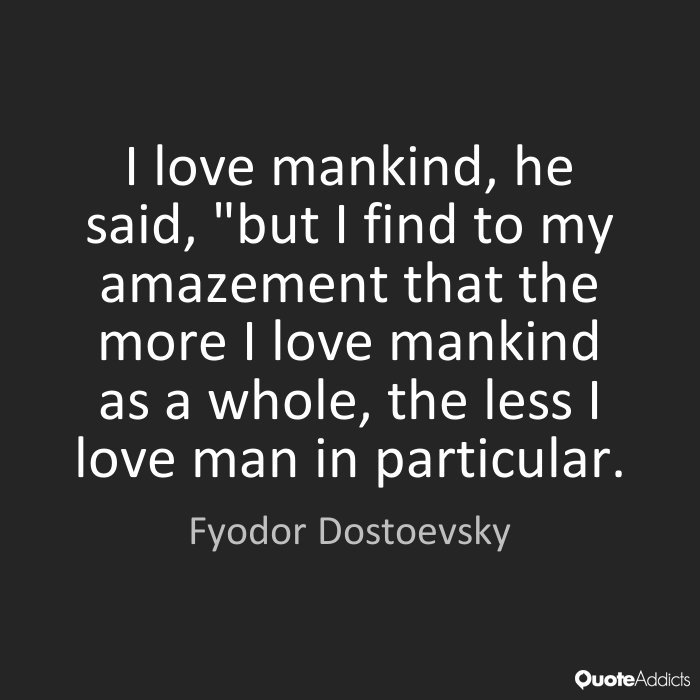
In Notes From The Underground Dostoyevsky’s underground man character is pitiful, spiteful and loathsome. Naturally, I relate to him very much. In the book the underground man is railing against 19th century rationalism, the growth of scientific explanations and the beginnings of psychology. Mostly he is railing against the idea that humans can be explained by scientific reduction. The underground man expresses a profound point about human nature. Human beings do not like being reduced to the sum of their parts and they will tell you about it in so many words.
Even if man were nothing but a piano key, even if this were proved to him by natural science and mathematics, even then he would not become reasonable, but would purposely do something perverse out of sheer ingratitude, simply to have his own way…then, after all, perhaps only by his curse will he attain his object, that is, really convince himself that he is a man and not a piano key! If you say that all this, too, can be calculated and tabulated…then man would purposely go mad in order to be rid of reason and have his own way.
Fyodor Dostoyevsky, Notes From Underground
Though this would naturally take us down the road to discuss free will and determinism, we will save those topics for another time. The topic for this post is consciousness, specifically, the way theists use consciousness as a god-of-the-gaps argument for the existence of God.
In the year before my deconversion I was going to write on this very topic with the title “In defense of the Soul.” Ironically, it was my thinking about the veracity of my soul that was the final straw to break my faith. Instead I wrote “The Death of a Soul” a year later.
The underground man expresses the theist’s abhorrence of materialism and what for them is reductionist account of humanity. “I am not a piano key,” one can hear them say, “I have a soul, I cannot be reduced to synapses and electrical firings.” How can an atheist materialist suggest that consciousness does not require a soul and ultimately the Animator of that soul? How can consciousness come from purely physical processes?
To be fair even some atheists admit that because theism entails consciousness and materialism does not, yet consciousness exists, this is evidence on the side of theism.
Sidebar: I deeply respect Jeffry Lowder from the above link, and clearly he is not suggesting that theism is correct. He is merely conceding consciousness is built into theism and is not in materialism. I have one rant about the form of the argument, my problem with attempting to quantify probabilities in philosophy is that one winds up only quantifying one’s biases. If I am an atheist I assume the probability that god exists approaches zero. If I am a theist I assume the probability that god exists approaches one. Therefore the conclusions derived no matter how technical the process used are still based on one’s presuppositions baked into the initial conditions.
Thoughts on consciousness
Let me begin to respond with a strange confession, by admitting my ignorance. Consciousness is such a wildly complex phenomenon and so poorly understood by the scientific community that I feel I am in good company by admitting my ignorance.
I have said before, one does not need to have a complete unassailable explanation to a problem to critique another proposed explanation. The three hardest problems or the largest gaps in scientific knowledge are how the universe began, what jump started organic molecules into living RNA and what causes consciousness. Interestingly, the theist’s answer to these is the same: god. From the atheist’s perspective these are all god-of-the-gaps arguments. Meaning, though we admit ignorance, the gap in knowledge, asserting a more complex solution, god, is not a satisfying solution to the problem. It begs more questions than it answers.
Emergence
So having admitted my ignorance, I’ll give some thoughts on the way I understand consciousness. I am most certainly a naturalist and a materialist. I have the audacity to say consciousness is not from a soul but rather biological processes.
The idea of consciousness as an emergent phenomenon in complex biological systems makes the most sense to me. When brains (in the case of our evolutionary past) reach a certain level of complexity consciousness emerges as phenomenon. Notice this is intentionally fuzzy. We think of ourselves as conscious of course. We include animals like elephants, dolphins and apes who demonstrate a self-awareness. What about fish? Or an amoeba? I don’t know. And because we don’t understand consciousness well it is difficult to draw a hard line.
Now, I am out on a limb. Others have argued that emergence is a non-answer, including neuroscientist Sam Harris:
Most scientists are confident that consciousness emerges from unconscious complexity. We have compelling reasons for believing this, because the only signs of consciousness we see in the universe are found in evolved organisms like ourselves. Nevertheless, this notion of emergence strikes me as nothing more than a restatement of a miracle. To say that consciousness emerged at some point in the evolution of life doesn’t give us an inkling of how it could emerge from unconscious processes, even in principle.
…
Consciousness—the sheer fact that this universe is illuminated by sentience—is precisely what unconsciousness is not. And I believe that no description of unconscious complexity will fully account for it. It seems to me that just as “something” and “nothing,” however juxtaposed, can do no explanatory work, an analysis of purely physical processes will never yield a picture of consciousness. However, this is not to say that some other thesis about consciousness must be true. Consciousness may very well be the lawful product of unconscious information processing. But I don’t know what that sentence means—and I don’t think anyone else does either.
…
At some point in the development of certain complex organisms, however, consciousness emerges. This miracle does not depend on a change of materials—for you and I are built of the same atoms as a fern or a ham sandwich. Rather, it must be a matter of organization. Arranging atoms in a certain way appears to bring consciousness into being. And this fact is among the deepest mysteries given to us to contemplate.
…
Every chain of explanation must end somewhere—generally with a brute fact that neglects to explain itself. Consciousness might represent a terminus of this sort. Defying analysis, the mystery of inner life may one day cease to trouble us.
So although Sam argues emergence is a non-answer, we do not currently have a better one. We currently cannot explain how consciousness emerges from synapses firing. But we can observe the fact that it does.
The Cloud Analogy
I like to think of emergence like “the cloud.” When you see advertisements about storing your data (music, movies, documents, etc) in the cloud, what do you think that means? It basically means you have no idea where or how that data is stored. It could be in the US, Europe or on the African continent. You don’t know and probably don’t care as long as you have access to it when you want it. In the networking world a cloud is a symbol for something we do not have information about. It is a place holder.
Similarly, explaining consciousness as emergent phenomenon is a bit of a place holder for something we do not yet fully understand. We suspect that someday we will have a theory that explains how consciousness can come from unconscious mater, but we don’t know what that will look like yet.
The reason I think this is a justifiable position to hold is that science knows very little not only about consciousness but also there is much science does not yet fully understand about complex biological systems such as ourselves.
Evolutionary biologist, Jerry Coyne, has written about how vastly complicated biological systems are. I don’t have the exact quote but he compares biology and physics and suggest that biology is “harder” due to the complex path evolution takes. In fact, in arguing against Intelligent Design rather than ducking the complexity of biology he leans into it, only evolution could explain how complex biological systems are.
Human beings are in effect the pinnacle of evolution, the most complex biological systems on the planet. No wonder we do not yet fully understand ourselves. In many ways we are at the beginning of studying the brain and consciousness.
Physical source of consciousness
Humans experience consciousness in Sam Harris’ words as “irreducibly subjective.” In some way we think of ourselves as something other than our bodies. The ‘I’ floating along with the physical body. Due to the influence of dualism on Western thought rather than analyse this we lean into it and suggest it is due to a soul.
But humans are physical. If a certain medication is administered to a human being, the light of consciousness goes out for a time. If the brain does not receive enough oxygen one becomes unconscious. Victims of brain injuries sometimes experience radical shifts in personality. Consciousness is affected by the physical world not a spiritual one.
Though our unconscious brain comes alive while we sleep there is a real way in which we experience the loss and regaining of consciousness on a daily basis. Our bodies are flooded with chemicals that immobilize us and stop us from being aware of our surroundings. We dream and sleep, awaking in the morning.
At death homeostasis in the body is stopped. The synapses stop firing. The physical body has stopped functioning. Consciousness ceases and unfortunately does not return.
It seems clear that consciousness is produced by the physical even if we cannot yet explain it.
Update: My new favorite blogger, Matthew Ferguson, writes on this very topic in his description of meta-physical naturalism. In it he quotes Keith Augustine who says that mental states are supervenient upon physical states. This means that the mind is dependent upon physical states but not identical to those physical states. In other words, emergent, more than the sum of the parts *but* dependent upon those parts.
The Underground Man’s Perspective
The underground man rightly asserts that we as humans are more than the sum of our parts. We rebel against attempts to reduce human beings to scientific objects. On this point I agree.
Is the answer to assert that we are souls traveling along in these physical bodies? No. Human beings are physical, this is an essential part of being human. That does not mean that we are only the sum of our physical parts.
Human sentience is painfully unique on Earth and as far as we know in the cosmos. We have value for far more than just the particular set of molecules that compose us. Our intellect and thoughts have great value particularly to one another. We live, we love, we give and this entails incomprehensible value. Secular Grace and humanism represents this well. The care, protection and advancement of human kind is of the utmost importance.
As time passes and my deconversion is further and further in the rear view mirror, I find it more and more difficult to remember how or why I once believed certain things without questioning. Christians might say this is because I have distanced myself from god and I am alone in my sin. Which leads me to the topic of this blog post.
What the hell is the deal with sin?
One of the dark sides to religion is the focus on sin. This may be one of the most baffling aspects for secularists who have never subscribed to one faith or another. It is also one of the most difficult mindsets to break free from for the deconverted. Religions indoctrinate the idea that you, as a human being, are broken.
I have talked about morality before but I did not address the elephant in the room, sin. From the perspective of the believer it is why one cannot be good without god. It is why when secular humanists talk about morality and ethics believers are unable to to take them seriously. The presupposition is that as a human you are sinful and broken by default.
The most fascinating aspect of the doctrine of sin is that it is an entirely fabricated problem. The atonement is a solution looking for a problem. What Christianity posits is that a perfectly good god created good creations (humans). Gave them basically one arbitrary rule about a tree. And for reasons no one can adequately explain the humans decided to listen to the snake. Did I mention there was a talking snake? For this the whole of humanity is permanently held responsible for the rest of human history.
Think about this from an omniscient god’s perspective. Why create creations with an Achilles heel, knowing they will reject you, particularly, if your purported reason is for relationship with said creatures? Free will is a wholly inadequate explanation for why a god would make this decision. This bleeds into the problem of evil and theodicy which I have written about before.
Let’s take a closer look at the doctrine of sin. In Christian theology sin is pervasive and complete. Paul quoting the old testament explains it in this cheery way:
10 “There is no one righteous, not even one,
11there is no one who understands,
there is no one who seeks God.
12All have turned away,
together they have become worthless;
there is no one who shows kindness, not even one.”
13 “Their throats are open graves,
they deceive with their tongues,
the poison of asps is under their lips.”
14 “Their mouths arefull of cursing and bitterness.”
15 “Their feet are swift to shed blood,
16ruin and misery are in their paths,
17and the way of peace they have not known.”
18 “There is no fear of God before their eyes.”
— Romans 3:10-18
In reformed (sometimes called Calvinist) theology, this is canonized as the doctrine of “Total Depravity.” Not all Christian sects go this far but it is illustrative. To be fair, the doctrine does not assert that people are all bad all the time. Rather, it suggests that even the best motives are tinged with sin. So even when a person is being good it is not purely good. It is not just about the sins one commits or omits but the state of having been impugned with Sin with a capital S.
Even for what I considered the best of Christianity, grace, sin is the dark flip side of the coin. The believer cannot understand the need for graceful forgiveness without truly understanding their sin. To the believer the doctrine of sin is not abhorrent because the solution to sin is one sinner’s prayer away. The entire point of Christianity is the sacrifice of Jesus dying on the cross for the Sin (capital S) of humanity. Good news, right?
He who is forgiven much, loves much
The critique I want to make is about the psychological damage that this inflicts. The message that is internalized is that the person themselves is worthless. Whether this is the intent of the doctrine or not this often happens in practice.
The constant message of the church is a dark one:
You are a sinner
You are broken
You are defective
You are lost
You cannot save yourself
Families are broken and dysfunctional
The world is broken
I want to focus on this word ‘broken’ because it gets used quite often and is quite damaging. Even beyond the spiritual term sin, broken has a very real world connotation. Constantly sending the message that a person is broken is not helpful, it does not encourage a healthy perspective and ultimately can be destructive.
Imagine a person who is experiencing real world tragedy, a person battling depression, and the message of the church is, “you are broken.” What would you expect that person to take away from that message? To add insult to injury, when people suffer real tragedy the victim is often blamed. This does not help people to wellness.
Once you assume a creator and a plan, it makes us objects, in a cruel experiment, whereby we are created sick and commanded to be well. I’ll repeat that. Created sick, and then ordered to be well. –Christopher Hitchens
Before I continue, I need to address the reality of evil in the world. Human beings are capable of great good and terrible evil. I am not denying that we as a species are capable of the worst atrocities both individually and collectively. Though we have evolved the ability to think rationally, logically and morally, those selfish and sometimes destructive instincts can and do assert themselves. We are often in a battle with our baser natures. But stigmatizing this as sin does not help the problem and is certainly not a solution.
Evolutionary psychology has some insights into human nature. We have evolved to be selfish as a survival mechanism. We can be tribal. And we are prone to overreact to fear and anger. We are capable of fooling ourselves and others. But that is not the end of the story.
As far as we know, we are the only sentient beings in the cosmos. That makes us painfully unique and can add to our sense of loneliness as a species. At least on Earth we are the only species who have the capacity to be self aware of our instincts and act in spite of them with rationality and morality.
Humans are not broken, in fact we are the most precious commodity in the universe, sentient beings. We are capable of altruism, forgiveness and sacrifice for the greater good. Humanity is capable of both defining and being good.
To err is human, to forgive divine
Humans are, however, fallible. We make mistakes. Sometimes often. We need to be gracious and empathetic with one another. We need to acknowledge our fallibility even embrace it. Admit when we are wrong quickly and not beat our selves up over it.
We are accountable to one another rather than sinners in the hands of an angry god*. How we treat each other is the basis of all morality. I have argued for a secular form of grace. Humans deeply need to feel accepted. That begins with accepting one another’s imperfections.
Interestingly, the entire point of the scientific method is to rule out as much as is humanly possible human fallibility. Peer review, falsifiability and repetition are attempts to avoid human error. This method mostly rules out erroneous ideas leaving room to discover the truth. Through this method the human species has gone to the moon, overcome diseases and created the internet. What is next?
You are not broken you are human and that is divine.
* I am aware Edwards’ sermon was actually about grace but the phrase is evocative.
Since my deconversion and becoming an atheist I am particularly interested in engaging Christian apologists. During my Christian faith I was always fascinated and somewhat uncomfortable with apologetics. Reading apologists I began to realize the arguments tended to have fatal flaws and I became increasingly doubtful about their efficacy. Ultimately, apologetics was one of the factors that led to my rejecting the faith.
Now as an atheist I am relieved of the need to defend apologetics and Christianity in general. Instead I am fascinated by why I ever found them convincing even in part. I spend a fair amount of time thinking about why I used to find apologetic arguments if not fully convincing at least comforting and why now they sound hollow.
Atheists are sometimes falsely accused of being willfully ignorant of the gospel. Contrary to this false narrative, I find atheists to be some of the most biblically literate people I have ever met. Likewise many atheists can express apologetic arguments (and their flaws) better than Christians can.
Instead of avoiding apologists, I have re-read or read for the first time a number of books on apologetics after becoming an atheist. I actively listen to the Unbelievable podcast which hosts theists and atheists in constructively debate (however, with a decidedly Christian bias). In fact to put my money where my mouth is, if you are a theist and have a suggestion for an apologist with a killer argument I am not familiar with, let me know on Twitter or in the comments and I will try to read or listen and respond.
The average Christian in the pew (and even the average pastor) tends to take the resurrection as a given and work backwards. Jesus was raised, therefore he is the incarnation of God. God communicates with his people, therefore the bible is his authoritative word. God is, therefore he is the creator of everything that is, etc. It is in the realm of faith alone and evidence and logic have little to nothing to do with it. I actually have no problem with this as long as it is acknowledged and not obfuscated.
Apologists, on the other hand, at least make the appearance of objectivity, rationality and logic by attempting to make the arguments for God without taking his existence as a given, a priori. In other words, they have stepped into the arena of evidence. Evidence, unlike faith, can be tested and weighed for its validity.
On the podcast I challenge believers not to an intellectual contest but to an honesty contest.
So let’s do a thought experiment. Let’s assume there is a true 50/50 probability that God does or does not exist making as few assumptions as possible and let’s examine some of the apologetic arguments. I am going to be overly generous, only making passing arguments against, and granting the apologist’s argument as we go for the sake of argument in order to progress through the complete apologetic argument for Christianity. The point of this exercise? Does this line of argument lead to a theistic God? Does it lead to Christ?
My apologies up front for the cultural and religious centrism. Since my background is Christianity that is what we will focus on.
Watch your step
Step zero is actually granting that the immaterial, non-physical or meta-physical is even possible. I discuss this in a thread about presuppositions. It is important to highlight here that we cannot even begin the discussion without granting without any evidence to support it that the immaterial exists at all.
Rather than building up to an argument for the existence of a god, tellingly, we must begin almost immediately with asserting one. We effectively have to bootstrap the existence of a god. This takes a tremendous amount of assumptions about the nature of reality. Obviously, this is the step that atheists cannot accept. There are so many bootstrapping apologetic arguments that picking just one is difficult. I will focus here on the one that used to make sense to me.
First Cause
This is often called the Cosmological argument. Aristotle called it the Unmoved Mover. Thomas Aquinas called it the First Cause or the Uncaused Cause.
The modern version of the argument is called the Kalam Cosmological Argument most prominently espoused by William Lane Craig. It starts with this syllogism:
1. Whatever begins to exist has a cause;
2. The universe began to exist; Therefore:
3. The universe has a cause.
I’ll just mention that there is not scientific consensus beyond the Big Bang and the expansion of the universe. Therefore, even premise 2 is an assumption of sorts. However, here is where we get to the point of this post.
What if I grant you that?
If I grant the universe has a cause, this leaves us with a near infinite range of possible explanations. The cause could be 4 dimensional branes from M Theory banging together. The universe could be a simulation with an “intelligent designer” that would probably not satisfy theists. It could be that universes pop into existence from the quantum mechanical nature of vacuum energy. It could be the Great-Universe-Creating-Thingy. I am skeptical of all of these because as yet there is not enough or in some cases any evidence to support them. The point is I do not know what caused the universe. Scientists do not know what caused the universe or if it is caused at all. And neither do you.
Nothing about acknowledging the universe had a cause leads to evidence for a god. Ignorance (lack of knowledge) is a terrible argument for god, because our gaps in knowledge have a tendency to get filled. This has happened over and over since the scientific revolution.
Bootstrapping a deity
Having accepted that the universe has a cause William Lane Craig moves on to an argument for God:
1. The universe has a cause;
2. If the universe has a cause, then an uncaused, personal Creator of the universe exists, who sans the universe is beginningless, changeless, immaterial, timeless, spaceless and enormously powerful;
3. An uncaused, personal Creator of the universe exists, who sans the universe is beginningless, changeless, immaterial, timeless, spaceless and enormously powerful.
Or like me and many many others, do you recognize that premise 2 is the definition of begging the question. That means the the desired outcome or conclusion is baked into the premise of the question. How did we get from a cause for the universe to “an uncaused, personal Creator of the universe exists, who sans the universe is beginningless, changeless, immaterial, timeless, spaceless and enormously powerful?” I need you to feel the vastness of this logical leap.
If I tell you to stand at the edge of the Grand Canyon and unassisted hop over to the other side, that starts to… No that is not enough. Stand at the East coast of the US and hop over the Atlantic Ocean … No that is not enough. Hop from the Earth to the moon? No, how about from the Earth to Alpha Centari? I am only beginning to express the vast void one needs to traverse between premise 1 and premise 2.
In the technology world when a difficult problem is overcome with a complex solution, it is said:
Now you have two problems
Asserting a deity for the cause of the universe is the ultimate complex solution to a difficult a problem. Now you have the second problem of explaining where the deity came from. Further asserting said deity is uncaused and eternal only furthers your problems as you add complexity on top of complexity. If the deity invoked to explain the existence of the universe can be eternal and uncaused so can the universe itself which is the simpler answer.
I would rather have questions that can’t be answered,
than answers that can’t be questioned. ― Richard Feynman
Before I grant you that. I actually need to insert several steps here because William Lane Craig has inserted so many unsupported assertions into premise 2 that I have to grant you more than one thing.
Rather than beat a dead horse, I need to grant you a number of things:
2. If the universe has a cause,
2a. there is an uncaused cause,
2b. it transcends the universe,
2c. it is powerful,
2d. it is a being or beings,
2e. it is creative,
2f. it is intelligent.
This is an incomplete list of what is being asserted in premise 2. Notice that none of these things follow from premise 1. There is no logical requirement that if the universe has a cause it must be a deity like being. We have begged the question.
What if I grant you that?
I need to point out that around this point, I have granted you Intelligent Design in regards to the universe. The ID advocates may rejoice.
Hold your rejoicing for a moment. We have had to grant a huge logical leap to bootstrap a deity or deities. But what does this give us? The answer is deism. Deism is the idea that there is a creator god but that it does not interact with its creation. The analogy of a clock maker is often used to describe deism. The clock maker winds up the clock and steps away from its creation. This was actually the predominant philosophy of the founding fathers of the United States. Thomas Jefferson famously ripped out all the parts of the bible that included miracles of any kind.
What deism is not is theism or a personal god that interacts with its creation. Most Christian believers will not be satisfied with a deist deity or deities.
Theistic God
Observant readers will note that William Lane Craig’s premise 2 sneaks in personal as one of the descriptions of the cause of the universe. I have left it until now to point out that even though we have granted the huge logical leap of a deistic deity or deities, absolutely nothing we have said so far requires said deity to interact with or care about its creation. The universe could be a simulation by a pan-dimensional programmer and it would mostly still fit what has been granted. Another point is that William Lane Craig has been a bit cheeky by asserting so much in premise 2. I had to break it into multiple arguments just to highlight how much question begging was taking place.
Update: I have come to understand why Craig does this, but this does not diminish in any way the critique being leveled here.
William Lane Craig is asserting an all powerful, all knowing, eternal, interactive, transcendent, unchanging, personal creator. Also note the singular.
3. An uncaused, personal Creator of the universe exists, who sans the universe is beginningless, changeless, immaterial, timeless, spaceless and enormously powerful.
What if I *cough* *heave* grant you that?
Again, I need you to feel the vast logical leap from a deistic deity to a theistic one. Nothing requires this. It is being granted for the sake of argument. At this point, we have granted a theistic singular God who created the universe and interacts with his creation. Note: for the sake of the argument I will now use the capital ‘G’ and the pronoun ‘he’ just for expediency, nothing granted thus far requires this.
Try this thought experiment to see if you find this line of argumentation compelling in a different context.
One might think we have just about wrapped this up. But what we do not have is any indication if this God is a good God. He could be a malevolent sadist. Or he could be indifferent.
Eternal: Existing in all of time: past, present and future
This has effectively been granted thus far. But in addition to the above at least Christian theists add:
Loving and benevolent
Here we have to address a negative argument against the existence of God. If we accept the five definitions of God above we have a logical problem for the source of evil or suffering in the world.
This logical problem is most famously posed by Epicurus, the Greek philosopher:
Is God willing to prevent evil, but not able?
Then he is not omnipotent.
Is he able, but not willing?
Then he is malevolent.
Is he both able and willing?
Then whence cometh evil?
Is he neither able nor willing?
Then why call him God?
If you are a theist and you find William Lane Craig’s argument convincing as a logical argument, then you have to take seriously Epicurus’ logical problem of evil. Is God responsible for evil and suffering in the wold and if he is should one worship him?
The attempt at overcoming this logical problem is called theodicy. Theists have been making theodicy arguments for centuries for either why there is no logical problem or why God is still just to punish evil doers regardless of his own culpability in creating evil.
The most often quoted theodicy is free will. The idea that in order for creatures to love they must be capable of choosing otherwise. I’ll just note two problems with this. One, nothing about free will explains why a free willed good creature, created by a good God would choose evil. Why did Adam and Eve eat the apple? In fact, this raises more questions than it answers. Second, we run right back into a logical problem.
An omniscience, omnipotent and eternal God, one that knows the outcome of all possible choices would seem to preclude truly free will in his creatures. This God in physics speak is able to observe the space-time loaf and nothing can surprise him, so how could a creature choose anything other than what God already knows and wills? And if this is the case, how do you explain evil and suffering?
Extra credit: My favorite theodicy from a beloved systematic theology professor of mine is that evil is absurd and therefore cannot be accounted for. But again, this raises more questions than it answers.
What if I grant you that?
Let’s pause and appreciate, yet again, what a large leap is being granted. We are granting a benevolent theistic God that in some mysterious way is not responsible for evil and suffering experienced by his creations. This does not logically follow from what has been previously granted. This is granted for the sake of argument.
What has been granted is a benevolent theistic God. Should one worship him?
Pascal’s Wager
When theists talk with atheists they often eventually use some variation of this lovely argument:
If you (the atheist) are right and I (the theist) am wrong, when I die nothing happens.
But, if I am right and you are wrong, when you die you will go to hell.
This is called Pascal’s wager named after the famous mathematician who made this as a probabilistic mathematical argument.
God is, or God is not. Reason cannot decide between the two alternatives.
A Game is being played… where heads or tails will turn up.
You must wager (it is not optional).
Let us weigh the gain and the loss in wagering that God is. Let us estimate these two chances. If you gain, you gain all; if you lose, you lose nothing.
Wager, then, without hesitation that He is. (…) There is here an infinity of an infinitely happy life to gain, a chance of gain against a finite number of chances of loss, and what you stake is finite. And so our proposition is of infinite force, when there is the finite to stake in a game where there are equal risks of gain and of loss, and the infinite to gain.
But some cannot believe. They should then ‘at least learn your inability to believe…’ and ‘Endeavour then to convince’ themselves.
There are a number of problems with this argument. I’ll point out just one at the moment. Even if I am convinced by the probabilistic argument, can I make myself believe? Can I fake it till I make it? I understand that theists believe atheists choose not to believe but this is actually not the case. Atheists are atheists because they are unconvinced by the arguments for God. It turns out it is not actually possible to choose to believe. Think of it this way, can you choose not to believe?
What if I grant you that?
If I were convinced by Pascal’s unassailable game theory, I still have one very important question that needs to be answered before I can act on it.
Which God?
I was a bit sloppy earlier by jumping to the use of capital G god and using the pronoun he. Nothing precludes multiple gods nor likewise goddesses. But for the sake of argument let’s ignore that.
There are approximately 5000 gods worshiped in present day. If we take into account the 200000 years or so of human history, the vast majority of which was before writing was invented, that number likely balloons to something much greater. Even just within written history we have many gods to choose from. Is Zeus the one true God?
This is very important for theists to understand. The great passion, dedication and piety with which you believe in your God is equally felt and expressed by theists of other traditions. Yet each faith tradition claims unique exclusivity. How can a person possibly decide which is correct?
If you are a Christian, a Muslim feels exactly the same way about their God as you do about yours and looks at you as an outsider the same way you do them. Can you honestly say if you were raised in another part of the world under a different tradition you would still believe your current faith is the one and only?
Try this thought experiment to see if you find this line of argumentation compelling in a different context.
Even if you are of the ecumenical type who says that YHWH, The Father and Allah are one in the same that is still a tiny fraction of the gods who are or have been worshiped by humanity. Even if you are a universalist, many theists would argue you are condemned not in spite of but because of your universalism.
YHWH
As a nod to Pascal, let’s use probability math. Granting that there is a theistic God to begin with your odds are 1/5000+ (< or = .o2%) of having been born in the culture which worships the correct God. In this case, we are assessing the probability that YHWH is the one true God.
What if I grant you that?
YHWH is the particular theistic God who has been granted for the sake of argument.
Now the burning question is how should YHWH be worshiped? Do I need to sacrifice a bull? Will eating bacon offend him? Am I to give all that I have to the poor? Must I tithe? Is the Eucharist a saving grace? Is baptism a requirement? Do I need to be born again?
For the sake of expedience even if I grant that the God of the New Testament supersedes or reveals YHWH (with apologies to my Jewish friends), we are still left with approximately 2000 different Christian sects. Which one is correct?
This is a non-trivial question. For a millennium there was almost exclusively the Catholic (universal) Church. Then came the Orthodox Church near the first millennium. Protestantism is a relative new comer in the last few hundred years. There are some dramatic differences between even just these three faith traditions.
Evangelicalism
Things are beginning to take focus. Much has been granted but we still have a handful of steps to go. We are selecting among the many sects to decide which is the correct way to worship YHWH.
We still have a number of selections to make:
Jewish or Christian?
Catholic or Protestant?
Bible believing or liberal theology?
Mormonism, Jehovah’s Witness or orthodox Christianity?
Main line or Evangelical?
What if I grant you that?
Ignoring the great many other sects of Christianity, let’s grant that Evangelicalism is the correct way to worship YHWH. For the sake of expediency we are going to ignore the fact that Evangelicalism itself can be split many more ways. Baptist or Pentecostal? Calvinist or Arminian? etc, etc. Diminishing returns and all that. We will grant that one must be born again.
Besides their focus on the Great Commission to evangelize the world the other defining characteristic of Evangelicalism is their reverence for the bible.
Try this thought experiment to see if you find this line of argumentation compelling in a different context.
The current question on the table: can the bible be trusted?
Biblical Authority
Fundamentalist Evangelicals hold to a few hard line doctrines in regards to the bible.
The bible is God-breathed: Inspired by God
The bible is inerrant: It has no errors
The bible is authoritative: The buck stops here
Apologists like to point out that the bible (if one takes it as one unit) is the most attested to ancient text. Meaning there are more and older fragments of the new and old testament than any other ancient text.
What is the second most attested to ancient text, you probably did not ask? Tellingly, it is Homer’s the Odyssey and the Iliad. Should we ascribe only slightly less authority to Homer’s descriptions of Zeus as we do YHWH?
Regarding inerrancy, apologists claim there are no contradictions in the bible. I will simply ask you to read two stories in all four gospels and decide for yourself. The Christmas story and the story of the resurrection. However, when you read them in each gospel, actually compare the genealogies, try to reconcile the timelines, who was where and when. I appreciate that there are apologetic explanations. But do you find that compelling when you read it for yourself?
For a slightly more comprehensive look at biblical contradictions take a look at http://bibviz.com/.
Update: When I originally wrote this piece I was still learning. Though the above link has many real contradictions, they tend toward the trivial and easily dismissed. For a much more scholarly and, therefore, all the more devastating look at contradictions see Steven DiMattei’s Contradictions In The Bible.
What if I grant you that?
Logical minded theists will note that around this point we should be at the end of the conversation. If I have granted you that YHWH is the one theistic God and that he has inspired the inerrant and authoritative bible and that Evangelicalism is the way to worship him, there is not much more to debate.
However, for the sake of argument I have granted many things thus far so please grant me a few more steps to discuss. We have yet to discuss Jesus. I think you will agree he is rather an important figure to bring to the front.
Jesus
It is to the person of Jesus we turn next. We have had to forcibly bend the arguments to get here by ignoring all the other religious traditions in human history. For Christians the person of Jesus is both the revelation and the veiling of YHWH. And thus the most important figure in history.
In Mere Christianity C.S. Lewis put forth the argument that is often paraphrased as:
Jesus is either
a liar
a lunitic
or Lord
The argument that C. S. Lewis is making is that based on the claims of Jesus he cannot be just a good teacher. He is arguing against people who admire Jesus’ teaching but do not believe his claims as a member of the godhead. The fantastic claims made by Jesus require a choice to be made. You are “either for him or against him.”
There are some flaws in the logic and there are other possible answers. But ultimately, Lewis’ argument is that Jesus claimed deity and one must grapple with that claim.
Did Jesus claim deity?
What if I grant you that?
Because my background was Evangelicalism this one is not difficult to grant. Unlike a few sects of Christianity and many of the other world religions who deny Jesus claimed deity I have no problem granting that he made these claims, with a couple of fairly large caveats.
I’ll first have to grant the historicity of Jesus though this is not a given and requires granting. I’ll also have to grant that the words and claims made in the gospels attributed to Jesus were claimed by this granted historical figure. But please keep in mind the longstanding historical tendency to put words into a historical figure’s mouth long after the fact.
To be clear, what I am granting is that based on the New Testament texts that we have today the figure of Jesus in those texts claimed deity.
How do we evaluate those claims to deity?
Paul and the Gospels
If you have been paying attention over the last 20 years or so of apologetics, you will have noticed a curious thing. Apologists have stopped using the four canonical gospels as evidence and focused almost entirely on Paul and an early catechism of the Christian faith:
3 For I passed on to you as of first importance what I also received – that Christ died for our sins according to the scriptures, 4 and that he was buried, and that he was raised on the third day according to the scriptures, 5 and that he appeared to Cephas, then to the twelve. 6 Then he appeared to more than five hundred of the brothers and sisters at one time, most of whom are still alive, though some have fallen asleep.7 Then he appeared to James, then to all the apostles. 8 Last of all, as though to one born at the wrong time, he appeared to me also. — NET 1 Corinthians 15:3-8
Rather than attempting to hide or downplay their lack of faith in the gospels many modern apologists in debates with atheists will make a point of it with a bold statement like:
I am going to make my arguments without reference to the gospels
What a curious thing. And the reason they are doing this is the dating of the gospels. Even conservative theologians are starting to recognize that the gospels were likely written much much later than previously thought. I’ll not go into depth on this argument but to say that some of the prophetic statements attributed to Jesus are not as impressive if they happened after the fact.
Regardless of the academic debates of the exact dating of the gospels, apologists have in fact moved away from using them as evidence. They now focus on Paul’s 1 Corinthians 15 catechism because it is dated much earlier. The average Christian is unaware that many of Paul’s writings preceded the gospels. It would not be unfair to say that Christianity is of Paul’s making.
Was the catechism in 1 Corinthians from an early date and an accurate expression of the Christian faith at the time?
What if I grant you that?
Accepting an early date of the Pauline catechism in 1 Corinthians proves beyond a shadow of a doubt one thing and one thing only. It proves that Paul believed that Jesus had been resurrected from the dead and was the Christ.
I’ll just point out there is a huge difference between accepting that Paul believed Jesus was risen and Jesus having in fact been resurrected. An honest apologist will acknowledge this. When we read of other religious claims of people raising from the dead we dismiss them out of hand. There is as much reason to believe these stories as there is the Jesus story.
If you are an Evangelical you probably do not believe Joseph Smith discovered golden glasses that allowed him to translate the angel Moroni. Why not? Were you aware that there are signed affidavits to the authenticity of Smith’s translations? Clearly I am not trying to convert you to Mormonism. The point is you rightly dismiss this story as unreliable even though it has more and more recent “evidence” than the 500 unnamed sources who are claimed to have witnessed the resurrected Christ. Did they sign affidavits?
Resurrection
Apologists rightly focus on the resurrection. It is the crux of Christianity. C.S Lewis’ argument hinges on the resurrection to prove Jesus’ claims to the godhead. This is the starting point that most theists take as a given. But here we are trying to look at the evidence.
Believe it or not I agree with Paul:
12 Now if Christ is being preached as raised from the dead, how can some of you say there is no resurrection of the dead? 13 But if there is no resurrection of the dead, then not even Christ has been raised. 14 And if Christ has not been raised, then our preaching is futile and your faith is empty. 15 Also, we are found to be false witnesses about God, because we have testified against God that he raised Christ from the dead, when in reality he did not raise him, if indeed the dead are not raised. 16 For if the dead are not raised, then not even Christ has been raised. 17 And if Christ has not been raised, your faith is useless; you are still in your sins. 18 Furthermore, those who have fallen asleep in Christ have also perished. 19 For if only in this life we have hope in Christ, we should be pitied more than anyone. – NET 1 Corinthians 15:12-19
A few years before my deconversion I had this conversation with my atheist friend. I acknowledged that it really is binary. Either Jesus was resurrected from the dead or this is all useless. At the time I was confident in my faith that Jesus was raised from the dead.
I would still be a Christian and I would return to Christianity today if there were strong objective evidence for the resurrection. Alas, I am sad to say there is not.
Either this super-natural, unprecedented and never repeated event is true or in Paul’s words “our preaching is futile and your faith is empty.”
What if I …
There is a fourth option to C.S. Lewis’ argument even granting that Jesus was a historical person: Jesus may have been acting on faith in what he believed and simply been mistaken.
Apologists tend to ignore or minimize information that is difficult to explain. Mathew describes some unbelievable phenomena at the time of Jesus’ death:
51 Just then the temple curtain was torn in two, from top to bottom. The earth shook and the rocks were split apart. 52 And tombs were opened, and the bodies of many saints who had died were raised.53 (They came out of the tombs after his resurrection and went into the holy city and appeared to many people.) — NET Mathew 27:51-53
No one bothered to comment about dead people coming back to life and walking around town like some kind of zombie movie!? Not only do we not have a mention of this extraordinary phenomenon in secular recorded history but no other gospel writers felt the need to mention it. It is not that apologists do not have explanations, it is that the explanations make the apologists case less tenable. You might argue that this is poetic or metaphorical but if you do then you must give a reason why the resurrection itself is literal and not metaphorical.
Apologists often make the argument that the disciples were willing to die and therefore they must have seen the resurrected Christ. But to make this argument is to willfully ignore the history of martyrdom among all faith traditions. People have been willing to die for their particular faith throughout human history. Unfortunately, this is not unique to Christianity.
I’ll make the same point I did with Paul. The New Testament proves only that the disciples believed Jesus had been raised. And even here we have to grant the historicity of the disciples as the gospels were written years after the fact.
The difference between proving the disciples believed Jesus rose from the dead and Jesus actually having been raised is similar to our earlier analogy of hopping from the Earth to Alpha Centauri. This extraordinary claim would require extraordinary evidence. Hearsay is not enough for me.
Was Jesus resurrected? I am afraid, based on the evidence, I cannot grant you that. And if the resurrection is not literally true, believers “should be pitied more than anyone.”
Try this thought experiment to see if you find this line of argumentation compelling in a different context.
Conclusion
The purpose of this exercise was to see if using apologetic arguments from the general to the specific would lead to theism and ultimately Jesus and the resurrection. An honest apologist will acknowledge that at each step we had to grant the argument in order to proceed.
The arguments do not follow from each other logically and inexorably toward the resurrection. In fact the opposite is true, we had to make very large logical leaps at almost every step. The three largest leaps requiring the most faith without evidence are the following:
The non-physical exists at all
Asserting a deity as the first cause of the universe
The resurrection of Jesus
Without granting each of these there would be no discussion at all. There is no evidence for a non-physical reality. The apologetic theist needs to begin by providing evidence for meta-physics of any kind before asserting anything about deities.
It takes a massive complex leap to go from acknowledging a cause for the universe to asserting that the cause is a deity. “Now you have two problems.”
Having documents that show that early followers believed Jesus rose from the dead is much much different than having evidence for the resurrection itself. It takes more than an empty tomb to be considered evidence for such an extraordinary claim.
It is possible to quibble over a point here or there in the above arguments. I have purposefully avoided an in depth argument over any one given point. You may think, “Aha!, I have got you on this one or that one.” However, the thrust of my argument here is that the long list of assertions made by apologists is cumulative. If just one of the assertions is incorrect the whole of the apologetic argument crashes like a house of cards. I argue that none of the assertions has enough evidence to overcome reasonable doubt.
1 Now faith is being sure of what we hope for, being convinced of what we do not see. — NET Hebrews 11:1
Ironically, I am actually OK with a person saying that they believe by faith alone. If you find the above apologetic arguments comforting based purely on faith, more power to you. All I ask is that you acknowledge this. There are, however, some implications to this position. If it is faith alone, then the believer must acknowledge their faith has no bearing on anyone besides themselves and possibly their faith community. It has no claim to reality in the physics sense. It is not OK, therefore, to impose your faith on others in the public forum.
If, however, you enter into the arena of apologetics and evidence you must acknowledge the dearth and weakness of the evidence. Evidence is not that which convinces the faithful. Evidence is that which convinces the skeptic. Based on the evidence available to me I find the claims of Christianity un-believable.
Tripp Fuller, a progressive theologian, recently put into words on the God Debacle an evasive tactic I used to be guilty of and something I have heard over and over again now that I am an atheist.
When talking to non-believers you spend a lot of time distancing yourself from other Christians. “You don’t understand, I am not like the other 99% of Christians. I am different.” * Paraphrased quote
I think Tripp was mocking this position not espousing it. It was a communally self-aware statement so I will not disparage him. But what I used to mean when I said it is “Don’t judge me by all the horrible things other Christians have said. I am different, I know about grace.” I did not want to own the baggage that came with associating with the “cultural” Christianity one sees on TV. I certainly wasn’t a legalistic, moralistic, hell fire and brimstone Christian and I didn’t want to have to defend those who were. “Don’t you want to hear about my version of Christianity?”
Christians tend to slice up the world into smaller and smaller slices. Theists and atheists. Christians and followers of other religions. Protestants and Catholics. Bible believers and liberal theologians. Baptists and Pentecostals. My specific denomination. My specific church. My specific beliefs. I am the 1% remnant who really understands the gospel.
If you ask 100 Christians what Christianity is all about, you will get 100 different answers. There is no arbiter of truth between faith positions. One might say, “the bible is the arbiter.” But Christians are using the same bible and coming up with conflicting belief systems.
Here is a subtler version of the evasion expressed by Andy Stanley while on the Life After God Podcast with Ryan Bell describing having listened to deconversion stories:
I am so glad that you let go of that view of god …
The thing that drove this person away from faith wasn’t even an actual part of the Christian faith.
What he means is the version of god or Christianity someone believed in was incorrect: god as authoritarian, capricious and vindictive. Of course a person would choose not to believe in that god. The implication: “If only they believed in the version of god that I do, they would be spiritually satisfied.”
I am ashamed to say I used to use this tack. A lot. Here is the problem with that argument. I believed in the version of god Andy does. I was a “Grace Junkie.” I wasn’t interested in scaring the hell out of people I wanted to share god’s loving grace. I have read Andy’s books! I could have written similar books with as much passion and conviction. But for one problem. When one takes in the whole bible, not just cherry picking the “good” grace filled parts, the inescapable truth is that the god of the bible is authoritarian, capricious and vindictive. The version of god in the bible when read without grace colored glasses is a monster.
I became an atheist not because I had a terrible image of god and not because of some tragic hurt against me. I became an atheist because as soon as I began to use the same level of scrutiny on my faith (which included reading the bible as whole) as I did with others it did not hold up.
What I have come to understand is that followers of religions do need to own the baggage of their chosen faith. If one’s religious ancient text leads some people to do terrible things to other people one does not get to ignore those parts of the ancient text. There is no arbiter of truth between faith positions because faith positions are not based on evidence. If one’s own sense of ethics prohibits one from accepting the whole of one’s ancient text, then the ancient text and the god(s) it purports should be abandoned.
* I am paraphrasing from memory. My apologies to Tripp. Please correct me if I got this wrong or misrepresented the idea.
Philosophy of religion has much to say about the origins of religion. Under no compunction to accept religious claims as fact, philosophy of religion can look at the root causes. In vernacular terms, the explanation tends to be that religion evolved due to early humanity’s attempt to explain that which they did not understand. The list of confusing phenomenon included everything from the weather to death itself. The idea of an unseen agent observing one’s actions helped keep group mores enforced. The priests, shaman and spiritual leaders likely enjoyed the recognition and power it brought and began to use said power to overtly control others by enforcing orthodoxy (right thought) and orthopraxy (right action).
While the above explanation is a good one it does not capture the pathos of why religion is so tempting to humans. I will argue the driving force for the evolution of religion is death itself. The soul (if you will permit me the term) of the continuing appeal of religion today is the fear of one’s own death and the need to understand the death of our loved ones.
Lest you think this discussion is in the abstract, I would like to make this personal. I am writing this within arms reach of my mother’s ashes. Eight months after my loss of faith my mother somewhat unexpectedly succumbed to the disease of alcoholism and drug addiction. I had to face the stark reality of her death without the comfort of my previous faith. She is gone. She will not one day be resurrected with a body impervious to addiction. I will not be seeing her again.
It is from this perspective that I would like to discuss how powerful a motivator the need to explain death can be. In my early not-a-Christian state I will admit it was tempting to fall back to the comforting self-delusion that I would get to see her again some day. Worse than that was dealing with the rest of my believing family showering me with similar platitudes that rang profoundly shallow to my ears. Not to mention, the misplaced attention on me by the family pastor who knew I was an atheist during my mother’s funeral.
We humans have a number of psychological defense mechanisms regarding death. We have the amazing capacity to ignore its inevitability until it is thrust in front of us. When we are young we are invincible. The understanding of our mortality slowly grows on us as we age. Some handle this gracefully, others rail against it until the end.
I am sympathetic to those who still believe and even more so to the early humans living in a hostile world they did not understand. The idea of our loved ones living on after death is a powerful one. Our minds take evasive action in order to protect ourselves from the grim reality that not only will we not see our loved ones again, but one day we too will cease to be. It is so much easier to tell ourselves a beautiful story about heaven, and easier still to ignore the evidence to the contrary.
Our cognitive goal is not one of truth but of validation. Opposition results in cognitive dissonance, a psychological conflict that is seldom resolved by the abandonment of belief. Consonance is restored through refutation, support, and proselytism. — Neil Brown
Accepting the truth that there is no life after death and the inevitability of one’s mortality has benefits beyond just being true. For one, I was able to truly grieve my mother’s loss without the pressure to “Buck up, because you’ll see her again someday,” I could allow myself to feel the pain of her loss, to weep with all of my being and to be inconsolable without the guilt of not having enough faith piled on top of my grief. This allows the eventual and even inevitable acceptance to feel freer and more complete. She is gone but the love that we had for each other continues on in me for a time.
Understanding at a deep level that this is the only life I get to live makes each moment more poignant. My time with my wife and children is invaluable to me precisely because it is finite. To be a mortal human is a glorious and terrifying thing.
As we as atheists* interact with and debate theists we must keep in mind the many powerful motivators pushing people toward faith. Our logic may come up short against the visceral need to believe life continues after this one. We need a bit of Secular Grace for them in our interactions.
Have you lost a loved one? Are you worried about facing death as an atheist? Need a bit of Secular Grace yourself? Tell me about it in the comments or on Twitter.
Recently I have noticed in the twitterverse a number of theists arguing some variation of the following:
Atheism takes as much faith as theism
This is an interesting argument for me because even when I was a believer it would have never occurred to me to think this way. I spend a great deal of time trying to understand the process I went through from faith to lack of faith. I try to remember how I felt and how I thought when I was a believer. But I never would have made this argument.
Words have meaning
The definitions of words matter. Atheism is by definitionNot-theism or the lack of belief in a deity or deities. End of conversation. Saying one is an atheist makes the very simple statement that one does not believe in god(s). Nothing more and nothing less. Atheism is by definition the absence faith. So to make the claim that atheism requires faith is a bit of a non-starter.
I am not trying to be obtuse or pedantic. If I am being extremely generous in an attempt to facilitate communication, I can almost understand the thinking of the theist. To the theist all things have their being in god and therefore, the concept of a universe that does not require god does not compute. To the believer god is self evident and therefor the atheist must be deliberately willfully rejecting god. They might call that a type of “faith.”
Bad argument
There are a number of problems with this perspective. Not the least of which is “Which god is self evident?” My believer friend, let me do you a favor. Stop using this argument. It is a bad one for anyone who owns a dictionary. Atheism is a statement about what one does not believe. We do not say it takes faith to not believe in other things. The number of things one does not believe in is infinite.
It takes no faith to not believe that the titans were birthed by Gaia and Uranus.
It takes no faith to not believe Brahma, Vishnu and Shiva are the creator, maintainer and destroyer of the world.
It takes no faith to not believe the world sits upon an elephant which sits upon a turtle.
It takes no faith to not believe Joseph Smith found magical golden glasses that allowed him to translate the angel Moroni.
It takes no faith to not believe in pan-dimensional super intelligent beings who happen to be green.
It takes no faith to not believe in an omnipotent, omnipresent, omniscient god.
There is no evidence for any of the above statements.
Burden of proof
The problem arises when the believer assumes the atheist needs to disprove god. This begs the question. The burden of proof is on the believer to provide evidence that god exists. Most atheists are skeptics, meaning they require evidence before they will accept a claim. Atheists like myself have examined the arguments and the evidence and found it wanting. A rejection of the claim that a theistic god exists is based on lack of evidence or poor arguments for the claim and not on “faith.”
In a future blog post I will address some of the things that some atheists may be said to “believe.” Some of us are humanists, some of us are naturalists, some of us are materialists. But it is important to distinguish these positive philosophies from atheism. Each of them stands or falls on its own merits. If one or more were to be disproved, that would not constitute evidence for a theistic god.
Secular grace is a proactive acceptance, love and caring for our fellow human beings person to person.
Secular humanism has a ways to go to catch up to religious organizations in regards to building community and facilitating deep human connection. Religion has had centuries and sometimes millennia to fine-tune their strategies. Some of their strategies have been manipulative and others have been genuine. One of the manipulative strategies is easy to induce guilt in the guise of sin against a deity. One of the more effective and genuine strategies is simply loving acceptance sometimes called grace.
When I was a Christian I was a grace junkie. I became a Christian because of grace and I stayed a Christian much longer than I would have without my understanding of grace. I understood on a deep level my need for acceptance. I saw it as equally important to give grace to other people. I still do.
Many atheists hate the term grace for a number of reasons. For one, the implications of both substitutionary punishment and substitutionary atonement are offensive. The idea that someone can be punished for another’s crimes is heinous as are the implications of human sacrifice. Atheists also don’t like the term because it implies people are broken in some way and are in need of fixing. The very idea of sinfulness has dark implications about how one feels about oneself. Lastly, atheist balk at the idea that people can do anything immoral and then just repent/confess and all is forgiven. Is that really moral?
Christians will argue atheists are reacting to the “offense of the cross,” without really thinking through the implications because to them atheists are actively rebelling against God. They cannot begin to comprehend how someone would reject such a wonderful offer sometimes while simultaneously condemning atheists to hell.
So let’s remove the theological implications of grace for a moment. At its best, grace is about being accepted and loved for who you are as you are. I believe there is a deep human need for this kind of acceptance and love. One of the great draws to religion is becoming a part of a community that cares for you. Our need for human connection does not go away when we discard belief. In fact, that may be the time of our greatest need.
So is grace about being forgiven by an omniscient, omnipresent and omnipotent god? Or is it at its heart people caring for people? I realized after deconverting that it is very much about the latter. And since then I have noticed more and more that religious organizations are leveraging their communities to bring people into their doors. It is the people and not a deity that provide meaning and connection.
Humanism is the idea of being good and ethical without the need for a god. I propose an addition to humanism: secular grace. Secular grace is a proactive acceptance, love and caring for our fellow human beings person to person. Humanists being human to other humans.
The concept of Secular Grace acknowledges that there is nothing more valuable, moral or ethical than people loving and accepting one another.
It is summed up succinctly in the South African term, ubuntu:
“I am because you are.”
Secular grace does not assume people are broken. It does not assume punishment is required substitutionary or otherwise. Neither does it necessarily condone peoples’ poor decisions. It does attempt to understand them. But most of all Secular Grace attempts to empathize with people without requiring them to conform to an ideal. This simple act of human kindness is quite powerful.
You do not have to look far for the opposite of secular grace. Many atheists and theist online see it as their personal mission to disabuse each other of their respective positions. I’ll admit debate and argument are a lot of fun. But it rarely actually changes someone’s mind.
I am much more interested in interacting with people who are questioning, deconstructing, on their way to deconverting or have recently deconverted. It is clear to me that this is the group of people who could benefit most from secular grace. People in these positions are in the greatest need of human connection and community.
When a person is considering giving up their belief structure, it is not just their beliefs they are losing. They may be risking relationships with family, careers and their concept of meaning. That is a fragile place to be. They need a listening ear more than cold hard logic.
I am looking for ways to create humanist community. And to help those who are doubting, deconstructing and deconverting through the process.