
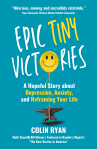
Colin Ryan: Epic Tiny Victories

Agnosticism, Artists, Authors, Deconstruction, Mental Health, Podcast, Purity Culture, Secular Grace, Secular Therapy
Listen on Apple Podcasts

Welcome back Colin Ryan, author, storyteller, comedian and survivor of Bipolar 2, OCD and ADHD. Colin has written Epic Tiny Victories: A hopeful story about depression anxiety and reframing your life. It is hilarious, honest and poignant.

Colin describes in the book growing up Evangelical, purity culture and his deconstruction process.

Join us as we catch up on where Colin’s deconstruction journey is at. We discuss his mental health journey. Colin tells stories from the book.

Get Epic Tiny Victories today.

Links

http://www.epictinyvictories.com/

https://www.colinryanspeaks.com/

Chapters

00:00 Graceful Atheist Podcast Intro
01:36 Welcome back Colin Ryan
03:50 Deconstruction Journey since 2020
15:27 Epic Tiny Victories and we were all 11
29:44 Impact of therapy on Colin’s Life
47:49 Mental Health takes work
52:36 The book process and how to get ETV
64:40 Final thoughts on the episode
66:43 Secular Grace thought of the Week

Amazon Paid Links
As an Amazon Associate, I earn from qualifying purchases.

Amazon #CommissionsEarned: https://amzn.to/4thnu4J

Interact

Join the Deconversion Anonymous Facebook group!

Support the podcast
Patreon https://www.patreon.com/gracefulatheist
Paypal: paypal.me/gracefulatheist

Deconversion
https://gracefulatheist.com/2017/12/03/deconversion-how-to/

Secular Grace
https://gracefulatheist.com/2016/10/21/secular-grace/

Transcript

NOTE: This transcript is AI produced (otter.ai) and likely has many mistakes. It is provided as rough guide to the audio conversation.

this is the graceful atheist podcast welcome welcome welcome to the graceful atheist podcast my name is david and i am trying to be the graceful atheist i'm incredibly excited about my guest today my guest is colin ryan i consider him a friend he is an author a comedian a public speaker and he has written a book called epic tiny victories epic tiny victories is this true story of colin ryan's unlikely journey from an anxious asthmatic kid with depression to a national speaker comedian and storyteller who has made more than 1 million people laugh learn and feel less alone all while managing bipolar 2 ocd and adhd in colin's book he talks about the power of the divine and the power of the divine and the power of the divine growing up in an evangelical world the experience of purity culture deconstructing and all the while managing his mental health i mentioned in the interview that colin said to me once that you can tell any story as long as people know that you're okay colin has come through all of this and although he continues to manage his mental health he is able to share with others how they too can have epic tiny victories here is colin ryan colin ryan welcome back to the graceful atheist podcast nice to be back that's amazing uh you're an author storyteller you've been a comedian you've done financial literacy uh how do you describe yourself you're doing great i'll just let you keep going yeah i mean i would say that yes i'm a professional communicator in the sense that i've done a lot of studying and testing and work in different mediums of communication so i've written two books um i've been a public speaker about 15 years i did about five years of stand-up comedy i've been doing storytelling a long time and so these different modalities if you will are all ways that i can communicate with people and i've been doing storytelling for a long time i've been doing storytelling for a long time i've been doing storytelling for a long time i've been doing storytelling for a long time i've been doing storytelling for a long time i've been doing storytelling for a long time express concepts but also ways that i interact with life like they're just how i like to play with how do you say this best or this is a painful experience what if it could be funny you know or i'm in a big room of people what if i could say the thing that everyone's thinking but no one feels like is safe to acknowledge you know and so i'm very fortunate to have had a career where i i go around i speak i speak a lot on personal finance on mental health but in the those topics, what I'm always really trying to do is bring a lot of humanity and vulnerability. And so I think that as a man, as an adult, I feel very lucky that I get to, for example, go to a college audience and talk openly about the emotional side of life or show them respect, even though our age isn't the same, you know? And so I feel like I get to kind of lift people up and just like try to figure out the best way to tell the story. And I think that's, it's very hard to articulate. Yes. I'm not sure I succeeded, but that's kind of the gist of it. I was looking back at, it was 2020. Uh, November, uh, that you did your deconversion anonymous episode. You've been on a couple of other episodes with the whole gang, uh, doing stuff, but man, uh, that's a lot. That's a few years ago. Uh, how are things? Things are great. Yeah. That's so interesting. That was five, six years ago. I mean, that's, that's, that's really, I think about where I was at, at that moment. And I had heard about you and I had heard about how you did these anonymous interviews with people who were like X Christian X religious, whatever. And I am that, but I also was like, I don't know how to tell that story or what it means if I say that. And I had a lot of, put a lot of weight around that, that I no longer do because I like myself just fine. And that was part of the process of growing up. Christian was trying to figure out, well, do I have to have a new label or a new identity? And I think it was a beautiful thing that I could have this chance with you and I could just be like totally anonymous and tell my story safely. And that was something I always told people about your podcast was it's really, he gives you this chance to tell your, like, you want to share your story, but you're also a little nervous about, will people just see the name graceful atheist and like make some sort of snap judgment. And I don't know, that just didn't feel that important this time around. Yeah. Yeah. They're bigger fish to fry in the world than what label I may or may not use. Right. I understand. Yeah. Yeah. But at the time it was really, it was really meaningful to be able to share with you. And I just love the way you listen and validate all of our stories. And I still believe that leaving any tradition. Or. Or framework that you are steeped in from a young age is a huge act of courage. And it's, it's a moment of self-honesty, whatever. It's kind of a come what may journey. I mean, it really is like, feels like the, the, the, the stakes are really high. Yeah. And it was certainly part of me figuring out who I am was just wanting to take what worked from my religious childhood. And what I love about my. Life now as an, a fully self-directed adult with my own principles and, and, and way of seeing things and just kind of smoosh those together and, and try to be the best me. I mean, I love what you just said that it's, it's about self-honesty. Yeah. I really feel like I connect to that a lot, that it was, it was self-honesty that led me out of, of Christianity. And regardless of what labels you put on things afterwards. It's being honest with yourself, no longer lying to yourself. That is the big deal. Yeah. I mean, and, and, and what comes with that or what that brings up for me is that you're motivated to lie to yourself. Like you don't, you don't want to acknowledge, Oh, I'm having big questions that throw this whole thing into, into doubt. You know? I was, I think from the very first moment I had a, a, a challenge or a question where I thought this could actually be a real big issue with my faith as I understand it within my religious upbringing, which was evangelical Christian, uh, reformed Presbyterian. So pretty, pretty for realsies. Okay. Yeah. Calvinist, you know, um, fairly fundamentalist, uh, very doctrinally, you know, aligned, you know, you know, you know, you know, you know, you know, you know, you know, you know, you know, you know, you know, you know, you know, you know, you know, you know, you know, you know, you know, you know, you know, you know, you know, you know, you know, you know, you know, I was just this color outside the lines kid, you know, I, it's almost like the way I interact with ideas that I love is I like to challenge them and poke at them and look at them from all angles. And there were people are very important to me in my young life who just saw that as, as rebellion. Right. And, and I couldn't really articulate, I was like, I think this is me interacting with the stories of the, of the Jewish people. Yeah. Yeah. Yeah. Yeah. Bible and of church. Like I love stories and, you know, any, any Sunday when the pastor would tell a story, I would just like snap into focus, you know, cause I'm holding my children's Bible and inside of it, I have like a paperback book or something that I'm reading cause I'm totally bored. And then he would tell a story and I would be like, oh my gosh, I would just feel myself lean in to the storytelling, you know? And I just, I think that's the piece of faith that always really connected for me was like the, the stories of Jesus as this person wandering around, like giving speeches, people being like, not knowing what to do with him, you know, like, there was something about like the human side of all these characters that I was just so into and intrigued by. And I just didn't, I didn't feel like I needed to be super, um, what's the word like reverential or overly, you know what I mean? Like respectful where there's no messiness. I like the messiness. Right. Yeah. Yeah. I tell you, Colin, the thing that, that struck me when I first met you in the first interview is, uh, you, I had quoted you, uh, as saying that your, your first and only religion is inclusion. And then one other way you described it. And I don't remember what it was, but it was, it was, it was, it was, it was, it was, it was, it was, it was, it was, it was, it was, it was, it was, it was, it was, it was, it was, it was, it was, it was, it was, where the context was, but like, you know, if you're not in my circle, I'll make the circle bigger. And, and that has stayed with me, Colin, for all of those years, man, that is so beautiful. And I can see where that would not fit in to a fundamentalist way of thinking. Yeah. Wow. I don't even remember saying those things. And I, but I, I respond as though, Oh, I like that. Yeah. That does sound good. You know, that guy's, that guy's brilliant, man. I don't want, we'll go that far, but like the spirit of that, I do still really resonate with, and I did as a child. And so thank you for reflecting that back to me, because I think that even as a little kid, I had this very strange math that was going on in my head that wasn't validated by any of my, my sort of adult authorities in my life, which was like, I'm just for people. Like I'm for people. I tell me about you. I'm fascinated. I want to, how can I make you laugh? How can I learn from you? How can we like create something cool together? And it was not surprising, David, that when I noticed people being excluded or mistreated for any reason, I bristled. Like I, like my first reaction was I, it wasn't something I could name. I just was like, something about this. I do not like. And as I got older, I was able to say, Oh, well, you know, and I say in the context of the churches, I was in my experiences, I don't speak for any larger groups or anything. I wouldn't even presume to, but in my churches, I witnessed sexism. I witnessed homophobia. I witnessed, uh, shaming, uh, attitudes toward people. And it just didn't, it just didn't sit right. Like I wanted them to be in the circle too, you know? Right. And I didn't realize maybe at the time that that kind of made me on the very outside of the circle also. Cause I was like prepared to, it's weird to say it, but I was almost was like, well, I guess I'll be outside the circle then with you. Like if these are my options, even as a kid who wanted to fit in and wanted to belong, I still wanted to make sure that kid belonged to. And so it just created this tension, right. Of like, you know, every, I don't know, big group like that. They got to have their policies and their rules. And I just, those were not for me. You know, I was, I was people first. That's amazing. And you know, that is such a, an expression of, of secular grace, right. Without using the same terminology. And I just, I just think it's, it's very beautiful. I think when I, I think when I met you and started listening to the gracefully atheist podcast, what struck me was grace and this love and respect for people's stories. And so that's, that's why I'm back to support your work and to share my journey. And, you know, what's funny for me is a couple of years ago, I, found myself really needing community and I started going to a church and it was the weirdest possible experience after having worked so hard to honor my own values and, and paradigm and leave the churches that I had grown up in behind. And I didn't think I'd ever come back. And the truth is I came back because I wanted to be around people in a regular way. And I wanted to allow space for, you know, I wanted to be around people in a regular way. And I wanted to allow space for church to have evolved in ways that the ones I'd experienced hadn't. And wouldn't you know it, the church I went to, the pastor is a gay man. First, like he, I didn't know that he's standing there and starts preaching. And I'm just like, Oh, see, this isn't that hard. Just accept everybody. It's fine. We're all fine with it. We're all able to love and honor each other and not, you know, create all these very narrow, you know, um, disqualifying criteria. And so I think for me, I've always been a person who I love people more than anything else. And I think it's in that sense, it's kind of funny to be going back to a church. Like it doesn't, it doesn't really matter to me one way or another. I just want to be in spaces where people want to know how I'm doing and how I can listen to people and, and yeah. So I don't have like a, I'm definitely a misfit that way. I don't have an identity that goes with it, but I have a, interestingly enough, I have a relationship with church that has continued and is so different than anything I would have, I would have predicted, but I do, I've done it on my terms in a way that feels right to me. And I think there's, there's grace in there. And I think that's what I love about your work is us just taking the time to listen to each other's stories. And that, that leads us to, you know, what, what we're here today for, and that is your new book, Epic Tiny Victories. I, I wonder if I could limit you and ask for the elevator pitch first, and then we're going to delve into the deep end as we go. So, what would you describe the book as? Take a shot at it. Colin is an anxious religious kid with depression, and he's got divorced parents, and he grows up feeling very alone and sort of not sure of himself. And he finds his way into becoming a standup comedian, telling stories, standing on stage, like having a successful career. And he still has depression and anxiety. And there comes this point where he kind of realizes, if I don't figure out how to manage my mental health some way or another, it is going to manage me right into a place I don't want to be. Really a sense of really like a reckoning with the challenge of dealing with mental health, you know, when life is sad, but also when life is great and you're still struggling and don't know why. I could say maybe what you won't in that I think it's deeply funny. It's painfully honest. It is vulnerable in all the right ways. And I think one of the things that you taught me early on was that you can tell any story as long as the audience knows that you're okay. And we have the sense of... That, you know, you are the narrator of this story and that, you know, you are okay. But you go into very honest difficulties that you've been through, including some deep mental health problems. Yeah. Well, thank you for expressing it that way. It carries a lot of weight. And I appreciate you saying it. And I do think that that's kind of what I mean. I don't mean to say, oh, I'm so good at communicating. So I should write this book. I meant like, I'm kind of obsessed with humor in dark places and in finding vulnerability as a strength instead of as like a slip up or a confession. And I just was like, well, then that's how you write the book. Like, be unafraid to tell like the really some of the really hard moments that a person can have in their life. And then right in the worst part. Like, that's where the joke goes. Yes. That's awesome. And that's okay. And trust people to relate to it in their own way. And I am gratified to say that's what people have said is they see themselves in the story. And that's why I did it. You know, I'm not remarkable. I'm remarkable in the sense that I'm a human. And that is its own incredible, magical event. That... How do you... Explain, you know? Like, we all are that. We're all magic. But in terms of like, I'm not different. I just grew up in a certain way where I wrestled with depression and anxiety. And I could not figure out why. And no matter how dark things got, I would not give up. I just refused. I just... I was a fighter. And then in my adult life, no matter how good things got... There were still this like heaviness around the edges. And sometimes would just show up in the most unexpected moments. And I just felt like, what an honor to get to tell that story. To tell that very human story of the journey to just be okay. And to just like, hold your own hand. And love yourself. And believe in yourself. And fight for yourself. And... And... And... And... And... I mean, that's kind of an inspiration of the idea of an epic, tiny victory. I think the everyday stuff is epic. Yes. Absolutely. You know? Like, every person you've had on your podcast. I've listened to so many of these stories where it's like, it's remarkable. What they have navigated. What they've come through. You know? All of us are underdogs in certain ways. And I think I just love hearing... I think I just love hearing about how people kind of climb out of the valley. You know? Yeah. One of the stories that you return to, kind of in multiple points in the book, is a story when you were 11 years old. And you had kind of an embarrassing moment in a classroom. And a young girl stood up for you. Yeah. I'd like you to maybe tell that story. And then we'll unpack a little bit about why you came to this. And then we'll come back to that. Okay. Yeah. I mean, I was this kind of quirky, bold, dorky kid. And then I went to middle school. And it was like, the second that I got there, it's like, oh no. Hide. You know? Be invisible. Yeah. And that was such a powerful instinct for me. But I had no idea how to do that. And I tried very hard to be... I tried to be invisible. And I made it about three periods. And then the teacher gave us a questionnaire and said, I want everyone to fill out this questionnaire. I want to get to know you. And then I'm... And so I still trust adults. I trust adults at this point. And I am not apparently someone who listens to directions. So I just answer it with complete honesty. And we hand them in. And then she shuffles up the questionnaires. And she hands them back out to the class. And... And we go around and read, like, three answers from each kid's questionnaire. And I am just like, oh no. Oh no. Like, this is so bad. And this kid gets my answers. And I can't remember his name or even his face. But I remember he was really mean and popular. And, like, kind of an intimidating, you know, sixth grader. But, of course, you know, like, he was probably, like, a little taller than me and had, like, peach fuzz. Right. He seemed like a man, you know, to me. And he's reading my answers. And it's just... It's so bad. It was like, where would you go on a Friday night? And, you know, these kids had said, like, to the mall. And, you know, I'll smoke in and whatever they were saying. And then... And I had said... I was at rehearsals with my... With my local church's clown troupe, Clowns for Christ. You know, as you do. As you do. And it was just a moment where, like, when I wrote that on the questionnaire. And when they got shuffled back out, I thought, I'm on a train headed to disaster. Like, it's going to get said. And it gets said. And it, like, my whole body, I just shrink. I'm just crushed. I'm so embarrassed. I mean, everyone is howling, laughing. I mean, this is, like, the end of any social status. Day one. Like, it's... I'm starting at a major deficit here. And I want to stand up and yell out, I get it. Like, I will do whatever you think is cool. I will be whatever you think I should be. I will quit clowns. I will watch all the R-rated movies that you guys are watching. I will... I will, like, whatever. Just, I don't want to be special. I don't want to be different. I just want to be liked by you. And I didn't say that. And I just felt ashamed. And sat there silently. And that's when this voice from the back of the room rang out. Belonged to a student. Her name is Michelle Beaver. She was, like, two rows behind me. And I didn't know her well. She wasn't... She wasn't necessarily, like, the coolest kid in class. So she took a risk. But she stood up for me. And she said, These are his opinions, guys. Like, why are we doing this if we're just going to laugh at each other? And it just put a dent in the, like, humor of the moment. Like, it was, like, a bit of a gut check for people. And I'm not going to say, like, it changed everything. But people definitely backed off. And we went on to the next person. And I never forgot that moment. And I never forgot that Michelle, like, put herself on the line for me. And she stood up for me in a moment when I really, really was the outsider. Yeah. And I say in the story that, you know, this is the deal. Like, you can stand up for somebody when they need you. When they need you. And they will remember you as their hero for the rest of their life. And I was struck in my adult life by how that memory was still with me. And I ended up telling that story at a moth event in Burlington, Vermont, in front of about 1,000 people. And it was, like, there's a scoring component. It's called a Grand Slam. And so at the end, they pick a winner. And I didn't really care about that. To me, it was just brave enough to tell 1,000 people that I had been, in Clowns for Christ. Seriously. You know, even all these years later, still kind of painful to say out loud. Yeah. And it just really, people really resonated with the story. It ended up winning. And it ended up getting played on the Moth Radio Hour, which plays on National Public Radio. It got featured in a Reader's Digest Best Stories in America collection. I mean, it really, like, took off in this really, you know, surprising way for me at first, because it was like, oh, no. You know, now a million people know that I was in Christian Clowns. But what came next was also really special, which is that, you know, I got to see people resonate with this story. And at one point, I was doing a show, and I had told that story and went well. And I think afterwards, I became, I bumped into this woman and she said, I loved your story about Michelle and being a clown and all that. And I kind of said, you know, despite myself, like, I'm surprised people connect with that story. It's so specific to be a Christian clown. And, you know, and she said, Colin, we were all 11. Yes, we were. Yeah. And I was like, it was a really a paradigm shifting moment for me. Yeah. Yeah. Yeah. Yeah. Yeah. In a weird way, the more specific you are about your example of whatever happened to you, it's actually more relatable because people, they don't care about the specifics. They care about the emotions and the themes. And so you tell a story like that. You could, you could frame that a million different ways. It's just a story about a child who feels alone. Yeah. Yeah. And another person who is not special, is not a Marvel character, does not have like healing powers, right? Like Wolverine. And yet she was willing to stand up next to me and, and fight for me. And I think that that's just something very important. I think that I try to remember as a person is just to be honest about what's happening to you, because people are going to get it from their own lens. And they're going to appreciate that you were real. Absolutely. And they're going to appreciate that you like gave us the juicy details in my case. The other thing I'll add is that I, I've reached out to Michelle a couple of years ago and we reconnected and I got to send her the video of me telling this story and everybody cheering for this, this girl, Michelle, who stood up for this, you know, dorky little boy who needed it. And I think it just, it just really meant a lot to her. And, you know, it turned out she had been having a really hard growing up experience at that moment too, in ways I had no idea. And so for her to kind of be able to like look back and go, wow, I did this thing that like really mattered to somebody. And then other people really connected with that. And I just, that to me felt like maybe the coolest part of the whole thing was I get to go see, you didn't even remember that you did that, but that, that has moved a lot of people. Absolutely. I, I think that's why I wanted you to tell the story is like, you know, getting the opportunity to come back and connect with her. It's just amazing. And while all of us have been 11, Colin, not all of us have told the embarrassing stories about being 11, when the moth grand slam and be able to reconnect with our childhood friends. So well done there, sir. Thank you. Oh, oh, oh, oh, oh, oh, oh, oh, oh, oh, oh, oh, oh, oh, oh, we are going to skip over a lot of parts. The book is amazing. You are a world traveler. You lived in Scotland for awhile. You almost ran with the bulls in Pamplona. Yeah. Uh, you were a VBS star on as an actor, you did all kinds of things, but I want to get to the heart of the book, which is your mental health journey. Yeah. And maybe talk a little bit about the first time you connected with a therapist and what that did for you. Yeah. When I was in my late 20s, I found myself in a real bad spot. I had probably since around college and into my 20s, I'd started to experience really pronounced, profound depression, you know, and I could usually manage it. And I've always been a very silly, goofy person. I love to make jokes. I love to make people laugh. I light up around people. So I can always kind of hide it. Some people have said to me, like, I wouldn't have thought that you like you don't seem like the type of person who who can be struggle with that. And I think that, well, that's its own conversation. But I think it's like we're kidding ourselves if we think that everyone isn't doing their best, whatever that looks like. Right. Just struggling through, like just doing their best. Everybody's winging it. Right. Exactly. We're all fighting our battles and there is no one who has it easy. And I really think that for me, this was the stone on my back. I just it was really weighing me down. And it was creating a very small life. I became a person who I wanted to be creative. But I was terrified of rejection. I wanted to be brave. But I I was afraid of failing, of choosing the wrong thing, of of embarrassment. And I was just stuck. And I was working a job as a journalist and I started to experience really severe social anxiety. And so my job is I would call people and do phone interviews or do in-person interviews for articles. And I started trying to come up with ways to do it all via email. And I would be making. I would be making up excuses, you know, covering in all kinds of different ways for the fact that I was actually just so sad I couldn't leave the house and I couldn't imagine having a phone call. It was kind of like, you know, if you ever wanted to call a crush, like maybe in high school or middle school or something. And this happened to me. I remember dialing this girl's phone number. And then on the very last number, I would just hang up. I just, you know, over and over. Yeah. I remember. Yeah. Yeah. And it felt that way with like every conversation I needed to have. Like I would be gaming it out ahead to try to figure out how I wouldn't mess it up. And I would just I was so overwhelmed. And I started falling behind on my work. And of all people, one of the head staff people at the newspaper I worked for called me into his office and he he kind of took a look at me and said, are you are you depressed? And I was like, I didn't I don't think I was like didn't even make eye contact. I was really in a low spot. And he reached into his drawer and he pulled something out and he hands it to me. And it's a business card. It had a man's name on it, Sam. And it's a therapist. And the only reason that that. Being my first encounter with therapy. The only reason that's significant, unfortunately, really is because of the way I was raised internally. In terms of religion and also growing up in the late 80s and the 90s. And it's just like there was a lot of messaging around. You don't go to therapy because that means something's wrong with you. You're falling apart. You can't manage it. You can't stuff it down, you know. And, you know, some of that, I think, is is very. Maybe funny, like you think about the like Irish Catholic thing of just like. I'm just going to hold my emotions in. And then that's just, you know, and then and then you're just OK. So you just got this guy in the corner who's like. How's that working out for you? How's that working out? Exactly. But I think that with my Protestant tradition on my my mother's side, there was more of a explicit warning away from mental health and away from secular therapy. And. I just got to a point where. I had no other option. And I went and saw this guy, Sam, and I can I'll never forget. And I write this in the book probably better than I can say it here. But I will just say I'll never forget sitting in this tiny room. With a complete stranger and finally saying out loud. To someone else, things that I'd been thinking for years and being able to. Actually hear them in detail. And deal with them just a little bit. And so like saying things out loud, like I think I'm really messed up and something's wrong with me and I don't think I can keep going like this. And and to just have this man go. OK. What else? OK. Huh. Why? Why? Tell me more. Just. And the thing that I remember, Dave, is I was like, I can't phase this guy. Yeah. Like I'm I'm laying out some darkness here. Yeah. I just like. All right. Like he seemed a little bit. Misaligned with the drama of the weight of what I was going through. And it took me a long time to realize that. He was already teaching me. He was showing me that when you have those thoughts. You don't have to match their energy. They can just be thoughts. And. It's. Wild when you realize that you can say to yourself. And mental health is is an arena where this happens or we we have these thoughts that we tell ourselves like I'm really messed up. No one will ever. Accept me. I'm always going to be this way. And. You can notice it and you can go. OK. It's all right. Let's take a walk. You know, you can you can be that Sam, if you will. For yourself. And. I remember sitting with Sam and within like. The first hour. I thought this is going to save my life. Amazing. And it did. And and I. You know, I said, I know I need to learn how to do this. OK. Thing to myself. So like just be even and safe and loving strong for myself. And. And I did. And it only took. 15 years and thousands of dollars in therapy and. Several medications and. A lot of life lessons. It's easy really is what I'm getting at. Yeah. But but at the end of that process and probably even from the beginning of that process, what I was becoming is what I like to call a successful depressive. Just for lack of a better way of explaining it. I am not successful. I am not somebody who. Has it all together. I'm not somebody who doesn't. Have. Low low moments. But. I have learned how to manage them. I've learned how to be my own friend. In those moments. And I've learned what works for me to help me. Get out of those. Those valleys. And so I look at my relationship to depression as. Not. Do I never have it? I don't look at that. I don't look at that way at all. I see success as. Am I able to go into it and then come out of it. In a relatively. Brief amount of time. And so that's actually how I look at it. I look at it now is like I can get really, really down. For about three, four days. Okay. Like that's it. I can't. I can't sustain it beyond that because I have these other habits. In place and I just know how to love myself out of that. Out of that life. Out of that low spot. And. That's why I kind of wanted to write the book was like. You know, encouraging people to figure out what are your things? What are your. Your foundation. That you can put together. I really think a big part of this is having friends. Relationships where you can be just genuine and vulnerable. Yeah. And so who is the person you can text when you really. Really are being like. Hard on yourself. That's. That's a good number to have. Yeah. Absolutely. Right. And so it's like, that's a tool. That's part of how you do it is you've got. You've got somebody in your life where you can say, Hey. I don't even feel comfortable doing a phone call right now. Can I just text you for a minute? And what I've come to believe. I think you would agree is like. I want to be that other person. That's what I want to be. That's what I want to be. That's what I want to be. That's what I want to be. That's what I want to be. That's what I want to be. That's what I want to be. That's what I want to be. That's what I want to be. I want to be that other person that somebody would text in that lowest moment. Yes. So I kind of just have, have taught myself that that is true of. Most people, unless they prove otherwise, is that they actually would love to help. And be leaned on if I'm willing to ask for it. Wow. So many things I want to, I want to respond to there. Number one. Yeah. I've talked a lot in the, the deconversion. Context of needing that one person. Yeah. Who you can just go and, and, and talk to them and be truly yourself and not have to worry about them trying to protect your faith or your lack of faith or what have you. Right? Like having that one person is so, so important. And then the other thing that I think is so beautiful about the book, Epic Tiny Victories is you, you know, go through your life where you've learned. Yeah. So about 10 songs. Yeah. Right. That are, that are pre-ography, so they've started those episodes more widely throughout the world. And not, it's very clear balanced lifespan and the way that they're built. But in 150 years or so. It's also, and, and we're, we're sitting here, putting it in some science. Cr meetings, you know, with the audience, brings your power and Então, you know, even more directly to the family, right. And that's in the first half. Of Cam än Ngân. there's kind of a funny layer to that when i was a kid i watched the movie braveheart i was probably like way too young it's like very like people get their heads chopped off and everything but but what i really took from that movie was the epic soundtrack and the the heroism and the honor and the nobility you know and i wanted to be brave like that i wanted to be heroic even in a normal way you know i just wanted to be courageous and i think as a person who was afraid of failure afraid of rejection or afraid of embarrassment like i got to know intimately this moment when i would almost take a risk and then i wouldn't and like i said in my late 20s around the time that my depression was really taking over my life i was also living a very small fearful life you know i i was trying to write a book and i couldn't share it with anybody because i was terrified what that it wouldn't be good enough and so i mean to me that actually that's kind of a perfect picture i'm spending i'm working in office and i'm spending every minute i'm not at work writing something that i don't have the guts to even let my friends read let alone submit so i'm i'm not going anywhere like just objectively and so i assessed myself with a courage problem and i was lucky lucky i cannot believe how significant this was by accident i was in uh i was going to a small church community and like around this time and after the service i remember i overheard a guy who's telling somebody else he said yeah i signed up for this comedy class at the flynn center uh flynn theater in burlington vermont and uh teen nerd at the flynn meet my mom she'd stick a finger in my eye on my eye like your thick can't see my face he would keep ignoring whining and pansing and i'm like because i'm sense of need and getting out of the park i was learned how important my parents love comedy so i wanted to um get an equipment for some of my friends i was super nervous and i think i was a bit so sad that day and even i was peppered it was devil's day i alive a little he was like hey god how many of you know thoseics have today but i don't know what they do and i couldn't hire people over those last several months that i had to find the parts out of that room i've only two or three ways to do something, but it was very clear. I was like, if you don't do this now, you're never going to do this. There's something about this that is intriguing to you. And it's not, if not now it's never. And so I signed up for that class and I walked into that room. Like I was walking to my death. I could not believe that I had chosen to be in this extremely vulnerable environment of standing in front of people. And there's something so like full body cringe about turning to an audience and pretending you're like being a comedian and then saying a joke. And then they don't laugh. It's like, it's, I mean, right. It's like, yeah, it's a nightmare to describe. And this was dawning on me, you know, more and more vividly. And then they called my name and they said, everyone had to get up. And do a couple minutes of jokes. And I got up there and I wasn't very good, but at some point I got a laugh and it was like tectonic plates rearranging themselves. I mean, it was just a moment where I thought, Whoa, wait, wait, I could, I could actually, I could figure this out potentially. But even as I went, sat in my seat, what struck me even more was like, I just did the thing that scared me possibly the most. And I walked all the way from my car to my seat, from my seat to the stage. I did the minutes. I sat down, like I made myself do all that. And in a weird way, I felt like this is kind of heroic, like in a normal way, you know, I didn't fight a war. I didn't slay a dragon. I didn't save a kingdom, you know? But I picked the thing that scared me and I leaned into it instead of ran away from it. And honestly, I've tried to live my life that way ever since, because there was something very clarifying about that. And so I like to give people advice. I think that confidence is something you can earn for yourself. And it is, there's, there's math to it and you're not going to like the math. Cause it's pretty simple, right? It's like, if a thing scares you, go do it. And, and I know that doesn't make it easier and it doesn't. And that's the, that's the important part is the only thing that makes it easier is you actually doing it. And so I like to tell people, if you need a hack or a trick to make it make sense in your mind, just do it for a minute. Just do like one horrifyingly scary minute, right? Walk across the room and, and ask out your crush, right? Or go to a job interview or write a book and, or write an essay and put it online or whatever to go to a standup comedy open mic. And that's really scary and can be really rewarding. And for me, that just kind of became the deal is every minute that I would do standup comedy, I became a minute. Less afraid. It was like, I was like reducing that, that, that monster of fear in my life. And then at a certain point, you kind of get your momentum going. It starts to become fun. And so for me, I did open mics. I started doing comedy shows. I recorded like enough content for an album. And then I got a opportunity to apply for a job as a public speaker. And I had just enough confidence stored away from this little comedy adventure to say yes to that. And so that's kind of become the formula for me now is like, if something is scary, you know, if you can lean in. One of the things that struck me reading it is, you know, you talk very vulnerably about the internal monologue, the internal heckler, the internal critic, and these epic tiny victories, these little almost hacks that you have of talking a positive talk to yourself are, are things that helped you deal with and, and learn to live with the depression and various other mental health. So one minute less fearful was one of them. And there were others that, you know, you were able to just love yourself, right? Like to talk to yourself, your way out of some of these, some of these things. Yeah. And I do want to say too, that mental health is very different for each of us. And so for me, you know, I also recommend therapy. I also recommend medication. I recommend you figure out, treat it as a science experiment and really try to figure out what it is that you need. So I, this is not me saying be brave and that's it. Sure. Thank you for saying that. I mean, that's, that's basically the seventies. I like to think we've come somewhere forward from that period. And so I just, you know, for me and, and my therapy journey helped me understand that I actually have a OCD and bipolar two. And so these things express themselves as depression and anxiety. A lot of these things kind of show up in that overthinking or that very heavy, low depressive experience. These are very common. And so that's why I chose to write about them in the book is that we all either know these experiences for himself, or we know someone who, who wrestles. Yeah. And I wanted to name those things in a very human normalizing way. You know, I think one of the big discoveries for me is that depression is normal. It's like, this is something I have to catch up with. I have to catch myself, David is, is, you know, cause in my relationship with my wife, you know, this is still a thing that happens. And when I do get depressed, I have to catch myself from being like, it's okay. It's okay. It's just a little, it's low, low level. Everything's fine. Like I'm apologizing for it. Right. When my partner loves me and just wants to be present for me is perfectly fine with me saying, you know what? I am depressed right now. I'm working on it. Okay. You know? And I think that's, that's kind of the big epiphany of it all is that, well, look, I say this in the opening of the book to, to be very clear about this. If you are feeling challenged around your mental health, uh, you are not broken. You are not alone. There's nothing wrong with you. Yeah. There's nothing wrong with you. And I like to think that you will find your way to a better mix that feels a little more manageable, where you can be a little more transparent, a little more functional and that's it. And so I, you know, I'm, I became a person who I've done speeches for huge audiences and I've had my face on the big screen while I give a talk and I've signed books, you know, I've had these moments that, that seem quite, like, Oh, that must be a nice life. And I have all the other moments too. And so I think that that to me is maybe where I want to kind of offer something to really to anybody, to the world, to the, to the listeners of this, you know, to, to the readers of the book is like, you're not broken. You're not alone. We need you. Like, how, how can you help yourself? How can we help? Each other to like, get ourselves into a place where we can share our story and speak our truth and fight for the person in our life who is down and needs somebody to stand next to them, you know, be, be a hero for someone else. I think that's, that's, that's kind of what I have landed on is like, we're already there. We're already like where we need to be. We're closer than we think. We just got to lean into, to this moment and lean on people around us. I want to talk just briefly about the writing of the book, the process itself. My biggest compliment to you is that you were showing and not telling. I was literally yelling at the book, like, this is bipolar. This is bipolar. And you reveal that near the end. I hope I haven't given away too many secrets. No. So well done. In showing, you know, your experience through the storytelling. I thought that was, that was really well, really well done. Thank you. It, it's a, so I'm obsessed with storytelling as an art form, but also as like a kind of a practice for knowing yourself better. And the, the basic formula for it is what's a moment that really stands out in your memory. And I think that's what's so important. So I'm going to go ahead and start with the story as being significant. Okay. Got it. Great. Now, instead of just focusing on. Why was it the war like so hard? Why was it such a overwhelming, painful experience? If it's that kind of experience, maybe the question is how was I growing and changing during that moment? Right? So that's now that's a story. It's not just you're slogging along and life sucks. It's like, no, yeah, life sucks, but look how determined this character is to not give up as things get worse and worse and, and look what they leaned on in themselves to grow and to change. Right. And so I say that because I think each one of us is a character in our own story. And it's actually kind of fun when you think of yourself as a character in a story. And one of the things that was important to me with this book was that I wanted to, to stay true to, well, how does the character experience it in the moment? Like, I know, I know a lot more now, but you know, there's a chapter in the book where I'm in fourth grade and I'm at a spelling bee and the day doesn't go the way I hoped. And I cannot tell you how delightful it was to really lock into, okay, I'm nine years old, 10 years old, whatever. Like I only know nine years. Yeah. Yes. You know, and that was really, really fun. And to your point about my realization that I have bipolar two, that is something that is revealed later in the book, but it's also on the back of the book. So it's not meant to be like a spoiler. Really the only spoiler is I wrote a book about mental health. You don't have to worry like it, you know, it's going to get bad, but it worked out for this guy. And so I know what you're referring to. There was a moment in my twenties where I experienced unbelievable insomnia. I just swung from depression to insomnia and I was awake for like a couple of weeks. And, um, and so I put that in the book as like a wink, wink, like that'll make sense later. Yeah. But at the time it didn't, you know, at the time I just thought, man, I don't know. I don't know what's going on here. So, you know, that's bipolar two, by the way, is the kind of less well-known version of bipolar disorder. It's much less severe, but it does also involve mood, uh, mood swings where you go from you really sleep is really the whole deal with bipolar twos, learning how to manage your sleep. And yeah, so there were moments in throughout my life where I just wanted to, as you say, show it, not tell it like, just, just come with me on this journey and it'll, it'll start to snap into focus as we get further along. And that's quite lovely to inhabit the moment in time in your life and, you know, not be the, the adult that you are now, uh, you know, retrofitting, uh, information, uh, into that, that moment. So yeah, that's, that's beautiful. The other thing that I just really related to is you talked about, uh, completing the book and, you know, that maybe that was a dangerous moment for, for mental health as well. And having kind of a sudden realization that, you know, I'm not going to be able to do that. I'm going to be able to do that. I'm going to be able to do that. I'm going to be able to do that. I'm going to be able to do that. I'm going to It's not that people were ignoring it. It was that people didn't know it existed at all. And man, can I relate from being a podcast person? I think anybody who's ever created anything ever can really, really relate to that. You, you pour your heart and soul into something. And it's not that people see it or hear it and reject it. It's that they don't even know it exists, you know? So talk, maybe it's just a little bit about the process of getting the book out there and getting people to know about it. Well, yeah. And that's, you know, I'm glad you, I'm glad you pointed that out because the central idea from the book is what I call reframing. And so it's looking at a moment and saying, okay, here's my default. I'm suffering. This didn't go the way I wanted. I put all this work out into the world and no one cares. That's the default story, storyteller narrative. But what's more interesting is to go, well, is that how I really, want to see this moment? Is that really what I believe? Or is that just kind of my insecurity talking or my, you know, despair? I wrote all this and no one, no one cares. That was the thought I had after I finished my first book. And I was like, you know what? I think the more honest, more obviously true interpretation is no one knows. And so that even that just changed the energy. Hmm. It's that they don't know and everyone's busy and it is hard to find your audience and it is hard for your work to like reach the people you want it to reach. And it just is. And maybe that's okay. And I cannot tell you how that has served me this time around because, you know, this time around I finished, this is my second book and I went into it very open-eyed about this next part is going to be hard. Yeah. Because you haven't quantified what you expect. So whatever book sales you get, you're going to wish it was more. Right. And you, you've never decided how many Amazon reviews you want or, you know, bookshop.org reviews, but you're going to want more than you get. And what I've had to really do is slow down and go, what's in my control? Like, what do I actually want to declare? How do I declare victory instead of this was pointless? And look, I'm talking to myself right now because this is, this is the work. Like I put this book out there and you know, everybody's like, I wish I want the whole, I want people to be walking around, like walk by me reading my book. Like, of course, like I put all this work and I want to share it. And what I have landed. On is when somebody writes to you and says that mattered to me, that really spoke to me. I, I, I really loved it. And you gotta be like, that's enough. And Hey, let's, let's play the game a little further. Maybe you don't even get that because not because they don't feel that way. Cause if you didn't ask or they didn't tell you, it just, it just lost in translation. How about this? You got to make a thing. You got to spend time making a thing that just like you loved making it. And that, that's the piece I've really like leaned on this second time through with a book is like, no matter what happens, I got to spend almost, I think a little bit over two years writing a book where I was like proud of every word. And. I thought a lot about some of the stories were like these. Dragons I had to fight, you know, some of them just poured out onto the page and they were perfect. And then other chapters were like, I defy you, Colin, you know, I'm twice as long as I need to be deal with that, you know, and, and all of these challenges and, and I really enjoyed it. I really enjoyed the, the, the project. And so that's what I would say is. This idea, it's in the subtitle of the book, you know, it's a hopeful memoir about depression, anxiety, and reframing your life. And I would say we are all capable of reframing our life and saying, I know how I feel about this. I know what I'm telling myself, but is there another version that might also be true that I could focus on a little more? And I think that's where you start to really like listen to your own voice and start to hear yourself. Say things like, you know what? I got to do that. And my sister read it and she loved it. You know, I got a chapter about my early on about our grandmother, who is this iconic five foot tall British woman who would show up on our lives. I kind of like a Mary Poppins character, but like, but she swore more, you know? Yeah. I love her already. I know. She was one of the greats. And she, you know, writing about her is so meaningful to me. But then my sister called me. She left me like a voice message of how beautiful it was and how it reminded her memories of our gran and her connection and reliving that. And so I think it's that. It's realizing that what you do is going to have an impact on somebody else. That's epic. Absolutely. I think that's maybe the best advice to any artist ever is make art. That you want to consume. You may have even said it, that you were writing the book that you would have wanted to read that kind of thing. Yeah. Colin, I want to give you a chance to plug the book. How can people find it? Let's make sure that they get access to it. So where is it available? Yeah. So my book is available. Basically type in Colin Ryan, epic, tiny victories. You'll find it on lots of different sites. You'll find it on lots of different platforms. If you go to epic, tiny victories.com, I have pictures from the book. You can read the first chapter for free. And then it's available on all the different platforms that you might. If there are any platforms you don't want to support right now, I get it. I've got other platforms you can feel good about. And so, you know, it's my honor to share the book that way. And I've got some funny photos from along my journey. You did mention. I was a vacation Bible school star movie star for a week. And those photos alone are worth the price of admission. Can confirm. Yeah. Can confirm. It's just, I'm very proud to say like, there's some stories in there that are going to really make you just laugh. And there are going to be stories in there that are going to make you really feel big things and feel connected. And that's why I wrote it. Colin Ryan. Thank you so much for being on the podcast. Thank you, David. Final thoughts on the episode. I love it. When someone independently comes up with ideas that are very similar to secular grace. And I think Collins, his first religion is inclusion and opening the circle. To include everyone around him really encapsulates that it's a beautiful expression of secular grace without using those terms. I loved reading the stories that Colin wrote about and then getting to talk to him about it. They are hysterical. They are vulnerable and honest in a way that is very rare. And that is my cup of tea. That is what I love about Colin the most. I also want to point out that as I did the edit. I could hear that maybe I was minimizing and I want to just reemphasize that Colin points out how much work, how much time, how much effort it took to live with the mental health experience that he had. So I don't want to minimize in any way that was difficult. It took therapy. It took medication. It took a lot of work on Colin's part. So let's learn from Colin on how we can work through our mental health experience as well. Another thing that I wanted to talk about is the fact that I'm a Christian. I'm a Christian. I'm not like everyone else. It's a really complex and complex thing. It's a really complex issue that is common, but different from the rest of the rest of the world. And I think one of the things that I loved about what Colin was saying was that you're basically a science experiment of one figuring out what works for you will be unique and different from everyone else. So you won't be exactly like Colin, nor will you be like your neighbor or roommate. Although you are not alone in your mental health journey, you are a science experiment of one. There will be links in the show notes for purchasing. I think, I'm sure it's something that you can find out about yourself. Epic Tiny Victories. Obviously, you can get that wherever books are sold. I encourage you to get the book itself. It is hysterical and wonderful. Thank you, Colin, for sharing and being vulnerable and honest and giving us a chance to have epic tiny victories. The secular grace thought of the week is you're not broken, you're human. That has been an ongoing theme of the podcast from the get-go, but this is a great opportunity to say that mental health is a part of that. There are some faith traditions that look down upon therapy or acknowledging mental health. That has been destructive for people for years. Allowing yourself to recognize your mental health challenges is the first step in living with those mental health challenges in a healthy human way. You are not broken. You are just human. Grab someone you love and tell them how much you love them. Until next time, my name is David and I am trying to be the Graceful Atheist. Join me and be graceful human beings. If you want to get in touch with me to be a guest on the show,

Racquelle: Deconversion from SDA and Conspiracy Theories

Agnosticism, Atheism, Conspiracy Theories, Deconstruction, Deconversion, LGBTQ+, Podcast, SDA
Listen on Apple Podcasts

Arline interviews this week’s guest, Racquelle. Racquelle grew up in Canada in the Seventh Day Adventist church. Conspiracy theories were common in her household. Some of them she bought into.

Throughout her life she went through periods of doubt but something kept bringing her back to Church. A sense of obligation and expectation never left her.

Eventually, Racquelle deconverted from her faith and deconstructed the conspiracy theories. She now has an interesting perspective on the deconstruction process.

Links

Facebook
https://www.facebook.com/racquelle.pilon

Instagram
https://www.instagram.com/racquelle_p/

Recommendations

YouTube

Holy Koolaid

Podcasts

The Thinking Atheist

The Friendly Atheist

Misquoting Jesus with Bart Ehrman Podcast

Conspirtuality

Oh No, Ross and Carrie

Books

#AmazonPaidLinks

Quotes

Once I started the motion it started moving very quickly.

We aren’t actually looking for truth we are looking to confirm what we already think
and so we will find it if that is what we are looking for.

Obviously the creation story, Adam and Eve, is a myth. And If it is a myth, then all of it is bullshit … it doesn’t hold up … it doesn’t make sense.

If [they] do not face it, deconstruct it, see the criticisms … life, as they get older, confronting death, confronting change, often times it will take them back.

Interact

Join the Deconversion Anonymous Facebook group!

Graceful Atheist Podcast Merch!
https://www.teepublic.com/user/gracefulatheistpodcast

Support the podcast
Patreon https://www.patreon.com/gracefulatheist
Paypal: paypal.me/gracefulatheist

Deconversion
https://gracefulatheist.com/2017/12/03/deconversion-how-to/

Secular Grace
https://gracefulatheist.com/2016/10/21/secular-grace/

Attribution

“Waves” track written and produced by Makaih Beats

Transcript

NOTE: This transcript is AI produced (otter.ai) and likely has many mistakes. It is provided as rough guide to the audio conversation.

David Ames  0:11  
This is the graceful atheist podcast United studios Podcast Network. Welcome. Welcome. Welcome to the graceful atheist podcast. My name is David and I am trying to be the graceful atheist. Please consider rating and reviewing the podcast on the Apple podcast store, rate the podcast on Spotify and subscribe to the podcast wherever you are listening. We have our merchandise store on T public you can get all of your graceful atheist and secular Grace themed items there The link will be in the show notes. If you're in the middle of doubt, deconstruction, the dark night of the soul, you do not have to do it alone. Join our private Facebook group deconversion anonymous and become a part of the community you can find us at facebook.com/groups/deconversion mighty had the week off so any editing issues you can blame me on today's show Arline interviews this week's guest Raquel Raquel grew up in Canada in the Seventh Day Adventist Church. In the Seventh Day Adventist Church she always felt slightly set apart different from the surrounding Christian experience. Throughout her life, Raquel went through periods of doubt and recommitment and found herself coming back to church again and again. Ultimately, the way the church treated LGBTQ people, and the violence within the Old and New Testament were issues that she could not get around. Eventually, she deconstructed her faith and she has a really interesting perspective on deconversion and deconstruction that I think you're gonna enjoy. Here is Arline interviewing Rocco.

Arline  2:06  
Hi, Raquel, welcome to the graceful

Racquelle  2:08  
atheist podcast. Hi, Arline. Nice to meet you.

Arline  2:11  
Yes, nice to finally meet you. The way we normally start is just tell us about the religious environment you grew up in. Um,

Racquelle  2:18  
I grew up Seventh Day Adventist. And I know that that seems to be a bit of a smaller contingency. I've seen a few throughout the deconversion anonymous Facebook page, but it's still a little bit smaller, we felt smaller, even growing up we've had felt like definitely we were kind of the, the different people for sure. I grew up kind of born in it. Second generation, I guess on my mom's side, and third generation on my dad's side. And I grew up in the seventh devenus community in Alberta, Canada. So there was like, college and high school and elementary and everything all on a campus and the big church and some industries. Cuz you probably know, any type of Christian private schools are not cheap. Yeah, so kids who were going to college or high school could work in some of the industries that were on campus. So that's kind of what it was like when I was really small. I think of it as being conservative. But looking back, we weren't super strict compared to, but it was around different people for sure. Like there was a variety. I knew kids in my school whose parents were very strict. Most of my friends and most of us looking back it was fairly I guess liberal in the sense not liberal in theology. Like we sang hymns at church you know, the kid I think they probably loud drums now but like, but liberal in the sense of life was fairly normal. Like I didn't feel super isolated from society. It was funny because there's a a something I've just accepted a podcast that I listened to I can suggest that for any listeners who are interested call haystacks in hell. And I'll explain the title of that later. Who just had a question today, their podcast comes up every Saturday which is kind of a funny nod to the fact that we kept saying yes, that asking about Halloween cuz I guess that's even a question with evangelical people. Did you grow up with Halloween? And we did we we dressed up my grandma made popcorn balls when that was still allowed because I'm an older millennial. So that was in the seven years before the scares all went around about that. I mean, I watched all the TV programs I knew other popular music like I didn't feel isolated in that way from the the world, the secular, secular world, but yet in some ways you do feel different because your beliefs are so much different. And you do have this background idea especially as you get older and you learn about the doctrines that it's very much the other you know, people are the other where the innocence where the other end I went to school, mostly Christian school, except for a couple years I went in grade eight, I went to public school and then grade 1011, I went to public school. I know this in retrospect, my mom had become fairly disillusioned, I think with her faith because she had my dad was very abusive person. And so when they had divorced, I think she felt very, I knew I knew this leader from afterwards conversations with her as I got older, I didn't know this as a child, but that she had gotten very felt very abandoned some wider, or that the expectation is that somehow she had failed and not staying in the marriage. Right. So I think she felt a great deal of and there was some other things she had gone to an avendus college and there would have experienced some date rape incident and stuff like that. So I think she was just had a lot of issues. And then she just felt very unsupported within the church. And he also had a good friend who was closeted gay. So I think, just a lot of things. So even though I went to school, there, we didn't, we weren't always consistent with going to church every week, as I kind of got older until I was in my teens, and not at all in grade 1011. Because we had moved to another province, I was fully had the teenage experience of drinking and drugs and like it was a fairly normal teenage years. And then I after high school, funny enough, I started working at this place, and I met my now husband when I was like 18, or whatever. And, you know, you asked you asked those questions. Where are you from? Where did you grow up? Where did I was like, Oh, you probably wouldn't know is this I went to school at this little Christian School in Macomb, Alberta. And he's like, Oh, so you've seen him like, back because nobody knows that. And his mom was honest, his dad was Catholic. So he'd gone to Catholic school, but he knew of it right. He'd gone to church as a young person. Oh, and I had been baptized when I was when I was 10, which is, like, considered very inappropriate of churches to do that. But it was after like a week of prayer, you know, like they we used to do, I don't know if other churches do this, but especially you'd been on a church school campus, they would have these big week of prayers at the school. And they would bring in special teachers, speakers and stuff. So it's a lot of, you know, you know, you've been I'm sure ballistic series or things like that. emotional manipulation. So, at the end of the week of prayer, you're this vulnerable 10 year old who's also kind of at a dysfunctional home, he's going, oh, yeah, you know, you're baptize, which is so bad, because like, you can't stick with it, or, or in what your mind is the ideal of it, right, that's presented to you. So then you go through teenage and you do normal teenage things. And then, you know, then you feel even worse, in a sense, if you had never gotten baptized in the first place. And I didn't, I didn't dwell on that a lot growing up, like there was a lot of stuff going on in my home that had nothing to do with church or Christianity anyways, so like, I was focused on a lot of those issues. But then they met my now husband, and we started getting interested in church again. And then we were rebaptised. Like, when I was like, 19, or whatever, you know, he showed more interested in it first, and then I kind of like, not that he like, he wasn't a bully, or he and like pull me into but it was just, it was more of a sense, like, oh, you know, God's God's really using this person to bring me back to him, right, kind of, kind of a feeling. And then so for a few years, we were really, I'm sure my family. I know, my family thought we were kind of getting extreme because we it's hard to explain to people some feminism in a sense, but it came out of the, the Great Awakening time, the Second Great Awakening of the eight hundreds. And then if you know anything, they were our early founders, were part of this Millerite movement who believe that Jesus was coming again on a specific date, he didn't come and then they kind of reset the date. And that was something called the great disappointment and then they believe that oh, okay, we got the props. We got the day right. We just got the thing wrong. And actually something happened in heaven and blah, blah, blah, is this crazy thing? Ah,

Arline  9:18  
that's convenient. Oh, yeah, it's it's it's typical.

Racquelle  9:21  
It's typical, like moving the goalposts kind of behavior which when you're indoctrinated and growing up, I can look at all in hindsight now, but it all seemed. And then of course, we had a prophet's which, of course, yep, similar in the sense similar in a sense to similar but different to Mormon, cuz I would say there wasn't nearly as much it wasn't nearly as scandalous as obviously scandalous behavior, like I can look back and go no, oh, there's something problems with it. But you know, whatever. So we got more involved in the more serious teachings of our church and we take it very serious Wesleyan started reading more of her name is Ellen G white and we started reading more of her read her books. And we took our faith mores too seriously. And we actually even went for a few months out to this, what they call self supporting schools because they're they're like, they're adventurous, but they're independent. So they're getting it's kind of getting fringy but not full on like, not like David Koresh weird, but just like, but just more more more like they consider more authentic, you know, getting back to the Bible, kind of a, you know, we're getting back to the real the truth, the the true love of God or whatever, you know, however, people define that. And so we're there for a few months. And I know my family was a little bit because they're not there. They were they were they were conservative, Christian, but not like me on that. And we just viewed it as well, we were just taking our faith seriously, right. We also never pushed it on them. Like we were never trying to like, Oh, you have to think that way we do. We just kind of we're trying to live what we thought was right. And then we left that place, because we found it really culty we so we ended up leaving? Yeah, I know. It's funny. It was weird. Where they're

Arline  11:08  
like little things along the way. And all of a sudden you're like, or is it just like something big happened at that place

Racquelle  11:14  
where that's where we left early, we were there for a few months, it was supposed to be this medical missionary thing was very poorly, okay. But the whole compound it just those kinds of places I find, no matter how well meaning and I don't think the I don't necessarily think the people who started it were super culty in themselves. I don't think that's what they were trying to do. Never. I'll give them that much grace that there was they were very problematic, and then a lot of ways, but they weren't trying to establish any sort of cult they didn't. They didn't necessarily, but just the way people behave, you know, you felt watched you felt like what were they doing? Well, there was some weird stuff. They had all these all night prayer, meeting things. And then some of the avenues put on this thing. If you ever see in your community of revelation seminar, that's 100% said Davines. Okay, that's amazing facts or, or

Arline  12:03  
I've seen that

Racquelle  12:05  
stuff. Yes. That's revelation. So that's, that's a relation seminar. And that's simply evidenced. And so we were part of helping out in the community with some ministers that were coming to do that. And so this one guy, he did this one portion of how some Davin has tried to explain Daniel and Revelation, prophecy breakdown, and he didn't, he wasn't very good at presenting was very confusing. And so my husband Michael had said, just made a statement that we were in a primitive Church was like what we should do, he made a critique, like saying that I probably didn't come across well, we could probably the past certain people just piled on him. It was really weird. And they were like, Oh, you're you know, you're I can't even remember he'll he can tell you the words better. But they just really had this thing. And we just started feeling really weird and uncomfortable. And we left early and I have family that lives in the state. So we just kind of visited them and came home plus I was founded I was pregnant down there. And I was starting to need to know about me even in April is tough. I live in Georgia. So we were in Phoenix city. Columbus, Georgia, Phoenix City, Alabama, right on the corner. Yeah. Yeah. So yeah, it was so we were just decided to leave and come home. I started to feel really the pressure very deeply of I was trying so hard to emotionally connect with it. Yeah. But always really struggled with that. Like I was really started with actually feeling any sort of presence of God or that my, my prayers were going anywhere. I felt I never felt surely of salvation. And I, I just I remember thinking like, if I'm not, if I'm doing all this for nothing, if I'm doing all this and then not saved anyways, why am I doing this? But I still had these deconstructed at that point, it was more just like, Screw it. I'm leaving. I I'm not even why am I bothering like, like, I might as well just live my life how I want to and if I'm going to be lost Anyways, if there's, if you know, you know. And so for many years, we were sort of out of it. We have two kids, I guess when my son was born, we still weren't there. They're about four years apart. I had my daughter when I was 20. I had my son when I was 24. We still weren't really in it so much. And then we had moved away. We are living in this small town where it like my husband's parents lived in we moved out to Vancouver, British Columbia. And our kids were getting older and I think partly because we had never really yet deconstructed it. There was still that call. In a sense, right? There's all that call especially when you really grew up with something and you really grew up with a deep sense of doctrine ation that this is the right thing or that will ultimately you you do want to go to heaven or you don't want wouldn't be lost or, or those kinds of things and you think, Oh, I'm not doing right by my children or something by not teaching? Yes, yes. So we did start going to church sporadically. So even I'd say in the last see my, my daughter is 35. My son is 31. So probably probably in the last 20 years, it's it's been differing levels of in and out in and out of it. And being disillusioned still, I never felt really close with the church community, though they were never a welcoming place. So that was never placed. I felt like I had a home even though but I still thought, well, I should be trying to find it, or I still should be figuring it out. Yeah, and I just started to get just, just over the years, I started to get more and more progressive in my own ideas. And I was moving in and out of where I, this is really short, and I'm trying to keep this distinct but

Arline  15:58  
no, you're fine.

Racquelle  16:01  
It was like, I never really felt like I had a home or family in church. So that was leaving to go there. Because I know that's a thing for some people is they really feel a pain in leaving when they deconstruct because they're leaving their community i i was always struggling with like, I wanted to find that but never found it in there at all. Yeah. I didn't feel connected with those people. I didn't find them terribly well. There's a person here and there. But it was all it was it was a bit of a strange, toxic bunch. There was a lot of weird history to the church. And then just i There were certain shifts we had when you grew up some families love people vegetarian, not everybody is it's not? Yes, I

Arline  16:45  
didn't know that I have a friend. Yeah,

Racquelle  16:48  
it's not an absolute thing a lot. There's a lot of people who, even in the states consider those conservative because it's too conservative is a little bit different in the States. And it is in Canada, although it's changing a lot of here, too. A lot of people still do that what they call the clean meats based on the Levitical clean versus Yes, unclean laws. And then there are people who are vegetarian. And then the way it was spoken of in the EG white writings was like, eventually we would be moving off of all animal products, because as you know, the world gets more corrupt and blah, blah, blah, we should be moving to completely cleaned diets, a lot of wellness, a lot of the wellness stuff that was coming up in the 1800s is mixed in with messages and stuff, a lot of pseudoscience and stuff. But we have been primarily vegetarian because I grew up both. And just for my own has been an animal lover, I tend tended to be primarily vegetarian. And then we made that decision probably about 1518 years ago to be vegetarian fully. Because we weren't eating a lot of meat anyways, we always grew up, I always grew up eating a mixture of some days, some days we didn't, my kids have grown up with it like that, too. And then we became vegan. And now, that wasn't part of our churches thing. Although there are some avenues to do our plant based. There's this more religious stance mine was mine was more ethics and more rights. And that's what made it stick for me. Because back when my kids were young, and my my husband and I got more into the fringe Adventism we were plant based for a couple of years. I didn't stay that way. Because just whatever, a lot of reasons. But I found that when I made that choice, and I and my compassion, sort of, I've always been sort of an empath and more of an empathetic person. But when I made that choice, just it opened up my world up more to even more and more social justice issues and compassion. And I started to view things differently with how our church oriented itself to a number of things. And I think a lot of it started with the LGBTQ issue. That wasn't something that was it wasn't something that was talked about a lot like, like I know, in the I think in the evangelical church, it's really focused on avenuewest theology is pretty similar, you know, like, that's, you know, like, if you go to the how they stand it on our church website or whatever, like, it'll reiterate that, you know, marriages between a man and a woman you know that the biblical thing, but they didn't pound it from the pulpit, the way I think it's done in American evangelicalism, even though that's I think that's changing and I think it was probably different in the States. But growing up in Canada wasn't I've heard from other people in the States, it was a little more so but I didn't grow up. I didn't grow up hearing a lot about it. I just knew the opinion about it. Yeah. And that bothered me because I started especially being part of animal rights you do you meet a lot of gay people that are doing amazing things, who are compassionate, wonderful people. And none of that started with making sense to me. And then another another big catalyst for me was the violence of the Old Testament, the New Testament, that became a huge thing like I, yeah, that was a huge, that was a huge thing. For me, that was a huge problem that I couldn't reconcile for myself, in a belief in God. And I do want to say, that part of part of how I grew up, I had, my father was very radical in a lot of ways in his religion, he would go in and out of weird religion. So I'm going back to this because I'm gonna tell you about myself. He had, he was a conspiracy theorist, 100% Oh, wow. And I found that all my brothers and I, my two brothers, and I have been definitely more likely to be like, I was a 911, truther. They're kind of for a while. And I definitely was anti backs for a number of years. And I found that I was more inclined to conspiracy the night and I think that's true with a lot of a lot of, and we're seeing that play out in the world right now that that's because the more magical thinking I think you accept, yes. And I found this too. I'm finding this with a lot of avenues that I've watched. Because I have a few people I haven't been for you for you for years now. But I've, but I have a few old classmates and different things on Facebook and stuff like that. And I've, and I've watched, you know, with Trump, and with him with COVID, I've watched and then you probably heard about the trucker convoys and stuff here in Canada. Remember that? So I've watched a lot of them be unfriended a lot of people, people that weren't posting they just needed, didn't need to see their stuff, right. And it's true of evangelical too, but sometimes I think even more of evidence, because we have a lot of Magical Thinking in the sense that we've accepted this idea of a prophet. So to me that even seems like you would even be more susceptible to some really strange ideas. That's interesting. Yeah. So hook line, and sinker and the hole in our hole. And really, a lot of people. I'm a member of a few X SD, Facebook groups and stuff like that. And we've we've kind of talked about it as being or like, there was an also an X SDA Reddit subreddit group that, you know, someday having this basically started out as conspiracy theory, because it started out with this idea of, oh, well, you know, it's the second year that the Great Awakening, and Jesus is gonna come and they send it down, and they were disappointed. And then they switched. And then they've made up this whole theology around why that didn't happen. And what really happened, something took place in the heavenly sanctuary. There's all this big story about it, that I'm not going to explain, that would take forever. But anyways, so I had been sort of involved in that too, like in my brain, I, I even watched some old Alex Jones videos back in the day about, you know, Bohemian, Bohemian Grove. I mean, I've not watched it for like, good 20 years or more, but you know. So I think because of that, I think, because of that mindset of that magical thinking and being cling to that, I find when I see Adventism, that there's this very specialness, feeling. And I think it's even more so than even a lot of just just Christians, because it's so indoctrinated into the mother denomination, but growing up, and especially if you start really getting more serious about and learning about learning your faith, as we did, there was this very much, you are very much. They're the remnant church. Yeah,

Arline  23:40  
yeah, you're the chosen one, the leftover, the ones that before

Racquelle  23:43  
the end of time, and we are the ones with this, the most important message to mankind before Jesus comes that kind of thing. So I think that that also makes you more susceptible to compute to conspiracy theories, because, well, as we know, it's got nothing to do with intelligence, because I consider myself a pretty intelligent, very intelligent person. That's very true. And I do have critical thinking a lot of other realms. But they play into that specialness, too. We know that even there was I remember reading a really good article about like, how sometimes really intelligent people can be more susceptible to conspiracy theories, because they're so good at talking themselves, or the justifications or like talking themselves into it or rationalizing it or, or and then harder to get out because, you know, the whole sunk cost fallacy and like, how could I have been duped or all that kind of stuff, right. So as I started sort of confronting and deconstructing certain ideas, my ideas of God or I, I was really struggling with any sense of like, a loving God or talk about that. I think I've heard even you you talk about that your own personal thing, but like a Thought that was there, you know, so many times, you know, I would pray or if I was going through different struggles with my kids or different things. I just had this intense feeling of like, I'm like, like my words are just going up to the roof. I'm talking to myself. Yeah. And so I was struggling with that. And because the oven's ism is, is probably a lot of critics say about it comes across as a very works oriented religion, even though we tried to say it's not theirs. It's very, very weird in there. There's there's been different movements to try to focus on Jesus and everything we're about, you know, whatever. One of my movements towards sort of less Adventism a little more progressive was Greg Boyd. I don't know if you've ever heard of him.

Unknown Speaker  25:45  
I know the name. I don't know. Yeah, he's

Racquelle  25:48  
a minister of a big church out in, I think, oh, soda or something I can't remember. Okay. He's less than different. He wrote a book called The Myth of a Christian nation. And he lost like, 1000 members of his church after he wrote that book, sermons. Wow.

Arline  26:04  
Okay, so at least props to him. I don't know what the books about but even just the title.

Racquelle  26:09  
Yeah, it's very anti the idea of that. Yeah. Yeah. It's actually it actually is it holds up, it's still a really good book. And I started listening to some of his sermons where he really tries to focus on love. And he's, he's very, he's done a whole series on, you know, the, the context and the MIS interpretation of not having women in leadership and all of that kind of stuff. He's, he's brave. Okay. So I started listening to a lot of his stuff and had different ideas about our church. And, and, I mean, I'm still sporadically going, but it's so funny because I was, I think I was sort of one of those physically and mentally out people for a lot of years before I actually fully deconstructed part of listening to this podcast, haystacks in hell. It's in the next Adventist podcast. The guy who went who started it, he had deconstructed, and he had started listening to this podcast, but it's only an archive, they had done this back, the two women had started this podcast called Seven atheists. Back in 2015, there was had run from, I think, 2014 2017 2018. So prior to I mean, I wish I could go back I wish I was in thing there and listening to it real time. But so I went back to the archives, and I've listened to all of the episodes because it just felt like, ah, you know, when somebody and grows up the same as you, even if it's slightly different, yes, it's really meaningful to be able to laugh or think or it feels like you're almost having a conversation with an old friend, because you always knew that weird church that you grew up in, and the weird little quirks of it and things like that. But one point they made, I thought was so perfect. And it was a way I often thought about it in a sense, but they articulated well, it really well is that there's a couple different ways people leave the church, they either actually deconstruct, and either they just deconstruct and they go to other denominations, or they deconstruct completely and become unbelievers. Or they kind of just leave it but they've never really looked at it. They've never, they've just walked away because of like, like I did when when my when I was just feeling what's the point of all this, but I never, I never, I just felt like I was lost. And I couldn't connect with God. And I just felt it was I felt it was a problem with me. Yes, and yes, not so much God and I was I was at fault, right? Like, I couldn't figure out I was just a sinner, I was just lost. I've just a hopeless cause or whatever. And so you just kind of go do your own thing. And you're it's all it was kind of there to the back your mind, but you're not really, you're not really dealing with it. So and I've noticed this in like old school classmates that were not religious at all growing up, but they're kind of more so now is that when you don't do that, when you don't confront it, and you don't deconstruct it, you don't look at the criticisms of it and like figure that out. Because the indoctrination is so strong, because especially if you grew up in any went to church school in it like I did, and a lot of these other kids do. When something happens in life, and I've seen this with my younger brother. He like a life and death situation or older brother passed away. And my younger brother has a really serious heart attack and some things happened, right? Or you have children, some for some people that either takes them away from faith because no hell are they going to raise their kids the way they work. So I've heard those stories. Yeah, for that on the podcast. Or you think oh my god, I have to get back to church. I have to I'm not doing anything. I'm not raising my child in the way that he should go kind of a thing right. So unless they deconstructed something life as they get older, confronting death confronting change, oftentimes, it'll it'll take them back

Arline  30:01  
Yeah, especially if they don't go if they don't go anywhere else to find the things that the right church used to fill. Yeah, I

Racquelle  30:09  
think so I think that's kind of where I was at for a lot of years. And not really not really not feeling comfortable with it, looking into certain things, having conversations with my husband about how much I didn't. I struggled with certain things. He didn't feel comfortable with many things. We had some conversations about that. Whether whether we agreed with all of it, but that we still were going to be connected with, you know, faith in some way or whatever, right. And then, it was weird. It's, I don't even remember what it was I came across, but we are in Mexico, with with his mother who brought his mom and dad with us. And I was just Googling something. I was looking up some vegan recipe or something. And I came up to this lady's blog, who was dumbed down, she was so Christian, but she was excellent. So it was she she had a big she was still vegan, and she was she had a recipe blog, but she had written this article something about why she wasn't an Adventist. And what she was just talking about deconstructing. And her reasons were like, Yeah, I get what you're saying, like, but they weren't, she wasn't leaving Christianity, but I was like, Oh, it got me thinking. And yeah, I can't even I can't even remember exactly what she said. But I resonated with some of it. It was to do with the expectations of the community, how they kind of use you and abuse you and they don't they don't take to critique Well, or it was it was a bunch of different things. Right. I was like, Yeah, okay. Yeah, I really resonate with that. And I she had a Facebook community which she sends archived, because it was given as as, as religious things can do get a little on people. And she just said, I don't even have the energy right, but energy for it anymore. And she's just kind of shut down. But this one guy had commented on there saying, Oh, I have this podcast and I'm an accent. So I started listening to his podcast, I stopped because he started getting a little bit weird after Trump, but so but, but it was interesting just to listen to because he also he's covering certain of the taboo topics like criticizing the prophet or, or what does, because we have these we have this sense in our church that we really are the ones who understand. Hmm, we have the keys of the mysteries of Daniel and Revelation, what they really mean, right? We we know it's been given to Okay. Yeah, oh, yeah. No, it's very, we have the interpretation, we have figured it out. We have the light, God gave us the light through our Prophet and we know when we, we can not the time of Jesus coming, but we've got we've got the whole thing figured out what what revelation means. And so he was critiquing that when he was going through some of like, what a lot of modern scholars know now to be the context of those books. And when you start to look at the history in the context of them. Now, this was all around the time of Trump and I know a lot of people have spoken, like, watching their churches, follow up to Trump and disillusion them. That didn't happen to me because I was already thought the people are a little bit crazy. Every understood, I though, it didn't surprise me that people did that. Yeah. It was already understood how lunatic Christianity could be. But I still didn't think necessarily Christ, the idea of Christ was bad or that it's that No True Scotsman fallacy of like, they have it figured out, they're not really

Arline  33:22  
good. They're not the true Christians. If they were, they wouldn't think this way. Yes,

Racquelle  33:26  
right. Or even not just so much that it's just like, they're not really living their faith. They have it. It's a phony God, whatever. Anyways, so that didn't really propel my decontrol because of my big deconstruction sort of already started again, like with the LTV, GTB. And the violence in the Bible issues and things like that. So for years, for years, even before I started looking at these books, I wasn't I didn't have any sort of personal, you know, relationship or or study thing, or I wasn't really praying it. I was trying to make sense of it all in my head, still feeling guilty that I wasn't partly like, they're still pretty much just living my life for the most part, but it was still there. You know, we weren't really attending church. We're still occasionally but it was just radically I was very disillusioned with the church. There was some weird political shenanigans going on there with some of the people how they were treating this pastor that I'm still friends with. He's not in the church anymore, but he's still a Christian. And I would only go occasionally, because I sing. And I would they would ask me to sing special music sometimes, or I would help with the praise team. Sometimes when I wasn't really, I felt kind of like a hypocrite doing those things because I wasn't really

Arline  34:41  
super understanding.

Racquelle  34:44  
So once I actually started the motion and moved fairly quickly,

Arline  34:49  
ah, that's interesting.

Racquelle  34:51  
Like I started listening to this when I started listening to this one guy's podcast. Then I read this book by Rachel Held Evans, which I don't remember the title but it was about the Bible kind of To inspire,

Arline  35:00  
maybe inspire is a black and white cover.

Racquelle  35:04  
No, you know, when I listened to it, it was more about her kind of. I don't know if it was that one but it was more about her reimagining the by like taking back the Bible for herself and like looking at the Bible stories and reinterpreting them and making them meaningful. But yeah, I really liked her zoos. I think at this point when they really I think she'd already passed away, which is really sad. But

Arline  35:28  
she was on the list of women I couldn't read. Like she was this like, not erotic, but really close. And it wasn't until she had passed away. And I didn't know much about her. And then when I was deconstructing, but didn't know that's what was happening. I started reading Pete ins and some other some more liberal people. And she was one and I read Inspire. I don't know if that's the same book, but it was the first time now it's okay. She she has a few I don't remember all of them. But um, but I read Inspire. And it was the first time I really, like realized how much of the Bible, I had been taught to see it a certain way, rather than just letting it be like, poetry or a really cool story or an art. Oh,

Racquelle  36:11  
it was inspired. It was He was sleeping giants walking on water and loving the Bible. Yes. Yes. So good rates. Yes.

Arline  36:20  
And it was so good. And it did. It was like, okay, I can just let the Bible be what it is. Eventually, I was like, Okay, I do think it's just a bunch of stories like the other the other ancient myths, but it was a good it was it was such a good book. It was and I listened to it on audio as well. Yeah, go ahead. And

Racquelle  36:37  
I think it might have been her reading it actually, if I if I have to go back. Yes. It was so good. It was such a good book. Yeah, I was I was in and so that was an eye for me. The progressive books that I read prior to her would have been the Greg Boyd books, because he had written and he listened to a whole sermon series on him about the Getting back to the idea of love. And that our job is to love not to judge and how that's actually all these other sins in the Bible. And the biggest one was judging other people. So I'd already sort of been going in this different route than my own church was like, or whatever. So then I read her book. And then while I was kind of listening to this other podcast, and then I just started looking at the criticisms about the critics of my own church, I had had come out of my church, I had criticized it that I had never read before. Talk about the nose, those were the nose, right? Oh, not people not to the way that say Scientology is right, because we are told that we're suppressive people or something, and we're not. And we're not excommunicated, or anything like that. But it's a, you don't want to listen to those books. Because it'll lead

Arline  37:46  
you astray, which look where we are.

Racquelle  37:50  
So I still didn't read any of the books, but I just started looking at websites that share some of that information. So then I and then I did read one book of looking into the Prophet and some of the lies and whatever around that. Yeah, so that was a big thing to actually critique the faith. At this point, I still, I wouldn't say didn't believe in the idea of a god. But it wasn't really sure what that God looked like I wasn't, I was in a sort of a state of limbo of what did that mean? Because I didn't believe in the Adventism. Or I was really doubting it. I still kind of thought, Okay, we have the Sabbath, right, or things like that. But it was still sort of loose on that. Like, I wasn't sure that I even believe the Bible I I was starting to understand that the Bible has been misinterpreted and what what does that all mean? I hadn't even read it yet. But but then I saw I read a bunch of critiques on Adventism first, because I had to look at my own church because had been so deeply grilled into me that we are the truth. I had to look at the critics of that first. That was a that was a big piece for me. And as I was reading all this, I'm sharing it with my husband. So luckily, we did this together. I drove it, but he was originally doing his own thing. He was looking into Buddhism thought and things like that, that made more resonance with him because he wasn't really connecting with the faith either. Even though part of us we still kind of thought, Oh, they've got the certain interpretations Bible, right. They're just living it wrong. And we don't we can't relate to how they're living it or doing it. And then I read this book by Israel Finkelstein, there's another co author of I can't remember his name called the Bible on Earth. It's older this like it's, it's older. I mean, Bible scholars have known this and this is another thing I thought of when I after I read it, it was like they've known this for so long. Yeah, this has been so No, I never knew. You know, I never. I just recently found out that Bible scholars for like 50 years didn't have said no, it didn't exist. I mean, not Noah Moses never existed, like those are all stories. I mean, I grew up in a very literalist tradition, like we believe in a Sunday confession. Where they're young earth creationist. Well, good. We have to because

Arline  40:11  
I was gonna say you'd have to be happy

Racquelle  40:13  
because you Sunday was one that they saw that wouldn't make sense outside of that, that paradigm, right? So I read this book, the Bible on Earth, and it was talking about, yeah, the Bible on Earth, or it's called the Bible on Earth. Archaeology is new vision of ancient Israel and the origin of its sacred texts by Israel Finkelstein, and Neil Asher, silver, Superman Silverman. And that was going through that was written back and like the 20s, like 2000 2001. And he was just talking about the archaeology and what they were find dnn. And he was talking about how the archaeology had been done up until more modern times of like, the Bible and the spade, right? You go to the archaeology art to find what's there. And so they would find things, you know, how we do we twist things, right? We, yes, we aren't actually looking for truth. We're looking to confirm what we already think. And so we'll find it if that's what we're looking for. Right. So that he's archaeology had been done so much by that by people who are believers where they're Jewish with a Christian and so they would find things that seemed but when you look deeper, no, that didn't it contradicted and it did the record didn't bear out the physicality didn't bear out. And I just remember reading that book going, okay. All right. He talked about the the real origins of the kingdom, how the Joshua, all the all the conquest never happened, all that was just mythology that they that they had vented about there, it was really their origin story. And where that came about, during which now I think, you know, it was just their origin story that kind of came out with King Josiah and like, the sixth century or something like that. And, and I was like, Okay, wow, like, I'm telling my husband all over. I'm reading this. And I don't remember when this was, it was, it was a few years ago. Now. It was a couple of years ago now. Or I just kind of I do remember having an exact moment where I thought and I learned more about the creation, sir. And I was watching other videos to like I was, I found this great. YouTube channel called holy Kool Aid. Oh, I've heard of it. So we were watching different things like that. I don't think I had been listening to any of the podcasts as far as atheist podcast yet. Maybe I was I, it's hard to remember exactly. Because it's all kind of tumbling, right. Like, you're, you're doing all these things. And you haven't? Yeah,

Arline  42:33  
it's all coming apart. Yeah. Right.

Racquelle  42:36  
And you're just like, it's all like, all these new all ideas. And I just do remember having this thought, where I was like, Okay, well, obviously, the creation, the Adam and Eve story is a myth. If it's a myth than all of its bullshit, it doesn't it doesn't hold up. Like if, if there's no Adam and Eve, a fall, all of that story doesn't make any sense. The whole story of Jesus doesn't make any sense. And I'm like, I don't believe any of this anymore. I don't, I don't believe it. It's all just their mythology story. Like I already learned about, you know, how the Epic of Gilgamesh and stuff and I, there was lots of stuff that I was getting from different places. I had watched vide videos and talks by what's her first name South Africa, Polo. She's a she's Greek, but she teaches that she teaches New Testament. No, no Old Testament and Biblical stuff. At University in England, so she's British, but great. Oh, man, she's that she's a Bible scholar. And like, she just likes the Bible as far as literature, right? Like, yes, yes, absolutely. She still thinks it's interesting. But she knows she just talks about how it's taken out of context. And she's one of those. And also, I had read during this time, and I'd read Christopher Hitchens books. God is not great.

Arline  44:00  
Goddess, not great. Yes. That was on. I also listened, I listened to that one as well on audio and it was fantastic. I was angry for a long time listening to it. It was the first it was my first exposure beyond like, the Catholics, you know, with the Inquisition killed lots of people. And then the Puritans and the witch hunt, you know, my, like, basic, bad things Christians had done. But this was like, expanded my understanding of how just religion in general has harmed so many people and made lies. I'm just, yeah, a lot. It was excellent.

Racquelle  44:34  
No, it was great. And, and I and I don't really like to Hitchens for a long time, just as like a because I, for years, I was I was one of those people who was able to mock the silliness parts of my faith, like I could laugh. I wasn't, I didn't understand the people who got angry. You know, I had no problem laughing. The hypocrisy or the insecurities or I could take a joke. We'll put it that way, like, that's fine. My daughter's fiance of 10 years. He's an atheist. And we can laugh and talk. And I had no problem with that, or whatever. I mean, I was already sort of, you know, anyway. But But it's funny. And I also then I also read Richard Dawkins book, The God Delusion. And I, what the funny thing is, I had started to listen to the audiobook years ago, and it was him and his wife who did who read it. So and I, I had been curious. I had heard some, and I was like, I'd like to, I want to know what the arguments are. Like, I want to know, I'm curious to know. But as I listened to I was still very much in the paradigm of like, Oh, he's just, you know, like, and then I, as I'm listening to him, I found his voice so arrogant, that he was being really arrogant and condescending. And you're, you're in a certain type of Christianity, but that's all Christianity or whatever, right? And then when I really listened to him, like, no, he sounds very reasonably, then some. I think I still think he can be an arrogant house. But that's a whole other thing. But

Arline  46:03  
yes, that's, uh, yep, that's its own podcast. But it's so

Racquelle  46:08  
funny how I had that experience of trying to read it like maybe 15 years ago, and then actually read it. Again, giving you the second chance going? Oh, yeah. That my, the way I felt about it was way different than how I asked how I feel about it now. So

Arline  46:26  
yeah, now like, where are you now? How did because you've read the four horsemen, or at least two of them so

Racquelle  46:34  
well, and I did watch their conversation that they had, there was like a two hour conversation that has listened to that. If you put it up, put a label on it. I don't have to have a label. I'm gonna say it. But if I do label it, I would say agnostic, agnostic atheists, because I, my brother and I were having this conversation one time because he can't he's just so baffled at the idea that how could you know this? And now you don't believe I mean, you know, the truth. Like, you grew up with this, you knew it more than I did. And I'm like, hey, yeah. I knew a lot more than you did. So give me a little credit

Unknown Speaker  47:08  
here. Good point. Yeah. But we

Racquelle  47:11  
were having this conversation finally, because he just it was just baffled him. And he was just like, you know, and I said, Look, I am I, I am not saying for sure that I know. Right? Because he was trying to he was trying to bring up because he was bringing up the intelligent or, you know, design argument of like, I can't remember that Stephen Meyer guy or whatever, who works for those discoveries. I can't remember. It's just, you know, who tries to make science design of it not. It's just one of those. One of those intelligent design organization that tries to look scientific in their creationism in here was just Well, what about this with this with us? I'm like, Okay, look. I'm not saying that I know everything. I don't know, I'm not a scientist. I wish I will learn on science science growing up, we should have Too bad we didn't. But I said, so. I'll concede. I'll concede to you that, okay, there could have been an intelligent start to everything. That's a million steps to get into a Christian God. That God does not take you to that. So that, even if I can, even if I can see the possibility of an intelligent creator of something out there, that doesn't take me to the Bible.

Arline  48:26  
Yes, absolutely. Yeah.

Racquelle  48:29  
And so where I'm at now. Yeah, I mean, I still I'll go through bouts where I don't want to hear any more religious stuff. I feel like it also Amin each brain, so I still like to hyper focus on certain things for sure. But also, I do still really like to like, I can't remember someone else was talking about it. I can't remember if I was listening to someone or if someone talked about it on the deconversion on this Facebook page, but something along the lines of it's still helpful for me still, to learn about it. Because I don't feel like I really learned about it right, like so it's still helpful for me to listen to say Bart Ehrman, or, or I sometimes listen to the experience Colin show, although sometimes that's the lowest common denominator people get phoning in with their arguments. I still, I listened to the Thinking Atheist with Seth Andrews. I listened to the friendly podcast. I've read or I've listened to and I want to go back and look at it again. There's this atheist guide to the to the Bible in Volume One and Two written by this assyriology Oh, have you listened to the podcast at all the

Arline  49:42  
I have done his Great Courses Plus on the New Testament how Jesus became God, but I've not listened to the podcast.

Racquelle  49:48  
So he has this new podcast well, not new new cut podcast, but he's got a podcast called Misquoting Jesus based on his work. So his co host, Megan Lewis are the one kind of interviews in They're there the format is she can interview him and talks. Her husband Josh Bowen. Isn't there both is Siri ologists. So Josh, Josh Bowen had grown up in evangelical Christian, and he's deconstructed out and he has written this volume one and two of the atheist guide to the alternative. Very cool. Yeah. So I've read that and he just kind of puts them in context and story, he tells you the, the overarching story of the thing and then kind of goes into the detail. And then also part one of the part of that part because again, I grew up in a very literalist church, I started I started reviewing this and what kind of even before I think I had my epiphany about not believing or maybe just after I started reading this, I think it's a Nature article called The Impossible voyage of Noah's Ark. And it just kind of goes through each different aspect, like the the animals, the the environment of the water, like all these different aspects. I think it's a very long thing like I have with you're going, oh, man, how do they ever believe this? Like, what? Oh, yeah. Yeah, just didn't think it through, you know,

Arline  51:06  
even if we're not explicitly told them to, not to ask questions like, like, for me, the the Exodus, when I found out the Exodus, there's no historical, linguistic, archaeological, any evidence that it happened? It was like, wait, I had never questioned because I just assumed there had to be evidence, because why else would all these smart people believe this stuff? Like it? And so then it was like, Wait, there's, there isn't evidence, like any evidence that this was really how things happen? And And I'll say, Oh, I don't know. Yeah. Because so even if it wasn't that no one told me to question I didn't even think that it needed to be questioned. I just assumed it had to have some kind of evidence behind it. When

Racquelle  51:46  
something is taught was that surety among people, people who do have have like, you know, PhDs or whatever rights in theology and theology or whatever, right? And you're thinking, Well, okay, you've you've come across all the arguments. So

Arline  52:01  
you've done all the work. Now I just can trust your judgment. And also, you know,

Racquelle  52:08  
Han, there's a particular, there's a particular mindset that's drilled into you when you grow up in a young earth creationist group as well. So it's very different, I think, I think, and Bart Ehrman said this, and a few different people have said this, like Matt, Matt Dillahunty, has said this and said, this is like, he feels like fundamentalists are actually more honest. interpretation of the Bible, because they are, he says, I prefer progressives, because obviously, ideologues ideology, I want all of us to I'd rather people think that way. And I agree, and my son and I have had this conversation where it's like, because my kids have probably been atheist. They've been a good influence. They've been great. I really appreciate my children. I prefer that's where people were at if you're going to be a believer, because I, like I think Seth Andrews has talked about like, I and I know other people have to versus I have more in common, you know, ideologically with those people than sometimes some atheists, depending on where they are, as far as humanism goes, or things like that. And they're my biggest allies. But But, but in a purely philosophical thinking of the consistency of belief. There's more hoops you're jumping through to make make that there's, there's to me, there's more. There must be more cognitive dissonance to be there than to be a literalist.

Arline  53:32  
And just let it say what it says. And if it makes you look like a bigot, but there, that's God's word. You just gotta

Racquelle  53:40  
love the Bible. What's that song? God centered, I believe in that settles it. So cringe. Well, yeah, I think and I think to that, to be honest, when I had that little moment of epiphany, and even since then, I've had those weird moments. I don't know if that's been for you, where I'm like, Oh, my gosh, when I'm dead, I'm just dead. You know, I've had those rare little moments of like, Have you ever had that? I don't know. Like, we're just like, oh, it's, I think that's this idea of like, just being gone and gone. And because you're just gone and nobody remembers you're not thought of or whatever. Because really, you're not going to know but it's just still it's just so so weird. Because you've been raised thinking and to be honest, I never felt certain that I was going to have an either like I never felt that that's part of what led me in and out in the first place. But just the idea that it can be possible, right. But other than that, I don't know. It's like, how did I describe it to my I think I described this my husband's like, I do feel kind of like a weight off my shoulders. They don't have to carry there was definitely more peace. I felt I feel fortunate. I like because I you know, I've been interacting with some people on the Facebook page where I can see this massive struggle and I feel really bad for pupils. It's really hard a lot of fears and I didn't grow up with a fear of hell. That's something we we grew up with in seventh day Adventism because they elation ism. But I did grow up with a lot of end time before the spheres like there's a lot of fear mongering around that. So I did grow. I didn't have those fears. I was afraid of that time, but I didn't wasn't afraid of burning forever. Because to me, even as a kid, I'm like, How could you believe in a God that you thought burned you forever? Like that seem completely vile to me? Yeah. Because I didn't grow up with it like I did. To me that made no sense like you, then you still think that's a loving God that that's, that was so strange to me. So I see people that are struggling with that fear that I feel really bad. And also, I think it would be really difficult if your spouse is not on the same page as you because I'm lucky that I've had that person to talk to all through this has been pretty much on the same page with me, in fact, and I've had the kids to talk to, you know about it. And I found the different communities, you know, like with with the group, and my whole, my whole being wasn't wrapped up in church, like, that is so much harder for people who are that's their community, that's everything to them. That wasn't for me, that was actually it was a struggle for me to feel connected. I wanted that, but I didn't feel it. So it's been much easier to sort of deconstruct once I finally did it, because I didn't have those things. pulling me back in I already felt pretty disconnected for from it for a lot of years. So it wasn't really hard in that, on that front. You know, the guilt or the the indoctrination still was a challenge because I'm and I'm 55. And it feels like oh my gosh, it took me this. Like it's been probably about five years of definitely about three years of not believing at all but like, and I think it's often because I look back and I see younger kids, or they're doing it somewhere in their 20s. Even at this just like, man, as soon as I started to really look at these beliefs, I couldn't believe him like, Oh, I didn't die. But I'd really never looked at it. Because I had a lot of other trauma going on in my life that I needed to deal with. I didn't have the bandwidth.

Arline  57:25  
Yes. You didn't have the leisure time to read all these books. Yeah, I've heard other people say it. Like there's a lot of privilege to dish deconstructing your religious beliefs, because it's like, and to be able to live as someone who doesn't have religious beliefs, because there are a lot of people who, they don't even have time to think about that, because they're just trying to survive. And the

Racquelle  57:45  
young person there was there was a lot there was a lot there was I had to deal with trauma before I dealt with religion, because there was just like, formerly trauma and, you know, abuse and stuff like that. That was that took up a lot of my bandwidth. And you know, so I didn't I probably just that's probably one of the reasons I never really fully looked at that would have been a whole other angst to go through. normal teenage angst, so yeah, no. Oh, yeah, I remember what I was. I was I think I was listening to the thinking of this and stuff talked about that someone talking about, like, just feeling embarrassed that it took you this long or whatever. He's like, Nah, you got there. You know, you gotta remember the indoctrination that happens and how deep that can be. And yeah, I'm just glad. Glad where I'm at with it now. I'm glad my spouse is where I'm at with it. No. So being all out of it has helped in a lot of different ways. Part of part of COVID happening and watching Q anon happen, even though those things are things that I had already started to deconstruct. But someone on another pot on Facebook patient were had recommended this podcast called can spirituality. And they were they they were three, the three hosts were people who were involved more than New Age wellness community, and they were watching those people get really involved in conspiracies, and yes, huge overlap. Yeah, huge overlap. Yeah, they call it the new age to Kuhn on pipeline or whatever, right? Wow, did I saw a lot of I saw a lot of the connections or the similarities. It's not the word I'm looking for. But we'll go with similarities between the two ways of thinking whether it's New Age spirituality, or whether it's Christian spirituality, you get there pretty easily together, right? There's, there's definitely and you see that within the kuna community, so it was listening to them, because there's a lot of connections in the way that it's the thinking whether it's cold in the New Age cult, or it's cultish thinking in Christianity, thinking which I would say my church is very cultish even though I wouldn't call it a cult per se. It's a cult adjacent or culty or whatever you want to call it. It's helped me really arrange some of the ways I thought and be more critical in my thinking and get out of some of the conspiracy minded stuff and made me confront. Oh, that's not logical or this is why I think that way and I think I'm very fortunate because I, I don't think I could explain to someone else. How do you talk someone on the conspiracy there? I don't think I could tell you, even though I've come out of it. I don't know that I could, because I know what worked for me. But that was, that was only my own investigation that got me there. And why I don't know I'm not special. I don't I don't really know why I you know, unfortunate. I was I never would have gotten down the kuna thing, because I'd already moved away from that, that I was never the hardcore, every loopy conspiracy other certain level, right? But that was never, I never would have got like, I was already. I was already mortified. I was already disgusted by you know, the Alex Jones stuff of the Sandy Hook and all that kind of stuff. Like I wasn't there yet. I was still I was still antibiotics. It was one of the wellness for me that, you know, the wellness. The still the wellness mindset was in there for me like of like, you know, health is some personal virtue that you've attained, right? More than a lot of things, right? More communal aspects of it. And it was funny because one of the CO hosts he's really into what's neurology? Neurology? Neuroscience. Yeah, neuro psych, thank you. And in he actually talked about Ellen White, the profit of my church, as well as as, as related to frontal lobe epilepsy, because she had had a really bad head injury when she was young. And then started visions, but also she'd grown up in a very charismatic setting or whatever, even though we're not charismatic at all. Like, it's a weird story. But, um, and I was like, Oh, that's so interesting, right. And that if, and they, and they had, they had all come from wellness and the mindset and so it was there, it was really helpful to get me into actual science of pseudo science, you know, that was actually big. That was also a big help for me to, to see more clearly and to like, fully deconstruct that of my beliefs. Because I think when I started listening to NAMM 2020, I don't know if I decided absolutely, I was unbelievable. I was pretty close. Yes. So it was like, yeah, so that was also really helpful. Yeah, so that's kind of where I'm at. I feel a lot better about my perspective on life. As far as my own personal thoughts make the most sense, always. Because there's a lot of ugliness that still going on right now. Yes, that's very true. Yeah. So yeah, that's kind of I guess we're not within I, I would say, I'm much more at peace than I was when I was still trying to figure out whether I believed or not, or we're still stuck in church or faith or whatever. And I don't, just in the silliness, like, for instance, I got my first tattoo when I was still kind of on on the believer life. But they felt, even though I thought, I don't think there's anything wrong with it, like, biblically, or anything like that. But spending that kind of kind of money and my beard, like, am I going to be called to account someday, you know, for the waste of hundreds of dollars on something on you know what I mean? Stuff like that, that I see things at the back of my mind, which I can kind of go no go. I don't have to think about that anymore. Well,

Arline  1:03:27  
Raquel, thank you so much for telling your story. And girl you have read some books and listen to some podcasts and we will have so many recommendations. I love it. This is fantastic. So thank you, again for being

Racquelle  1:03:38  
on the email you a couple of things to email, try to remember some of them because I know it's probably I talked to you might not have been there. I would also I'll send you also if anybody's curious. It will be because you mentioned knowing you've seen amazing facts, things. You've probably heard of the owner Ross and Kerry podcast because I've seen that sometimes Okay, so they go into everything obviously. But they actually had a number of episodes I think I think it was Jessica on the Friendly Atheist podcast brought it up because she knows an avendus family and so she brought up how Ross and Carrie has actually gone through Amazing Facts revelation seminar, yes or no if any, if anybody's interested in knowing what avenuewest believe those are good episodes to listen to all I know that I'll send you the numbers the because it's there was like a few and then there's a break in between and because he he went to all the all the seminars, so I'll send you those and the haystacks. For anybody who's interested in who on the page might be evidence I can recommend some of those resources as well.

Arline  1:04:42  
Well, thank you so much. I appreciate it. My final thoughts on the episode. I have interviewed a few Seventh Day Adventist people and I have former Bible study friends that were SGA and a current friend who's SGA. And I feel like I just learned a ton today, from Rock Hill, about seventh day Adventism that I just didn't realize, when she talked about the magical thinking within seventh day Adventism the idea that like, they can just believe that this person was a prophet. And they can just believe that Well, the great disappointment was because of, you know, and then create some kind of story about a battle in heaven, which I'm pretty sure some Jehovah's Witnesses have told me about, which makes me wonder if they just, every time Jesus didn't come back, you had to come up with a story about something that happens in heaven, because it didn't happen here. I don't know. But just the magical thinking, the conspiracy theories, and then of course, with evangelicalism, Christianity in general, a past guest and a friend in the deconversion anonymous Facebook group, Lars Cade, has said so many times, and it's like stuck in my little brain, just believing stuff without any evidence. It makes sense that if you are religious or spiritual in some way, that if you don't have evidence for those things, but you believe them very firmly, then if there are other things like conspiracies that are taught to you, then it is very easy to believe those. That doesn't mean you always do. I mean, it just makes sense. I think another thing that stuck out to me was, like conspiracy theories, like it's not people who are not intelligent. I used to think it was gullible people who would get pulled into cults or conspiracy theories, but it really is just lots of different kinds of people. And it's hard not to feel special when you're the one with that special knowledge that somehow the rest of the world doesn't know about. Anyway, this was a fantastic episode I really enjoy getting to talk to iCal.

David Ames  1:06:58  
The secular Grace Thought of the Week is that the religious do not own gratitude. I'm one week late. But this is your yearly reminder that you can be grateful for people and to the people in your life without including a deity in that equation. If you're listening to my voice, you made it through Thanksgiving for those of you in the United States. Congratulations. I hope it wasn't too difficult, that can be very hard going back to family that can be even triggering, particularly with religious family that might try to make you feel like you don't have all of what it means to be human the ability to be grateful to be thankful and to have joy in your life. This is your reminder that you can be thankful to and for people and the religious do not own gratitude. Until next time, my name is David and I am trying to be the graceful atheist join me and graceful The beat is called waves by MCI beats. If you want to get in touch with me to be a guest on the show. Email me at graceful atheist@gmail.com for blog posts, quotes, recommendations and full episode transcripts head over to graceful atheists.com This graceful atheist podcast part of the atheists United studios Podcast Network

Transcribed by https://otter.ai

Jeff: Deconstruction of a Southern Baptist Minister

Agnosticism, Autonomy, Deconstruction, ExVangelical, High Demand Religious Group, Podcast, Quiver Full
Listen on Apple Podcasts

Jeff grew up in his words “a very religious household.” He attended a large Southern Baptist church.

In college he fell in love with the seriousness of Calvinism after reading John Piper’s Desiring God. He left seminary early to become a minster because he felt time pressure to be “on mission” for God.

After three pastors he knew died by suicide in one year, Jeff began deconstructing his faith.

Today, he is agnostic and finds therapy and mindfulness helpful in his life.

Links

Instagram
https://www.instagram.com/Backwoodspiper

Recommendations

Jon Kabat-Zinn

Mary Oliver

A Book of Luminous Things

Quotes

After a lifetime of having all the right answers, now I don’t even know what the questions are.

[You are told] this is your position on [multiple things]. Everything was given to you. This is what you believe.

For the first time, I was really able to sit down and think: What do I value?

Interact

Join the Deconversion Anonymous Facebook group!

Graceful Atheist Podcast Merch!
https://www.teepublic.com/user/gracefulatheistpodcast

Support the podcast
Patreon https://www.patreon.com/gracefulatheist
Paypal: paypal.me/gracefulatheist

Deconversion
https://gracefulatheist.com/2017/12/03/deconversion-how-to/

Secular Grace
https://gracefulatheist.com/2016/10/21/secular-grace/

Attribution

“Waves” track written and produced by Makaih Beats

Transcript

NOTE: This transcript is AI produced (otter.ai) and likely has many mistakes. It is provided as rough guide to the audio conversation.

David Ames  0:11  
This is the graceful atheist podcast United studios Podcast Network. Welcome. Welcome. Welcome to the graceful atheists podcast. My name is David, and I am trying to be the graceful atheist. Please consider rating and reviewing the podcast on Apple podcast store, rate the podcast on Spotify, and subscribe wherever you get your podcasts. If you're in the middle of doubt, deconstruction, the dark night of the soul, you do not have to do it alone. Join our private Facebook group deconversion anonymous and become a part of the community. You can find us at facebook.com/groups/deconversion Check out our merch store on T public you can get all of your graceful atheist and secular Grace themed items. You can find the link in the show notes. Special thanks to Mike T for editing today's show.

Jeff  1:12  
On today's show, our Lean interviews

David Ames  1:15  
today's guest Jeff, Jeff grew up in his words a very religious household. He was a part of a very large Southern Baptist Church. In college he fell in love with the seriousness of Calvinism. After having read John Piper's book desiring God. Jeff went into the ministry, he was very serious about it. And it wasn't until several pastors that he knew committed suicide that he began to ask deep, deep questions. Eventually, he deconstructed his Christianity and now calls himself agnostic. Here is our Lean interviewing Jeff.

Arline  1:59  
Hi, Jeff, welcome to the graceful atheist podcast.

Jeff  2:02  
Hey, Arline. Thanks for having me. I've listened to a lot of episodes, and have enjoyed it immensely. So I'm honored and thrilled to be on the show.

Arline  2:12  
Yes, I'm excited to hear your story. And I'm glad to have met you recently. We're both part of the deconversion anonymous Facebook group. And yeah, it's been good times. So the way we normally start is tell us about the religious environment you grew up in?

Jeff  2:27  
Yeah, so that is the that's the big question, isn't it? Um, I definitely grew up in a very religious home. My parents were nominal Christians growing up. My dad was raised sort of Methodist, my mom was raised Roman Catholic. She's Italian from Long Island. And so both of them definitely grew up. In Christian homes, more or less, neither of them, what you would call Evangelical, they were converted later in life, and made sure that we were basically in church every time the doors were open. So I grew up in large Southern Baptist Church, and Carolina. You know, our pastor was the president of the SBC. At one point, it was a very large and influential church. And we did everything that there was to do my parents were both Sunday school teachers. You know, I was in Mission friends as a little kid, and royal ambassadors, Vacation Bible School, I mean, you name it, if they had a program we were doing. I was a very sensitive child to all these things. And I remember, I think I was probably about 789 years old, somewhere in there when I first was baptized. You know, I first told my mom and dad like, this is something that I really want to do. And I did, and there was there was even I think, I think there was a second baptism

Arline  4:15  
me to Southern Baptist Church in two baptisms. Um, I understand.

Jeff  4:19  
Yeah, so you know how in some of your Southern Baptist churches you they have like the altar call, and folks can go down front and like kneel down on the stairs to pray like it's some special sanctuary. So I was a teenager. Probably like, 13. If I had to guess 12, something like that. And my best friend Joel and I were sitting next to each other, and we're like, we're gonna go down front and pray today after service. So we make our way down the front aisle, and Joe breaks to the right to go pray, and I get intercepted by the pastor. Oh, no. He grabs my hand and it's like You know, what do you want to what are you coming down front today for and I'm, like, get saved. And I'm full blown panic because we're playing around in church and I knew my found out that they were going to be various. And so rather than ever admit to it, I went through with the entire thing from my heavenly man to counseling, to getting baptized, just so I didn't have to tell my parents that I was actually playing around in church. So obviously very, very much in in the church, you know, grew up in youth group. A lot of fun stories, you know, I could tell about that it was, there was there was a lot of good times, it wasn't all bad or anything like that. There was also a lot of turmoil in that youth group. I mean, we went through at one point, I counted, I think we went through six youth pastors and about eight years. Wow, yeah, there was just some was our fault. Some was their fault some folks never needed to be working with to begin with. I understand that. But you know, and then larger church scandals that went down that I was too young to really understand at the time, but it was just a very, very large church and a very kind of traditional, but also chaotic experience in a lot of ways. I was saved again, or for the real, you know, whatever you want to say, when I was probably about 15, I was dealing with a lot of depression, and a lot of suicidal ideation. And it was a youth group night one time. And it's like, everybody's eyes closed, you know, if you want to get saved, stand up and leave the room, or whatever. And so I did out and youth pastor came and found me. From that point on, I took things very personally and very seriously. You know, I wasn't just a cultural, you know, like, youth group kid after that point. It was very, very important to me. And, you know, if you could go back and read my journals from that time, you know, I did the one I'll never forget, it was like, it was a black book. It was like David Nasser, I think was the guy's name.

Arline  7:31  
The missionary guy. Yes.

Jeff  7:36  
And that was like, hardcore. Hardcore self introspection, and like, living off for Jesus type thing. You know, I definitely like DC talk Jesus freaks, I had that book and read it and was like, no, these people, they, they did their best, they gave their all, blah. And so, but all of that with typical high school kids stuff, you know, I transitioned out of a public high school to a private Christian high school when I was a sophomore. And so there was a lot of upheaval over that, you know, losing a lot of friends back from my regular school. And finding out that in a private Christian school, it's a lot of the same stuff. It's just, they had more money, and they were a lot more intelligent about hiding their offenses. So things didn't necessarily change in that way. But because it was a Christian high school, there was like a whole nother layer on the cake. You know, it was just one more filter for everything to go through. And it was, it was, again, good times balanced with a lot of turmoil. And, but being a Christian high school, you know, we had chapel every week, twice a week. I can't really remember now. But, you know, I took these things so very personally, and so seriously, that I always had this kind of inner guilt and inner turmoil of repentance and wanting to come back to the Lord every time I strayed, you know, type thing, and it was just over and over and over and over and over again. And this desire of wanting to just return to the Lord, you know, very seriously after every offense, kind of, I think that's probably when I really dealt with depression for the first time. In a really dark and despairing kind of way. So much to the point that I was writing poetry about Suicide and I left a journal out one night, and my parents found it. And they brought it to me in the next the next morning. And we're like, What the hell is this, like, what is going on. And I couldn't tell them the fullness of it because I felt all this pressure to be a certain way and to not own types of things. So I got whisked away to the doctor, and you know, they they prescribed me with Zoloft or something like that. And that helped for a while, but it didn't really deal with that, that perpetual cycle of, you know, straying from the Lord wandering, you know, getting into just normal high school stuff, like, I wasn't doing anything excessive or weird. It was growing up, and tremendous guilt over and all these other things. And so you take that, and then you combine all that guilt with all that religious upbringing and all that language. And just this idea that this is deadly serious, this is life or death stuff on the line on a day to day basis that you get the recipe for for college, and really the next probably 15 years of my life.

So I went to a small Christian school, just north of Greenville, South Carolina. And I majored in Christian studies. I was, I sort of had that, you know, call from God type experience, like you need to go study the Bible. And at the time, I wanted to be a New Testament teacher, professor, whatever. But that was a that was a big transition as well, that was a big culture shock, a shock to the system to go from this nominal Christian High School, and mega church that had all these issues to go then to a Christian university, that for all appearances, had its act together. Later, things would come out that they weren't all what they seemed. And there was other scandals and stuff that I could tell you about. And I could tell story after story after story after story from all of these places from all these years. But as I was thinking about it, and preparing for this, I realized none of my stories are really unique. They're just representative of the broader Christian movement, right all day, different manifestations of that. So I get to my, my college, North Greenville University, that's where I live. And for the first time, discovered these Christian celebrities, you know, these pastors, other than, you know, like your typical Southern Baptists, like John Piper, like, Sinclair. You know, these various folks discovered Calvinism in the, in the cafeteria, no less.

Arline  13:41  
Huh, me too. It was a camp, campus ministry, people sharing the gospel and like, doing all the things Yeah.

Jeff  13:49  
Yeah, exactly. And that, for me was like, you know, red meat, too. I was just starving for something serious. I remember being upset when I first read desiring God, not because of the content, but because I felt like this type of Christianity had been withheld from me. That's a cue mean that there is this superficial, like Southern Baptist existence that I've been living. And all the while like this book was came out. I think, maybe I was three or four years old. So this has been around my entire life. And I never knew that there were people that took it like this did seriously. I felt like I'd been shortchanged by the church. And so I really dive head over heels into this. You know, at that time, there was a there was a student at Bob Jones. I can't remember his name, but he had his own CD ministry called desiring God audio. And he went to his website, you could fill out a form and he would make you copies of John Piper's sermons and mail them are free that now this is like pre big internet pre superfast Wi Fi. He distributed more sermons more of John Piper sermons than desiring God did. And actually had an agreement for a long time that he was allowed to do this. And then he outpaced them to the point they're like, Hey, we never thought you're gonna get this big. We wouldn't really like to be the primary distributor.

Arline  15:27  
Yes, that's, wow. That's fascinating.

Jeff  15:31  
I listened to that's all I listened to in the car. For three and a half hours of school. I listen to John Piper, on Romans on Hebrews.

Arline  15:39  
Oh, yep. Eight years enrollment, I think eight or nine years it took them to go through Romans. Oh,

Jeff  15:45  
and I took these guys seriously. Whether it was Piper sprawl or Ferguson or da Carson. Call washer. I'll never forget the first time I heard the shocking youth message. Paul Washer, I'm driving down the road. I don't know why you're clapping. I'm talking about you. You know, I almost lost it. I was like that. Here's someone that gets it. This man. He sees I

Arline  16:11  
missed that one. Oh, no, I missed that one. My big one was the message of John Piper's and Beth Moore's that passion whatever year that was, that was the big like, Oh, these young people are wasting Oh, I guess it would have been his wasting. Don't waste your life before the book came out. Yes.

Jeff  16:28  
Don't waste your life. Yeah, there's a you don't need to know a lot of things you only need to know.

Arline  16:34  
Yes. Do not pick up seashells. Yeah. Oh,

Jeff  16:39  
Lord. So I took these guys dead seriously. You know, I thought they were they were genuine. I thought that they were serious. I'll never forget listening to this sermon on John Piper, in which he's encouraging people not to waste their lives. And he gives the example of his ideal retirement. When I finished pastoring, Bethlehem This is Piper saying, I'm going to buy a one way ticket to a closed country in the Middle East, get up on a street corner and preach. What's the worst that can happen? They kill you. And you're over 65. So you get a discount on your airfare. I really thought that he was, you know, serious. Like I'm still waiting on Piper to buy that one way ticket and go be martyred for Christ because you say this to impressionable. And they then follow your example and go devote themselves to some missions work or to you know, inner city work or whatever it is and give up on you know, basic life needs, like health care and like and all these other things. Where's your where's your ministry? Eyebrow, you know, your seemed like, kind of forgot about that. But so I took this very seriously. And unfortunately, along with Calvinism and with with these heady teachers came a lot of arrogance. I'll never forget being in my my advisors office. And we were talking about NT, right? The bishop of Durham NT, right. And I said, You mean NT wrong. My professor was actually a he had actually applied to be NT rights doctoral student and basically like his personal assistant, so that joke went over like a lead balloon.

Arline  18:46  
Yeah. Yeah. I remember in t right. There was the whole like, he and John Piper, like, wrote about the same. I don't even remember what it was. But yes, he was on the list of, you know, theologians you do not read. You don't take seriously, they're not, you know, whatever. So he was definitely one of the ones I learned a lot from when I was on my way out, even though I didn't know I was on my way out. But I was like, if John Piper kept telling me no, and now I don't know that. I love John Piper. Who should I go read? Rachel Held Evans into you? Right? Like, there was a list? Yep.

Jeff  19:21  
Yeah. So but back then, you know, we looked at if you didn't have that endorsement from these together for the gospel, you must be a heretic, right? Yes.

Arline  19:33  
But you're leading people astray. You're you're not quite teaching the Bible properly, you know, fill in the blank with all these different things that they would say. And really, it was like, it didn't feel culty at the time, but looking back, I'm like, they were literally telling us who we can listen to, and who we can't listen to or read or, you know, whatever it

Jeff  19:51  
is. Yeah, and, you know, with eternity hanging in the balance. Yes, exactly. This isn't child's play. They, you know, they made it seem like they were so serious and so invested in these things. And I'm not calling into question their, their integrity on that regard. Those guys they are, you know, I've met some of these folks in person. And um, yeah, it's just crazy because it leaves you with all this mental baggage. Yes. And it's hard to untangle these things, especially when it starts when you're so young. And it's reinforced for so many years.

So I graduated and went to the seminary. By this point, I had decided that I was going to be a pastor. So I graduated, graduated college, and headed off to seminary in Wake Forest, North Carolina at Southeastern Baptist Theological Seminary. And at that time, I don't know what it's like today. But at that time, it was just still on the heels of the conservative resurgence. There were still faculty members that, that were kind of grandfathered in, that were vastly different positions. Not necessarily teachers, but I worked in the library. And you know, there was folks that worked in the back offices of the library that were what we would call liberals, you know, liberal Baptists, not conservative evangelicals. So it was a very different experience. Working for the school, I saw some of the behind the scenes stuff. And some of the, you know, I could tell stories from from churches and from universities and colleges that would just make your head spin. But it was, it was around that time that I started to see some of these things were in congruence. And you could say a lot of things. And you could preach a lot of things. And you could purport to believe a lot of things. But when the rubber met the road, where was What were you really doing? What were you really upholding? And it seems in a lot of ways, it was the status quo that was being upheld. It was a religious culture that was being upheld. And it was, I just couldn't put up with it. I ended up quitting after one year of seminary and just like, this is just, I'm just spinning my wheels, I'm wasting my time. Oh, wow. There's there's stuff to do. There's, I have to be on mission, right? I've got to go do all these things. And so I stepped out and began looking for a church to take on. And it was around this time, it was around 2008 2009, something like that when the first person that I knew D converted deconstructors wasn't even a term that. Yeah, it was just a friend from church, who admitted to, you know, our small group that he was having a lot of doubts and a lot of questions. And he was he sort of filled us in at the tail end of it, he was a very personal, very private individual. And so he didn't share a lot of this with us. On the lead up to it, it was more like we kind of caught him at the tail end. And I was very concerned for him, and really wanted to understand what was going on with him. And so I tried to set up a meeting, hey, let's get coffee and, and talk about what's going on. I really want to kind of get my head around this. And I remember that the morning that we were supposed to me. I had envisioned it would just be he and I and we could sit down and kind of work through some of this stuff. And I could really get his perspective. And an ended up in probably five other men from the church showed up. And it just kind of was like, we're not going to discuss this. We're just going to grill you on everything. And I was like, Guys, this is this is not helpful. Like we're not at all getting at what's going on. And we're not really understanding his side of the story or really, and so I never did circle back around to that. And I never did figure out what was it that motivated it. What were the things that he was dealing with, and I really regretted that in a lot of ways that I never was able to at least hear him Give his side of things without an entire panel of other guys, you know, coming out and saying, Yeah, offering them all the counter arguments or whatever.

So fast forward a couple years, and I find myself at the church that I ended up pastoring for about seven years. When we first got there, I went through sort of an elder training program, you know, at this church was about a year long and kind of got to know the pastures and got to know the people and, and came up to make sure that I was a good fit, et cetera. You know, it wasn't it was very different than just being hired on and, and saying, you know, here, come on board, it was, again, you know, I wanted to keep finding folks that were very serious about these things that were very intentional about these things that weren't just playing around and weren't just culturally engaged in on Sunday mornings, and not throughout the rest of the week, like I wanted to find, you know, that kernel that remnant that true, you know, true. So I completed that elder training, and I was ordained in 2012. And the week after I was installed as one of the new elders who was five of us at the time, four or five, the head, lead pastor stepped down, admitted to some personal failings. And in order for him and his family to heal, he had to take a step back. And he made it very clear, he wasn't leaving the church, he was just stepping down from ministry for a season. And then less than a week later, he left the church.

Arline  26:52  
How could you stay at a church like that, without knowing everyone is talking about you, everyone wants to know all your business, not in any kind of way that might be kind or helpful, but just the gossip and the unkind words, oof, I couldn't do it,

Jeff  27:06  
ya know, and it's, it wasn't tenable. I mean, there was no way to really do it, we all kind of believe that, that's what was going to happen. So really, I should have read the room, I should have looked at what was going on. And just, I should have just been like, this is not a healthy place, when, you know, as soon as you install a new elder, your lead pastor steps down and leaves. And not just that, but then in like the fallout, and in the following weeks and months, I bet the church probably lost 30% of its membership. And I really think that there was so many people who were terrified of that man to do anything. They knew that if they tried to leave, if they tried to resign their membership, that they were gonna get blacklisted they were gonna get, you know, all these arguments, you know, there's there was never a rational, there was never a good reason to leave the church. Never. I never saw it one time, everybody was always treated in such a way as this is not right for you. This is not right for your family, we are telling you, you need to stay you need to work through these things, whatever it was. And so I think that when he left, folks finally, so, you know, the door was was a jar, and they ran. And I was blind as I was just so I was so hopeful. I was sighted, you know, I thought, here's a place that I can really put into practice all these things that I've learned over the years. And so there was no way that I was going to leave at that point. Although looking back hindsight being 2020, that was exactly what I should have left. Yeah. So we worked through those issues. And we, we moved on. I shouldn't say we worked through those issues. We swept all those issues under the rug, and on. And I kind of got into the rhythm of preaching on Sundays and counseling folks, and you know, just doing things that pastors do and a small church started a family. We now have five kids. And so you know, there was if that tells you anything, there was a strong type of Quiverfull mentality amongst some people that certainly wasn't the overall position of the church, but there was definitely a very strong more as better. There was a very strong drive for a family integrated church, right. We didn't have Sunday school for kids. We didn't have youth programs. It was it was a family integrated church. It was basically it was one step above a house church and So, oddly enough, you would think that a church like that would be someplace where you would get a lot of support. With someone with young children, it was just the opposite. We were almost totally on our own. We didn't have anyone to help us with the kids. Even during and we had, you know, some of our kids were were difficult when they were real little. And the trope that we always heard was, well, we don't want to make it worse, you know, something's happening. We don't want to make it worse. We don't want to intervene, you know, we went to, and they were trying to respect our parenting, which I guess in one sense is good. But when you're already overwhelmed with a ministry, family and other stuff, we were just kind of really looking for help and not finding anything. And add on to this, that ever since the beginning of the church, we just kept shrinking, right, we just kept losing folks left and right. And all of this really compounded to make my mental health much, much worse. And the depression that I dealt with, back in high school, really came back in full force. Most notably, right after we lost our son, James, my wife was 22 weeks pregnant, and we went in for a checkup. And it's hard, it's stopped, and never did find out why I'm so sorry. Yeah, so we went through through that. And that was probably where my mental health really took a turn for the worse. And we, we were granted a sort of a mini sabbatical to recover from that we went to this place in Tennessee called chalet retreat ministries. I think they're out of business now. But it was a place where you could go and very cheap housing, and it was a beautiful part of the mountains of Tennessee, and they had a counsel their own staff. And we have one counseling session. With this gentleman, that was the only time we ever talked to anybody about this whole process of of losing a child, which, you know, for something so monumental, that takes a lot of work to get through. And we didn't have really any support through that time of you know, other than folks bringing us a meal or two or saying that they're praying for us, we had nobody to really help us.

And it was during that time, I really discovered Martyn Lloyd Jones. Spiritual depression. So you can see I'm constantly trying to like how do I get back right? I'm, I've reached this this low point, either, you know, in high school, or in college, or now in ministry. And it's always like, alright, Lord, like, bring me back. Like, let's this is, you know, this is all that man, we've got to return, we've got to get back to that stasis. And so I'm, I'm not just doubling down, tripling down, I'm quadrupling down, like every time something happens, I am coming back, you know, hands out, arms open, like, Lord, please, please help bring me through this. help my family etc. But so that's, that's kind of up to where things got real difficult. So that was 2015. So for the next four years, my mental health just really tanked. And all the while dealing with this in a in the environment of this, this ministry. I can tell so many horror stories from that time, but none of them are overly unique to me. But suffice to say, after another three, four years, the church ended up closing. And from the very beginning, it wasn't never a large church. It was I think the largest set ever was was about 120 folks. And from the time that I got there, when when it began hemorrhaging members, it never grew again, it just shrink, shrink and shrink shrink. Until finally in July of 2019, we had our last meeting. And it was a it was an odd time I was I was so ready to be done. That I was excited. I was glad that it had closed and that I had kind of fulfilled my obligation. It was like, I didn't let anybody down. I didn't quit. I didn't resign, I didn't have some great moral failure or whatever disqualify myself. Yeah. But I was, I wasn't in a good place at all. And it was, it was shortly after the church closed in October of 2019, that the third pastor I knew, in the year committed suicide. Oh, my gosh, there was two in the spring and then one in October. And the gentleman in October, he left behind a wife and two young kids. And one of the focuses of His ministry was mental health and suicide prevention. And that hit me like a sledgehammer. Yeah, I, I had dealt with these things for so long, when when this gentleman took his own life, left behind his family. It was just, I could not any longer find within myself, that desire to come back. I remember praying, you know, maybe not praying, but I remember telling God, essentially, I'm done like I have, I've looked for help for so many years. And I know that that these gentlemen did as well for so many years. And it's, it's just not coming. Where is it? Right? Why am I here? Again, since I was 15, dealing with this stuff. And here's one more guy that didn't make it. And this was, you know, this, yeah, this was definitely the first crisis, that I did not reach bottom, and then say something to the effect of like, I'm really, like, we're gonna double down, we're gonna really put our nose to the grindstone and do this, again, I just said, I'm done. I'm done. I can't, I can't do more, I can't keep going through this cycle. And so I would say, that's when my deconstruction really began in earnest. And at first, it felt like, you know, a huge weight had been lifted. It was very much a feeling of peace and calm. And this is, this is wonderful, this is the best thing I've ever done. And I think it's, you know, just that sort of any big change in life can bring about that sense of newness or whatever. You know, it's not the kind of honeymoon phase. And that was good. That was cathartic in a lot of ways. But it also didn't really help address the root issues. And in a lot of ways, you know, it kind of cut me off from any sub type of foundation or mooring that I had at that point. And I, I just began to drift I was after a lifetime of having all the right answers. Yes. Now, I don't even know what the questions are. Right. You know, I was, I was talking to my therapist the other day, actually, which I highly recommend and find a good therapist. Don't talk to your family, about all this stuff. I mean, sure, talk to your family, but don't don't use them as your only source of of help. So I was talking to my therapist the other day, and he was we were talking about a was a story about a gentleman who had been released from prison. I think he was overseas. And he had been been held in solitary confinement, and for whatever reason, he was allowed out and was allowed to come back to America. And he was talking about how prison and all this time had taken from him. Not just his freedom, but it had taken away his mental agency, and and couldn't think for himself anymore. He was told what to do and what to think, you know, all the time. It took away his bodily autonomy, because here he is trapped in this so he can't get out. He can't do what what he wants. And it took away years of his life, right as he was in confinement. And no, I'm not saying that, that being a pastor in a church is anything like being in prison overseas or anything like that. But it immediately flashed across my mind when I heard this, that this is in in a lot of ways what a high control religious environment does to you. It takes away your mental agency, it tells you what to think about everything. It takes away your bodily autonomy because it tells you how to live in in every respect. And when you get out you look back and realize that it took away a lot of years of your life to and not only that, but when you do get out especially If it was from a place that was very controlling, or a group that was very exclusive, you lose all your relationships. You lose all of your community. You know, if you're a pastor like I was you lose your employment. You lose all your cultural markers, right? What are you going to do on? On every Sunday? You know, we were in church, Sunday, Wednesday, Tuesday nights, sometimes on Thursdays, and then I was preparing to preach, you know, every day, otherwise. And so it takes away holidays, right? What do you do with Christmas? What are you going to do with Easter? What are you going to do with all these other things. And it can really erode your sense of purpose. And so going through all of this, you know, I was just adrift. I didn't know what to do or what to think. And for a long time, I didn't want to think about anything. I didn't want to deal with these hard questions anymore. I just needed to give them a break. So I spent at least a year, year and a half, just sort of coasting through life, just doing whatever, and not thinking too much about anything, but I have a very overactive mind. And it would not let me rest in that way for very long. I could not stop thinking about these things. But what about eternity? What about heaven? And hell? What about, you know, you name it. And so I tried finding other ways to think about these things, you know, I tried reading philosophy. But my honestly, I'm not smart enough. And my brain was just too exhausted. I just couldn't. I tried reading, self help books, like from a stoic perspective. You know, Marcus really is simply things that you kind of popular. And that never really did it for me. I wanted to for that to work, you know, I wanted to have that sort of Mana, right? Take these things by the horns. And that was appealing to me, but it never brought any sense of peace, it never, never really helped me. get over that hump.

I will say one good thing about that time, was it, it really gave me a chance to step back and assess who I wanted to be, and what my own values were. Right, because after a lifetime, in church, I was told, these are what thing these are the things that are important is your position on abortion, right? This is your position on whatever, you know, everything was given to you. This is what you're to believe. This is what makes a good person, this is what makes a bad person etc. And so for the first time, I really was able to sit down and think like, what do I value? What is What do I think is important in in life in general, but but interpersonally right, what are what character traits do I esteem, you know, kindness, and creativity and intelligence and thoughtfulness and all these other things? More so than being right, you know? Or having all the answers or being righteous or holy, or whatever, you know, it was, it was definitely a time for me to kind of consider what was important to me, what mattered under my evaluation. And it was, so this that's probably about 2000. This probably about 2021. I'm dealing with these things and kind of trying to figure out what is what's important to me. And I was at a used bookstore one day in town. And I just kind of meandered over to the poetry aisle, and found of this book on the shelf was called a book of luminous things. And she says love Milosz was a Polish poet. And he edited this book, an international anthology of poetry going all the way back to like 500 bc of the current day. Oh, wow. And I paid $1.54 It is the best money I've ever spent. It certainly wasn't an immediate fix. It wasn't a cure or anything like that. But that book exposed me to all of these people, all of these authors, these poets and writers from you know, literally spanning centuries, from all over the world from different backgrounds and walks of life. expose me to these people. That that showed me that dead white men theologians weren't the only folks that had ideas worth listening to.

Arline  45:04  
Yes. Oh my goodness, yes. 100% Everything you're saying, yes,

Jeff  45:08  
that's really obvious to some folks. And that was totally revolutionary to me. I had been so indoctrinated to think that if you weren't a dead white Puritan, or a living white theologian, or you know, someone you didn't have anything to say, Yeah, you had, maybe well, we'll give you your token black guy here there, you know, but otherwise, you better toe the line, these are the folks that have the answers. And expose me to the fact that these questions, folks in China, in 500 BC, you were thinking more clearly and better about them than I was today? And like, what, what is going on? And it really just, the main question was, as I read these different authors, as I saw, in their writing, these folks encountered the big questions of life, they encountered the natural world, they encountered relationships with one another, they encountered that inner dialogue, the relationship of their own mind, if you will. And they did it in a way that expose more of the loveliness of the beauty of the world, and of kind of the wonder of the just the fact that we're alive, and get to experience any of these things than any theologian I've ever read or met. And what really was so shocking to me, you know, as I'm trying to get my head around this stuff that some of these folks are gay, some of them are lesbians, some of them are Buddhist, or Muslim, or whatever. And they're, they're not Christians. They're not southern white evangelicals. Like, how does this work? How do these unbelievers look at the world with more of a sense of wonder, then the preachers and professors and writers that I've been in reading and listening to for so many years, he says, the editor explains it. Yeah. Just very concisely, in the introduction to this book. He says, in a way, poetry is an attempt to break through the density of reality into a zone where the simplest things are, again, as fresh as if they were being seen by a child. I love it. Yes, these will say about entering the kingdom. They like little children. Right? And that's what what that book and what that mindset showed me. And that was utterly transformative for me. One of the folks that I encountered in that book was Mary Oliver,

Arline  48:03  
when you were talking about books that were life changing. I was like, my new Bible. This is what a covenant is devotions. Like, I just have it that's my Mary Oliver's Yes, devotions. It's just so many years of the most beautiful poetry she and Billy Collins are my two go to heavy people that are that are good, good for me, good for my soul that don't know what the right word would be. But yes, they're just good for me.

Jeff  48:29  
The first time I read Mary, I was in love. I mean, yes, she had a better understanding and a better way of showing the glory of of the world and the being and of the human experience. And just the natural world than than any theologian I've ever met. Any young earth creationist I've ever encountered. You know, you think about like, Mary Oliver, in one of her books, she wrote an entire essay about a spider that lived in the corner of a stairwell in a house that they rented for the summer. And all of the different cycles and the things that it did during the weeks that they rented this house. And I remember sitting there reading that book, and just being utterly floored at how much attention and awareness she brought to a simple little house spider. And like, one hand, you've got this lady that's, you know, she's from from the perspective that I was brought up with. She's lost, right? She's got a depraved mind. Yes, He's incapable of seeing the glory of God. And yet if you believe in God, she's describing his glory and creation better than anyone I've ever heard or seen. Yes, something did not compute Right. And, and reading her. It really changed the way I looked at the world the way I looked at other people. And it's funny that you said that was that's like your new Bible, because I literally I wrote down while I was preparing this. I imagined that the way that her works spoke to me is the way that the Psalms speak to a lot of people.

Arline  50:17  
Yes, absolutely, yes, I can see that.

Jeff  50:21  
And as a result, you know, I so wanted to see, like she saw, I wanted to be able to sit down and look at the little spider in the corner and just be, you know, in, in, in wonder of this little creature, doing its thing.

Arline  50:46  
So where are you now? Like, what do you have a label, you don't have a label?

Jeff  50:50  
I would call myself an agnostic. Yeah, I'm definitely not an atheist. I heard a fun illustration the other day that someone said, you know, the looking for life in the universe. It's like going out into the ocean and filling up a cup of water. And looking in the cup and saying, oh, there's no fish in the ocean. Yeah, universe is like the ocean. Right? It's so expansive, that our minds are so limited. And our experience is so limited that to grab a cup of water out of it and say, Well, this is all there is, you know, I'm very cautious to because I was so convinced that I had all the facts for so many years, because I was so arrogant. And knowing that I was right. I'm just not interested in that anymore. Like, Mary Oliver, she says something like, I have a lot of perhapses and a lot of what ifs. You know, and that's, that speaks to me. And this, this idea of, you know, for so many years, being in church for so many years. feeling like I was trying to squeeze myself into those confines, like, you know, a tight shoe. You know, relaxing out of that, and relaxing into uncertainty. It felt like being in a warm bath. Right? It was, it was just for the first time I was at peace, I was at ease, I have to have all the answers. I didn't need to know even what all the questions were. Yeah, and just discovering these folks, these authors I wanted to see like they saw I wanted to, to have that sense of wonder in the world again. You know, I think she says there was a poem that she wrote that was instructions for living a life. Pay attention. be astonished. Tell about?

Arline  52:55  
Yes. Yeah. Like, that's exactly what she's done and what we can do.

Jeff  53:01  
Right. And so, another happy Providence, I was in that same used bookstore. And from that, that book of luminous things, and the International anthology, and then from Mary's writing, I kind of gotten exposed to, you know, this idea of awareness, this idea of just really paying attention to what's around you, not being so distracted by things. And I wandered over into another section and I discovered another book about mindfulness meditation called wherever you go, there you are by Jon Kabat Zinn. And that exposed me to meditation into mindfulness practice. And that gentleman, Jon Kabat Zinn, he has been teaching this since like the mid 1980s, in clinical settings, and in hospitals, and in prisons, and doctor's office type settings, to help people reduce stress, dealing with anxiety to deal with chronic pain. And it was, that was the next step in my journey was was beginning to sort of practice mindfulness. And that was really the key that unlocked the door for me to get out of my head, right. Past and to get on with life. Because I mean, up to that point, I was I was very bitter. I was very angry with God in a lot of ways. And it was it was getting out of that stream. I think he says at one point in the book, he says, mindfulness doesn't stop the water from flowing. But it allows you to sit on the bank and observe it, right? Yes, you're not being carried downstream anymore. You're able to just sit and say like, oh, this is what's going on. And and he's especially non religious, at least in the beginning of the book, he definitely does get more into the Buddhist philosophy as the book progresses, but at the very beginning, he shows how like this can apply to any worldview, it doesn't matter. This isn't shutting things out, it's not shutting things off. It's trying to see very clearly and deliberately, it's trying to change your position towards yourself and to others and, and really bringing an intentionality to things. And it was, it was realizing that that's what I've been doing for so long are trying to do, right, trying to find some sort of peace of mind. Whether it was through all the religious cycles, whether it was rigorous prayer, whether it was constant. Bible study, right? journals, books, you know, you name it, listen into every Piper sermon, you can get your hands on, you know, that's really what I was looking for. Was something to quiet that inner turmoil, something that say that this is okay, that you're okay. And that that life is gonna be okay. And I never could find that in religion. I never could find that that sense of peace in in evangelical Christianity. And, and really, the more I thought about it, the more I'm convinced that, that the modern evangelical movements greatest failure is the way it disconnects us from our body and disconnects us from our mind. Right? You've got purity culture, like when I was when I was in youth group, right? We did all the things I hadn't the purity, we'd had the ceremony, we were gonna save ourselves from marriage, blah, blah, blah. And so you're disconnected from your body, even as you're developing even as you're going through adolescence. You're not taught to understand even what's happening, that rigorous self denial that comes with that in the rigorous pursuit of holiness. You know, I talked earlier about how I control religion takes away your mental agency, it takes away your bodily autonomy, it tells you what you're supposed to think and what you're supposed to do, and, and we're taught not to trust ourselves. Right, we're taught not to trust our body, you know, you hear about, and thank God, I'm, you know, really grateful that I didn't have it any worse that I didn't have to go through any of these, you know, real traumatic events, like sexual abuse or anything like that. Survivors do with but you know, you hear those stories, and how much of that could have been prevented? If folks would have just listened to their gut, right? As a creep. He's doing whatever around my kids, this is wrong. And we need to find something, you know, we didn't get out of the situation. But we're, we're trained for so many years. Don't trust your instincts. Right? Don't trust your gut feeling. Don't trust your mind. Right Question everything. Don't don't trust anything but what the Bible says or your pastor, right? He buffets his body to make it a slave, right to bring it in. And yeah, so yeah, putting that all together the. So Mary, you know, and these poets showed me that there was a better way to see the world. Mindfulness Meditation, started to show me how I could sort of enter into that world. And the first time I ever sat down and tried writing a poem was probably probably last fall last November, I think it was. And I realized that if I was going to sit down and write anything, honestly, if I was going to try to replicate what I had read in these books, and had read of various folks, if I was going to enter into that, it required me to be really vulnerable, right? Because that's what we love about these, what we love about Mary or whoever is the way they look at the human condition as they're experiencing it. And they tell us about it very plainly. They tell us very honestly about what is going on, and what they're dealing with. And, you know, a lifetime and church had taught me that. That's a really dangerous thing to do. That is a very dangerous thing to do, because not every time and there were some good experiences over the years, but for the vast majority of times when when I opened myself up to folks, it backfired big time. So that was very, very difficult for me to to be honest with myself and to be honest with others. And but I was able to say like if I'm going to write something if I'm going to try my hand at this Then I've got to be willing to at least be real with myself. And then with whoever reads

that connected me with other folks. I know you interviewed grace from hyssop and Laurel, Oh, yes. I submitted some stuff to there and got in that magazine and connected with some of those folks and just seeing that, here's this community of people. Really, the thing that's, that continually strikes me as I've, as I've moved out of those spaces, is my whole life I was brought up with this mindset that, that we're the in group and everything out of this is not right, it's not these aren't good people. We have the right answers, we have the truth. They are lost their their their minds are depraved, you know, radical depravity, etcetera, however you want to say yeah. And the more I've, I've moved out of those religious spaces, the more I have seen that, actually, those folks, the world, quote, unquote, does relationships. They do honestly, they do integrity, they do all of these things, in a lot of ways better than any church I was ever a part of. Yeah. Yeah. The way that that high control, religion isolates you, and dis embodies you, and causes you to question your own mental faculties causes you to question your own worth and goodness, in order to you're making a really big exchange, you're trading off everything about yourself for acceptance into this community. And the more you do that, the harder it is to break free from it. The more you're in that system, the more you fear, people who are outside of it, the more you are, you know, you add in a healthy dose of persecution complex, right? We're told that we're gonna be persecuted for Christ. Blessing Are you and you're persecuted. And when folks say all sorts of nasty things about you. So it's like you're priming this pump for thinking like, Oh, we're going to be oppressed, we're going to be oppressed, whatever. You throw in fear of how conviction about end times things, right? We could go on and on. It's no wonder the modern church is imploding. I mean, because folks are starting to see that, wait a second, things really aren't that bad, right? We'd really have it that but so they've either got to manufacture things and make them bad. Or they've got to see that maybe things aren't quite what we've been told.

Arline  1:03:06  
And used to, you know, the next generation could be like, you know, they could be homeschooled, they could be kept within the church, they never had to interact with anybody outside, like in the world, Quick Quote. But now, parents have to work really hard to keep their children away from the internet, their children away from, like, there's just it's information is so much more accessible, that I wonder how you know, how it'll go with each generation, to just be able to know, okay, this stuff my parents grew up with just isn't true. Like, I can just Google this and know that this isn't true. And each generation seems to not buy into the fear mongering of a lot of the older generations. And I think it's great. I think it's great,

Jeff  1:03:55  
I think our hope is really in in the next generation is in the folks who are teens right now, and maybe a little younger, who are going to grow up without these cultural blinders on? Yes, and they are going to see that, you know, the, the world is getting hotter. And that a lot of the systems that we have in place that privilege the few at the expense of the many are not in everyone's best interest, that religious dogmatism is almost never helpful or healthy. And you know, that just a sense of, of awe and wonder at the world and that this, this experience of being alive is too precious to trade for fitting into some very strict and rigid culture of the 19 and 20th century The Evangelical Church I mean, it's just not going to survive with the amount of information that we have. Like you said, the the ready access to it. You know, it's when you can get on Netflix and watch multiple documentaries about the damage that high control religion does. Yes, what's on your phone and watch it. I mean, I don't know what kids are gonna be watching this thing, they probably don't care too much,

Arline  1:05:29  
probably more teenagers, but still, like, they have access to all the things. And they have different values. The next generation has different values, like the things that are important to them, or, you know, equity and everybody having the things that they need. And I feel like the next generation also knows they have a voice. Whereas in the past children and young people weren't necessarily listened to. And now it's like they can get on Tik Tok, and influence millions of people in a way that some young people used to not be able to do.

Jeff  1:05:58  
Yeah, it's, it's amazing. And so I am, you know, kind of land the plane, if it were, I'm hopeful for for my kids. You know, there'll be going to church later today. We could we could have a whole long discussion about that. But oh, yeah. Yeah, it's not what it was. Right. It's different. And I think they're seeing that there's options, right, they're seeing that it doesn't have to be the way it used to be. And that's true for for all of us. Right. That's, that's one of the biggest takeaways from this whole deconversion deconstructing experience is that we can expand our horizons, right, we can look out ahead and see that this way isn't so good, you know, maybe, maybe we need to correct course, we can see that there. There are better ways of engaging with with one another and with the world. And with ourselves, right? That's one of the biggest takeaways for me is I started buying that book that Jon Kabat Zinn, wherever you go, there you are. Every time I see it in the US bookstore, I just grab a copy, you know, dollar, $2, whatever, and then just give it away, because it's not the panacea, right? It's not going to solve everyone's problems or anything. And it's not going to be a great fit for every individual. But the more we recover our own agency, the more we recover our own inherent worth, the more we sever those, those chords that kind of hold us back, right? That's what they that's what high control religion wants you to think, is that you don't have any inherent worth. Right? You're a radically depraved Senator, that God had to murder his own Son to save that you don't have any inherent goodness, that you can't trust yourself that you can't trust, your intuition, your instincts. You can't listen to your body, right? It's all these things. Yes, everything. And the more you experiment with that, the more you realize that that's just not true. It's just simply not true. We have an amazing power within us to to heal ourselves. Not talking, you know, like woowoo, Crystal rubbing or anything. I have been brought back from the brink of a full blown panic attack by sitting down and watching my breath for five minutes.

Arline  1:08:45  
Yes, yes. Coming back into your body. Yep.

Jeff  1:08:48  
It didn't take anything special. There was nothing supernatural about it. It was just getting out of my head for a second. And being passive observer realizing what was happening, not investing in it, and moving on from it. No, God involved.

Arline  1:09:08  
I know. That's, that's the huge thing is you realize, like all the supernatural stuff that's unnecessary. We have. There's so much that we can just do inside our bodies. And yep. Jeff, thank you so much. Thank you for telling your story. Thank you for the beautiful recommendations from Jon Kabat Zinn and Mary Oliver to poetry from 5000 years ago. I really appreciate you being on the podcast today.

Jeff  1:09:30  
Yes, absolutely. Thank you so much for having me.

Arline  1:09:39  
My final thoughts on the episode. He and I had a lot in common. Like I knew there were other people in the world who listened to way too many John Piper sermons in their lives. But I didn't realize how many of us there are in learning that there was some guys selling CDs Nice to people to listen to John Piper sermons. Oh heavens, I just, it's amazing how the small number of white male American Christian pastors can have so much influence. Even before the internet, like so much influence all over the United States. I guess there was radio, I kind of forget about radio. But I loved hearing Jeff's story, all the different things we had in common. And I can understand them being agnostic and open to possibilities. I think for me, the idea that there are gods and goddesses at least the way I've ever been taught about Gods and Goddesses, just seems like a big jump. But when you're out of high control religion, you can think about the world however, fits best for you. And if it's not harming you, it's not harming others. And it seems when people get out of religion more often than not, at least in my limited experience, people's lives get better. And the way they treat people in their lives get better. So maybe that'll have a ripple effect. Also, Mary Oliver, Jon Kabat Zinn, any type of book, like a book of luminous things that he recommended, where you can just get beautiful words inside of you like, yes, that was something I missed after it converted. I didn't know the word daybook. I didn't know you could buy books that were just like short little readings. I just knew the word devotional, but just Oh, getting beautiful words inside of you. It's just, it's just wonderful. So I'm glad Jeff has found all these different sets of beautiful words that are able to change his life without having to have some kind of supernet natural entity, be part of that. And no kind of high control religion. Oh, anyway, Jeff, thank you again, for being on the podcast. This was wonderful. I'm really glad we were able to do this.

David Ames  1:12:07  
The secular Grace Thought of the Week is embrace the mundane. As Jeff talked about, within Christianity, every decision that you make every choice, every action seems to have eternal consequences. And the weight of that can be exhausting. We are human beings and our decisions, of course have consequences but not the eternal time. They are mundane human. Embrace that mundanity. Until next time, my name is David, and I am trying to be the graceful atheist. Join me and be graceful. The beat is called waves by MCI beats. If you want to get in touch with me to be a guest on the show. Email me at graceful atheist@gmail.com for blog posts, quotes, recommendations and full episode transcripts head over to graceful atheists.com. This graceful atheist podcast part of the atheists United studios Podcast Network

Transcribed by https://otter.ai

Jordon: Mennonite to Philosopher

Agnosticism, Atheism, Autonomy, Deconversion, High Demand Religious Group, Philosophy, Podcast, Purity Culture, Scholarship, Secular Therapy
Listen on Apple Podcasts

This week’s guest is Jordon. Jordon comes from a long family line of Mennonites, but Jordon is bookish and musical and never quite fit in.

He grew up in the church, but with two older brothers already having left the church, by 21 he was also out. He’d never had a television, went to public school, or really knew anything beyond the small bubble he was in. University changed all of that. 

“The sense of community I was getting from the friendships I was making outside of these church communities…was really kind of gratifying.” 

Over years of therapy and some world-traveling, Jordon has come to terms with his upbringing. He’s found fulfillment as a professor, discussing philosophy with students and continuing to learn and grow. 

Quotes

“My own beliefs continued to evolve away from the conservative stuff that I grew up with…” 

“[Purity Culture], it just seemed so backward to me.” 

“I had a moment where I really realized that  I didn’t enjoy going to church. I didn’t like the music. I felt really out of place…I realized I’d been pushing myself to go…”

“I remember having a really profound sense of the problem of evil…”

“The sense of community I was getting from the friendships I was making outside of these church communities…was really kind of gratifying.” 

“It wasn’t just that people didn’t go to college, it was actively discouraged.” 

“I grew up without TV, so what do you do with yourself? You read.”

“I couldn’t really go anywhere without running into people that I’d grown up with. It just felt like, ‘I can’t escape from this place…I need to get away from it.’”

“I wanted to believe. I actually really wanted to believe. I didn’t want to let go of it, but it was gone. There wasn’t anything bringing it back.”

“I was alienated from the community I grew up in. Never fit in there. Never belonged there…later, I felt alienated from the [mainstream] society that I was in.” 

“[Buddhism] just didn’t click for me; it just didn’t work. Those traditions seemed to have the same issues as the tradition I grew up with, just in different ways.” 

“I tried reading a couple of the Christian mystics. I just found it—to be honest—just kind of repulsive…the self-effacing language.” 

Interact

Join the Deconversion Anonymous Facebook group!

Graceful Atheist Podcast Merch!
https://www.teepublic.com/user/gracefulatheistpodcast

Support the podcast
Patreon https://www.patreon.com/gracefulatheist
Paypal: paypal.me/gracefulatheist

Deconversion
https://gracefulatheist.com/2017/12/03/deconversion-how-to/

Secular Grace
https://gracefulatheist.com/2016/10/21/secular-grace/

Attribution

“Waves” track written and produced by Makaih Beats

Transcript

NOTE: This transcript is AI produced (otter.ai) and likely has many mistakes. It is provided as rough guide to the audio conversation.

David Ames  0:11  
This is the graceful atheist podcast United studios Podcast Network. Welcome, welcome. Welcome to the graceful atheist podcast. My name is David and I am trying to be the graceful atheist. Please consider rating and reviewing the podcast on the Apple podcast store, rate the podcast on Spotify, and subscribe to the podcast wherever you are listening. Remember, we have a merch store on T public, you can get all of your graceful atheist and secular Grace themed items, you can find the link in the show notes. If you're in the middle of doubt, deconstruction, the dark night of the soul, you do not have to do it alone. Join our private Facebook group deconversion anonymous and become a part of the community. You can find us at facebook.com/groups/deconversion. Special thanks to Mike T for editing today's show. On today's show, my guest today is Jordan. Jordan grew up in a very insular Mennonite environments. He didn't have TV, he didn't go to public school. But when he went to university, everything changed. Today, Jordan is a PhD candidate in philosophy. He teaches about the self. Here is Jordan telling story.

Jordan, welcome to the graceful atheist podcast.

Jodon  1:44  
Thank you. It's a pleasure to be here. I've been a fan of the show for a while. And I've been interested in coming on and having a conversation with you.

David Ames  1:53  
Fantastic. Thank you for reaching out. It sounds like you have Mennonite background, which we'll obviously get into here in a minute. Let's just start. Tell us about what it was like growing up for you. What religious tradition? Did you grow up it?

Jodon  2:07  
Sure, yeah. So I did grew up in the Mennonite tradition. For listeners who might not be familiar with that. It's a small religious group that originated in Europe. And basically broke away from the Catholic church over disagreements about things like baptism. So one of the central tenets of the Mennonite tradition and the Anabaptist tradition in general. So there are other groups that are associated, that might not call themselves Mennonite would be that they baptize people who are of of age, not rather than baptizing, infants, things like that. So that was one of the major things that they disagreed with, over sort of the mainstream Catholic and Protestant groups at the time. So that's kind of the origin of it. But one of the other central tenets is non violence or pacifism. So I grew up with that, as well. But in general, is a pretty insular kind of upbringing. I'm from a pretty small town in Pennsylvania, I grew up on a farm. So there's kind of like a tradition of, of agriculture, that kind of thing, or very working class kinds of kinds of jobs. So that's sort of part of the whole kind of culture. I went to a very small religious school as well. Didn't go to public school for for 12 years. Okay. Yeah. So that's the kind of general setup as it were.

David Ames  3:40  
And then the question I often like to ask is, you know, when you were growing up, was it something that you took on yourself? Or was it something you were just kind of following? In your parents in the community?

Jodon  3:50  
Yeah, so my family history goes back to Germany and Switzerland, the origins of these groups, right. And then they came over from Europe to escape religious persecution because the Catholics didn't like them the process and like them, so they came over to the to America. And so it's, it's that's the family tradition. That's the tradition I grew up in. My parents were Mennonite, my grandparents were Mennonite, my great grandparents are Mennonite going back many generations to Europe. Yeah, so very much something I grew up with. There's very much that sense of history, I think, as well, you know, that kind of awareness of it as you're growing up. That's, that's something that does get talked about a lot as well. So, yeah, in school as well as church.

David Ames  4:40  
Okay. I'm gonna ask the question just a little bit different internally. Did you have like a personal sense of faith or like, Were you just going through the motions, or was it something that you owned yourself and your youth?

Jodon  4:55  
Right? Yeah. So I think pretty Early on, I had an intuitive sense that there were issues with faith tradition I grew up in. Nonetheless, nonetheless, I still believed in God. And that was something that I took upon myself personally, from a relatively young age. So in the Mennonite tradition, at least the tradition I grew up in, which was quite a conservative variety of it, you joined the church, somewhere around the age of, you know, between the ages of maybe 11, and 15. That's kind of the typical age range. So you joined the church, that usually goes along with becoming a Christian. So you invite Jesus into your heart, and then you join the church at the same time you become a member, you have to go through a little kind of process of that. So I did not do that. And my parents church. So I wanted to find some kind of alternative, I guess to that, because at the time I did identify as a Christian, I did believe in God, but I didn't want to be part of the church that I grew up in.

David Ames  6:05  
Interesting. Do you want to expand that a bit? What were some of the issues you were seeing? And why did you make that decision? So yeah,

Jodon  6:12  
yeah, there was some precedent for, you know, me not being part of it in the sense that I did have two older siblings who had left the church, one of them had never joined the other left. After joining. I knew I wanted to go to college. So another thing to mention is that there isn't really a tradition of going to college or higher education in general, in this kind of tradition. There's no intellectual tradition really at all. People don't go to college, they go through, you know, through high school, a lot of people didn't graduate from high school, a lot of young people left, you know, around, you know, grade eight, 910, that kind of thing to that was pretty common, at least when I was growing up. Yeah, so since that was a priority for me, I felt like that sort of came into conflict with some of these, the basic ideas of religious, you know, tradition I grew up in, but also, you know, the rules I grew up with were very restrictive. You know, it was a situation where I grew up without TV, for example, ya know, TV, pretty traditional dress styles, so particularly intense for women. But for men, too, there were a lot of rules. I was allowed to wear shorts as a kid, things like that most mostly button up shirts. You couldn't go to the movies, things like that. So there was always a sense of kind of missing out on that even as a kid, you know, just not wanting to have to deal with all these rules. So I wanted to get away from that I wanted to be part of something that wasn't so restrictive.

David Ames  7:55  
You mentioned, you know, it's fairly insular, like, was school then an opportunity to expand out of that, or was that also as insular?

Jodon  8:06  
It was just as insular? Yeah. So the church community that I grew up in there were like, you know, a few associated churches that were part of kind of a organization, right. Okay. With similar belief structures, similar beliefs, and so on, there's some variance, but very little. And then those churches supported a small school that went from grades one through 12. So that's where I went to school for 12 years. So it was run by the church, all the teachers were Mennonites, from the same kind of traditions. There was religious education that was part of the curriculum, and pretty much everything we studied. So yeah, it was definitely not an opportunity to kind of get break out of that.

David Ames  8:47  
So I'm curious where the drive to go to college came from? Was that within your family then or something else?

Jodon  8:53  
So I am a first generation college student in the sense that nobody else for prior generations had gone to college, but two of my older brothers did go to college so that again, there was a little bit of a precedent there for that. There were the two siblings that I had, who also were not part of the church.

David Ames  9:10  
Okay. And then it sounds like in, you know, not just church shopping, but you begin to have some issues in your teen years. First, let's start with kind of moving away from Mennonite Church. What happens next after that?

Jodon  9:25  
Yeah, well, so initially, I actually went to a different Mennonite Church. So around the age of 17, I stopped going to my parents church. And I went to a different Mennonite Church. So it was still Mennonite, but it was it was a much more kind of mainstream kind of Protestant church. So the church I grew up in, you know, it was just like sort of acapella singing, you know, hymns, that kind of thing. This church, people didn't have the traditional dress styles, music at a worship band, that kind of thing. So we would have just looked kind of like more of like a mainstream Protestant church to somebody looking on on. So I went there for a while because a cousin I had went there, and they sort of invited me to join their band because I played guitar and bass and stuff.

David Ames  10:09  
Yeah. And was that fulfilling for a while.

Jodon  10:13  
In the short term, it was nice to get away from the really restrictive tradition I grew up in. But ultimately, you know, after I spent a little bit of time there, you know, maybe a year or so I really didn't realize it really didn't fit in there. My own beliefs were continuing to evolve, it was still very conservative in certain ways. And I don't know, I just had this real pervasive sense that I didn't belong there, you know, so. Yeah, so at that point, I, I was dating a girl who went to a Presbyterian Church. So I was kind of bouncing around for a little bit, not really going anywhere consistently. And then, when she and I started seeing each other I have attended her church for a while the Presbyterian Church.

David Ames  10:57  
And I'm curious, then, was that significantly different than the more modern version of the Mennonite church? Not significantly?

Jodon  11:05  
No, there, there are a few things that were a little different, but they were relatively small differences. Yeah. At that point, it was still a pretty conservative branch of Presbyterianism. At the time, I did like the pastor, I felt like he was a nice guy who also, you know, he was highly educated. And that was sort of different, I guess, like, listening to sermons at the time. So there was a difference there. But ultimately, I experienced kind of the same thing. You know, I realized that that kind of environment. My own beliefs continued to evolve, I think, away from, you know, the kind of conservative stuff that I grew up with. And some of the conservative teachings of the Presbyterian church really didn't sit well with me.

David Ames  11:52  
Would you mind getting into the specifics? Like what Yeah, so you've you've mentioned, your beliefs were evolving, like, well, like, in what direction? What were what were some of the changing?

Jodon  11:59  
Yeah, I mean, some of that was political. So over time, I became more politically liberal. So the Mennonites, despite having, you know, like, despite adhering to things like pacifism, for example, that might sound sort of liberal in a broad sense. At least a group I grew up with, were very politically conservative. Now they don't participate in, in politics, so they don't vote, or hold political office or, or government jobs or anything like that. There's like a kind of separation between those groups and the outside world. But they did kind of espouse a kind of conservative political view. So I grew up with, you know, parents who listen to conservative talk radio, and things like that, right. So that's kind of the political atmosphere I grew up in. And over time, you know, I kind of moved away from that and realized my own political beliefs were more liberal than that. So that was part of it. But also just, you know, the, the Presbyterian Church still felt, I felt conservative ways as well, that weren't like necessarily codified. So there were a lot of people there who I guess had, you know, kind of a more conservative outlook in terms of politics, but also just in the way they kind of carried themselves or presented themselves and things like that, that didn't necessarily make me feel super comfortable. There are a lot of still kind of prohibitions around sex and sexuality that, that I wasn't super comfortable with. But that was a big part of it. That felt kind of just as conservative as the world I grew up in. To be honest, the Mennonite World did not like that either. I started to really feel like that didn't align with my own values. Yeah.

David Ames  13:46  
Would you say like, was there some purity culture? Like, for you, specifically? Are you referring to like LGBTQ support?

Jodon  13:54  
Um, I mean, some of both, really? Yeah. So definitely, the purity culture was something I was more aware of at the time. And that was the kind of thing that really affected me, because I, you know, I brought up this teaching that, you know, sex outside of marriage is wrong. And then I remember a specific instance, actually, while I was sitting in this, at this in service at this Presbyterian Church, and the minister who I had come to respect, partly because of his education and things like that started espousing this kind of view of like, you know, being against, you know, sex outside of marriage, or premarital sex and things like that. And I remember being really turned off by that, you know, it's just seems so at the time, it's seems so backwards to me. And, you know, I was again, I was just I wanted to be free of some of that stuff. I had grown up with it. And I was starting to move away from it. And so that was the thing I think that really kind of cemented it for me at the time. Yeah, and also, I just I realized I had a moment where I really realized that I didn't enjoy going to church. I didn't really like the music. I felt again, I just felt kind of out of place. This is not the place for me. And I realized that I had been kind of pushing myself to go even though I didn't like it. And I had this moment, one Sunday where I went, or I intended to go, and then I just drove by the church and drove around for a while. And I realized, I don't want to go, why am I why am I going? I don't want to do this.

David Ames  15:17  
How did you answer yourself? I mean, what did you decide? Do you just weren't going back? Or?

Jodon  15:23  
Yeah, yeah, I decided not to go back. Yeah. after that. I was like, why am I forcing myself to do something I don't want to do doesn't make any sense. Yeah, but yeah, the purity culture stuff was definitely a major, a major part of that for sure. For me at the time.

David Ames  15:44  
And would you say, at this time, did you still have a sense of faith? You know, in other words, differentiating deconstructing the church versus deconstructing God? Right. Like, which, which of those were you in which category?

Jodon  15:57  
Yeah, at that point, I was still identifying as having a personal sense of faith, you know? Yeah. So, uh, but I was kind of over the more kind of structured organize forms of, of Christianity. But I still would have identified as having some kind of faith that kind of started to really go away for me around the same time as the time I stopped going to church. So this would have been around the time I was maybe 21, early 20s. So you know, it kind of left my parents church at 17, even though it's still going to the Mennonite school. So I finished out them in high school while going to, you know, a much more liberal, quote unquote, liberal Mennonite church then went to the Presbyterian Church. And at this point, I was in college, I was still living at home with my parents. But, you know, I was taking college classes and learning a lot. I'm sure that was part of the influence, too, of just getting a sense of the outside world in a way that I kind of hadn't before. Yeah, yeah.

David Ames  17:03  
Were there any particular things? Like any specific doctrines that fell first?

Jodon  17:11  
The doctrines part, I mean, I think for me, it wasn't a doctrine so much as I remember really having a profound sense of the problem of evil, you know, at the time, that was something that really started to bother me. But even before that, you know, like, I was having real issues, making sense of the idea that, that I could pray to God and that God would influence or have power over my life in certain ways. Because then I thought, well, what's the point of me having any kind of sense of ownership over my own life? Like, how can I have any agency or ownership over my own life? How can I take pride and things I've done, or even feel guilty about things that I've done or anything like that, if I have no real control over my own life, or if some kind of external force can just kind of change things around without, you know, me having any control over it whatsoever? That just seemed really troubling. So I remember at the time, you know, I still prayed and things like that. But I remember thinking, like, I can't really pray to have this thing changed, because then I'm not living a life that I could be proud of, or have any kind of agency over something like that. So that really bothered me at the time. And then around the same time, the problem of evil kind of thinking about that really started to bother me as well. The idea that that suffering is in the world and that how can I how can I reconcile the suffering, even even the own things that I experienced with the good are benevolent, all powerful God?

David Ames  18:46  
Just as a side note, I think, you know, apologetics is very focused on answering that question. And to my mind, the fact that it is a question that we identify it as the problem of evil is the problem, right? You can make as many rationalizations and justifications for that, but almost everyone has to grapple with that issue and come to some conclusion about it.

Jodon  19:13  
Yeah, and for me, the kind of standard ways of responding to that issue that I read about or that I started to investigate just weren't satisfying to me. Right? Yeah, the idea that you know, free will or something like that as one way out of it. Just didn't quite convinced me or compelled me.

David Ames  19:39  
So, you know, it sounds like you're having very serious questions and learning a lot in college exposed to maybe the wider world bit, you know, walk me through like the next steps. What happens after that?

Jodon  19:52  
Yeah, so one other thing I should mention too, around this time, is that you know, I think a lot People find a sense of community in, in faith communities or traditions that they grew up in or that they're involved in, right. And that was just really lacking for me, I just didn't feel like I fit in or had a sense of community in these places, I would try to integrate myself into them, but it just never really took for me. And some of that was just cultural difference, like the things I was interested in or like talking about, or whatever, just didn't fit or align with the traditions I was kind of around at the time. So. And then in a church, you know, again, there's no intellectual tradition, right? People weren't, you know, reading or debating some of these kinds of questions that maybe I was kind of starting to think about, I started become really interested in literature or music, philosophy around this time. So I was interested in all that kind of stuff, right. And I started to kind of form a group of friends in my early 20s, that were interested in that stuff, I was playing in bands and kind of getting more involved in the little local music scene, actually, that popped up at the time. So I was really kind of, I think, getting more of a sense of community from that. And I just didn't have a sense of identification with their sense of community from these churches that I was attending, you know, at the time. So yeah, even the kind of music that was, you know, being played at church, I just didn't, I didn't like any of it. Really, I, you know, I participate in the praise and worship band, it was nice to have, you know, an outlet to like, play music with other people at the time. But, you know, I felt, I felt like the music was kind of corny, and it just didn't really do a lot for me. But I'd also grown up with just like these really rigid hymns. And those felt like really traditional, and they didn't, they didn't appeal to me either. So just like no kind of outlet there, that really worked for me. So there's a lot of things at the time that just weren't working. But the sense of community I was getting from some of the friendships I was making, outside of these church communities, and then also like a sense of community from the music scene. And, and also, like, sense of intellectual fulfillment that I was really discovering in college was really kind of gratifying. I was going to like a public, you know, you know, public, nonsectarian university, you know, that was nearby. So I wasn't like, part of a religious institution at that point for at my education. Yeah.

David Ames  22:14  
Everything that the church fears is people going on to get an education in a secular environment. And yeah, but there's a reason why they fear it right.

Jodon  22:23  
There is and so that was, that was something that really impressed itself upon me growing up. It wasn't even just that people didn't go to college, but it was actively discouraged. Right? So even my father was, like, you know, don't like don't go, you know, like, he basically really didn't want me to go, and he couldn't sort of out now prohibit me from doing it. Because, you know, it was my own person, some sense, but he, he was totally opposed to it. I heard other people, you know, ministers and things like that in in sermon saying, like, you know, we really discourage this kind of thing, right? Because probably for the reasons that, you know, for the kind of influence that those things did have, or for me, in some sense, yeah,

David Ames  23:04  
yeah. Yeah. For what it's worth, I had, my pastor warned me before I went to Bible College of all places. So yeah, this runs pretty deep, this anti education bent, I think, within the church.

Jodon  23:19  
Yeah. And for me, I think I was a natural student, you know, it was something that I just had like a really strong kind of inclination towards, I was always really good at school, as I was interested in learning. And that was pretty, pretty different from most of the kids I grew up with going into this little Mennonites school, because again, the tradition was kind of in the opposite direction, a lot of people left school at grade eight grade 10. Or if they did finish, you know, there's just a culture of kind of like thinking that education was, you know, not valuable. And so I grew up around that. So I think like, that further kind of separated me in that sense, because I was good at school and interested in it, kind of like reading things on my own, that separated me and also gave me a kind of outlet, I think, at some point, just that kind of intellectual fulfillment for me. So that was a huge, huge outlet. And I think just kind of way out of this whole kind of a restrictive world I grew up in.

David Ames  24:24  
Yeah, and you talked about just reading on your own, you know, that you're actually exposed to the world a bit by just reading to seeing that, that not, not everyone lives in this restrictive way. And that alone can be a really dangerous thing.

Jodon  24:39  
Yeah. So that's the thing. I spent so much time at the library as a kid again, I grew up without TV. So like, what do you do with yourself? Well, you read? Yeah, yeah, so I just I read compulsively just I read all the time when I was a kid and like kind of going into my teenage years into my 20s or just reading all the time.

David Ames  24:57  
Anything stand out from that like either fiction or nonfiction that really had an impact on you?

Jodon  25:02  
Yeah, it's interesting question. I mean, there's stuff that I read later that definitely had a direct influence. But I mean, when I was younger, I was just, I was just reading anything really that, you know, like, I remember like, kind of exploring kind of maybe like late teens, early 20s, when I was first going to college as well like reading things like, you know, classic novels or classic literature on the road, you know, or Dostoyevsky's Crime and Punishment, stuff like that, you know? Yeah. Yeah. Yes. So those were connections to a world that was outside of much, much larger than the world that I grew up in. And I was really interested in literature. So I started studying literature College. At the time, yeah.

David Ames  25:52  
I feel like we're right on the edge here of the story. Is there a moment where you decide like, I don't believe I don't want to assume maybe, maybe you still do? Like, what? Where are you at now? And how did you get to where you're at now?

Jodon  26:05  
Yeah, I'm an atheist now. I think there was a period. So after I stopped attending the Presbyterian Church, there was a period where a brief period where I still had a kind of sense of faith. And then that pretty quickly faded. And then I was in this kind of state where I would call myself an agnostic for a long time. Yeah. So there was a moment when I was traveling, I was I was a little bit lost in my early 20s. So I had actually taken a break from college at the time, this was around the time of the 2008 economic crash, it wasn't a great time to like, have left college to be honest. But I had trouble finding work and stuff. But I managed to find a job scrape some money together. And I was doing some backpacking. So I was traveling around in New Zealand. I didn't realize it fully at the time, but it was really my attempt to sort of get away from the past. Get away from my upbringing, because it's such a pervasive thing. I mean, I grew up in a small town in Pennsylvania, I couldn't really go anywhere that, you know, without running into people that, you know, I'd grown up with, it just felt like the sense of like, I can't escape from this place, you know, I need to escape from this place. I can't sort of get away from it when I'm here. Right. So I, I went to New Zealand, which was pretty much as far away as I could get. Yeah, it's pretty fun. But yeah, I remember, you know, going to a church there just going in and participating in communion, the service there, and I'd already kind of, you know, at the time was Experimenting a bit with, you know, with alcohol and sometimes drugs. And I felt pretty far removed from it in that moment. And I realized, I think in that moment when I was in that church that I no longer had any real belief. Right? Yeah. So that was kind of a real breakthrough moment for me. So I kind of came back from that. I realized that I was an agnostic, and I had this conversation with a friend at the time who, who said something along those lines, like I sensed that now you're an agnostic or something like that. And I think I might have denied it at the time that I realized after that conversation is like, okay, yeah, I think I am agnostic. Now, I don't really, you know, I don't really feel any sense of the presence of God. Like I used to feel. I felt really bad about that for a long time. I continued to try to pray and I wanted to believe, you know, I actually really wanted to believe I didn't want to let go of it, but it was gone. And there wasn't any bringing it back.

David Ames  28:54  
Yeah, yeah. I think that is really common Jordan, that that, you know, wanting to want to believe. And, and, and just, it's just not there. It's, you know, like you say, it's just gone. So, so were you feeling guilty then? Or what? What was that experience life as you've kind of acknowledged your agnosticism?

Jodon  29:15  
Yeah, I felt guilty and also pretty depressed. I felt pretty lost at the time. So I grew up in this very rigid world with a lot of rules. And I kind of reacted to some of those rules by wanting to get as far away from them as I could. And some of that was like, you know, I grew up in a culture that you know, we're any kind of self indulgence or any kind of pleasure was kind of forbidden in a lot of ways right? So I kind of swung the other way for a little bit and again, like I was kind of experimenting with with alcohol which I didn't have any experience with or things like that or or smoking weed things like that, that I didn't grow up with that were totally foreign to me and

David Ames  29:53  
sure, pretty also common to just especially like if you know, you grew up in a repress it environment where you're not able to be yourself make adult choices, that kind of thing, then then you get out. And it's pretty natural to just swing the other way for a bit and experiment with all kinds of things.

Jodon  30:12  
Yes, I was experimenting with a lot of stuff. Eventually, I was pretty depressed, but struggling with some of those mental health kinds of things at the time. But one of the things that really made a huge difference for me at the time was just going to therapy. So that was another thing that hadn't really grown up with, but there's some family history for me with some mental health stuff, particularly depression and things like that anxiety. So I was kind of aware of it a little bit. At the time, I relocated myself and moved to Pittsburgh, and basically ended up finding a way to start therapy. So I did a lot of therapy between the ages of like 23, and maybe like, 27, something like that. 28. So sort of like my early to mid to late, late 20s. There, I did a lot of therapy. So that really kind of helped me. I don't know, fine, fine, a little bit more of a balance kind of accepts the kind of unusual upbringing that I'd had. I think, in retrospect, I felt pretty alienated a lot of ways from mainstream American culture, just because my background was so different from other people's, that I just felt like there wasn't a lot that I had in common with, with other people that I might meet. And it wasn't even something that I was totally conscious of, I think I think it was like a deeper kind of deeper sense of just kind of alienation. So I was alienated kind of from the community I grew up in, never, never fit in there never belong there, really. And then a little bit later, I felt sort of alienated from the society that I was in. But therapy kind of helped me resolve some of those feelings. Yeah.

David Ames  31:53  
And then I'm curious, was the therapists that you worked with? Were they willing to kind of point the finger at that the religious experience at all? Or was it just the insular nature of the community that they would?

Jodon  32:07  
I think it was both. Yeah, I definitely had to work through aspects of both of those things. And to be honest, the for the religious community I grew up in there was no separation between those two things. Right. It was insular and insular because of the religious commitments of the people in the community. And because of the religious commitments in the community, it was insular, right? So it kind of went went both ways. So one of the central tenets was just like this idea of separation from the world, right? So the idea being that we need to be separated both in our appearance and our behavior, and literally separate like, by having our own schools and things like that, right. It was only when I became a little bit older, and I encountered people who'd grown up, you know, in, like, the Orthodox tradition, or things like that Orthodox Judaism and things like that, that I realized, oh, there are other communities that are just as restrictive and in some ways, just as insular as the one I grew up in, in different but related ways, you know, that I started to realize that I wasn't alone, right. And even even with this kind of experience, but yeah, it was, it was definitely some of both of those things, for sure. The both the insularity and the religious stuff.

David Ames  33:17  
Yeah, and I think you've rightly have pointed out that this is maybe a another level of a bubble. Right. So not just the typical evangelical experience of, of being within the Christian bubble, but also, like you say, physically, the community is separate physically, you have these, you know, different appearance different, a different changes. And I think that's a good comparison to the Orthodox Jewish tradition as well, were very, very, very separate. And, and that's going to have an effect on a kid, and obviously, come out as you grow up and recognize the impact that's had on your life.

Jodon  33:58  
Right? Yeah. And maybe another point of reference for people who might not be familiar with this kind of tradition would be the Amish. Right? I think most people are familiar with the Amish communities. So I mentioned that just because, you know, the community I grew up in wasn't as restrictive or as insular as the Amish, most Amish communities, but it was several degrees, you know, removed from that, in some sense. So people had cars and things like that, you know, but, you know, the traditional dress, the, you know, the abstaining from things like, you know, like, watching TV or things like that, right. And I was growing up kind of in the late 90s, early 2000s. So there's no internet, right? Or it's very limited. It's not like it is now where, you know, like, just having access to the internet would sort of allow you a portal to the world, you know, in a lot of ways. So not having a TV meant just sort of being cut off from popular culture almost wholesale right?

David Ames  35:05  
Okay, so, you know, therapy sounds like that really helped. I want to hear the story of going from agnostic to you call yourself a self an atheist now. So what was that transition? Like?

Jodon  35:15  
Yeah, interesting thing is that took place over quite a number of years. And it happened in stages. And this is one of the things that really impressed itself upon me just like hearing other people's stories in this podcast or other podcasts, you know, how common that is. But I did go through a brief period where I was probably about 25, or 26, when I tried to find a way to come back to certain aspects of Christianity, I was kind of seeking in a way for something to replace the religious belief that I'd had, I think I still felt guilty about it, I still miss certain aspects of it. For a while, I was reading a lot about Buddhist traditions, I even went to, you know, Zendo, a couple of times, like, Zen Buddhist meeting. And I just, it just didn't, it didn't click for me, it didn't work. Those traditions seem to have the same issues as the tradition I grew up in just in different ways. I started reading some of the Christian mystics. So that was one way I tried to kind of like find a way back into Christianity, I thought, Well, okay, maybe I can reject all these aspects of, you know, the, you know, the, the more structured belief system, but maybe I can find some kind of very personal way of connecting with some idea of the Divine, you know, and so I tried, I tried reading a couple of the Christian mystics, and I just found it, to be honest, kind of repulsive, I remember at the time, just being totally turned off by a lot of the self effacing language that really bothered me this idea of like, Oh, I'm so terrible, I'm so horrible, you know, like, I'm like this depraved, you know, like, sinful, you know, being and only God can kind of pull me out of that, I just found that I found that just a huge turnoff in these in these mistakes that I was sort of reading. So that was, I think that was that was when I was like, Okay, I don't think that there is any way I can kind of pull anything out of this. It's just, it's just too far removed from things I believe. At the time, I also remember that I started listening to a series of lectures by Dale Martin, who is in the religious studies department, or at least used to be in the religious studies, studies department at Yale University. There are this open yo courses online. And I started listening to a series of his lectures on the history of the New Testament. And it was the first time that I'd ever really considered the historicity of the Bible as a document. And just realizing the ways in which it was constructed. I just realized, oh, yeah, of course, this is totally constructed by human beings. Like, I probably believed that before, in some vague sense, but hadn't really kind of worked through it in a systematic way. And once I started listening to his lectures, I was like, okay, yeah, I, at this point, that's completely out the window for me in terms of like, being able to, like, affirm any of these beliefs as being, you know, from God or something like that, right. So that was a major influence on me at the time. And at this point, I'm around 2425 years old, I'm going to therapy, I returned to college, I'm studying philosophy. Now. I'd started out doing an English degree and then kind of switched over to philosophy. So I'm learning how to think systematically and critically about all kinds of things.

David Ames  38:58  
I want to touch back on the historicity issue within the Mennonite tradition, was the Bible focused on important was there a sense of authority? inerrancy, those kinds of things within that tradition?

Jodon  39:13  
Oh, yeah, very much. So yeah, so the Bible was seemed to be the divinely inspired inerrant Word of God. There, the group I grew up in was pretty rigid about only using particular translations. So they pretty much just use the King James Version. That was the version that they felt was most I guess, authoritative or close to adhere most closely to their own beliefs. I know one thing that a lot of people were pretty concerned about and this was like a nother major tenant was in the in the King James Version. You know, the wording suggests something like women should wear a covering over their hair. So that was a major, major belief that was part of that tradition. At the time that I grew up with, and so like, for example, that kind of belief, they felt like the King James Version of the Bible most clearly articulated. And in more modern translations, there's more ambiguity around what that meant, and so on. Right? Yeah.

David Ames  40:19  
Interesting. I think you've expressed something that I felt as well, where you just kind of make the assumption like you've been taught, this is authoritative, it's trustworthy, what it has to say you can rely on and then when you actually go to investigate yourself, you find that it's basically a house of cards, right? And for people who have grown up in a tradition that, especially to have the doctrine of inerrancy, that can just be devastating. That's the beginning of the end for most people.

Jodon  40:52  
Yeah. And I had some sense, I think, even before, like I was saying, Before, I kind of started investigating in a more systematic way that there were aspects of the Bible that weren't, you know, that were more literary or seemed to come together in ways that were influenced by people. But I hadn't really thought about how far down that went, I guess, right? Yeah. Yeah. Yeah. So investigating that a little bit more just out of interest sake, you know, really helped me get a get a sense of, of, of why the Bible no longer works for me and all these other aspects of Christianity, why they weren't something that that was going to work for me. I think at that point, I would have, you know, I started out kind of being an agnostic with who was sort of undecided. I mean, I guess the term agnostic can mean a lot of things, right? Does it mean that you that you reject certainty in God, but that you still believe? Or does it mean that you reject certainty and in the existence of God, but you don't believe you know, that kind of thing. So I think I started out as an agnostic, who felt like, a lot of doubts there that I couldn't kind of resolve. And because of that, I couldn't affirm a belief in God. But then I kind of moved along the spectrum of agnosticism. And then for a while, I was sort of probably would have said, well, I have some theistic, you know, inclinations or something like that, like, I still think maybe there's, yeah, maybe there's some kind of like, divine author of the universe, but it's totally just has nothing to do with Christianity or something like that, right. So there was a period of time where I would have probably said something like that like, almost like a deistic kind of thing, like God created the world and just kind of let things work like clockwork. But eventually, I reached a point where I felt more comfortable with the idea of atheism. And I can't point to a specific moment for that. But I think like some of these points along the way, are clearly pushing me in that direction. Yeah.

David Ames  42:53  
I am what we say all the time. Here's, you know, it's not one thing, it's 1000 things, right, it's, you discover about yourself, I no longer believe, and then you can, in hindsight, look at some of the things that pushed you that direction. But yeah, it's not something that necessarily happens all at once.

Jodon  43:19  
For sure, and I think a big part of it, too, was getting over the guilt that I felt. And it's complicated, right? I mean, some of the guilt was associated with just me not being able to be a Christian anymore. But some of it was also went further back, you know, I you know, I have four siblings. So three of us are not members of the church to our so there's a lot of pressure on me as the youngest of five kids, you know, to my older brothers that kind of already left the church, there was a lot of pressure on me to join the church to be part of it, because I was the youngest of five, I was almost like a kind of tiebreaker, I think, in a way, you know, you know, it's sort of like, well, if he's, if he's part of the church, then at least most of our kids are in the church. Right, that

David Ames  44:07  
successful parenting, successful parenting. Yeah,

Jodon  44:10  
so there's a lot of there's a lot of pressure there. And I think that, just knowing on some level that I was probably disappointment in a lot of ways to my parents. Because of that, I probably felt a lot of guilt about that, I think. And my relationship with my parents wasn't very good for a lot of those years. It's much better now. I'm a little bit older. I'm in my 30s. But, you know, I think probably for me, and for them just kind of coming to terms and being able to accept each other for who they are. Right? was a big, big part of that journey in that process as well.

David Ames  44:45  
I want to talk a little bit about now, you know, it sounds like education, therapy, travel, reading, all those things were really positive impacts on your life. What is fulfilling to you now, what are the things that you look to You for some of that existential need that we all human humans have.

Jodon  45:05  
Yeah, well, the funny thing is I did end up becoming an academic. So I'm a PhD student now, after I finished my bachelor's degree in philosophy, I sort of worked in restaurants for a while and kind of bounced around between doing different things. But eventually, I went on to graduate school, enrolled in a master's program, and philosophy did that. And then went on to go into a Ph. D. program. And that's what I'm doing now. I'm currently working on my dissertation. So there's always been, I think, for me, like a real sense of fulfillment in learning. And I think even just going back to like, you know, when I was a kid, like, I can remember sitting in church service, you know, in like the sweltering like Pennsylvania summer, you know, humidity and a button up shirt, just sweating and listening to the sermon and just kind of questioning some of those things. Like, wait, this doesn't sound right, this doesn't fit together. Right. So I think that kind of philosophical kind of attitude that I had, even from the time I was probably 1012 1314 years old, just kind of carried through for me, and I'm still, that's still a big part of who I am, and, and how I live my life now. So that's something that I find fulfilling, I still find, you know, a sense of community. I think friendships are extremely important. And maybe that sounds sort of obvious, in some sense. But I think it's an easy thing to overlook. Especially if you're in academia, sometimes you can get sort of caught up in the individual pursuit of learning or things like that. But yeah, friendship, connection with other people community, even through music, again, things like that. I think those things are still important to me. Yeah.

David Ames  46:55  
And I think friendship is one of those things, as you become an adult, you have to be more and more intentional about, yes, you know, actually giving time to your friendships, that is not as easy when you've got lots of other obligations.

Jodon  47:07  
Yeah, and that's definitely true. And it is the case that if you don't have kind of like a prefabricated community for you, right, you have to kind of go out and create it for yourself. And part of that is finding the kinds of friendships that you do kind of connect with and things like that. So for me, that was a thing I had to learn early on, as well, because it was like, Well, I don't feel super comfortable, or like finding like a place for myself in these like church communities, I'm kind of bouncing around between. So I'm going to have to find, you know, a sense of community somewhere else, or friendships outside of that, you know, and I think that's a big part of what allowed me to, to leave, right. Something else dimension too, is that these communities do retain most of the people that, you know, grow up in them right. Now, my family is pretty unusual in the sense that the majority, my siblings are not part of the church. But that's, that's very unusual. Most families retain all their kids and our faith. Yeah.

David Ames  48:18  
Jordan, as we, as we wrap up, main question that pops up for me is, you kind of buried the lead. The, you know, your PhD candidate in philosophy sounds like that's been a major part of your academic career. Yeah, a lot of philosophy is literally about the question of the existence of gods. I'm curious if you maybe trace your experience of that when you first began your Bachelor's to where you are now and how you feel about those philosophical arguments.

Jodon  48:44  
Yeah. So my particular area of of expertise, the thing I work on is not necessarily directly related to that. So I work on Yeah, I work on questions. I work on French and German philosophy. I work on questions concerned with self awareness, self, self knowledge, self consciousness, and how that relates to human rationality. In a broad sense, that's what I work on. Now, those questions aren't totally removed from questions about the existence of God, because those are questions about knowledge about pistol Knology. Right. Yeah. Yeah. So in that sense, they there there are connections. But I've always been interested in some of these questions that directly relate to like belief in the existence of God and so on. Right. So, yeah, I mean, those things. I don't spend time systematically studying them in the way that I did. But there was certainly a time you know, in my early 20s, especially when I was kind of like, going through my bachelor's degree in particular, and kind of after that, that I was kind of like, going through more of like, the philosophy of religion stuff and thinking systematically about some of that stuff. You know, I also teach because, you know, part of my program is that I I work as a teaching assistant for the university that I attend. And I teach I teach introductory courses in philosophy. And so some of the introductory courses, you know, we talk about proofs for the existence of God and things like that. So that is something where like, I go through those with undergraduate students on a regular basis.

David Ames  50:19  
And what's that experience for you personally?

Jodon  50:21  
Yeah, it's really interesting for me personally, because not only am I kind of working through it myself, every time with the students, but it's also interesting to kind of see how students will respond to it with their own beliefs, right. So I mean, my job as a philosopher is not to teach people what to think it's to teach them how to think, right, you know, and I want them to like, systematically examine their own beliefs, and think about them, you know, critically, right, no matter what they are. And if they if those are, you know, religious commitments or whatever, that's fine, as long as they're thinking about them critically. That's what's important to me as a teacher. But just kind of seeing how students respond to it. And I learned I learned stuff from undergrad students, right. Like, they will bring up interesting points about some of these arguments even now. Right? After all my years of education, I still hear like, interesting, it's still interesting to me to like, talk through some of these arguments and things like that now. Yeah. Yeah. So it's not as though I'm I ever, you know, it's not as though those questions are open for me in the same way they were when I was younger, but at the same time, I have to kind of come back to the arguments with an open mind in a way think about what are the strengths and weaknesses of these kinds of arguments?

David Ames  51:43  
Well, we may need to have you come back, and you can school us on the self? And, you know, that's a pretty deep topic in itself. I'm sure. Jordan, any any any topic that you were hoping to get to that we haven't hit yet?

Jodon  51:57  
Um, well, one, one of the things i i I wanted to mention, just because one of the reasons I wanted to come on the program is that, you know, I think it's important for people who might be growing up, or be part of these kinds of more restrictive groups, so Mennonites, Amish, you know, Orthodox, Jewish groups, things like that, perhaps conservative, conservative Islam, things like that, that are very restrictive, and conservative, you know, it can be very alienating to be to be in in those groups and feel like you want to leave and that there's kind of no clear way out, so on. But you know, I just want to emphasize that, you know, like, one of the things I learned through my experience with therapy, actually, is that even people who didn't share, like the kinds of restrictive background that I had, that there are pieces of other people's experiences that you can find that you can kind of share right in common. And I think that that's a way of finding, you know, some kind of common aspects of your experience that really helps you feel less alone if you're in that kind of situation.

David Ames  53:15  
Yeah, I can't agree more. I say all the time, some of the magic about the show is the diversity of experiences, the diversity of faith traditions, the diversity of the way people have dealt with that. And, you know, who knows who's going to react to your story, Jordan, you know, in a way that they don't to mine or the next person's you know, but you've learned from hearing other people's stories. And I think that's super powerful. Yeah. So Jordan, thank you so much for being on the podcast and sharing your story with us.

Jodon  53:42  
Yeah, it's been my pleasure. Really appreciate your

David Ames  53:50  
final thoughts on the episode? Jordan story reminds me again, of how difficult it is for precocious kids growing up in a very insular environment. And Jordan's environment was even more small and limited than many of the evangelicals who are the typical listener of this podcast, no television, no public schools. And he escapes two books. I love that I absolutely love that. And it is a testament to how education or in I mean, this in the loosest sense of the term, the reading of other experiences is a way to escape the limitations of where you grew up or the bubble that you grew up in. I feel for Jordan, I could hear the guilt that he feels for being one of the three children who left you know he wants to support his parents, but obviously he needed to move on with his own life and experience his own autonomy. As I joked with him at the end, he kind of buried the lede. He is a PhD candidate now and in some very deep heady stuff about the self, the existence of the self. That is absolutely amazing. We'd love to have Jordan back on to dig into that in further detail. But I enjoyed talking to him about how he now teaches entry level philosophy, which again, is often about the existence or the non existence of God. And he has to put himself in that position of more agnostic to teach that and I think that is wonderful and amazing. I want to thank Jordan for being on the podcast for telling his story, for living his own life, I really appreciate that. Thank you so much, Jordan, for being on the show. The second Degrace Thought of the Week is about independent thought. I think one of my character flaws is that I have to figure things out on my own, it's very difficult for me to learn from someone else. And what I'm saying here is that I'm kind of pathologically independent. My wife jokes with me, my family has joked with me over over the years, I have to feel it, touch it, see it, to believe it to know that it is true. This is a particularly bad trait within the Christian bubble, because I was always asking myself questions. And recognizing some questions. I couldn't touch like if I actually found the answers to those that I wouldn't like what I found. And so I avoided those questions. But Jordans story reminds me that you can be within a community. And, again, I think belief is very much tied to community and the sense of not wanting to leave your community is terrifying when you realize you no longer hold the same beliefs. But be brave, be willing to have independent thought you don't have to take it as far as me you can learn from others. But when you recognize that your thinking no longer fits within the insular community that you grew up in, be willing to move on to experience the world. The world is so much bigger. There's so much more diversity and more things to experience, and you will grow as a human being. As you do that. Next week, our Arline interviews Mandy, you will not want to miss that conversation. Until then, my name is David and I am trying to be the graceful atheist. Join me and be graceful. The beat is called waves by MCI beats. If you want to get in touch with me to be a guest on the show. Email me at graceful atheist@gmail.com for blog posts, quotes, recommendations and full episode transcripts head over to graceful atheists.com. This graceful atheist podcast part of the atheists United studios Podcast Network

Transcribed by https://otter.ai

Josh de Keijzer: After God’s End

Agnosticism, Atheism, Bloggers, Deconstruction, Philosophy, Podcast, Post Theism, Scholarship, Secular Grace
Listen on Apple Podcasts

This week’s guest is Josh de Keijzer, PhD. Josh writes at After God’s End: Fragments of a Post-Christian narrative  

Josh grew up in an evangelical home in the Netherlands. He knew his family was “set apart,” different from the mainstream Dutch culture. 

“I realized…I had been brought up as an evangelical…We were always part of a minority. ”

As a teenager, Josh took his faith seriously, so he had a hard time with the adults in the church. Their actions did not line up with what they believed, and the hypocrisy was rampant. 

Josh had always wanted to visit the US and was able to attend university and seminary in the States where the questions really began. 

“[I was at] a solidly evangelical seminary but there were plenty of people who did a lot of questioning. I have to credit them for opening my eyes…”

Josh’s questions led him out of the Christian church, but he hasn’t given up on spirituality. Josh’s life has meaning as he lives with compassion and love for others. Always a beautiful thing to behold. 

Links

Substack
https://joshdekeyzer.substack.com/

Instagram
https://www.instagram.com/aftergodsend/

Recommendations

#AmazonPaidLinks

Quotes

“I realized…I had been brought up [in the Netherlands] as an evangelical…I realized that we were always ‘set apart.’ We were always part of a minority. ”

“I really hated worship music. I’ve always hated it.” 

“[I was at] a solidly evangelical seminary but there were plenty of people who did a lot of questioning. I have to credit them for opening my eyes…”

“I was given white privilege even as a foreigner.”

“[Justification by faith, now] simply refers to an immaterial fantasy in order to avoid material responsibilities.” 

“Systemic thinking does not come easy for evangelicals.” 

“I call myself a radical theologian but not a Christian.”

“Even though I’m not a Christian, I’m not against religion.”

“Basically 99.9999% of all god concepts are neurotic constructs to drive us away from ourselves, and so, therefore, I’m not too excited about religions.”

“If religions go, then you get something else. You get ideology, and all ideology is just as bad.” 

“That’s the problem with religions and ideologies. They are not just glasses for how we see the world; they are our eyes, our instrument for understanding…”

“Knowledge is social and perspectives are transmitted socially.”

“There is no meaning in life, and you need to accept that before you can create meaning.” 

“…once you leave the Christian faith you don’t have to become an atheist. Atheism is often another version of a committed point of view about which we cannot say anything for certain…”

Interact

Join the Deconversion Anonymous Facebook group!

Deconversion
https://gracefulatheist.com/2017/12/03/deconversion-how-to/

Secular Grace
https://gracefulatheist.com/2016/10/21/secular-grace/

Support the podcast
Patreon https://www.patreon.com/gracefulatheist
Paypal: paypal.me/gracefulatheist

Podchaser - Graceful Atheist Podcast

Attribution

“Waves” track written and produced by Makaih Beats

Transcript

NOTE: This transcript is AI produced (otter.ai) and likely has many mistakes. It is provided as rough guide to the audio conversation.

David Ames  0:11  
This is the graceful atheist podcast United studios Podcast Network. Welcome welcome. Welcome to the graceful atheist podcast. My name is David and I am trying to be the graceful atheist. Please rate and review the podcast on the Apple podcast store, rate the podcast on Spotify and subscribe to the podcast wherever you are listening. If you are doubting deconstructing going through the dark night of the soul, you do not have to do that alone. Join our private Facebook group deconversion anonymous and be amongst friends. You can find us at facebook.com/groups/deconversion Next week's guest is Holly Laurent from the mega podcast. Holly and the mega podcast crew are amazingly funny. And now they're about to do a special series that you're gonna love. Mega is an improvised satire in a world of a fictional mega church, and they're releasing a comedy investigation mini series inside the world of their own show called The Rise and Fall of twin hills. The Rise and Fall of twin Hills is a hilarious riff on the self important truth seeking that happens around church scandals and the twisted psychology of those who are inside them. This mini series is chock full of ridiculous scandal put it this way. If you think that the real mega church pastors improprieties we've seen over the last few years are bad. Get ready for the outlandish high jinks of Pastor Steven Judson. If you're a fan of great comedy parody or just want a light hearted take on deconstructing the harmful beliefs we know so well then go check out mega and their new mini series that comes out on May 21. My favorite past episodes have awesome guests like Cecily Strong and Louie Anderson. So look up mega now and follow them. You're not gonna want to miss the rise and fall of twin hills. It's on Apple, Spotify or wherever you get your podcasts. Special thanks to Mike T for editing today's show. On today's show, our lien interviews. This week's guest Josh de Keijzer. Josh calls himself a radical theologian. He no longer calls himself a Christian. You can find him on Instagram at after God's end. And he brings a really interesting perspective to the table. Josh is Dutch the discussion that Arline and Josh get into reflects on the differences between the Netherlands and the United States. Near the end, Arline and Josh talk a bit about post modernism. And Josh begins to describe something that I would call secular grace. Here is our lien interviewing Josh de Keijzer.

Arline  2:54  
Hi, Josh, welcome to the graceful atheist podcast.

Josh de Keijzer  2:57  
Thank you, Arline.

Arline  2:58  
I'm super excited. A past guest, Tony, George sent me your information and said, Hey, he may want to be on the show. And I reached out and I was already following you on Instagram. So I was excited when you said yes. And yeah. I'm excited to hear your story. So the way we usually begin is just tell us about the religious environment that you grew up in and tell your story.

Josh de Keijzer  3:21  
Okay. Well, thanks for inviting me on the podcast. And I'm excited to tell a bit about myself. I'm, I'm from the Netherlands. And I have studied in the United States from 2009 to 2017. So it was a long time. an MA in, in Christian thought and then a PhD in systematic theology. Oh, wow. And so I left America, actually, I wanted to stay in America and teach at a college but the whole theology thing in academia was collapsing. So an early sign an early sign of, I would say the de Christianization, or the upcoming de Christianization of the US anyway, so I had to leave and and after returning to the Netherlands, I was unable to make the significant meaningful theological connections. So my academic life finished with me leaving America and now I'm a copywriter and enjoying it very much and taking on bigger names, and bigger jobs. And I'm a ghost writer. Now I write books for companies and for people. And I'm always able to throw in quite a bit of my theological heritage, even though I'm no longer a professing Christian. Anyway, so I started by being born in the Netherlands a long time ago in the 60s. He's, and it was only much later, let's say, you know, toward the end of my stay in America, that I finally realized that I had been brought up as an evangelical as an American Evangelical. Oh, wow. And specifically, you have to attach evangelical to, to the nomenclature because I realized that growing up as a Christian, we were always set apart. We were part of a minority. And we had our network of people. We were not alone, as a family and as a church. But we also didn't really fit into the wider scheme of things. We were strangers in a strange land. Yeah, so later, I realized that's because I was an American Evangelical. And so I've always had a deep interest in America. I also had family in states in the Seattle area, my uncle and and emigrated to the United States in the 60s. So it was kind of an infatuation like America was the real deal. That's where that's the origin of my faith, and, and the whole shebang. So I grew up as an American Evangelical, and we met American missionaries who would come over to Europe, and we, my father was very much in love with an organization that originated in America by the name of Operation mobilization, okay. And he always wanted to join that organization. But he didn't. But eventually, I did. And I spent a couple of times with a couple of years with Operation mobilization on their, on one of their ships, initially, until it sank in South America, and then stuck around for a total of eight years with that organization. During that time, I also wrote a course for like, missionary awareness. So, you know, if deeply, deeply invested, and later I did my bachelor in, in theology, and biblical studies, and then eventually I ended up in, in advertising as a graphic designer, and later as an art director, but I wasn't really satisfied intellectually, I guess. And so it feels like I had an intellectual awakening. And then we're talking like, early 40s. But the intellectual awakening was accompanied by a renewed interest into sources of my faith and the foundations of my Christian faith. So I, I got deeply interested in apologetics, and which is the defense of the Christian faith. A lot, lots of that in the US. And I applied to go to seminary in applied for a seminary in the US for my Masters, and then got admitted at a Christian thought program. And by then I'm in my 40s. So that's where I come from.

Arline  8:02  
Yes. Wow. Okay. I'm curious. What is you said, you guys were set apart. You are clearly like this American version of evangelicalism. What is the like religious look of the Netherlands? Or is that it's very broad, or is it very secular? I have no idea.

Josh de Keijzer  8:18  
Oh, the Netherlands is very secular. Okay. So we experienced our de Christianization moment in the 60s and the 70s. And by the 80s. Basically, nobody went to church anymore, but nobody is not entirely fair. There are still, you know, a bunch of Catholics in the south. We have strong roots in Calvin Calvinistic reformation. But it's, it's only present mostly as a cultural cultural memory. And it is not a there. So we have our Bible belt to like you have in the in the US, we have our Bible Belt. It's really like a narrow strip that crosses the entire nation is like this, where the very conservative people live. And as an Evangelical, I did not belong to them. I had a allegiance elsewhere.

Arline  9:22  
So what did your upbringing look like? Like, was it Church on the weekends church on Wednesday night? That's what I think of evangelicalism, like the more modern music, or was it traditional? Was it at your home to that was another thing

Josh de Keijzer  9:35  
that started to house church in? Oh, wow. The late 60s. And I still have fond memories of that, you know, I don't ascribe to that faith anymore. But fond childhood memories of you know, all the interesting stories of the things that happen there. But yeah, it's very much a kind of a brother in church, met at a house and later at a A synagogue that was no longer in use in our town, gathered a group of people, I think the maximum number of members at one point was at 88, or something, usually much smaller. But there were a lot of a lot of hypocrites around. And let me nuance that because we're all hypocrites we cannot get by in life without being hypocritical. But there's, there's just like the basic level of hypocrisy. And then there is next level hypocrisy where people really try to achieve objectives with sneaky by sneaky means. And I've met a lot of dead men a lot of that. And so as a teenager, I struggled with my faith, because I liked all the music of the world. And I like punk music and new wave, you know, if we're talking about the 80s, and I was a member of a band, I was a singer and a keyboard player. And on the, on the other hand, the faith thing. So I struggled with that. And now when I look back, I realize that even back then, the hypocrisy that people had, and not just general hypocrisy, but people who try to con my parents and, and put them down and just did humiliate them. And replace them. I guess it really did something to me at a subconscious level. I know that I always hated worship music, I just hated it. And luckily, being the pianist at church, you know, you hit along and you turn all those songs, either in jazz or, you know, whatever you fancy you improvise around the song. And so that was the fun part. But actually, I really hated worship music. I really hated it. I've always made it. Interesting, right? Was that, like an early rebellious response? I guess. So I guess like did, this didn't work for me.

So and then later, when I, I came to the US to study theology, I was invested at a sort of an intellectual, from an intellectual point of view, looking that, you know, if you can nail down the intellectual foundation of Christianity, then you don't have to worry about the worship styles and stuff that I don't really care for. But then at least you were making a contribution at a very fundamental level, that kind of, I think that was my objective. And so he can make your contribution that way intellectually. But the culture never appealed to me.

Arline  12:42  
Oh, that's fascinating. I liked a little bit of both of it. Like I also have good memories, I did not grow up in the church. But my years in church, for the most part, were good. But I did I liked the Hillsong music, but I also liked the reading all the dead white guy books like So thinking back to when you were young, and you're talking about being rebellious, like young people take their often will take their beliefs very seriously. Like if Jesus really is the only way to God and like all the stuff that you're being taught is true. When you see people's lives not be changed, and the way they treat your family and the hypocrisy. It's much harder to like, make it work. Because it's like, if there really is a Holy Spirit, who's supposed to be changing people, why am I seeing this kind of behavior from these people, especially the adults that you're supposed to look up to? And things?

Josh de Keijzer  13:32  
I was not self differentiated enough. So in my view, it was just like, my dad was being beleaguered by evil men. Yeah, of course, that's not what Christians were like. So there was something wrong and maybe it was the devil. You know, he was he was waging a spiritual warfare here. And oh, good. Those lines. Yeah. So I think I think my rebellious ness is more at a subconscious level. And my hatred for worship music was a sign of that. It was it was a sign of things to come.

Arline  14:04  
Ha, that's funny. That's funny. So yeah, so what happened? Were there small things that happened that you started losing your belief? So we're

Josh de Keijzer  14:12  
no, no, no, not at all. So I struggled with my faith, but I was committed and I remained committed. And by the time I had my intellectual revival, or whatever you want awakening, I was, I was still firmly committed to the Christian faith, and already gone through a couple of phases of, like, recommitment or deepening or whatever you want to call it. I don't care. But so no, the questioning started only at the seminary. That's where I started going haywire from the Midwest, and I'd finally kind of achieved my dream. And so it was at the the Walhalla of Christianity, so to speak, you know, my, my blend of Christianity and And so now I have come to the truth right now. Now I would figure it all out. But then we were. And this is a personal anecdote, so I'm not going to go too deep into it if you don't mind. But in my family situation, stuff went really bad. Between me and my wife. It resulted in me living alone on campus. For the rest of my stay in America. Okay, so that was a first dent. And I'm like, so How was this possible? You know, the Lord guided us it was God's will. God knows everything, he knew that this was going to happen. So how can God make this happen? Why couldn't he have prevented us from going because then this wouldn't have happened bla bla bla. So you know, the questions start coming. And I guess my I also met people at that seminary, it was a thoroughly solidly evangelical seminary. But there were plenty of people who did a lot of questioning, and to credit them for, you know, opening my eyes, like, Hey, you can think differently. You don't have to be a mentalist. And one of the one of the major insights was, and it wasn't my first year that I realized, hey, look, you can describe certain things as sin, you know, or rich people need to repent and and get right with the Lord. But you can also do family marriage therapy, and then help them see where it comes from, and not sin, and they start feeling much, much better in the Lord. So that kind of I realized that. So I struggled along and try to embrace some some like postmodern notions, blah, blah, blah. But the big change for me came. In my second year, I had a black classmate, and she posted something on on Facebook, and one evening, where narrated how she had been stopped by the police in her own her own neighborhood. And police had told her, Hey, you drove through red light? And she had answered, No, I didn't. And then I said, okay, but next time, you know, you better be careful. And so she narrated that. And suddenly, it dawned on me, comparing myself with her situation. There she was in her own country, in her own name, having to experience these things on a regular basis. And here I was, as a foreigner, in America, driving my sports coupe, vehicle, speeding everywhere, all the time, under any circumstance, not just not worried. It's like, it's not in my mind that I should be worried about the police. And if I would have been stopped by the police, I would have thrown my hands in the air and say, I'm sorry, officer, I'm not from here. I'm from Europe, and we drive differently. I was just not thinking what I was doing. I'm sorry, it would have just let me get off. But hey, if you're a black, it's a different story. Ah, even even in the northern parts of the Midwest, and, and so I realized what was going on I was I was given white privilege, even as a foreigner, and I was living it out subconsciously, like all these other white people around me. And she was not having that, any of that. And she had to be careful in her own neighbor. So that set off a chain reaction. I finally started seeing racism from like, from the inside. I was already pretty much aware of it, but I started seeing it from the inside. And next I realized that racism played a large part in how things were being done at my seminary and university, because they have diversity committee. Oh, sure. And guess who was on the Diversity Committee of this all white seminary? X, black person? Why Asian person Z? And who is the president of the committee? Asian background, Professor, okay. Yeah, like African American professor. And so they were allowed to do their little thing in their little corner. As long as the rest of them could just go on doing what they were doing.

Arline  19:24  
It didn't look like anything was actually going to be changed or accommodated.

Josh de Keijzer  19:29  
at a deep level, not at a deep level. I see. And, and then, of course, you start hearing the voices and it started it's with like, a theologian, like what's his name? Nevermind, nevermind, his name doesn't matter. Like a very moderate, pretty conservative theologian who had a Hispanic background. We noted that you know, in history, the history of theology See that many decisions were made out of concerns of power, and over truth. And so you started, I started seeing more and more of that, and it became more and more uncomfortable.

And so I would say that racism was the big, the big chain, the big changer for me. Because how is it possible there you have a seminary, and we all have the word of the Lord. The Bible is God's absolute word contains God's absolute truth. And you know, we are so lucky to have it and to understand how it works. And so let's expound the Bible, the word, let's do a little bit more of Bible study or systematic theology, and you know, can get doctrinally righteous. But at the same time, they these very people were not able, and still, to this day, and 10 year from now will not be able to address the latent, not just even latent, blatant racism in their city. So what then broke?

Arline  21:10  
Again, it goes back to like, for me, at least I understood that the Bible, the Holy Spirit, all these different spiritual things were supposed to change people's lives. And when you watch people who have privilege and power, use those things for more privilege and power, and not to take care of the groups of people that when I would read the gospels, and even the Old Testament prophets, it looked like this is the stuff that God cared about. Now, I have a very, you know, a different perspective on lots of lots of parts of the Bible now, but Jesus seemed to hang out with the disenfranchised people. And yet, we watch, especially white American evangelicalism literally keep power and privilege for themselves and not not want anything to change, because why would they want things to change? Because then other people might have privilege and power and they don't? They don't want to have to share anything. It's, yeah, but it doesn't make any sense. Because you think that they're being changed by this magical supernatural stuff?

Josh de Keijzer  22:16  
Yeah. And so the funny thing is that, that I realized at one point that the entire theological structure structure, the way theology is set up, is a setup, to avoid the moral consequences of, of the gospel, whatever the gospel may be, I don't know. I don't know what the gospel, but it is, it's insane. So it always talks about the personal sins, and and it always addresses the vertical relationship between a believer and God. And so it's a very sterile kind of faith, justification by faith. For instance, when Luther first coined that that term, in the early 1600s, early 16th century, when he first coined that term, it was a revolutionary term. And it meant justification as in just pneus, as injustice for free. What does it mean technical term, as a technical term and evangelical theology, it means to get off the hook with God. So God is opening the invisible realm, blah, blah, blah, and nobody knows what happens. But magically, you're off the hook. So it's a real term, it doesn't it basically doesn't mean anymore. It's anything anymore. It simply refers to a to a non material fantasy, in order to avoid material responsibilities.

Arline  23:50  
That makes a lot of sense of I've heard it said that. I can't remember the name of the book, but it was it talked about the difference between how white American Christians and black American Christians and again, you know, there's nuance of course there's nuance, interpret the Bible, and there's this with white evangelicalism, especially, and maybe other other types of white Christianity, I'm not sure but it's very individualistic. Like anytime Paul's talking, it's not talking to y'all to use my like Southern Georgia. It's not y'all, it's just you individually. So then as long as you have done your vertical thing to deal with God, it doesn't matter the people that you've harmed. And then whereas with black Christianity, there's a much more a deeper understanding of the like, systemic things that are harming entire groups of people and because they've been part of being harmed by the system set in place. I used to wonder like, how do we help Christian when I was still a Christian like how do we help white Christians see this, but it was a chasing after the wind to use like a Bible phrase because I saw very little desire For to understand anything differently than what they did understand.

Josh de Keijzer  25:03  
There is there is no desire on the part of white evangelical Christians in America, by and large, because there are some there are some

Arline  25:12  
hashtag, not all I know.

Josh de Keijzer  25:15  
But it is very disappointing. It is deeply disheartening. And I have close friends at that particular seminary who are still close friends of mine. But when Philando Castile was shot by that police officer that happened in my street, by the way, I used to walk every day. It's a very long street, and I love to love that St. Larpenteur Avenue in Minneapolis, St. Paul, actually, anyway, so my friends for white hot, because the people were assuming things about the police officer, and things were not fully investigated. So they were white hot about the police officer being on what do you call that in English? Like leave, like afraid of leave, I think. But they could not muster enough indignation for you know, the shooting of a, of a of a black person

Arline  26:17  
who had done everything he was supposed to in that situation.

Josh de Keijzer  26:21  
I heard I heard audio. That's It's sickening.

Arline  26:26  
I had family who their perspective went straight to well, why was the woman recording? And it was like, because otherwise we would have never known what actually happened, like this poor lady has to has to like, extra traumatize herself to record this. And it was just, I couldn't understand. Sorry, I have a hard time articulating this, I couldn't understand how someone being just pointed, like murdered by the police officer was not the like, clearly this is a terrible thing that we need to figure out what's going on. I don't understand why it's not understandable.

Josh de Keijzer  27:07  
But for me, it highlighted my evangelical friends inability to, to understand or to even. And it's not like they hated blacks, those people? Well, they love black people. They had a very good friendship with our neighbor in seminary, he was black, you know, in time, they can't see it, and they're not willing to see it. And it's mind boggling, mind boggling.

Arline  27:29  
Have you noticed, I noticed this in the church. And I know that the worship of whiteness goes way outside the church like this is not just a church thing at all. But white church people that I knew, could have black friends, and even use that as an excuse to never deal with any kind of thing that they may have done that was racist, or see racist policies. But they could use that as an excuse. But it was like this bizarre I can separate you guys from the way that I vote or the way that I, you know, believe about police brutality, or I don't know, capitalism, I mean, anything, there's so many different things that, did you see the disconnect that people

Josh de Keijzer  28:11  
totally, I cannot figure it out, except that maybe as you when you're an evangelical you Your world is, in a sense, very simple. Because everything is your personal relationship with Jesus. And everything is seen from that perspective.

Arline  28:30  
And that little individualistic, individualistic approach, so

Josh de Keijzer  28:34  
you're not able to even understand the systemic nature of politics and the socio economic realities that surround you. All you can think of, we need to, you know, one issue here, to make sure that the Christians come back in power so we can do, can make sure that the Lord's will is done in this country that was founded as a Christian nation. But it's like, even there, the thinking is extremely simple minded. And systemic thinking does not come easy for evangelicals. And I know because I struggled to develop it, you know, at a later

Arline  29:11  
I was part of the group for a long time

thinking about Christian nationalism, what do you see happening over here with the Christian nationalism and trying to take back America and and all that stuff?

Josh de Keijzer  29:34  
Yeah. So I was I, I left the US in 2017. So I've had one year or good eight months of Trump. And I didn't know how quickly to leave the place. Yeah, because it was it was becoming a very scary place. And I think America is a scary, very scary place. And there's something deeply ironic and I I tend to revert back to the evangelical movement because I'm, I've been part of it for so long. So, in a weird way, I still identify with them, like I talked about us, you know, which is because I'm an evangelical but so what they're the weird thing is this. They are they are warning against an apocalypse and impending destruction of the world. And, and by their actions and voting in an absolute moral and moral monster, they are actually bringing about the demise of their own nation. Oh, wow. That's, that's how I see that I could completely exaggerate things here. But if I read some of the American media, not all the time, but there are people who say similar things like we're really sliding to chaos, anarchy, if we're not careful, and look at how polarized the American society currently is, there's even like Sean Hannity, and what's his name? Oh, cut of what did he call it? Breaking up the nation, they have a term for it. Civil War is that whatever euphemism of nation of states breaking away from from the off, you know, I

Arline  31:24  
know seceding, but I don't know. I don't know if that's the right

Josh de Keijzer  31:28  
thing. But that's not the term they're using. Yeah. This, my goodness, where you guys go on with this.

Arline  31:34  
It's sad, because there's this strange inability to see the idea of patriotism and love of nation, also bringing about what feels like the destruction of the nation that you say that you love them. But, you know, the nation that they love, I think is this mythical white supremacist world that I don't know that it's ever existed, at least

Josh de Keijzer  32:00  
for those are fantasy, people are always fighting, nostalgic fantasy.

Arline  32:05  
And if you live your individualistic little Christian world, then if your daily life is fine, it doesn't register that you're perfect. When you go and you vote, and you believe they do these different things, you're participating in what can make things way worse. But it depends on also your thoughts of what's worse, because for us, that sounds worse. But the idea of, you know, women having power over their own bodies, black and brown people having access to resources to like upward mobility, and more wealth, and all these different things that sounds bad to them. And it's, I don't understand it, I have a hard time.

Josh de Keijzer  32:42  
What I find very interesting is that evangelicals who always warned against post modernism, who Be careful post modernism, because that's like devaluation of absolute truth. They are the most postmodern idiots I've ever seen. But then postmodern thought is a great, then they are postmodern idiots. latently lie to you, when you confront them. It's something about Trump or they will ignore it. Now we keep talking about Trump, Trump is a little bit out of the picture, perhaps I don't know. But like the public debates that are going on, like there's been, there's often an obvious proof for for something, they will just deny it or they will, they will flock behind Fox News and and espouse those the lies that are going on there. So I find that very, very weird and ironic.

Arline  33:36  
That's fascinating. I hadn't thought about that. But that makes sense the idea of relative truth, because I remember learning that, that that was bad. You just don't believe that. Of course, there's objective truth. And yet here we are with those Saint very, very many of those same Christian people perfectly fine with ignoring objective truth, or believing whatever, what is it confirmation bias, whatever they are, whatever will already agree with what they've heard, which I know we're all guilty of. I know that's true.

So like, where are you now? What are like, metaphorically like, where are you now? What what are you doing as far as? Are you on a spiritual journey? Are you out you're done, or we were?

Josh de Keijzer  34:26  
What happened? Because of my family situation, I could not simply return to the Netherlands in 2012. And so in 2011, I applied for a Ph. D. Program at the same city. And I got in, amazingly, and it was a mainline Lutheran seminary. Oh, wow. And I have to say that was a breath of fresh air. And though I'm no longer I don't see myself as a Christian anymore. but I still like Lutheran theology, and of course Lutheran theology. There's two conservative kinds and that are not so interesting. But liberal Lutheran theology or if you will, radical Lutheran theology or where it intersects with liberation theology or feminist theology. I have to say it's it's fantastic, fantastic theology. And I did my research on Dietrich Bonhoeffer, who is famous in the in the US a claim by different different factions of Christianity. But in order to understand Bahnhof rebel, I had to study Luther. So I had been back to the 16th century. And I discovered a minority report and Luthers theology, even though he said about, or initiated the Reformation, which became super big, of course, it's probably fair to say that his discovery or his invention, if you will, imagination of justification by faith, and the theology that came to be known as the theology of the cross is actually kind of a minority report in, in Christianity and as pumped up here and there. And it is always the story not of power. So the main story, the main narrative of Christianity is always about power. And how you secure power, either by apostolic succession, because then the first pope got the keys from Peter, who got the keys from G. JC, right? That's right, yeah. So that works. And then the other ways to say, the word of the Lord, we have the word of the Lord, and it gives you knowledge of how things work. So those have been two main strategies in Western Christianity to hold sway over the masses, and power and gain political power. But the Minority Report says something very different than it's as if Jesus is God's self revelation, which we all are suggesting is, then we can be safe, we're safe, it's safe to say that whatever God is, is always going to be contrary to our expectation, because there you have a baby in the manger, making dirty diapers, you know, he could die anytime he's in a manger. So he has poor parents, and he becomes a man of, of with, with a lot of grief and suffering in his life, and he dies on it. That's God. So the god, you thought was sitting on the throne, the true nature of that God reveals itself or himself or herself as brokenness, weakness, as death. And so and so that kind of theology can never come to a consensus about this is the right doctrine or the right dogma, it is ongoing searching, that tries to subvert every constructed makes, because every construct you make is already like trying to domesticate the idea of God. That's very interesting theology. And I still like a lot of it, even though I'm no longer a Christian. And some of the best thinkers in Europe have come from that tradition. Think of Kant and Hegel and Heidegger, not that the role morally clean people, but very interesting people, and they have set the course on Nietzsche. He has a Lutheran background Kierkegaard. So I really liked a traditional LOD I still do. And then toward the end of my studies, I came in touch, I was introduced to radical theology. And unlike the name suggests, radical theology is not theology. It is not, it's not a discourse that helps us connect with God. But it is the discourse that takes every god concept, and it says, Oops, look at that wrong, something is wrong here. It started with the death of God theologians in the 60s if you've heard of them. That was an entire movement at that time of a theologians that said that God had died. And what they meant is God died culturally, or the way we do theology, we cannot do that anymore, or Christianity is over and things have to go radically different. And so that movement has continued. And it is, again, a minority report, because in the holes of official theory, theology dumb, that's it's not recognized. It's not talked about. It doesn't have it doesn't get a place. But that theology is very radical. It's very subversive, antithetical, and it is, and that's the beautiful thing of it. It's a perfect tool to actually analyze society as such, and to analyze ideologies and it has The routings in continental philosophy, like strong links, but the thought of Jacques Derrida, the French philosopher who came up with the notion of deconstruction, which even extra angelical took over and turn to something else. And strong connections with the Slovenian philosopher, Slavoj Shishak, who started is also fit, very influential in Europe. But it has a lot of connections with practical theology. And so it's exciting stuff. And I traveled down that path. And so I call myself a radical theologian, I guess. But I'm not a Christian.

Arline  40:42  
I am familiar with some of those names. Mostly just the names. I don't know much more than that. But that's fascinating. I love it.

Is there anything I should have asked, but I did not ask that you want to talk about?

Josh de Keijzer  41:04  
Well, let me just say that, even though I'm not a Christian, I'm not against I'm not against religions or anything. But religions are complex. ancient ways are usually ancient ways, complex ways of understanding reality, and bringing in morals and finding answer for questions. But because we as human beings, when we become self aware, and self conscious, and we become aware of the nature of our life, lives as meaningless. And as has eventually ending, we get this anxiety that drives all human beings, we devise strategies to avoid our end and to avoid facing the darkness in the eyes. And so that religions conform to, to the anxious human being, and then becomes a tool that is unhealthy. And so basically 99.999 of all God concepts, are neurotic constructs to, to drive us away from ourselves. And so therefore, I'm not too excited about religions. But okay, if religions go, what do you get, you get something else, which is ideology. And ideology is just as bad. It's just got under a singular name. And it is the same drive to or away from ourselves and away from our fate. And as we anxiously avoid our fate fee, we try to trample on our people and lord it over other people seek wealth and seek diversion, and run away from the truth.

Arline  42:41  
Yeah, it seems like if we're harming others, and we're, I don't know what the word is that I'm looking for, like so attached, maybe that's attached to the ideology, or the religion, anything that gives us meaning or just answers questions that we that we have. And we can't detach ourselves from it long enough to ask any probing questions. All the while harming other people and harming ourselves. Like, that's not good. No, like, no matter what, what version of that, whether it's an ism, you know, a secular ism, or a, or a religious thing? Yeah, it's, it's true, it's

Josh de Keijzer  43:20  
that but the problem is that both with religions and ideologies, we are not able to, to understand reality, apart from it, there's just no way for us to do it. So during, during the years that I wasn't even Jellicle Christian, like actualizing, that God would not exist was not an option. It's not that I could not say, Okay, let me just play the atheist here, and there is no battle. I can conceptually do it. But from deep from within, I was not able to conceive the world as possible. Out of God. That's fascinating. Yeah. And so ideologically, if you look at capitalism, for instance, people who are are not haven't thought about this long enough and haven't done the hard work. They cannot envision a world where the free market does not reign supreme. It just, it's not conceivable, then how should we do it? You mean, it should become ease, you know? It's not conceivable, even though they can conceptually talk about it. And so that is the problem with ideology and religion. They are not some they're not just glasses through which we look at the world. But there are basically our eyes there are our our main instrument for understanding our reality. And, and they're often very unhealthy. They're, they're anxiously driven, and we can see it. So we think we're normal people, or we think we're decent churchgoers, or we think we're, you know, we're pursuing a career in society, but All the while they're just driven by it is deep in this thing deep down in us.

Arline  45:05  
Do you know and this, this is me thinking of the fly? What are your thoughts on like, how do we help people not think in such a? Well, if it's not this absolute thing, then it will only be this other absolute this binary thinking, like helping people have nuanced. Do you have any idea how we do that? Or is it like? Well, it's not really our responsibility to do that to other people.

Josh de Keijzer  45:25  
Yeah, it's possible by forging friendships with people who think different from you. Because knowledge is social. And so perspective, perspectives are transmitted socially. And that is a very good thing. And also, I think we should be brutally honest about reality. And so I tend to say like, there's a lot of people who would say life is meaningful. Life is not meaningful, there is no meaning in life. And you need to accept that before you can create meaning.

Arline  46:02  
Oh, that's fascinating. Yeah. I think humanist I think it's what I would, I guess, put myself under. And so yeah, I believe, you know, humans, we make meaning out of things. Even when I was a Christian, I was, like, theoretically fine with when I died, I died. Like I didn't, I wasn't, you know, didn't feel any kind of way about that. In theory, and you know, I never got so sick that I might possibly die. And it was, it came, you know, face to face with it. But yeah, that's an interesting idea that we have to realize that life does not have meaning before we can begin to make meaning.

Josh de Keijzer  46:37  
Yeah. And so what drives that? Is this, the moment we become self aware, so we become to realize, so Mommy, are you going to die? The child asking that question. And, yeah, one day, I will put this a long way off. And then will I also die? Yeah, but that's a long way off, it's not going to happen anytime soon. Still, that moment is the moment where the conscious human being becomes, you know, her true self. So you need to you need to face that you need to not run away from it. And it makes sense, once we can accept the main Oh, yeah. So this is what I was gonna say. So what makes meaning for us is, we try to turn the world, or COVID into ourselves. So we become the center of the universe, and make everything evolve around us. And that's how we think we create meaning. I'm sure it works to some extent. And I'm not saying we're super selfish beings. I'm not saying that. But it's just it's an orientation, like the self has to be the center, the self has to achieve longevity or eternity. Immortality, if not, for real, that may be in the books I write, you know that that kind of thing. The memories, the things I leave behind are the ones I love.

But once you can let go of self, and kind of can accept that you're finite. So like, throw yourself in that abyss of darkness, and accept that, that even though it's maybe 30, or 40 years old, except it is now. And once you can do that, then you can return to life. And then say I have a surplus on my back, that's my life that I just lost. And I don't need to center it anymore. And so then you can start centering other people. And when you center other people, I guess to the common word for that is love. And when you when you use your life, your surplus for developing of others, and you don't care whether you're remembered, or you don't care, whether you're rich or poor, you just don't care. Because you've already lost your life. And then when you invest in others, then you find the meaning of life. Because the meaning of life is to live difficult word, EXO centrically or outside of yourself. But that's something that because of our evolutionary upbringing, your evolutionary origins, we can do, our self consciousness forces us to center ourselves in anxiety. And once we can overcome that we be find the meaning of life to help others to be there for others to give love.

Arline  49:26  
Part of me, you know, having been a woman in the Christian world for a long time, it's like, but that's what we did for all that. That's what I did. You know, it's like, and that's what you did.

Josh de Keijzer  49:37  
That's totally unhealthy.

Arline  49:39  
Yeah, that yes, the not being able, like Brene Brown, I don't know if you're familiar with her work, she talks about the most compassionate people are people with boundaries, people who can like give and give and give and then say no, I cannot give any more I need to be able to take care of my own self are really

Josh de Keijzer  49:56  
saying this, because that is the absolute necessary addition to what I'm saying? Because yes, you're right. Healthcare comes first. But I'm talking about is not like, you know, just be the least just serve you. I'm not saying that.

Arline  50:15  
Oh, yes, I know. I know. It's, it brings up that same feeling. But I know what you're saying. And you're not the first use of Internet who are like, loving other people taking care of other people like, because there really is a lot of truth behind that. Well, I was gonna say pour yourself out for people, oh, Christian Christianese comes out all the time.

Josh de Keijzer  50:35  
But yeah, that's not what I mean. It's just like, if you live decentered, then it's basically the Buddhist tradition, once you can see yourself. So it's like Jesus tradition and the Buddhist tradition coming together. Because Jesus said, If you want to gain your life, you have to lose it. Because like, what does it mean? What does it mean? What does it mean? And then quickly, Christians turn it into you needs to be born again and saved. You actually, you don't need salvation, you need loss. But the Buddhist tradition is like, once you can understand that you are an illusion, here, you're an illusion, and you can let go of the desires. And then everything is sold. There's no problem anymore. But healthy boundaries, so but this weird error is that there is a component there of self care. And you can only truly love others when you are able to take care of yourself. I agree. I agree to that.

Arline  51:33  
Yeah. Do you have any recommendations, podcasts, books, anything that you read, as you were deconstructing or that you're reading now that you're like, This is so influential in my life?

Josh de Keijzer  51:48  
So I'd like to bring up one book, no three books. One is then sort of the academic version. That's the Palgrave Handbook of radical theology. Okay. And it's not a cheap one. But it brings together so thinkers over a period of what 50 years in the area of radical theology, and what I like about radical theology so much is like, Okay, once you leave the Christian faith, you don't have to become an atheist. Atheism is often another version of a committed point of view, about which we cannot say anything for certain so why? And so it's like, radical theology charts, of course, beyond the division between theology faith on one end, and atheism on the other. Although it can be quite atheistic, in its in its own way. Then two other books. So one is a book that recently came out and I haven't read it yet, but the the author asked me to review her book for her. And the author has had her Hamilton. And she's, and the book is returning to Eden a field guide for the spiritual journey. So I thought it was so nice to mention that.

Arline  53:04  
Okay, yes, it has popped up a few different places in my Instagram. So I have been hearing about this book, and it makes me curious. Yeah.

Josh de Keijzer  53:13  
And so I think it is a way for Christians who can no longer be Evangelical, to still do something meaningful with a biblical text and find a new way of making meaning out of it through a mythological interpretation, I think that's what I'm, that's my take on it. And then the third book is interesting. It's called safer than the known way, a post Christian journey, by Maria, Francesca French. And she is, uh, she actually was in my seminary. So we're friends. And I'm also I just did a review on her book. And so her story or her, her narrative in that book is very much like my own. It's post Christian. It is radical theology. And it charts of course, beyond the division, or the end and antithesis between atheism, and Christianity. And so I think that's a very interesting book for, for people who are done who are really done with religion. And that might be a good book to

Arline  54:17  
pick up. And I have found there lots of people who they're done with religion, but they might still love Jesus, they might still, you know, have an end for so many people being a Christian was such a huge part of their lives for so long. That it is you know, it's not always something you can just throw away like, the language is still there. The some of the feelings are still there. Now, sometimes it needs to be like, and we're done, like completely. But yeah, that's not always the thing. So I've heard of the second author or the Maria author, and then yeah, returning to Eden has popped up a few different places recently. So it makes me curious. Okay, how can people find you online? That's how I found you. How can others find you?

Josh de Keijzer  54:57  
Yeah, so I have an Instagram work out after God's end, where I usually post things that would make any Christian angry. Which are expressions of my anger towards Christianity.

Arline  55:13  
Yeah, I very much get it. I recently just posted to my like personal Facebook, I need a women's like Facebook thread where we can just be angry sometimes together, and I've had three people be like, I'm here for it. And so we have our little group that just, sometimes you just need to be angry with some other people. And then you feel a little bit better. Yep, I understand. You're right, you're

Josh de Keijzer  55:36  
right. And other than that, as a theologian i, okay, I call myself a radical theologian. But on the other hand, I don't call myself a theologian anymore. I've, I've an interesting career now as a freelance copywriter. Maybe I'll call myself a philosopher. I do that sometimes. That I tell people I studied philosophy of religion, which is actually very true, as far as my PhD is concerned. But I'm a copywriter. So I could give you my account, or mentioned my accounts, but they are. I'm on LinkedIn there. But I write a lot of Dutch these days, because I've written 1000s of pages in English. But no matter how much I try, it's never going to be as good as my touch. That makes sense.

Arline  56:24  
Yeah. I'm enjoying honing

Josh de Keijzer  56:27  
my skills as a Dutch copywriter. And who knows, I will, you know, pick up a book idea and work on it at some point.

Arline  56:36  
That's awesome. Well, Josh, thank you so much for doing this. I had a delightful time getting to know you better. I appreciate it.

Josh de Keijzer  56:43  
Thank you, Arline. That was a great conversation.

Arline  56:52  
My final thoughts on the episode, I really enjoyed that discussion. I love that Josh is using his platform today to just be a space to get his anger out. But also to let other people know that they aren't alone, that you can deconstruct the fundamentalist or conservative Christianity that you grew up with, or that you've believed as an adult. And there are places for you to go. There is radical theology, feminist theology, womanist, theology, queer affirming theology, like there's so many other ways to look at the Bible, or Christianity or Jesus and still love those things, and appreciate them in a new way. I personally have thrown it all out in in fine without there being gods or goddesses or any kind of thing like that. But everyone needs somewhere that they can, that they can land if they want to land somewhere. And so this is good that this exists out on Instagram, and the online community that you're able to build on Instagram really is amazing. And so I'm glad Josh is doing that. And I've learned a lot from his page. And I know other people have learned a lot and will continue to learn. And so Josh, thanks again for being on the podcast.

David Ames  58:19  
For the secular Grace Thought of the Week, I really can't help myself but talk about the post modernism and secular Grace aspects of Josh's story. I've found it just amazing, having been a part of the church when the idea of being postmodern to have truth be relative, the will to power to be a negative thing, something that was decried from the pulpit constantly to find ourselves in a moment where the church seems to have embraced this entirely. Unwittingly, they would never obviously call themselves postmodern they use post modernism as an epitaph. The other interesting thing about that is that the way that post modernism is used colloquially by the church is incorrect. Interestingly enough, post modernism is really important for those of us who have gone through deconstruction and deconversion. And it's more than Derrida and the original idea of deconstruction, that had nothing to do with religion. But more so the idea of modernism, modernism was about having answers, answers to life's questions, authorities that could be trusted. And post modernism was a departure from that the recognition that those authorities could be mistaken, were in fact mistaken, that the answers that we were satisfied with weren't good enough. In Dana Freibach-Heifetz's book titled Secular Grace, she draws a direct line from the enlightenment to post modernism to see secular grace, and that in her mind that progression is a healthy and natural one. Obviously, that's something that that I agree with. But I appreciate when I hear someone else articulate secular Grace without using those words. I think Josh was describing that a focus on loving people even serving people to use that churchy word is a part of this proactive love that I call secular grace. Next week is Holly Laurent from the mega podcast. Holly is amazing to talk to. She is a fantastic comedian, and I think you're gonna love that. And also check out the rise and fall of twin hills, a satirical look at powerful pastors within the pretend world of the twin Hills Church on the Mega podcast. Check that out as well. Until then, my name is David and I am trying to be the graceful atheist. Join me and be graceful human beings. The beat is called waves by MCI beads. If you want to get in touch with me to be a guest on the show, email me at graceful atheist@gmail.com for blog posts, quotes, recommendations and full episode transcripts head over to graceful atheists.com. This graceful atheist podcast part of the atheist United studios Podcast Network

Transcribed by https://otter.ai

Joanna Johnson: Silenced In Eden

Agnosticism, Authors, Autonomy, Book Review, Deconstruction, Podcast, Purity Culture
Listen on Apple Podcasts

This week’s guest is author Jo Lloyd Johnson. Jo grew up in a “non-denominational charismatic commune”. She spent her adolescence in various churches, but they weren’t as “Spirit-filled” as she was taught they could be.  

She married young and the first years of marriage were difficult–alcohol abuse, church-shopping, and the difficulties that come with having young children. 

She and her husband needed the church to be a place of deep and meaningful relationships. 

“When we started seeing church as a social club [with no depth], we were like, ‘No. This is not what we thought it was…’”

By 2018, Jo realized the Church was steeped in Patriarchy. She was fine with “a woman’s place” until she wasn’t. 

Jo has used writing as a way to process the trauma and emotions she’s experienced and her book, Silenced in Eden, is helping others on their own journeys.

Links

Instagram
https://www.instagram.com/jolloydjohnson/

Silenced In Eden
https://amzn.to/3nBRBYy

Louder Than Silence
https://louderthansilence.org/

#AmazonPaidLinks

Recommendations

Books

Girl at the End of the World by Elizabeth Esther

Undertow by Charlene Edge

Unfollow by Megan Phelps-Roper

#Churchtoo by Emily Joy Allison

Sex and God by Darrel Ray 

Know My Name by Chanel Miller

Podcasts

Dirty Rotten Church Kids podcast
https://www.irreverent.fm/show/dirty-rotten-church-kids/

I was a Teenage Fundamentalist podcast
https://www.iwasateenagefundamentalist.com/

#AmazonPaidLinks

Quotes

“Those who came before can help those who are in it now.” 

“I literally tried to be perfect.”

“We’re either Virgin Mary or a whore. That’s the Bible’s idea of women.”

“I [was] a people pleaser. I [was] a female in a Christian church; that’s what I’m trained to be. From birth.”

“I am not quiet, so that was the problem.”

“I didn’t fit the mold of what the Church told me I was supposed to be.”

“I’m super blessed that when my thread pulled, a different thread for [my husband] pulled.” 

“All Churches are people playing happy, people playing [at]…a facade…”

“When we started seeing church as a social club [with no depth], we were like, ‘No. This is not what we thought it was…’”

“I love the idea of ‘Human helping Human.’” 

“Writing, for me, is processing my feelings.”

“Memoirs were my lifeline at the beginning of leaving [Christianity].”

“Through trauma and through being female and a child, I wasn’t given a voice…I was silenced.”

Interact

Join the Deconversion Anonymous Facebook group!

Deconversion
https://gracefulatheist.com/2017/12/03/deconversion-how-to/

Secular Grace
https://gracefulatheist.com/2016/10/21/secular-grace/

Support the podcast
Patreon https://www.patreon.com/gracefulatheist
Paypal: paypal.me/gracefulatheist

Podchaser - Graceful Atheist Podcast

Attribution

“Waves” track written and produced by Makaih Beats

Transcript

NOTE: This transcript is AI produced (otter.ai) and likely has many mistakes. It is provided as rough guide to the audio conversation.

David Ames  0:11  
This is the graceful atheist podcast United studios podcast. Welcome, welcome. Welcome to the graceful atheist podcast. My name is David and I are trying to be the graceful atheist. Thank you to all my patrons who support the podcast. You too can have an ad free experience of the podcast by becoming a patron at patreon.com/graceful atheist. If you are doubting deconstructing, or de converting, you do not have to do it alone. Our private Facebook group deconversion Anonymous is trying to be a safe place to land. Join us at facebook.com/groups/deconversion Special thanks to Mike T for editing today's show. onto today's show. My guest today is Joanna Johnson. Joanna has written the book Silenced in Eden. That is a memoir of her experience growing up as a dedicated Christian. experiencing sexual trauma is a young child growing up within a family and extended family of Christians trying to fulfill the expectations of being a Christian trying to go into ministry. The purity culture she experienced the sexism and repression were common throughout her life. Jo is an obvious leader and that showed throughout her Christian journey as she was a leader in various places but always was held back. You can find her book Silenced and Eaden on Amazon. Of course, there'll be links in the show notes. But before we begin, I want to read a statement from Jo Silenced and Eaden is meant to be a voice for all who have been silenced and encourage others to speak their painful truth. Because of this $1 from each book sale will go to the nonprofit Louder Than Silence. Louder Than Silence exists to provide survivors of sexual violence with the community and resources needed to gain hope and healing. They focus on paying for EMDR trauma therapy, hosting workshops and retreats providing self care kits and much more. Their biggest dream is that survivors know that they are not alone and have a foundation of support among other survivors as they navigate their journeys together. If you are a survivor of sexual trauma, I would very highly recommend that you reach out to Louder than Silence. And thank you to Jo for making that a part of her book sales. Here is Joanna Johnson telling her story.

Jo Johnson, welcome to the graceful atheist podcast.

Joanna Johnson  2:44  
Thank you. Thanks for having me.

David Ames  2:46  
Jo, you have written a really powerful book called Silenced in Eden, it is a memoir. It's really raw and honest. And we're gonna get to hear a bit of that story as you tell us here today. Thank you for reaching out, first of all for wanting to be on the podcast and I'm excited. You're here.

Joanna Johnson  3:04  
Thank you. Yeah, I love what you do. I love the the thing I love most about this podcast is it's people who have D converted or deconstructing reaching out and like helping other people who are in it. And like that was the whole motivation of writing for me was this idea that like we those who came before can help those who are in it now.

David Ames  3:29  
Yes, yeah, exactly. Jo, since your memoir is your story, we're basically going to go over the book in telling your story. But as we always talk about what was your faith tradition, when you were growing up?

Joanna Johnson  3:41  
Yes. So I did prepare for that one. So I was I am a grand pastor's grandkid. Okay, so my grandpa was a pastor. He started a non denominational charismatic commune. So it was a church but then people also started living together. And just like with both charismatic we had spent praying in tongues, we had my grandma would often see angels worship time would never have like a end to it. It would just go as long as it went. But my grandpa passed away. I was only four. So the church ended when, when his shortly after him. And then we were in the world of Calvary Chapel. And first Baptists and my parents it was kind of like the desert to them, because here they are these very Spirit moving, and then they're in dry.

David Ames  4:52  
Yeah. That's quite a change. Yeah, yes.

Joanna Johnson  4:56  
Very, very big change for them. So when I was 16, I actually stumbled on to a nondenominational charismatic church. Okay. And so I, of course, when I went there, I was like, hey, this feels really familiar, right? This seems like what my parents have been telling me, You're just supposed to be like, because you have very little memory before five. So I didn't really know, I just saw their Christianity and then the Christianity that was in front of me, and it didn't, like, line up the same. So I knew that there was a spiritual NISS or a charismatic pneus to their faith, but I didn't see it in in the church practice that I was growing up in. Right. Got it. Okay. Okay. So when I see that at 16, I like, this is what they've been telling me about and call it like, clamored onto it. And that became my entire life. Yeah. So at 16 and, you know, 16 years trying to find yourself, you're in high school. I had my like, six months of rebellion. And then I was like, Okay, I'm going to be perfect. Yeah, I literally tried to be perfect. And so, charismatic church became my life. I actually did two years of an unpaid internship, where I actually paid to go, like to work for them right or free. paying them also. And that was where I met my husband. Okay. Yeah, so, Christian, Christian. Everything was church. We were doing leadership together. He ends up on staff at church. Okay, we're we're courting or dating. Purity culture, right? Well, we're also Hardy kind of human in love for the first time ever. So we fumble the ball, right? We don't make it to the altar before we make it under the sheets, if you want to say

David Ames  7:17  
yes, yeah.

Joanna Johnson  7:27  
It's funny now, just the last like two years, somebody told me to read the great sex rescue. I don't know if you've read it. So it's a Christian book about like, from a Christian author, but it's talking about how purity culture, Christian idea of sex actually leads at it statistically showed leads to bad sex. Yeah. And like, I think, especially for women, because we're not allowed to have a sex drive in Christian, whatever. And I do try to talk about that a little bit in the book, like, we're either Virgin Mary or a whore. Like, that's the Bible's idea of women. So, now, so my husband and I, you know, we have sex before marriage. And now looking back, I'm like, I'm really happy we did. Yeah. Yes. Because I am a victim of childhood sexual assault, which disconnects you from your body? Christianity, which tells you your feelings are bad and your you are bad. disconnects you from your body. And so as we as me and my husband, at the time fiance, are trying to ignore our body but not doing it well. Right. Right. I it was the first time in my life, I realized now where I was able to connect with my body. Okay, and I realized, like, if I would have done the Christian way of being perfect, ignoring your body's urges, then you say a little promise. You end up half it like you're supposed to then that night, right? It's like, okay, yeah, on, turn everything on. All of a sudden it goes from zero to 100. And so knowing my own personal like trauma, that probably would have destroyed me, it would have destroyed our marriage. I don't know if if having sex and knowing my bodies, whatever, like I'm not ready yet. I don't know how I would have been able to heal. Like I know that would have been more damaging is what I'm saying. Right, right. So now I can look back at our first time with happiness. But sadly, I didn't have that this realization while we were in it, right? Yeah, yes. So while we're in it, we would have you know, it was pleasurable and then it was shameful. Immediately after, right, right. So, so it was. So Anyways, long story short. He, the church has this pre marriage counseling, counseling.

David Ames  10:43  
Yeah. Yeah,

Joanna Johnson  10:45  
exactly. Counseling by people who are not trained to be counselors. Well, the last one is on our last meeting was on our purity. And my husband spills the beans. Right? We are no longer pure.

So two weeks before our wedding, he gets fired. Oh, wow.

David Ames  11:17  
Yeah, you're Yeah, you're so you're already engaged. The church knows that you're getting married? We both are honest. Yeah. And in in marriage counseling, or in premarital counseling, you admit that or your husband admits that you've had sacks? And they fire? Unbelievable?

Joanna Johnson  11:33  
Yes, absolutely. Which, yeah, again, just like, Let's load the shame on us. And, yeah, so we ended up having to, like, move in with his parents, because that was his income. And so it started out our marriage really rough. And at that time, the pastor meets with us and she's like, okay, you can do X, Y, and Z for nine months. And then we'll talk about coming back on staff. And I'm like, Okay, let's do that. I'm like, Okay, I know how to try to be perfect. I will go back to trying to be perfect. Where, where my husband's like, no, like he's mad. He feels like a failure. Also, they took away like, we were in ministry, we were he was on staff, we already had multiple outreach things going on. And they just dropped all of them or took them away and handed them to someone else. So he's really hurt by that. And does it at the time is just like, forget everything, right? So we're on two very different ends of the like, reactionary spectrum. He starts drinking heavily. And I'm begging him to go to church. Right. That's how we start our marriage. Yeah. I feel like I end up pregnant pretty quickly mothering my daughter, well, my husband's still in this angry but not really dealing with it. That's the problem with alcohol. Right, is that you're not feeling the feelings. You're not. He's not deconstructing, he's not deciding what stays and goes. He's just mad. And numbing the mad, right. Sure. All the pain, the pain under it? Yeah, yes. Right. Because anger, I've learned is a second emotion. Right. So there's the hurt that he's hiding from. Um, so we're in that for a while. We start we actually find a it's funny, we call it the church, the church to point out because it was a church, that was birthed out of leaders that left the first church I found at 16. So in the end, it ends up being the same problems, right. But at the time, it's a lot easier to blame the one pastor, right. And even we hear this a lot with deconstructing and de converting. It's like, Oh, you got hurt by one person. But then you're for those of us who have left like, I guarantee it wasn't one person, right? Yeah, it was. It was multiple people it was you start to realize it's a system that is harmful. So at the time, we didn't know that it was the one pastor.

David Ames  14:55  
Sure. Yeah. It's easy to identify that way and I think you've expressed it really well. So far, just to say that purity culture, which is a major theme throughout your whole book separates us from our our bodies and our desires in very natural, normal things, and we're suppressing that. And as I've just been coming to learn that many, many people are affected by that. And even what you were describing that having to go from zero to 100, right off on the wedding night, so to speak. It does not work for many people. No, it

Joanna Johnson  15:28  
doesn't. Yeah, and the heartbreaking is I've heard stories of people who ignore that, like, I've heard both right. I've heard men who are gentle enough to be like, Oh, you're not ready. Okay, well, tonight we won't, and we're going to enjoy whatever level of intimacy we can have. Right. I've also heard the horror stories, where it is traumatizing. And the man is promised I get to have sex on this night. So I will with or without your

David Ames  16:03  
participation. Yeah. It tends to be better with the participation.

Joanna Johnson  16:11  
Yeah, on all blends, right. Yeah, for all people involved. And that's where, like, I know, with my background, that that would have destroyed. And it's funny because my husband is the most overly aware of my arousal and feelings. And I would joke with him that he was more connected to me than I was.

Speaker 3  16:35  
Oh, interesting. Okay, yeah. And not just physically like,

Joanna Johnson  16:39  
he will tell me when something's about when something emotionally is bothering me. Because I'll start to get I am so disconnected from my feelings that it usually takes a week, something will happen and I'll like ignore it or not realize, like that, that bothered me. But I'll start to get short with people. I'll start to get irritable, I'll start whatever. And he'll be like, Jo, something's something's going on. Take a moment figure out what's under neath here. Something hurt your feelings or something's wrong. But so yeah, I would just joke that he is more connected to my feelings than I am working on that though. Yeah.

David Ames  17:24  
Day to day by day, okay.

Joanna Johnson  17:34  
So anyways, we ended up back at a church. And he spent five years stone sober, starts preaching at church, okay. We're at a Calvary Chapel at the time. starts, he'll, he'd preached like, you know, pastor wants a day off or whatever. And then there was a church close by, that had a pastor situation where they needed a pastor. So we go there a couple of times to oh, I'll share this Sunday. Well, they ended up offering him a pastor ship. Okay. As well, yeah, I mean, fairly, it was like, you know, we interviewed for it type of thing. went to dinner with the elders, blah, blah, blah. But it's the Calvary Chapel. And we I grew up nondenominational, right? Where women are, at least pretending to be equals. Right. Okay. Are not head pastors, but they can be pastors, right. They can share at the pulpit, they can help lead a ministry. So like, at 16, I was leading a small group, and I'm trying to think if I ever I mean, I pray on the mic. I don't know if I ever liked it a sermon on the mic. I actually, that's I did I did do a sermon on the mic to a smaller group anyways.

David Ames  19:17  
But you were you were a leader in the church, though. You were a leader.

Joanna Johnson  19:21  
And, and a leader in the church and and acknowledged, I guess, yes. And so he's offered this pastor ship at a Calvary Chapel. And I remember this conversation with him. I'm like, Would I be able to like, even share my testimony? Like, from the pulpit? And he's like, I don't, I don't know. Maybe not. And so the book is Silenced and Eaden, right. So the whole theme is that I had a hard time voicing my feelings voicing for myself. So he's literally saying If I take this job, you will have no voice. Right? And he so he says, I don't think so. Can you? Like are you okay with that? And I'm a people pleaser, right? I'm a female in a Christian church. So that's what I trade.

David Ames  20:18  
Yes. People from Chinese. Yes. Yes.

Joanna Johnson  20:21  
From birth I come out. Yeah. So I couldn't answer him. Because I knew the answer. I'm supposed to say right. The people pleasing answer of Yes, of course, babe. I'm totally fine with that. But in me, I was like, screaming No, no, I'm not okay with that. No, you can't lead and lead without me. You can't tell me to stay silent. And it, it took me a moment to be like, okay. Okay, what do I say here? And for me, that was the little string that just unraveled everything. Okay. Yeah. That was the moment where I was I No, no, you can't I cannot okay with that. No, I'm not okay, that this is normal in any church. No, I'm not okay, that women are expected to watch the children and help you right sermons because I had written most like, helped him work on most of them. And then, okay, I have no voice like, yeah, I was like, No. And so yeah, it was interesting. It was like, an eye opening of the patriarchy of my whole life. Okay. I had been at until that point, I was fine with a woman's place, right? I was, I mean, for me, I am really nurturing. So the idea of like, oh, you get to be a mom, like, okay, that's fine. I love people. I love taking care of people, I can gladly be a mom. I am not quiet. So that was the problem, right? In the what the church I went to when we were like 16 women were a lot of, I would say they were arm candy. Like they would be able to pray and lead and whatever. But they were was it was Southern California. They were gorgeous. They wore high heels. Then there was me where I was like a punk rocker, I had a studded belt. And I would jump in the I would jump in a mosh pit. Like, I didn't fit the mold of what the church told me I was supposed to be. But I could definitely be a nurturing mom, like, I could do that. And so I do feel like for me, when I got married, it was like this. I got mold. I was like, okay, I can try to fit in this right? I can be a mom, I can be supportive. I can be a people pleaser, like I can fit in this mold. And that was the moment where like, the mold broke. I can't do this anymore. Yeah, we're done. And I'm super blessed that we, when my thread pulled a different thread for him pulled.

David Ames  23:28  
Oh, okay. I want to pause just for a second, because one of the things I want to mention is how common this message is that strong personality women who have natural born leadership qualities, and they find themselves trapped in you know, you can do church, you can do children's ministry, or you can, you know, do director of education, but you can't preach in front of the congregation. And it amazes me, especially outside of the bubble, right on this side of deconversion that so many denominations are losing half of their talent pool. Right off the bat, like I just think tactically, it's stupid. And then obviously the devastating consequences. If you are in fact a woman and you have these leadership qualities and you feel just completely contained and unable to use those gifts to use the Christianese. Right. It's absurd. It's a complete absurdity. So

Joanna Johnson  24:28  
it is and it's also crazy, because you said half but statistically, women are there's more women in church than there are men. Right. Good point. Yeah. So it's funny. It's like you have more women, but those are the ones you want to say they have no place so they have no you know, yeah. So that's a funny reality.

David Ames  24:58  
I digress there so you both are Pulling on different strings, but the sweaters are unraveling.

Joanna Johnson  25:04  
We're unraveling. So for him, he did a sermon on I'm not sure exactly what it was. Maybe it was the Holy Spirit. I just remember he got really into the word spirit, and, and hell. And he had an I do put this in the book, he had an experience where he goes in, and he was at work. He was doing insurance claims to get to go into someone's house who had a flood. And the person was clearly a drug addict. The house was in decay. Like, there was trash all over the house. It was. And the guy was looked nearly skeletal like he's just wasting away. And my husband was like, This guy is in hell. Yeah, like that. That's hell, I don't know how else to explain it. But that's hell. And so he did a deep dive into the word hell. And literally everything that love wins from Rob Bell, like II without reading the book came to all of the same like, this is how the Bible explains how the hell isn't even really in the Bible.

David Ames  26:26  
It really isn't a thing. Yeah.

Joanna Johnson  26:30  
So that was one of the things for him. That was like, Wait a second. And it was funny, because during that, that time, it was like 2018. We would have like, I would share this, you know, this doesn't fit in my Christianity anymore. It'd be like, Well, what about this? This doesn't make sense. And then I'd be like, Wait, well, you can't question Oh. And then I'd be like, Wait, that actually makes sense. And then the Spirit, okay. There's actually no diff difference of the word holy spirit or spirit, our spirit. And so it was just one of those things where it was interesting, he would have one thing that had bothered him, right, that didn't sit in his gut. And it would come up, and then I would be like, Wait, you can't question that. And then I listen. I'm like, Oh, that makes sense, actually. Right. Vice versa.

David Ames  27:24  
You both were sliding down that slippery slope together.

Joanna Johnson  27:27  
Well, it was funny, because there was definitely times where I'd be like, I'd grab him and be like, catch up. Now, yeah. But yeah, so clearly, he decided not to become a pastor. And for him, at that time for him, the we were at a church. The pastor who was was there had had some inappropriateness with a younger secretary or something. Okay. Something where the powerplay would be unethical as well than just an affair, right. And I don't think it was an actual affair. But the point was that something was icky. And the pastor left. And the congregation was really sad and lost. And my husband went to the elders is like, you know, I don't see why you guys are still having like a Sunday service. Like, why don't we go back to like a house church, try to build this community back where we heal, whatever hurt has been done. And, and then we'll start church, like, once we feel like, that process is over. And they were all like, no, we want to have our Sunday service. We want to print our pamphlets we want to, and for both me and him were like, This is playing church. Yeah, this is a show. There's no real depth. There's no community here. Is this what church really is? And so it was that realization of like, okay, for them churches, this is a band that shows up, and people fill in a room, sing a song, here's something we like, right? Well, we want a younger pastor, because we want you to bring some life. Okay, we want you know, and it's just this. There was just not the depth anymore.

David Ames  29:31  
You passed over very quickly that, you know, he didn't become a pastor. But but in the book, I think you really described that both of you are pretty dedicated to ministry, you that's like your vision for your life is ministry. So my question is, when you made that decision, did you think you would have already started deconstruct enough that it wasn't traumatic, or was it or was that a loss of a sense of like your purpose in life at that point?

Joanna Johnson  29:58  
Yeah. So when we started, do deconstructing it was a? Yeah, I think we had already gotten to the point where this doesn't feel right like this, this, this church is not just that this church is broken, maybe all churches broken. There we go. Okay, got it. So once we had that, yeah, once we had that piece of like, wait, I think that this church is showing us what all churches, all churches are people playing happy people playing a hole. And it's actually maybe it's really just a facade, and there's not the depth that we want it to have. Right? Because yeah, the reality was for us. Church was the deeper, like, we both came to church and like, got dedicated when we were in high school. And it was our whole life. And it was where we had friends, it was where we had these emotional experiences. So it was, for us always was relational. Like, we wanted to do ministry, because I mean, all these young people that we care about are dying and going to hell in our minds. So we need to save them all. And there was I'm not sure if it was on your guys's group deconversion anonymous, it probably was, but there was one about it was the social media post about if people, people really thought if Christians really believed in hell, then they would constantly like it would break their hearts. Yeah, something like that. And I remember being like, that was me. Okay, I was, I was the Christian who literally like I remember, staying certain nights, staying up until two in the morning crying over people that I thought were gonna go to hell. I was the person who was like, I can't let these people I care about or anyone go to hell. Because I hate people in pain. Like, I would rather be the one in pain. Let me have the pain, don't let them have the pain.

So I think that for my husband, Josh and I, we, what what we liked about Christianity that we had was the depth, the interconnectedness. So when when church became this plastic shell of a I don't know what you'd call it, like a social club. Right? When we started seeing church as a social club, we're like, No, this isn't what we thought it was. So I don't want to lead something. That's that. Right. Okay. So it was a lot easier to leave the idea of ministry at that point? Oh, yeah, I do think that there's been, for me specifically, that is something that I still feel the loss of. But it's been like, sometimes there's things where you're like, oh, I don't want that. But then you don't realize like, what you're missing now? Sure. I don't know if that makes sense. But it's, I guess I didn't feel the loss while deconstructing, but I feel it now.

David Ames  33:34  
Yeah. Yeah, we talk a lot about that, you know, there are good aspects of church, right. It's the built in community, you know, people that are there who care about you when you're sick. Hopefully, they come and bring you food and you know, ask about your children and maybe babysit for you. And all those things like having that interconnectedness is really important as a human being. And there are not great solutions for that in the secular world. So like, there's definite aspects of that. And then that does just what you're describing, again, your natural talent as a leader to want to be a part of that to foster more community to bring people together. And maybe not having the venue to do that in a secular world is a loss. And we can we can acknowledge that and recognize that that's, it's, it's sad.

Joanna Johnson  34:21  
Yeah, looking at. It's interesting once the cards fall, and you look back, and you can find certain points of your life where you're like, oh, that never sat well with me, or that's why I did that. And so now I look back and I'm like, Oh, well, that's why. When my husband and I went to the church, 2.0 they were doing, we started, we were in a small group. And the small group wanted to go over Sunday's notes. So we'd hear a sermon on Sunday. And then we talk about it on Tuesday, whatever. Sure. And I remember going to the, the leader and I was like No. This strong dominant woman was like, No, we shouldn't do that. And I asked him, I was like, why don't we all take turns and share our testimony? Why don't we all take turns and share part of our life and why we're Christians. Because I want that connectedness I want to learn about these people sitting in a room that I'm trying to have, quote, fellowship with, right? I want to get to know them. I don't want to talk about the pastor's five point message, I want to get to know my person next to me. And, and he let me do that or let us do that. And the people who are in that group have said, like, that was the best small group we ever have been a part of. And so it's interesting. Now I'm like, Oh, I wanted that I saw the surface, and knew that there was surface SNESs already and was trying to find depth. So it was like, I already knew that something was off. Right? I already knew that there was something wrong in the church, I was just trying to tweak it to still make it work for me.

David Ames  36:09  
Right. This also reminds me of what I call church shopping, that you start, there's some nagging thing that's missing, and you start to look around like, Well, maybe it's over here, or this denomination or this tradition. And you're just you're looking to fulfill the thing that, you know, ought to be there but isn't add it that is the beginning of the end, right. It's, it's going to end in tears.

Joanna Johnson  36:32  
It can be it's interesting when my so you know, I said my grandfather's church ended. I was really young. And then we would we went to Calvary Chapel. We went to first Baptist, like, during that entire time, my dad was desperately church shopping. Okay. Okay. He would like we would have the church would go to and then on a random Sunday, he would just show us up at some other church because he was not happy. And, and I don't know if he's been happy in a church since my grandpa's church. Right. But he's still at church.

David Ames  37:10  
I understand. Yeah. But I imagine that nagging feeling is still there. It might be if he were aware of that unable to articulate it.

Joanna Johnson  37:19  
Right. It might be. Yeah, that's an interesting idea. Maybe, maybe you're right. Maybe it's still there. And he's just a little more resilient in his faith than I was some.

David Ames  37:32  
Yeah, yeah. Yeah.

Joanna Johnson  37:41  
So yeah, we left that behind. And I, it's interesting. I'm trying to think when like, it was really done. Like, deconstruction is such an interesting thing. And it wasn't until really recently that I would even say deconversion. Okay. Yeah. Because yeah, it was. It was. And there's also the level of like, coming out of the closet. Right. It's deconstructing is like, Okay, well, you're just asking questions. You're still a Christian. You're still with us. You're still in our tribe, you're still a part. And hopefully, you'll come back to the truth. Right. deconversion is like I, you're out?

David Ames  38:37  
Yes. Exactly.

Joanna Johnson  38:39  
Yeah. Yeah. And I even recently, I had that like, Well, Ted, what are you a person? I'm a first time well said. Yeah. Yeah. So it Yeah. And recently, so there was a time where I was like, Okay, I'm done with the term Christianity. I feel like it's done harm to me. I feel like it's done harm to many cultures. And my husband was kind of like, yeah, I understand that. But wouldn't tell me where he was at. And that was, that was hard. I was like, okay, am I alone in that? Are we are we good? And then, very recently, he was like, yeah, no, I don't think I would call myself a Christian either. And I was like, Oh, cool. Okay, we're on the same page. I thought I had just gone all the way down the hill, and you were still up, right? They're not gonna move. Yeah, so for me, I'm really glad that we rode that ride together. It wasn't super easy. Because there like I said, like there were times where he'd question something and I wouldn't, or he would want to go to church on you know, Easter and Christmas or at one point he was talking about like going once a month just because this is These stories that we grew up with, it's part of our culture, right? It's, my parents are still Christian culture, our culture is Christian, basically. And so he was like, I don't know if I'm okay with like, my kids not knowing Adam and Eve and Noah's Ark and. And I was like, Well, can I tell you why each one of those I don't want my kids to know? I'm okay with my daughter's not hearing that Eve was the reason sin came into the world. Yeah, I'm fine with that one. I'm okay with my kids not hearing that. God flooded the whole earth and only saved this handful of people. Like I'm, I'm actually totally fine. Not having any of that. And, yes, that was a funny time where he was like, and it was, it's so ironic to me to because for those four years of him, self numbing and me, pulling him into church, like I was the one being like, Come on, baby. This is our raft. This is our safety net, like God is everything. And and so it was ironic when the shoe was on the other foot, and he was like, Jo,

David Ames  41:24  
just once in a while. Right.

Joanna Johnson  41:28  
But yeah, as of now we're both I guess we'd call I'd call. I think we'd say agnostic. I I do think that the secular humanist is probably more where I would land. I love the idea again, like with this podcast, I love the idea of human helping human.

David Ames  41:51  
Yes, yeah. Yeah, the labels are not important. Like, you know, it's, it's sometimes helpful as a shorthand to talk to one another, but but really, we're just talking about caring about people. And it really is that simple. And like, we make it too complex. And I think that the side of the podcast that is important is embracing your own humanity. So we've talked about in this conversation, you know, one's own sexuality, your own desires, your connection to your body, all of those things that have been denied you through your life. I think that part's important. And then whatever label you put on, it just isn't so

Joanna Johnson  42:28  
great. I definitely agree. And it's funny, on this side of deconversion, because, like, in my childhood, upbringing, an atheist was like, Oh, yeah. Like, I remember my dad talking. At one point when I was I think I was in like, fourth, fifth grade, they started doing evolution at school. And, surprisingly, at the time, I was at a public school, my parents had shifted gears a little because at first, we were homeschooled. And so because I was at a public school, and they tried to get me out of this, the science of evolution, they asked the teacher even if I could do something else, right, because evolution is evil. So when the school said No, his work, my dad's work around was putting on young earth movies when I got home. Okay. I would literally go to school, right? And then at home, be given school of just young earth school. And so I think it was in that time when I first heard what an atheist was, of course, it's from a Christian idea of an atheist, where's your, they don't believe in anything? They hate to God. And so it is a funny because now I'm like, like, especially with this podcast, like, like, Well, this looks a whole lot more loving and kind, but this is an atheist.

David Ames  44:06  
Yeah. That's what we're playing with. I mean, that's why, you know, I've said many times, you know, I could have called this the graceful humanist, you know, like, but it was kind of intentional to say, you know, to break down that stereotype a bit. And, you know, like I I've said to what, I meet somebody, I don't go Hi, I'm an atheist.

Joanna Johnson  44:28  
Turn around. Yes, it turned around because when you're a Christian, it says, Hi, I'm a Christian.

David Ames  44:33  
Exactly, exactly. Yeah. If someone does ask I will talk about secular humanism and you know, if we get deep then I'll start talking about secular grace and you know, my conception of that that can

Joanna Johnson  44:43  
I love it I love that you did choose atheist I because I think there is like, taking what Christianity for for those who are de converting has like tainted and turned it into something evil, right. And being like Hear this is it not? It's not evil. It's not scary. It's not bad just is yes

David Ames  45:15  
Well, you said very kind things about the podcast what other resources, podcasts or books or people? Have you found really helpful throughout this process?

Joanna Johnson  45:24  
So when I first started looking into my specific upbringing, I started obsessing about like, books on people leaving and cults more specifically. So I read girl at the edge of the world and sorry, girl at the end of the world under tow, unfollow, so once that come to mind, some some books on people who left, which was why I was like I should I writing for me is processing my feelings I am so I'm so disconnected from my feelings that it's easier to type it or write it and, like see it on paper homos? Because I have a hard time seeing it in myself. But so when I started writing for my own therapy, if you want to call it, I was like, I should put this out because memoirs were what literally, like, were my lifeline at the beginning of leaving. Yeah. So those with some books. And then for podcasts. I'm like, I guess I'm picky. Yeah. I really like dirty rotten church kids. They're like my age group. Sadly, this is their last season, so I'm going to have to find something else. Yeah, this this is a podcast. I do listen to. I'm trying to think of as any other Oh, the fundamental. I grew up of Christian fundamentalists. Yeah, yeah. Oh, sorry. I was a teenage fundamentalist. Yeah, so some, but a lot of times, I'll just do books. Hashtag church to was when I read recently. Yeah, that one was really good. Gets into purity culture gets into how women are treated. And then if for specifically, like my book talks about the sexual abuse side, so Chanel, Miller's No, my name was it is an amazing book that I would strongly recommend for anybody who either wants to understand what sexual trauma does to the brain and a person or who have lived that. That book was amazing. But yeah, a lot of times I'll do books, like Audible books on audible or my like, go to Yeah, and I am on deconversion anonymous. Excellent. Recently, I read God and sex by the same guy who did the god virus. Okay. That book was like, blow my mind. Okay, okay. In the book, I, at the very end, I talked about how like, I felt like I hit a point where I stopped deconstructing everything. Like before, it was like I had a sledge hammer, and I was just pulling down everything, right? And I was like, hmm, maybe I'm at a point where I can like, get a broom. Start cleaning this up. Yeah. Okay. All right. And then and then I read that book, and I was like, okay, maybe I need another sledgehammer.

David Ames  49:04  
There's a bit more.

Joanna Johnson  49:07  
A little more cultural, you know, stuff that there's stuff that was like, clearly church, right? And then you can deconstruct that and then it's like, oh, okay, maybe there is some validated this gender stuff or this. Yeah, just the culture. And then I'm like, Oh, maybe I want to maybe I want to pull down some of this stuff, too. Exactly. That's where I'm at.

David Ames  49:32  
Okay, yeah, yeah, it is definitely a process and it can go on for a while.

I definitely want to give you a minute to talk about anything about the book how people will find the book. Let's just Let's just promote it.

Joanna Johnson  49:51  
Okay. Yeah, so the book is silenced and eaten. The books somebody people have asked me like why silence didn't even know So I was born in a Christian commune where they separate themselves. They tried to build their perfect Eden, perfect idea of God again, right? And through trauma, and through being female and a child, I wasn't given a voice. So as that's why it's silenced in Eden, I was silenced. And they thought it was perfect. They thought it was a garden. I explain Christianity or Christianity as like a perfectly kept garden, where everything has its specific place. And then realizing at one point, like, I'm not a garden, I'm kind of wild. Maybe I'm the forest.

David Ames  50:48  
I love that analogy.

Joanna Johnson  50:52  
So yeah, so yeah, the book talks about purity culture, it talks about patriarchy. For me, I spent my first 35 years being told what to do being preached at. So the book is not that, right? I'm not, I'm not saying this is what you should believe I'm saying, This is my, like, what I went through, this is my path of life. These are the things that when I was in Christianity didn't fit didn't seem to work didn't feel right. And then these are the things that I'm starting to be like, hey, this feels better. Hit this sits better. And so I try very much to be like, this is where I'm at. And hopefully, the reader can find things that resonates with them. But I'm not going to tell you what to think I can tell you, if there's a heaven or hell, that's that's you, like that's on you. But I'll tell you my experience with deconstructing hell, right? Yes, the book is on Amazon. So I partnered with louder than silence. Louder Than silence is an organization that fund raises to help women who have been sexually abused, get get EMDR therapy, so they pay for therapy. And they also do workshops. So I'm a I'm a part of one that starts actually just started. And the whole idea of the workshop is for victims to help other victims. So it's all ran by victims. And they have, you know, we talked about feeling your feelings, okay. Today, we're going to work on what emotions are coming up and how you know, so it's all but it's all human helping human? Yes. Yeah. And so for me, like when I that was when I was like, Okay, this is the organization I knew when I put the book out, like, I'm talking about a crazy subject, I want this to help that subject, I want to do something good with my messed up story, right? More than just promote myself or whatever, I want it to do something good. So $1 for every book goes to that organization. If you are a woman out there who has been victimized and you want to heal louder than silence has workshops, we meet for 12 weeks, you will meet other victims completely anonymous. And then they also will help with the cost of EMDR therapy.

David Ames  53:47  
That's awesome. Jo Johnson, you are the author of silenced in Eden, I can tell the listeners that you know the story is is very raw and, and real. And I appreciate that. I think just like what we're doing here on the podcast telling your story is so powerful people are going to read that and especially those who've been through sexual trauma will recognize themselves and hopefully gain some healing from that. So thank you, Jo, for being on the podcast.

Joanna Johnson  54:14  
No problem. Thank you so much for having me.

David Ames  54:22  
Final thoughts on the episode. As you could hear, Jo is an obvious leader and an outspoken voice to help people. I'm always amazed at that women who are held back who have a real sense of ministry in their lives and because of the sexism and patriarchy within the church are limited to the roles that they can take. Even her describing writing her husband's sermons is just amazing to me, and then not being allowed to speak in the pulpit. One of the core values of the pod Cast is rigorous self honesty. And my belief is that when we are deeply honest about ourselves and vulnerable, that that helps others. Jo exemplifies that in telling her story of the sexual trauma she experienced as a child, and the impact that that had throughout her life, as well as the impact of purity culture on her and the people that she has talked to that have been affected by purity culture, as well. I know many of the listeners might be in that category, if not in the sexual trauma category, as well. So I want to thank Jo for being vulnerable and telling her story, I think it's going to help many, many people. Again, I want to point out that Jo says that $1 From every book sale goes to louder than silence that helps survivors of sexual trauma and gives them a community to build from, there will be links in the show notes that you can find that if you yourself, have experienced sexual trauma, please reach out. The book is Silenced and Eaden. It is fantastic. I couldn't put it down. I read a lot of stories. I don't say this about every guests book. This was great. It was compelling. Jo really has a way of letting you feel the experience that she had. I want to thank Jo for being on the podcast and for being so vulnerable and telling her story. Thank you, Jo, so much. The secular Grace Thought of the Week is about that rigorous self honesty. If you've ever been in a 12 step program, you're going to recognize that phrasing. This is a core value for me. And I want to differentiate it from the way that truth is often used as a cudgel within Christianity, or even in the atheist community. There's a way of using the truth to beat people over the head as opposed to helping them to thrive. And so juxtapose that with what I'm trying to describe here about a rigorous self honesty, truthfulness with oneself. I often quote Alice Greczyn, who said that she stopped being good at fooling herself. And I love that I want us all to stop being good at fooling ourselves. And it begins with rigorous self honesty. And this applies very deeply for those people who are in the middle of their doubts, the middle of deconstruction, who are counting the cost of what deconversion might cost and terrified. All I can say is that within the sanctity of your own mind, be honest with yourself. The truth, in that sense, will set you free. Next week's guest is Josh, who goes by after God's end on Instagram, or lien interviews, Josh, definitely check that out next week. Until then, my name is David and I am trying to be the graceful atheist. Join me and be graceful human beings. The beat is called waves by MCI beads. If you want to get in touch with me to be a guest on the show, email me at graceful atheist@gmail.com for blog posts, quotes, recommendations and full episode transcripts head over to graceful atheists.com. This graceful atheist podcast, a part of the atheists United studios Podcast Network

Transcribed by https://otter.ai

Doing Better: The Problem of Words

Agnosticism, Atheism, Blog Posts

Should I have called last week’s blog post No More Fundamentalism, picked a different term, or unpacked it a bit?

I want to draw out one (of many) difficulties with words: The tensions between…

  • correctness and convenience,
  • writing something technically correct and writing something people will read,
  • having a genuine and thorough conversation and having a conversation people will actually participate in till the end.

Imagine the following two blog titles:

  • No More Attitudes Toward Knowledge That Allow for Areas of Belief That Are Untouchable and Therefore Leave Certain Areas of Knowledge Permanently Unfixable: A Manifesto for Myself
  • No More Fundamentalism: A Manifesto for Myself

I’m overstating the difference, but the tension should be obvious. On one end of the spectrum, there’s a simple, concise title that may make the wrong impression. On the other end, there’s possibly getting things so technically correct that nobody reads the whole thing.

The tension is real.

A reader rightly commented on my recent blog post that using terms like Fundamentalism can be problematic. There’s a real risk that if we label something “fundamentalist,” we take the emotion we feel for our former religion and transfer it onto that thing. And when that happens, we give ourselves permission to dismiss it. We halt rational thought we could have had. This is both dishonest and stops growth.

At the same time, I’m not sure what else to call it–especially in a post I’d like people to read. See the trouble?

This tension shows up in another place: Do you call yourself an atheist? Agnostic? Or do you avoid labels altogether?

So what to do? Here’s a list of ideas:

  • Embrace the work. Religion allows us to get away with sloppy thinking about complex issues. This can lead to harm and we have an opportunity to do better.
  • When in a conversation with someone, consider working with them to define terms. What is a “fundamentalist” to your interlocutor? If you’re writing, consider the word itself: Is “fundamentalism” too problematic to use?
  • Consider skipping the words or labels altogether. Maybe it’s better to not even use the word “fundamentalist” but instead use the words describing what you mean by it.

If anybody asked, I used the term “fundamentalist” in the previous post mainly because I didn’t think through the implications (oops!). On review, I’m still OK with the word, though I see the potential for misuse. I’m leaving it up to you, the reader, to learn with me as I’m on this journey out of Christian Fundamentalism–a way of thinking that has core tenets, assumed 100% correct and therefore, untouchable.

Jimmy

Top-right image: “Yellow Tree – Daily Tree day 2” by fireytika is licensed under CC BY-NC-ND 3.

Matt: Deconversion Anonymous

Agnosticism, Atheism, Deconstruction, Deconversion, High Demand Religious Group, Podcast, Purity Culture, Unequally yoked
Listen on Apple Podcasts

This week’s guest bares his whole heart. “My story—at the moment—doesn’t end really well, but there’s hope for the future.”

This week’s guest is Matt. Matt grew up in a Methodist family and after partying through high school, Matt chose to attend a Christian college, serious about his faith.

As an adult, Matt did everything he could to be all things to all people—a good husband, a good leader, a father, a friend, a mentor… He tried for years, but superhuman expectations are put on Christian men. He couldn’t do it all. No one can. 

Matt tells his story with vulnerability and a whole lot of grace for himself and others. He bore heavy burdens: Cognitive dissonance, covert narcissism (in himself and others), codependency and spiritual abuse. Yet his story reveals his great optimism for the future.  

Recommendations

The Thinking Atheist
https://www.thethinkingatheist.com/

Divorcing Religion
https://www.divorcing-religion.com/

Leatherbound Terrorism by Chris Kratzer

#AmazonPaidLinks

Quotes

“I remember laying in bed as a kid [saying] ‘Satan, get away from me,’ and rebuking demons and evil spirits, kinda scared to death at that point.” 

“My story—at the moment—doesn’t end really well, but there’s hope for the future.”

“The more I began to prepare for bible study lessons and Sunday school lessons with the kids…the more questions I began to have, but I just ignored the questions because I was keeping everyone happy.”

“A megachurch…their position is, ‘Ten percent of gross [income] is just the start.’”

“Love-bombing is a pretty powerful tool.” 

“I think in many church settings, there are covert narcissists walking around all over the place.”

“The beginning of my unraveling was when I had the unfortunate opportunity to kick my friends out of the church…”

“‘Let’s get coffee,’ from people I don’t know very well means, ‘We want to get you back in line.’”

“When they don’t know what to say to you, they say nothing. They ignore you.”

“As much rejection as I felt from my Christian friends, twice the amount of acceptance from my Jewish or Agnostic or Atheist or Muslim [friends].”

Interact

Deconversion
https://gracefulatheist.com/2017/12/03/deconversion-how-to/

Secular Grace
https://gracefulatheist.com/2016/10/21/secular-grace/

Support the podcast
Patreon https://www.patreon.com/gracefulatheist
Paypal: paypal.me/gracefulatheist

Podchaser - Graceful Atheist Podcast

Attribution

“Waves” track written and produced by Makaih Beats

Transcript

NOTE: This transcript is AI produced (otter.ai) and likely has many mistakes. It is provided as rough guide to the audio conversation.

David Ames  0:11  
This is the graceful atheist podcast United studios Podcast Network. Welcome. Welcome. Welcome to the graceful atheist podcast. My name is David, and I am trying to be the graceful atheist. Please consider rating and reviewing the podcast on the Apple podcast store, rate the podcast on Spotify, and subscribe to the podcast wherever you are listening. If you're in the middle of doubt and deconstruction, you do not have to do this alone. Please join our private Facebook group deconversion anonymous, you can find that at facebook.com/groups/deconversion. Special thanks to Mike T for editing today's show. onto today's show. My guest today is Matt. Matt was a all in Christian he was a part of a very high control church, where Matt began to see how the church was hurting people and including him being involved in hurting some of his own friends. The deconstruction began. Matt has a lot to say here. I love his term covert narcissists, he'll explain what that means in a second. You're talking about forced intimacy, fake authenticity, covert narcissism, people as projects or objects and purity culture. Here is Matt to tell his story.

Matt, welcome to the graceful atheist podcast.

Matt  1:41  
Thanks, David. Glad to be here. I've really enjoyed the podcast. It's been therapeutic and healing for me over the past year.

David Ames  1:48  
I'm very glad to hear that man. It sounds like you have just a wild story to tell. fairly high control church. But as we always do, I want to begin with what was your faith tradition? Like when you were growing up?

Matt  2:01  
Yeah, thanks for thanks for asking. You know, like many of you, like many of your unlike many of your guests, you interview, I didn't have a fundamentalist or Pentecostal type, upbringing, I grew up in an in Georgia. In a Methodist family. There's four siblings, I'm the youngest by many years. And I would say my parents really didn't force their faith down our throat. And I say their faith, they were in a Methodist tradition and more casserole driven and social outlet for them. But they were faithful, and they were loyal to be there.

David Ames  2:42  
Yeah, for sure. Like, you know, there are some healthier versions of Christianity that are community based and people helping each other. And that sounds like maybe that was your experience growing up.

Matt  2:52  
Yeah, it was, it was it was a fun outlet for me. I was great. I know, I'll say that. Oh, my favorite. My, my, my parents really did not push their faith on me. My older brother, when he was in college, was pulled into a ministry called Maranatha ministries that I've no idea of is still around. And I think that's a would be labeled as a cult cult under today's terms. And I think it's a seventh grade, he's looking to a revival and that point with, I guess, speaking in tongues and all that was going on there and the emotional piece to it, I broke down in tears. And at that point, I accepted Christ as my Savior. You know, I think more of an emotional appeal and also wanting to please my older brother.

David Ames  3:38  
Sure. How old were you then?

Matt  3:41  
I was in seventh grade. So you know, he had me read my Bible and and

that was about the extent of it, but he took his faith really seriously almost too seriously actually approached my dad and questioned his salvation, because again, being Methodist, and my dad would have our dinner prayer. And that was about all that we, we saw in terms of the church at home. But then, you know, he pulled me aside one time I came back from Mexico on a family vacation, and I bought a Mayan Calendar. You know, one of the street art type pieces, and he had me smash it in the basement because it was full of demonic spirits. Wow. Yeah. And even had a candle making kit my bedroom had to throw away because that also could be seen as a seance I guess. And so I kind of have this dualistic component that our parents and their approach to their faith and my older brother, and I remember laying in bed as a kid. You know, Satan, you know, get away from me, you know, and yeah, just that we're looking demon evil spirits kind of scared to death really, at that point.

David Ames  4:53  
I can't imagine. Yeah, yeah. That didn't last long. I'd

Matt  4:57  
say by the time I reached high school now kind of back being me and enjoy life and girls and partying a little too much here and there but kind of moved away from my faith. And then I went to college, I went off to a smaller Christian school by the elliptical I could get into, quite frankly, okay. In Birmingham and kind of enter that space. And it was I'd say it's a Christian light school, couldn't dance or drink on campus, but we had a lot of fun. Hi. Most are fun was held off campus.

David Ames  5:31  
Yes, yeah, I understand

Matt  5:33  
in Christian colleges. And you know, from there, I kind of moved in past my childhood faith aspect I met who would become my wife in college and in was just totally captivated with her beautiful girl leader in school. And we both were in fraternities and sororities and just had really hit it off well. And it's funny, I think back now even going to her Southern Baptist Church. And comparing that to my Methodist Church, that Southern Baptist Church was so progressive compared to a Methodist Church only from a teaching perspective, but also from the music, which is almost laughable today, right?

David Ames  6:18  
Yeah, back back in the day, just having contemporary music was a big deal. Right, having a guitar and drums and things was

Matt  6:24  
absolutely, I mean, singing his eyes on the sparrow, and that was like, wow, that was so progressive to me back then. Yeah. Versus the Methodist liturgy, etc. But um, but we fell in love and started doing it all through college. And now Now we're starting to get in and didn't realize it didn't realize then what I've realized now just my Methodist, more liberal upbringing, Faith kind of light to being part of her almost fundamentalist type family in Alabama. And so I kind of shapeshifted myself to satisfy her to satisfy her family. Just a just to keep the girl happy. Right? Yeah. Which that really kind of takes me as we move through this into what my topics are today. And just to be transparent, as we go through this, that my story is at the moment doesn't end really well. But there's there's hope for the future. But I'd say four topics today as we go through this is that I was just characterized through a term often used today called cognitive dissonance, right. Covert narcissism, both as a covert narcissist, and receiving the other side of covert narcissism, codependency and then spiritual abuse, as what you're hearing my story as both a giver and a receiver. So kind of just moving through our story, I'll fast forward here in a minute to the to the more engaging part, that we were married and moving all over the South for my job and work. And but every time we moved to a new city, we had to find a new Baptist Church to join, it was just week one, that's what we would do, right. But it's funny just that the the unequally yoked type aspect of things that term is often used in Christian teaching. We were back from our honeymoon after the first week, we were attending a small Baptist Church in North Carolina, that I had no intention of joining, because it just wasn't a fit for us. And the, when the offering plate came around, you know, it went from me, and I passed it on to my wife, and she had written a check for $250 that she put in the offering plate, which was 10% of our gross income. Yeah. And has that plate left her hand, I reached across her and took the check out of the place, we had not discussed getting at all right. And I definitely did not have to enter the dollars of gross income to give away. Yeah. And so that kind of started our struggle, so to speak. Just with with various views on our faith and Christianity and stewardship.

David Ames  9:13  
It's fascinating to me, Matt, to hear you say that you were unequally yoked in that you were still a Christian, you were very much a Christian having gone to a Christian college and what have you. So what you're describing is an imbalance in fundamentalism or theological conservative, you know, on that scale, right. And so I think that's fascinating that even that you recognize was unequally yoked?

Matt  9:39  
Exactly but based on the standards today, right, and that's going to play itself itself out here in our conversation today in more detail. So we're we moved to Texas both had jobs and attending a large Baptist mega church in where we live and state of Texas. And I was just going through the motions at that point I really didn't enjoy the the Bible studies enjoyed the people a lot there at that church Yeah.

But after a couple years living where we live, I discovered that my wife had been having a work affair. And meanwhile, we're going to Sunday school and she's leading Bible Studies. And we discovered this had happened, and it was obviously devastating. And this is going to kind of begin my phase of codependency, where I was able to forgive her and move on past this primarily because I've just held the ideal of marriage up so high and just didn't want to lose that. And and a lot of that would come back to she would say, yes, she took ownership for it. But it also came back that I wasn't I wasn't leading the family. Well, her well, we didn't have kids at this point. Because she had had the spiritual, almost dogmatic stepfather who raised her that helped Bible studies every day and witnessed to people in malls, and that just wasn't me. Right at all. And she would tie that back to disappointment in my leadership in the, from a Christian perspective to her stepping out, well, so got passed through that neck. That point I began to really performed the Christian dance to keep my wife happy. And we begin leading Sunday School at this church and leading a kid's Sunday school, fifth grade, which was great, I could use my gift to communication and my creative talents and really take these kids from why we consider a boring Sunday school setting to more fun, more games. And it really brought us together as a couple. She was pleased, right that I was leading it this way. But I would say at this point, too, that this is where my cognitive dissonance. Although I didn't have that language back then. 20 plus years ago, were the more I began to prepare for Bible study lessons in Sunday school lessons with the kids reading the Old Testament and working in the New Testament, just the more questions that I began to have. Sure. But again, I just ignored the questions because I was keeping everyone happy.

David Ames  12:27  
And that's kind of the definition of cognitive dissonance. Yeah. So you're trying to hold one belief that maybe the your experience or your reality doesn't, doesn't hold up?

Matt  12:41  
Exactly. It's a term now that we hear weekly, right, where 20 plus years ago, it was just, you're crazy. Yeah. And so. So we had two of our kids there at that church and did all the dedication and Christian School etc, as they were younger, but then we decided that it was time for us to move on. She had a word from God that we needed to leave this church and find a new church, and I really still today don't know why. Okay, but we started attending a kind of a startup church. That was a non denominational Baptist Church. Back then, it was about 300 members. And I'll tell you, when I first attended, comparing this this nondenominational church to the Baptist Church, you know, I look around and everybody's wearing shorts and flip flops and drinking coffee. And you know, the typical hand raising in the worship in the music was incredible in the senior pastor was just dynamic man that could talk about leadership and parenting and being a better man better husband heavily focused on the husband's role, right. But it was a place that I've never heard these kind of messages before. I was like, wow, this is where I need to be. They really prided themselves on authenticity, transparency, I remember men going on stage and talking about their previous life as a homosexual. And now they were showing pictures of his wife and kids. And wow, people want to talk about porn addiction, and it was just refreshing. In a very shocking thing, compared compared to the way I was raised, but also our Baptist church home we have for the past 10 plus years. So I decided, our we need to be at this church here. This is my speed. And really, really dove in. Alright, and as we say this looking back now after 16 years, and I could say this place is a call. And you've mentioned the high control group at the start of the conversation. We'll talk about that more But absolutely. And when we say high control group or cold and we're speaking to people And nationally and all over the world, but sometimes we hear the word cult will think of, you know, David Koresh type, demeaning camp type event or it's a small sect of people. This is a mega church. Yeah, when I left this church, it had 16,000 members. And people are walking around in their cult clothing, I mean in their cult roles and talking about very influential people in this large city where I live of private equity. And I met Chuck Norris, when I first attended, he was a member there, kept Chuck Norris here. And so I was just very pulled into that of people that talk like me and act like me and stuff to some degree. And I just really, really wanted to be part of this,

David Ames  15:54  
can I jump in really quick and just respond to just two things. One, I very consciously use the term high control group, it's fine for you to say calls. But I feel like that brings so much baggage that people have some image in their head of what that is. And I think you've just eloquently described that right? People in robes, what have you. The Hari Krishna is in airports, that kind of thing. But that, that the point is that any group of any kind can be a high control group, and can be very damaging to people. And I thought it was fascinating that you started by describing a fairly positive picture of, of the churches. And I understand you're, you're describing hindsight, where we know where you were at the time. But that is how high control groups work. Right? They, they say they're authentic, they say that they're there for you. And as we know, there's more to the story, and they pull you in, and and then the demands begin to build up.

Matt  16:50  
And that stories come in apps. And as I say, the suit, and I know some of this is negative and critical. But I also want to point out that with any with any church, remember, there's some amazing people there. Yeah, and with my leadership roles at the church that we'll talk about here in a minute, I mean, they, they taught me a lot about about leading, and speaking in. And engaging people it was there's a lot of good that came from that. And, and one thing about the church too, is just the the amount of programs that they had to help people in their situation of life in their Christian walk. I mean, the marriage courses, the parenting courses, in addiction recovery type programs. I mean, it was a very well financed, you can imagine church that had lots of programs out there to help people and they've done a lot of good for people. Yeah. What I would also say is, we're gonna go into this, the closer you get to the center core, the more the high control unveils itself, in the complete control.

So it's a biblical church, we had to be to be a member, you had to sign a membership form every year, basically saying that the Bible is true from start to finish, right? inerrancy, you had to be part of a small group, which is also called a community group. You had to serve, you had to serve somewhere, whether it's handing out bulletins, or parking ministry or getting more involved as I did, and marriage and parenting ministries and recovery ministries, but you had to have a job somewhere with that. Right. And, you know, for a while, that was great. Now, the interesting part here, we came off this Baptist Church and I was, you know, trying to grow in my faith the best that I could, and that they pulled us in quickly and made my wife and I community group leaders. So we were assigned a group of four couples. And our job was it's kind of an arranged marriage, we didn't know them, they were brought to us and said Here Here, a group you're going to live the next year with, right? Wow. And I've got some great friendships that came out of that. We've led multiple groups over the years. And as I'll share in a minute to also use that platform to really spiritual abuse people. And I'll describe that here in a minute. It's a term I didn't know that even existed up until two years ago. But we really do community are and and living life with these people is different as we were, I was expecting the group to be I don't know executives and private equity people and guys to kind of run in the business were like I do and instead I had two musicians and a guy that was unemployed. A couple, okay, yeah, very different, but also love the fact that I was able to learn more about people that you know, I just have a different, different pace of life than I do. And, again, some really good friendships came out of that. That with community group, we let that for a while. And that was interesting. We had, we had some curriculum we had to go through, almost like authenticity was forced. And so the guys get together once a week, the girls would get together once a week, and then we'd meet as a couple, maybe twice a month, and just the pressure to disclose. You know, I masturbated this week, right? Or I watch pornography or, man, I got angry with my wife and I need help with this. And there's lots of value in that being known and have other people in your life, but it was an area of forced confessions, that is

David Ames  20:46  
the difference between being really open with a best friend who you trust implicitly versus the artificial forcing or pushing you to reveal things about yourself that you would rather have private to people who are not yet your friends, is that dangerous part?

Matt  21:03  
Yeah, there definitely was groupthink going on there. I mean, I felt it, I had pressured to, if I didn't really have anything I wanted to share. But if I wasn't sharing or mind sharing wasn't as juicy as the guy next to me that shared I just the pressure of Want to share something, yeah, to be accepted by the group.

David Ames  21:22  
So again, you know, it begins with good intentions and can go off the rails really quickly.

Matt  21:28  
And we took it a step further. My wife and I were pretty strong personalities, and I mean sales for a living. So I can use that skill set to kind of hate to coerce people. But one area that we would drive home is we would the church heavily influenced us to as leaders of the group to share finances? Twice a year?

David Ames  21:55  
Wow. Really.

Matt  21:58  
Every doubt down to the, to the penny of how much money we made, where our money went from an expense perspective. Do we have any debt? But also lots of pressure on did you give to the church, right. And even though this place here, again, a mega church, their position is 10% of gross, it's just the start.

David Ames  22:25  
That's the opening ante. Yeah.

Matt  22:27  
And I really struggle with that. Going back to the tithing story that I said, we were first married, right, that was tough, but at the same time to was leading the group and enjoyed that that authority position. Yeah, that moves us into pre married ministry, right. And then we moved in, we did that for years kind of counseling couples, in a group setting, to marriage recovery for those marriages that were in trouble. And that led to us being on stage frequently, videos being made about our story and using my wife's, you know, his previous affair as the platform for recovery. Right. And that was an interview. In one point, I just, I was so uncomfortable getting on stage in front of probably, I don't know, 1000 people at a time and sharing our story. But I'll tell you one thing I've learned love bombing is a pretty powerful tool. Yeah. And when you have done a good job presenting or serving in a ministry, and the church comes around you and pulls you on stage and tells me how great you are. And they tell you all the time we love you guys are incredible. You could get me to jump through a ring of fire, right? My personality if you just love me enough

but what I discovered and all that but myself and a new term that I now had language for that I didn't back then is a term called covert narcissism. And, you know, we often hear the term narcissist and that goes with grandiose so to speak, right. But now I'm looking back, I would say without a doubt I was or had I had become a covert narcissist. And what I mean by that is that I was able to control people in getting what's called narcissistic supply, because as I'm controlling them and helping them in their marriage and calling out men directly about their issues, what have you and couples, you know, correcting them? They're thanking me while I'm doing that. Right, right. Yeah. And then leadership, the multi hierarchical levels of leadership, they would praise you for that and I just found man, I would come home from leading these groups is so full of energy. And we'd say the term pride right back in the church days. Yeah. But I loved it. And my wife loved it, because I was white. And just looking back on that now, it was like, Oh, goodness. And now just evaluating other other aspects. I think in many church settings, there's covert narcissist walking around all over the place. Oh, yes.

David Ames  25:35  
Or not covered? Yes.

Matt  25:39  
Over, it's easy to find, right. It's the one that's loving Yeah. Meanwhile, getting their supplies by controlling you.

David Ames  25:48  
Absolutely. I think that that is extremely common. And to be somewhat fair to Christianity that's maybe common among human beings, right? It's just that it can be a breeding ground for that, especially in the very intimate settings of a small group, where the small group leaders is granted power. And people like power, they like to be the center of attention. And then that begins to feed into maybe latent covert narcissism that can grow into something that can be dangerous.

Matt  26:20  
Yep, absolutely. And so, you know, I think one observation with that, in hindsight, and again, I will say that part of our service and leadership, we did watch people turn their marriage around, right? We did watch them, find better ways to parent their kids. And I'll talk about that here in just a minute. It was takes on both sides that were made on that area. Yeah. But I will say, though, that here's what I found in my heart is that in these groups that were leading, I made people project and an object. Yeah, right. And so our job was to go in and help people recognize their fault, what they're bringing to the marriage, the problems that they're bringing to the parenting, the problems, etc. And as long as they agreed and made changes, then we were great, we'd be BFFs, right, at least until the group ended. But if you wouldn't change, or couldn't change, regardless of your family of origin, regardless of what you went through, and trauma in your past, whatever things you're whatever baggage you're bringing into your relationship that just made you an object and dismissed you. Okay, move on. Next one next in line, please write in to some degrees of total talk today to that happened to me. And so a lot of what I what I were talking through what I dished out, I had put right back on me, as we'll go through this message to the story today.

David Ames  27:59  
Also very common just to you've been the giver, so to speak, even though you're getting things back and return. And the minute that you need something that we're you're in a position of vulnerability, you experienced the other side of that and can have abuse take place.

Matt  28:17  
Absolutely. And, you know, I look at this now. And this goes back to the covert narcissism aspect is that we sacrificed 1000s of hours of time with our kids, when they really needed us to be leading in these ministries. Of course, we weren't paid, right? We're volunteer leaders, but I literally would land from a business trip, and would go straight from the airport, straight to my leadership meetings, marriage ministries, etc. And I'll come rolling in at 10 o'clock at night after that. We had couples over all the time that needed help. So we pushed the kids aside in years where they really, really needed us and we'll get into that, okay, in order to serve in this ministry in this church. So with that, you know, we adopted a curriculum called Growing kids God's way. Okay. With older curriculum, very fundamentalist, well known and older circles. And we use that in our parenting for our kids, as well as you know, coached up other couples, whether part of the church or not, you know, we love helping people all the time. Yeah. And lots of regrets around that. I'm not sure if you're familiar with that, that curriculum at all,

David Ames  29:45  
not directly, but I can imagine.

Matt  29:48  
It's, again, high control, right? Yeah. Lots of corporal punishment. First time obedience was the goal. And there's some good that came out of that also, but but If your child will not obey on first command, and they get spanked, okay, and I remember looking at my wife going and we're beating the crap out of our kids. Yeah, how awful. He has all been in love, right? Control that not out of anger. So are you disobeyed? Now you need to get a spanking. I'll be in your room and two minutes, you know, the spanking, and I love you. And, and there's a part that maybe there's a time for correction like that. But the frequency of what you're delivering does really have me turned up inside the other reality too. I was I was too afraid to challenge my spouse. Because it was working to some degree. They were, you know, Chip shaped little kids that stood in line and Yes, sir. And yes, ma'am. And they followed orders after a while, I would have to

David Ames  30:51  
seriously? Yeah, wow. Okay.

Matt  30:56  
And so kind of moving through this kind of where what was happening here is that I'm in small group, I'm leading a small group, okay, we're doing these various ministries, and taking it all this, this content driven towards men as leaders of the household, right, in that role, and I soak it all up, right. I've got to read every book that I could read, it's funny, I was cleaning out my inbox or cleaning up some old files on my computer of the weekend. And I found a an e book, written by Mark Driscoll called pastor dad. Interesting. I consumed all the Driskel I could get in the podcast and in everything else, and and he just read through it just skimming through, it just drove home that your family's spiritual development. And your kids future is all on you, as the biblical Christian leader of the household, right. And I took that seriously. And I would surround myself with older dads that were part of the church, other leaders and we just kind of soak in from them what they would do, I would go to Dad's class, not only as a leader, but also as a recipient of participant. And they put these older dads on stage. And we talked about how they discipled their kids and how they went on prayer walks and take off for weekends and fast and pray with their kids. And I'm just going oh, my gosh, I suck.

And I often look at it, there's I mean, there's there's two sides of the coin. I mean, I would I would judge other dads that weren't doing things as well as me. Right? To try to get them in line. And meanwhile, I'm looking at these other guys going, I don't measure up. And it was exhausting. The cycle there. And, and then, you know, trying to do devotions with the kids. When they're younger, it was great. They they get in line and do it, do it please us, of course doing devotional and you got a 16 year old then 14 year old 12 year old. The audience is not quite as receptive as they were eight, six and four. Yes. But that's what Christian dads did.

And that, that played itself out anything from just how we control the kids, as teenagers. With social media, things like Snapchat as they enter the scene and Instagram, a new back then newer type of scary pieces to it. But that was outside of our biblical mission statement. As a family, we'd written up a mission statement about what our faith was going to look like. And we would proudly share it with other people in our church and small groups, and they'd be overwhelmed. Again, they're looking at us go when you guys got it all figured out. And we're so prideful that we've got it all figured out at this point. Yeah. All right. And I'll talk about that here in more just a minute. But, you know, I mentioned the term spiritual abuse earlier. And thanks to a therapist that we've been seeing the past year that focuses on that I now didn't know that there was even such a thing. But part of my unraveling begin unraveling was when I had the unfortunate opportunity to kick my friends out of the church through a process called Matthew 18. Okay, wow. Right, which is basically you go to a believer, you confront them. If he or she doesn't change and you bring other people to confront them on their son. If they don't change them. Then you basically say you're out of here. Tonight, he said one of my very best friends, a couple that we were in small group with an amazing man. But he lost his wife in a horrific sledding accident. While in Colorado right in front of our kids, and the church did a beautiful thing of coming around that family. And it's really helping him with two twin daughters and an older son and just doing what the church does well, right loving people in time of need. But then once the initial shock goes over, you know, maybe a year passes, nothing will ever you can never get over that, right. But what's the initial shock of my wife's no longer here? People went back to their lives as normal. And my friend, being a 45 year old man, maybe 18 months after his wife passed and began to reenter the dating world. Right. And in one small group together, we're sharing everything meeting weekly. And then he started to date his high school sweetheart. Beautiful girl, and but she was not a believer, going back to the unequally yoked. And he had plans to move to her state after they dated for a year and move in together then pursue marriage. Right? Well, of course, that's a no no. Right? Not only does a believer not marry an unbeliever, but cohabitation with kids. I mean, what else can you go wrong, right? So we went to the process of confronting him. And he's a strong man, much stronger, much stronger than I ever could have been at that point in time, right? emotionally strong. And he basically said, I hear you guys. But no, a lover, man, we're gonna make a family out of this, right. And so the church came to me as the small group leader and said, We need to form Matthew 18 on him, and D member him. Which basically required a letter being written by a staff member, and then three people have to sign it. And I was one of those. And I kind of pushed back saying, Gosh, I can't do this. This is my best run. Yeah, no, no, you have to map like, I'm not going to do it. You have to.

And I did, at a fresher. And I remember that phone call that I received from him.

Where he was just like, you know, man, I love you. I've always felt accepted by you. Until now. And I've never felt judged in my life, as I'm feeling right now. Yeah. And I'll keep the story short, I did it to another guy that was having marriage problems. And the other letter signed by me and the same kind of reaction. And since then, kind of fast forwarding a little bit, I did go back to both those guys and seek their forgiveness. They were gracious and we're friends today. They're no longer part of the church.

David Ames  38:11  
Right, right. Right.

Matt  38:13  
In this church was on record for doing the same thing to people that were in the homicide, homosexual lifestyle that couldn't, that wouldn't repent from that. Lots of publicity around that. But it was just a very common practice at that point in time. Okay. Matter of fact, the senior pastor, the guy that was so dynamic that really drew me in. I was in a leadership meeting with him and he was talking about performing Matthew 18 on teenagers. Right, that would not up hold it up. I kind of said, under my breath. That's the craziest thing I've ever heard in my life. Yeah. Right. So I begin to really start to look at things differently. But I was stuck. Right. I was stuck. Not only afraid of my wife you know, hating me, right? Yeah. I was afraid of, of losing my status. I mean, I lead in five ministries, right or sometimes three at a time. And me speaking up and starting to say I'm having struggles with what I'm reading in the Bible having struggles with this, but I've seen this control. I spoke up about that then I would be maybe go through the same process of

David Ames  39:34  
it exactly.

Matt  39:43  
Well, we're our story really begins to turn this is not this is kind of moves us outside of that church we've been talking about. That my my spouse now of then of 24 years I've always had a dream of being a biblical counselor. And I really never knew what that meant. But basically it is you use Scripture to counsel people. And anything that secular in terms of psychology or therapy is not from God, this can't be trusted. Okay, back to the inerrancy piece to it. So she came to me and asked if I would support her if she enrolled in a program called masters University led by guy named John MacArthur at a California. Wow. I'm not sure if you're familiar with him. Yes. Okay. And I, being the codependent loving spouse that I was, absolutely, you know, I'll be glad to help fill the roles with kids and do things. And of course, we had money to do it. So I had no idea what I was agreeing to not that she needed for me to bless this, right. But we also were coming from a patriarchal complementarianism type, belief system. Kind of a side note on that, that drove me crazy as a husband. Yeah, because she's, she's a smart, competent woman. I mean, I mean, she can accomplish 10 times as much as I can. And again, in day, right? In the fact that she was coming to me asking me if she could do this, or if you know, one of our kids is going to have a friend come over after school and it kept going on. I'm like, you know, you, you don't need to ask

Unknown Speaker  41:37  
me to stuff. Right?

Matt  41:38  
I'm totally good with whatever's going on. I'm happy.

David Ames  41:41  
Now, I think that's important, too, right? It's not just the women who suffer and complementarianism but But men as well, like, not only there are maybe more introverted people than yourself, who wouldn't want to be thrust into a leadership position and the decision maker on all things, but also people who like yourself, you know, recognize your wife's ability to, to make her own decisions and our resistance to being the gatekeeper for her. So complementarianism just hurts. Everyone involved. The two spouses, the children, everyone who's involved with it. Yep.

Matt  42:17  
Absolutely. So she enrolled in a program and she was excited, and I was happy for while we continuously was you can you can do this all day long. Just don't make me your first patient, or first. Yeah, counsel Lee. And she laughed about that, and that lasted for about six months. Right. And what this program through this church, the Margaret MacArthur's program, set as a biblical standard for families in manhood in what is to be a wife and a husband is one of only supernatural superheroes can ever accomplish this. Yeah. And suddenly, I'm doing everything I can within managing my work and loving on the kids and being a good husband. I couldn't, nothing would add up. Now, I will say that as we were talking through this, I was also living a dualistic lifestyle, meaning that I was this church leader. But then from my work life, I had lots of great friends there. Right and have worked with for dozens of years. And they weren't all Christians, right? Jewish and atheist, and all types of religions are non religious, right? And we'd go on work trips together as a team and have a blast together and party and take clients out for entertainment. Again, not I say entertainment restaurants and

David Ames  43:56  
thank you for the clarification, though.

Matt  44:00  
But then I would come home and I would have I'd be would be this, the, the, the, the super conservative Christian dad, having a feat in both worlds, so to speak, right. And all of a sudden, everything we were doing, I couldn't measure up and part of it was I was living my life, even at home at times. But also in leadership and the standards that are set the leadership, this kind of where things begin to unravel. Okay. I mean, we'd set up this perfect family image, right? We have at this point, 16 year old 14 year old 12 year old kids and moving into the teen years. What's going to be what's going to come from that more of that story. But then as I began to push back against the control that was being put upon me from my spouse, just in terms of just the criticism Me Now she started to use the church as I began to push back against that control to get me back in line, okay to the indirect with me but but then use the church on the backside to come around and confront me whether I was having a few drinks at home, or we watched the show that had the F word on it, or was already my Bible enough until I was pulled into leadership conversations, more so than I could care to remember. challenging me and holding my leadership standard as the gold bar and how I was not fulfilling my obligation there.

David Ames  45:43  
Understood? Yeah, like, again, I think I want to be careful here that, you know, the people who are most often the experiences of abuse are not in leadership. But people who are in leadership also experienced that, because of what you've just described, the standard is inhuman, it is not possible. And then, while you're simultaneously asked to be open and authentic, you're also asked to live up to a standard that's not attainable. And that dichotomy can't live together at the same time. And it can only end in tears. Lots of

Matt  46:19  
tears coming, right? Yeah. So all of a sudden, my game had changed from the standard perspective, I began to push back against it, as I said, and meanwhile, she's growing more and more becoming more Christ, like, hurting from this, this one area of teaching through MacArthur's University. Right. That trickle this way down to our kids. Okay. And at this point, our oldest daughter is 16 years old. Trying to find her way, you know, wanting acceptance, friendship, right. Boyfriends, things that

David Ames  46:54  
every normal things. Yeah, yeah.

Matt  46:58  
But our standard was so high, really, kind of pulling back in purity culture, right from the 90s. And into what we were doing with our kids and requiring the the start line shot you're showing too many boobs? Yeah, yeah. Give us your phone and make sure not only inappropriate apps, marriages for their dating for marriage. Right. And you're really driving that standard home?

David Ames  47:31  
Yeah. Wow. And 16 that, yeah, it's intense. Yeah.

Matt  47:35  
And, you know, our kids are compliant little sheep anymore. They're independent thinking. Hormone raging. Acceptance, needing teenagers, right? Yeah. So we're always had two choices, you can either get in line and just put our head in the sand and suck it up or go around our authority. Right and find her way. And that's what she did. She had it she was living a dualistic lifestyle. You're walking out wearing the clothing appropriate. And then the trunk of her car was the leather miniskirt and the halter top

David Ames  48:17  
story is all this type of math Yeah.

Matt  48:25  
But obviously, with with controlling parents, she got caught frequently and church members reporting to us Hey, I saw your daughter out at the seven so ice cream shop and she got on a skirt that was too short in the top that was too revealing, right and confronting her and then the grounding right? And then give us your phone as part of the grounding. Look at your phone and their Snapchat on your phone. We can't have snap texts that Snapchats from Satan. And now you're grounded even further. Right and, and really, really putting the hammer on this kid. And she's an amazing girl. She lives in Hawaii today as a 20 year old but she's an amazing girl, but just trying to live her life. And that with that though this dualistic lifestyle she wound up becoming being raped while we were out of the country and grandma, we came in the house and that didn't reveal itself to two years later, when she was really in trouble for attending a party while we were out of town. Again, I did the same thing when I was 1617 years old

but once we she knew she was in big trouble for the party. She just decided to come forward and share with the two of us all that she had been doing this this other person that she was in shared with us about relationships with other boys Sex and the partying and hanging out with them. In college kids, right. I mean, we were going back to the Christmas vacation. You know, I woke up with my head stapled to the carpet. I couldn't be any more surprised, right? Yeah, same thing. I just sat back on Who is this kid? I was shocked. Yeah. And that really threw us into a spiral as a couple. And as a family. She needed help. And we wouldn't let her get help. Because back to the biblical counseling, or therapy, the secular right, and all we need some God's word. And I, I was passive. David, at this point, I was too scared to confront my wife. And say bullcrap, and he's not. And, again, then we throw into this incredible level of grounding and punishment and restrictions, and our friends are slipping away, because you can't contact them. My wife is under business left and right, and just controlling and critical. And that resulted in a suicide attempt. Now, okay. She's fine. With your 70. So at that point, the church being the church came around us, and now with great intentions to help. But we really got some bad advice. Yeah, it was very consistent on the therapy is not needed to, she needs to go to a Christian woman's home, away from where we love, right, and be with a mentor to live there for a couple months. And that's when I finally had enough. And I just said, this is no no more. Yeah, she needs to leave where we are, she needs help. Real therapy, their therapeutic help. You need to get away from her family, not as a rejection she needs to She needs time from us to heal. And she's going to go to a secular therapy program that specializes in adolescents. Right. And at that point, the tables began to turn. And she went and spent 10 months there and came out a different person. Because she was away from us. And the interesting, interesting thing when we would go do visitations and partisan is a great program because we were re parented right? On how to give our kids more freedom and let them fail and how to love them through the process. Right? And which completely opposite of what we had been teaching into the talk, which was complete control, obedience to Christ. Right, right. But the interesting observation over many, many months or weekends of going there, to visit her in for the RE parenting training. One observation I had is that every family that I met, was either evangelical or some version of high control, religious organization, every one of their kids were there to get for rebellion and things that were harmful to them as teenagers. I hate to say as a result of their parents, I can't say that but the one consistent theme was they all came from a very similar type of high control background. Yeah. So as we progress through this now, kind of moving into some hard part's, it's a tough time, right? At this point, I'm fed up. And now I'm really beginning to speak out scared to death, right to lose my position to lose my marriage to be rejected and community and I. And at one point, I this was wrong, I read some of my wife's writings that she had written in a journal that was completely the wrong thing to do. But as I read through it, it was a book that was about me journaling my sins and how I'm not adding up things that just that were very hurtful to me. And it's just coming out of a really tough four years and I looked at my wife at that time and I said, I'm sorry I read this for many reasons. I'm sorry what I saw in this and I'm sorry for how you feel about me but after I'm done being married to you at this point, okay. And we had left that day to go to a wedding in Tennessee and didn't say a word to each other in free to say I was done being married to her was just completely out of left field. But then that night, she flipped not in a good way, but she became easier to engage with. And we would sit in the pool and we got back and have some kiddos and watch shows that said the F word on it and, you know, be very playful in our sex life, nothing out of balance everything within your marriage, right? You're having fun. And I look back at that time and said, I've found the woman I've always wanted, where I can be accepted. And I could share where I struggled and share real things without fear of everybody else finding out about it. And I was so happy for about seven months, okay. And she apparently was really unhappy, because I was going against everything she was taught and she was doing that to please me, which is not right. But about seven months after that, she flipped back into her biblical counseling program, I asked her to leave that after her childhood attempted suicide. She moved back into some more aggressive programs in the church. And that pendulum swing really hard to the right. Okay, so it was a little bit too far to the left for what she was comfortable with. And I can respect that. It's weighing equally if not further, hard to the right, in terms of full blown indoctrination. Control, the inerrancy and being more Christ like

David Ames  56:27  
doubling down tripling down yelling,

Matt  56:30  
right. Endorse recognizing and conversations about as we pull in things like purity culture. When we're College. We were a great couple. Right? And we did like many college teenager college kids, did we actually have sex? Pre marriage? Yeah. Mutual right. He was both of us. And we share repeatedly It was a fun part of our relationship. And you know, then after she, you know, many years still blaming me for taking your virginity. Right. Don't take that into her recovery ministries and and just now recognize, I didn't know what purity culture was until a year ago, two years ago. Yeah. And just seeing that looking back over our marriage, just the shame, the guilt fear that that she had had, we could have, we could go to the beach and have a great time and you know, act like married adults that were in love and have sex in the pool chairs at nighttime when nobody's out there right? are fun and playful. Right? Then the next day followed with guilt, right? In shame and it's moved back in and it just really had us on a cycle for many years of just what's appropriate and you know, masturbation in the church was a complete nono and I've always been very appropriate for your podcast you're but free sexually as far as who I am in my body. And sir, if I travel and have a desire, I'll would masturbate. Meanwhile, thinking of my wife during this process, right, but that was a complete nono, I was actually called in front of church leadership for that. Yeah. And the verses they use to back up that position were pretty pathetic. I remember they tell you, you can't you can't masturbate like, well, I'm having gone for five days. I can't. I can't What what? Were you just gonna lead to sin? And like, what if I think about my wife while I'm doing that? We don't have an answer for I just need to be done. I got us off track. Sorry.

David Ames  58:42  
Well, I just say like, in general, the purity culture that you're describing is damaging because, again, it takes away our humanity. Our healthy sexuality is a part of being human being everything from masturbation to having fun sex with your spouse, your partner, and if there should be some external source of guilt for any of that. That is, it's just, it's ridiculous. It's damaging, it's hurtful. It hurts with the kids when they're growing up during a time of puberty and discovering who they are as a sexual being. It hurts that it but it's amazing to me still that full grown adults, married adults still feel the impacts of purity culture, and you know, it's just so utterly damaging.

Matt  59:28  
The hard part for me is I never I was not there was no purity culture being taught in my home growing up. Matter of fact, my dad was proud of me for having a condom in my wallet. That succeed although I had no plans to use it or knowledge to come into my wallet. Right. Right. Right. So but that piece of that those in marrying a person that that was raised in that just now looking back going wow, I feel terrible for it's stropped, a lot of joy and pleasure. And again, the cognitive cognitive dissonance on her and it just it was it was hard

so then, as she's back in this again, and things really started to turn south, but I getting really become fed up with not only the church control me doing the dance constantly, constantly beating myself up for not being good enough, then COVID hit. Okay. You know, everybody, there's plenty stories out there, we're COVID changed everything and I was thrilled meaning I don't have to go to church anymore. Yeah, you know, go for an hour and a half service and there's no more going to leadership. That was great for me, but I, it's my marriage is falling apart. I went to a therapist for help. And I went to the narrative therapist saying there's either one or two outcomes and I need help with. I'm either a narcissist or I'm codependent. And I don't know which one I am. Right. And I use the term covert narcissist before and I think that was really true in terms of my leadership with other people. And what I was getting from that. The bottom line when it came to a marriage, I was flat out codependent. Always working to keep my spouse happy, right and walking on eggshells constantly in the standard and ever been good enough. And so I worked really hard in books and therapy, and outside teachings and really gained grant gained ground on like codependency which is really hard when you're in a codependent relationship for 29 years, and you break free of it. And the game rules change, right? It's hard on the other spouse to Sure, he's used to the control aspect of things. But I really became fed up with the church because they again, in small groups kept really getting into wire marriage was falling apart, it had to be my fault. I remember going into a meeting with about 12 people where I was the center of the meeting. And I just arrived from the business trip, and I'm stopped by the house to get ready for this meeting. And I took my blood pressure.

Unknown Speaker  1:02:29  
And it was to 20 over 190 Oh, wow. Wow. And I'm a

Matt  1:02:35  
relatively fit guy. But I began now I know the Body Keeps the Score. Right? Yeah, didn't have any language around this. I was a tough it out. I'm going to get it done kind of guy. But that's the level of anxiety what I was headed into, again for another meeting, this time about my marriage and family. Yeah. Right. But at that meeting, I just basically let them have it. And saw my therapist who was very familiar with his church. He's a former pastor. That's no longer. I think he's deconstructed. I don't know that for sure. But he helped me say, here's how you leave this church. You go into a meeting, you tell him you guys have been awesome. You've helped me grow a lot in my life. Thank you for all you've done, but I'm no longer going to be a member of the church. He's like, that's all you say. Yeah. And that was great advice. So I go into a meeting. That's exactly what I say. And then that's not what I did. A question What's why and what do you believe? And, you know, I again, I didn't have a language back then. And I've learned so much, two years later, but one thing that I had language for was a couple things. I said, we treat human beings like objects and projects. That's a real people. And then secondly, you're telling me that every single person walking to the synagogue, this coming Saturday, a mile from our house is going to hell? I can't support that anymore. Yeah. Right. And so the question then came in well, so you don't believe in the inerrancy of Scripture like I don't, I'm sorry. Adam and Eve is an allegory. Job's a story. Noah's Ark never happened, right. Mark was written before Matthew and all these kinds of things are going through and I just can't see it. And then the question that came from my wife was, well, how are you going to make moral decisions going forward? And I looked at him and said, I'm pretty sure I'm not gonna go rate kill and destroy and stealing. I think I can make these choices on my own. So at that point, I was out, and I received a letter from the church you know, denouncing My membership wasn't the Matthew 18 letter we'd given other people, but it was you're no longer a member. You're an obligor expecting us to come alongside you and help you, right to guide you to shepherd you so to speak. Right, okay. But things were a mess in my home, right. And I've finally started to do some podcasting. And I heard this term called spiritual abuse. And I began to research it diligently on YouTube and various podcasts. And this was two years ago, the term was really, I think, starting to gain traction, then I found this therapist is PhD relative, that she specializes in spiritual abuse.

David Ames  1:05:42  
Oh, great. Okay.

Matt  1:05:45  
So I've sought her out. And turns out, I'm not the only person from my previous church that is a client of hers. Yeah. But really helped me understand what I went through what my body was experiencing the panic attacks and services, the blood pressure, so to speak, that I was not the broken one, okay. When your spouse tells you, you're going to help, it's pretty hard to hear when your spouse tells the family that if you love God and His people, you want to be in church every Sunday, no excuses, get your butt up, go to church. In so many things of that area is way beyond just that, right? It just developing language around that, like, what was I part of, and what happened. And I came home with that day, that day, and I looked at my spouse and said, whatever's happened in the past, whatever has been done to me in the past, I hate to like the victim, but it's never gonna happen again. I'm not going to let it happen. I'm not going to let you share. I'm not going to share anything with you. Because anything I share with you could share with 55 other people, right? There's no secrecy. There's no privacy, and you will never talk to me like that, again.

David Ames  1:07:02  
It's a breach of trust, right? If you're speaking privately to your partner, your life partner, and they tell 55 other people that that's definitely a breach of trust.

Matt  1:07:14  
Absolutely. And, you know, we she was big into boundaries. And I said, I understand I respect the heck out of boundaries, right? Boundaries are for you, not for me, right. But I'm like, I can't set boundaries with you, other than not share anything with you. Because it's my only boundary I can set. I don't want my life being shared with everyone else to get me back in line. Yeah. And the sad part of the story from that is that two months later, we decided to separate. It was we were, I was angry. She was devastated. I don't want to defame her or talk down about her too much. But we decided to proceed divorce. And that's been going on for about 18 months in, you know, kind of fast forwarding that it's been a it's been a freeing cycle, but a very, very difficult cycle. Of course, when you lead marriage ministry doing everything right, then you decide that my marriage is so toxic. As soon as I decided to not be in line with everybody else that we can handle it. And to leave a megachurch, we are so well known. Number one, that rejection in itself is is torture. to deconstruct your faith, if not lose your faith to lose that level of quote, unquote friendships. It's hard and you still on top of that, a marriage falling apart. You really kind of find out who you are as a person at that level of depression and isolation.

David Ames  1:08:57  
You also find out who your real friends are. The real friends will be there for you anyway and and everyone else wasn't

Matt  1:09:05  
you know, it's it's so true. A few guys have hung in there with me they love me regardless. And they're also going through their own version of deconstruction. They're not quite there yet where I am but they are going through that process. They if they've stayed with me the whole time. The vast majority of people turn their back on me i It's really hard now where I live in my city. I'm separated, we're you know, close to divorce, but I'm in an apartment and I'm not too far from where my church was because I'm close to the kids location wise and I'd go to restaurants and look around everywhere I go. I see people and people that I knew from the church, right and you know, your typical pat on the backs kind of piece to it, but I was bumped into a staff member probably about six weeks ago. And we served together for 15 years in marriage ministry. And he was one of my love bombers came up to me and gave me a hug and said, Man, I love you. And I'm serve what your family is going through. And I said,

David Ames  1:10:08  
sorry to laugh. I've had exactly that happen. I know exactly what you're experiencing. Yeah,

Matt  1:10:14  
I was like you really love me. I said, I've heard a word from you and 17 months, right? As I knew, and I spoke, I said, we need help, I need help. And I have your word back from you. Since I didn't remember. I was gone. So we had coffee, two weeks later. And I shared with him exactly that you say you love me. And you've told me 1000 times over the past 15 years, how much you love me and respect me that as soon as I'm not agreeing with your position on things. You turn her back on me like that. And not just you. I said it was everybody else. So beef, not just with us to the whole organization. And we kind of left it at that it was fine meeting and but I finally had a chance there. And you know, for the most part, I would occasionally get the phone call. Let's get coffee, which is triggering, by the way.

David Ames  1:11:08  
Sure.

Matt  1:11:11  
Let's get coffee from people that I don't know very well, so we can get you back in line. Yeah. Even family members from my wife's side would call once they realized that I was not going to agree with them on their position around scripture, they never hear from them again. And they don't know what to say to you. They say nothing. They ignore Yeah.

But fast forward. I've been gentle with my kids who are now 2018 and 16. My oldest two had that tragedy in her life, she decided to skip college and move to Hawaii. And she's doing fantastic. News. Yeah, live in her life. Right? Not sure where she stands on her faith, other two kids are, are really doing well. But what's happened in the past 18 months now as I've shared my journey with my kids, I've had more real conversations with my teenagers about culture, drinking sex, things, they're struggling with the some of my friends, both female and male are just shocked to hear what my kids share with me about where they're struggling in life, and they can't share that at home with their mom had a fear.

And so, today, I'm

on the fence. agnostic. Atheist don't know where I'm straddling, I'd say there's probably more weight on the atheist foot than agnostic foot. But still becoming comfortable with that. That terminology.

David Ames  1:12:54  
And there's no time pressure, Matt, you get to you get to figure it out. There's nobody watching you asking you what do you believe? What do you believe? What do you believe? Right? Wherever you land is up to you. And you get to take as much time as you need to figure that out.

Matt  1:13:08  
Being in Texas, I would say that this is no shock here. I thought this the word atheist is also aligned with Satanist. Sure,

David Ames  1:13:17  
yeah. Yeah.

Matt  1:13:21  
People really don't know what to do with that. It's I'm real careful with my I went to the cycle right of, of being the bitter guy that the pushback and my friends that would come to me and talk about scripture, I would just I can, quite frankly, I can level them on I can, I can cut them in half with my words. We did that a few times. It didn't go well. Now I just engage in smile. And so you know, I don't know where I am right now. Right? I don't know where I'm gonna land. But things are different. You know? Where you're going to church anywhere? No, I'm not. I'm not. Well, I'm gonna come visit this church was really good. Like, I'm good. I'm really good.

David Ames  1:14:06  
Honestly, that I think that is a a beautiful way to handle it. I think one of the experiences of coming out of a very fundamentalist or very high control group is the feeling or the pressure to have all the answers and to correct everyone around you, right, like there's a bounce back effect of correcting the believers. And it is much healthier, and much, much better for you personally, to be able to just, you know, let that slide. There they are, where they're at you are where you're at. And again, as we've said, your real friends, the people you actually trust, you can be open with them, and they're going to carry you through it. Well, I'm

Matt  1:14:48  
thankful that I had this dual world though of work friends, and church friends, because I'll tell you that as much rejection as I felt from my Christian friends twice as much as acceptance from my friends that were Jewish, or agnostic or atheist or Muslim, quite frankly. Yeah, I mean, actually follow up how you doing, man just got love on on your checking on you. And so thankful for those people I can't imagine. And I've been completely tied up and I feel for people that are on staff at churches that that are going to this journey that can't. I mean, they're there, their livelihoods tied to everything's tied to it, they're stuck. And so I'm thankful for for that part of my life as well.

David Ames  1:15:33  
Real quick, we are running out of time, but we you know, any any positive things on this side, we've talked about therapy, obviously, that, you know, any particular books, podcasts other than this one, any YouTube channels, and anything that you found really inspiring through this process for you?

Matt  1:15:48  
Yeah, absolutely. Of course, your your, your podcast was again, so therapeutic for me to hear other people's stories to realize I'm not crazy. Yeah. Because for awhile, I thought I'm absolutely the asshole here. Right. You know, the Thinking Atheist course, the big podcast that was good. divorcing religion. And those those pieces, they're just not a big reader. A book that really helped me was leather bound terrorism, which is by former evangelical pastor that kind of tapes. Here's his story of using Scripture as a weapon. And what he did to people in the exact story that I shared at the humanizing. There's so much out there. And I've moved from the trying to find work scripture and Jesus into my life. And as it worked out to really saying, none of this just makes sense to me. I can't sit back and say, I can take the Jesus from the Bible, and pluck out those stories and those verses that I want to hear and then ignore everything else. Yeah. And then to hear again, I don't worry about the Old Testament, because the New Testament is, is the word of God now. And then let's quote Psalms and Proverbs. And let's really dive into Deuteronomy and Leviticus and see what things look like there. Right. So there's a lot of great resources or resources out there, and you're one of those.

David Ames  1:17:13  
Oh, well, I really appreciate that. Matt, I talked about wanting to be having honesty contests in these kinds of interviews. And I think you've, you've lived up to that it's clear you're doing the work. I know, it's a painful place to be, both from a relationship point of view and from a deconstruction point of view. But I really appreciate you telling your story. I know there are going to be a lot of people who relate to your story. So thank you so much for being on the podcast. My pleasure, thank you.

Final thoughts on the episode, I really appreciated Matt's honesty and vulnerability here. He talks about a lot of relatively intimate things in such a way that you can hear the work that he's been doing in therapy and otherwise learning about the spiritual abuse that he experienced, as well as the abuse that he gave out. Matt's terminology about a covert narcissist is really interesting. All of us can think of overt narcissists, various pastors and things of that nature. But many of the people in Bible studies or in leadership positions like Matt was that need that constant attention need that constant feedback, I can think of those kinds of people as well. So it's a really interesting concept that Matt brings up here. hearing that story, what I am the most struck by is how the system of the church is spiritual abuse that no one survives it from the least powerful person in the church to the senior pastor, that everyone is ground down by the things that Matt described, this false intimacy, this fake authenticity, a invasion of privacy, breaking down a boundaries, impossible standards of morality and expectations. What I appreciate most about Matt's story is that he recognized how he was also the abuser, that he definitely experienced spiritual abuse, but that and his words hurt people hurt people. And that takes a lot of guts to say out loud, all of the spiritual abuse can be summarized in Matt's wording of seeing people as projects or objects. I think that was so succinct, an explanation of both what it's like as the person in power and as the person who is the object and how abusive that is. I can think of many times in my experience as a church leader, and as experienced as a church member of either making people projects and objects or being the object itself. I want to thank Matt for being on the podcast for telling his story with such honesty and vulnerability. Thank you, Matt. The secular Grace Thought of the Week is obviously inspired by Matt. And that is to give ourselves grace for what we did what we said, who we hurt, who we treated as objects and projects. When we were believers, when we were in the system of the church, when we were being spiritually abused, and we were spiritually abusing others. Hindsight is absolutely 2020. And I'm not saying we shouldn't make amends and feel true regret and sorrow for that. But I am saying we have to also recognize we were trapped in that bubble, that the system was grinding us down, and it takes amazing self awareness to break out of that. Probably if you're listening to this show, you have that amazing self awareness. The evangelicalism that Matt experience that I've experienced that many of you listening, is systemically abusive. And I've said this before, this isn't very popular, but I don't think it is redeemable. I do think that any system with people in it is going to have the potential for abuse. But the roots of this manipulation and abusiveness are so deep that I don't think it can be fixed. And here I don't mean that our job is to tear down the church or tear down even evangelicalism. Here. What I mean is for you to escape, to get out, to be free, to not allow yourself to be a part of that system anymore, to not allow yourself to fool yourself to not allow yourself to be abused and manipulated in the way that 2020 hindsight can show we have in the past. We have some amazing interviews coming up. We have a number of community members in line. I already did my interview with Holly Laurent from the mega podcast. That'll be out sometime in April. I'll be talking with Dr. Darrel Ray from the recovering from Religion Foundation. Arline's has a number of interviews including some popular personalities on Instagram. Until then, my name is David and I am trying to be the graceful atheist join me and be graceful human beings. The beat is called waves by MCI beats. If you want to get in touch with me to be a guest on the show. Email me at graceful atheist@gmail.com for blog posts, quotes, recommendations and full episode transcripts head over to graceful atheists.com This graceful atheist podcast part of the atheists United studios Podcast Network

Transcribed by https://otter.ai

Arline Interviews Ben and Ang

Agnosticism, Autonomy, Deconstruction, ExVangelical, LGBTQ+, Podcast, Purity Culture
Listen on Apple Podcasts

Ben and Ang have been married for seventeen years. They met as tender home-schooled church-kids. They married young, and the church’s “formula” worked well for a while.

They were mostly happy and went on to have kids of their own. But little things from childhood would pop up now and then—purity culture shame, fear of emotions, fear of the end of the world…

In June of 2016, the shooting at Pulse nightclub “broke” Ang, and she knew she had to find a different way forward. By 2017, they both were out of church—Ben trying to save their marriage; Ang trying to save herself.

Now, Ben and Ang are navigating a new and more intimate life together. They’re both agnostic, defining agnosticism a little differently from one another, but they both agree—this life is most important, and it must be lived to the fullest!

Links

Instagram
https://www.instagram.com/buildanadventure/

Recommendations

Podcasts

Deconversion Therapy podcast
https://www.deconversiontherapypodcast.com/

Books

#AmazonPaidLinks

Quotes

“If I have any religion, my religion is Empathy.”

—ANG

“I went from thinking that religion was a kind and helpful tool that could get you through life to very terrified.”

—ANG

“If it wasn’t for [Ang] going through [her own journey], I would probably still be at the same church doing the exact same thing I’ve been doing my whole life because that’s all I know.”

—BEN

“That’s part of the design of a lot of modern-day religion. They don’t want you to ask questions because then you might not want to go anymore.”

—BEN

“…it wasn’t that I wanted to stop believing. It was that I wanted to save myself.”

—ANG

“I made a choice—even if it meant my salvation, and it did—I said, ‘I choose to live right now.’ I had to save my own life.”

—ANG

“We love our Sundays!”

—BEN

“We love Sundays. I feel more at peace now on a hike in the woods than I ever felt in a church.”

—ANG

“There’s this ‘church formula’ where if you do this, this, this and this, your life’s going to be great and everything’s going to be wonderful. We were doing all those things, but we were struggling…”

—BEN

“To step back and look at it from the outside, you can really see that things aren’t how [the Church portrays] it to be.”

—BEN

“They either sell you on the promise of a great life and a great eternity in heaven or they try to scare you with an eternity in hell.”

—BEN

“In my little mind, I thought, If they can’t see me; they can’t hurt me.”

—ANG

“…gray is my favorite color because life is in the gray. It’s not all black and it’s not all white.”

—ANG

Interact

Join the Deconversion Anonymous Facebook group!

Deconversion
https://gracefulatheist.com/2017/12/03/deconversion-how-to/

Secular Grace
https://gracefulatheist.com/2016/10/21/secular-grace/

Support the podcast
Patreon https://www.patreon.com/gracefulatheist
Paypal: paypal.me/gracefulatheist

Podchaser - Graceful Atheist Podcast

Attribution

“Waves” track written and produced by Makaih Beats

Julia: Deconstruction of a Doctor

Adverse Religious Experiences, Agnosticism, Autonomy, Deconstruction, Deconversion Anonymous, ExVangelical, Hell Anxiety, Podcast, Purity Culture, Religious Abuse, Religious Trauma
Click to play episode on Apple Podcasts

Content Warning: miscarriage; traumatic birth; mental health problems; hell anxiety 

Listen on Apple Podcasts

This week’s guest is Julia. Julia is the clever mind behind the Instagram account, @painfulpostchristianprayers

Julia grew up in a German mostly-atheist home. The hostility, however, she saw for religion made it all the more appealing. As she came of age, she found herself confirmed in the German Lutheran church but attending and loving a very American Baptist church. Julia was all-in but soon found some doctrines were a bit much, especially the teachings about Hell.

For years, Julia threw herself into American Church World. She read the entire Bible, went to university to become a missionary doctor, met her spouse at church, even read Joshua Harris’s books. But life has a way of forcing some to wonder–Is the God I believe in really is as kind as I’ve been told

After one trying event after another, Julia could no longer see God’s “goodness, and she started to see through the “incredibly ridiculous explanations” people gave when God did not come through.

Julia is in a different place now. Her online presence provides an outlet for the anger that had been pent-up for so long, and it has also brought her community. She is far from alone; thousands are waking up to the empty promises of Christianity. 

And that is what is what humans truly need—not a distant, pretend deity but real human connection and relationship.

Quotes

“I’d prayed The Prayer…like, twenty times or so because I was never sure if it worked.”

“This Christian role that I was trying to press myself into was really causing me to be in a really bad place…”

“I think this is happening because I wasn’t faithful to god.”

“I felt like I couldn’t trust God anymore to do what he, supposedly, was suppose to do—namely protect his kids!”

“That’s what I am looking for, I am trying to find a god I can love, and I cannot love this one because he is abusive.”

“I came in touch with my longing for that god. I wanted it to be true … and I didn’t. “

“Everything works in that theological framework until it doesn’t.”

“It’s not just a belief system. It’s an abusive relationship with an abusive deity.” 

“I tried to salvage my faith … but the slippery slope is really as slippery as they say.”

“It just all came apart in my hands until nothing was left”

Links

Painful Post-Christian Prayers
https://www.instagram.com/painfulpostchristianprayers/

Recommendations

Online deconversion communities

https://www.facebook.com/groups/deconversion

Podcasts

The Phil Drysdale Show podcast
https://www.phildrysdale.com/theshow/

Books

Wayward by Alice Greczyn

Leaving the Fold by Marlene Winell 

#AmazonPaidLinks

Interact

Alice Greczyn
https://gracefulatheist.com/2021/01/31/alice-greczyn-wayward/
https://gracefulatheist.com/2019/07/25/alice-greczyn-dare-to-doubt/

Join the Deconversion Anonymous Facebook group!

Deconversion
https://gracefulatheist.com/2017/12/03/deconversion-how-to/

Secular Grace
https://gracefulatheist.com/2016/10/21/secular-grace/

Support the podcast
Patreon https://www.patreon.com/gracefulatheist
Paypal: paypal.me/gracefulatheist

Podchaser - Graceful Atheist Podcast

Attribution

“Waves” track written and produced by Makaih Beats