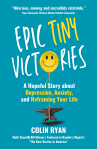
Welcome back Colin Ryan, author, storyteller, comedian and survivor of Bipolar 2, OCD and ADHD. Colin has written Epic Tiny Victories: A hopeful story about depression anxiety and reframing your life. It is hilarious, honest and poignant.

Colin describes in the book growing up Evangelical, purity culture and his deconstruction process.
Join us as we catch up on where Colin’s deconstruction journey is at. We discuss his mental health journey. Colin tells stories from the book.
Get Epic Tiny Victories today.
Links
http://www.epictinyvictories.com/
https://www.colinryanspeaks.com/
Chapters
00:00 Graceful Atheist Podcast Intro
01:36 Welcome back Colin Ryan
03:50 Deconstruction Journey since 2020
15:27 Epic Tiny Victories and we were all 11
29:44 Impact of therapy on Colin’s Life
47:49 Mental Health takes work
52:36 The book process and how to get ETV
64:40 Final thoughts on the episode
66:43 Secular Grace thought of the Week
Amazon Paid Links
As an Amazon Associate, I earn from qualifying purchases.
Amazon #CommissionsEarned: https://amzn.to/4thnu4J
Interact
Join the Deconversion Anonymous Facebook group!
Support the podcast
Patreon https://www.patreon.com/gracefulatheist
Paypal: paypal.me/gracefulatheist
Deconversion
https://gracefulatheist.com/2017/12/03/deconversion-how-to/
Secular Grace
https://gracefulatheist.com/2016/10/21/secular-grace/
Transcript
NOTE: This transcript is AI produced (otter.ai) and likely has many mistakes. It is provided as rough guide to the audio conversation.
this is the graceful atheist podcast welcome welcome welcome to the graceful atheist podcast my name is david and i am trying to be the graceful atheist i'm incredibly excited about my guest today my guest is colin ryan i consider him a friend he is an author a comedian a public speaker and he has written a book called epic tiny victories epic tiny victories is this true story of colin ryan's unlikely journey from an anxious asthmatic kid with depression to a national speaker comedian and storyteller who has made more than 1 million people laugh learn and feel less alone all while managing bipolar 2 ocd and adhd in colin's book he talks about the power of the divine and the power of the divine and the power of the divine growing up in an evangelical world the experience of purity culture deconstructing and all the while managing his mental health i mentioned in the interview that colin said to me once that you can tell any story as long as people know that you're okay colin has come through all of this and although he continues to manage his mental health he is able to share with others how they too can have epic tiny victories here is colin ryan colin ryan welcome back to the graceful atheist podcast nice to be back that's amazing uh you're an author storyteller you've been a comedian you've done financial literacy uh how do you describe yourself you're doing great i'll just let you keep going yeah i mean i would say that yes i'm a professional communicator in the sense that i've done a lot of studying and testing and work in different mediums of communication so i've written two books um i've been a public speaker about 15 years i did about five years of stand-up comedy i've been doing storytelling a long time and so these different modalities if you will are all ways that i can communicate with people and i've been doing storytelling for a long time i've been doing storytelling for a long time i've been doing storytelling for a long time i've been doing storytelling for a long time i've been doing storytelling for a long time i've been doing storytelling for a long time express concepts but also ways that i interact with life like they're just how i like to play with how do you say this best or this is a painful experience what if it could be funny you know or i'm in a big room of people what if i could say the thing that everyone's thinking but no one feels like is safe to acknowledge you know and so i'm very fortunate to have had a career where i i go around i speak i speak a lot on personal finance on mental health but in the those topics, what I'm always really trying to do is bring a lot of humanity and vulnerability. And so I think that as a man, as an adult, I feel very lucky that I get to, for example, go to a college audience and talk openly about the emotional side of life or show them respect, even though our age isn't the same, you know? And so I feel like I get to kind of lift people up and just like try to figure out the best way to tell the story. And I think that's, it's very hard to articulate. Yes. I'm not sure I succeeded, but that's kind of the gist of it. I was looking back at, it was 2020. Uh, November, uh, that you did your deconversion anonymous episode. You've been on a couple of other episodes with the whole gang, uh, doing stuff, but man, uh, that's a lot. That's a few years ago. Uh, how are things? Things are great. Yeah. That's so interesting. That was five, six years ago. I mean, that's, that's, that's really, I think about where I was at, at that moment. And I had heard about you and I had heard about how you did these anonymous interviews with people who were like X Christian X religious, whatever. And I am that, but I also was like, I don't know how to tell that story or what it means if I say that. And I had a lot of, put a lot of weight around that, that I no longer do because I like myself just fine. And that was part of the process of growing up. Christian was trying to figure out, well, do I have to have a new label or a new identity? And I think it was a beautiful thing that I could have this chance with you and I could just be like totally anonymous and tell my story safely. And that was something I always told people about your podcast was it's really, he gives you this chance to tell your, like, you want to share your story, but you're also a little nervous about, will people just see the name graceful atheist and like make some sort of snap judgment. And I don't know, that just didn't feel that important this time around. Yeah. Yeah. They're bigger fish to fry in the world than what label I may or may not use. Right. I understand. Yeah. Yeah. But at the time it was really, it was really meaningful to be able to share with you. And I just love the way you listen and validate all of our stories. And I still believe that leaving any tradition. Or. Or framework that you are steeped in from a young age is a huge act of courage. And it's, it's a moment of self-honesty, whatever. It's kind of a come what may journey. I mean, it really is like, feels like the, the, the, the stakes are really high. Yeah. And it was certainly part of me figuring out who I am was just wanting to take what worked from my religious childhood. And what I love about my. Life now as an, a fully self-directed adult with my own principles and, and, and way of seeing things and just kind of smoosh those together and, and try to be the best me. I mean, I love what you just said that it's, it's about self-honesty. Yeah. I really feel like I connect to that a lot, that it was, it was self-honesty that led me out of, of Christianity. And regardless of what labels you put on things afterwards. It's being honest with yourself, no longer lying to yourself. That is the big deal. Yeah. I mean, and, and, and what comes with that or what that brings up for me is that you're motivated to lie to yourself. Like you don't, you don't want to acknowledge, Oh, I'm having big questions that throw this whole thing into, into doubt. You know? I was, I think from the very first moment I had a, a, a challenge or a question where I thought this could actually be a real big issue with my faith as I understand it within my religious upbringing, which was evangelical Christian, uh, reformed Presbyterian. So pretty, pretty for realsies. Okay. Yeah. Calvinist, you know, um, fairly fundamentalist, uh, very doctrinally, you know, aligned, you know, you know, you know, you know, you know, you know, you know, you know, you know, you know, you know, you know, you know, you know, you know, you know, you know, you know, you know, you know, you know, you know, you know, you know, you know, you know, you know, you know, I was just this color outside the lines kid, you know, I, it's almost like the way I interact with ideas that I love is I like to challenge them and poke at them and look at them from all angles. And there were people are very important to me in my young life who just saw that as, as rebellion. Right. And, and I couldn't really articulate, I was like, I think this is me interacting with the stories of the, of the Jewish people. Yeah. Yeah. Yeah. Yeah. Bible and of church. Like I love stories and, you know, any, any Sunday when the pastor would tell a story, I would just like snap into focus, you know, cause I'm holding my children's Bible and inside of it, I have like a paperback book or something that I'm reading cause I'm totally bored. And then he would tell a story and I would be like, oh my gosh, I would just feel myself lean in to the storytelling, you know? And I just, I think that's the piece of faith that always really connected for me was like the, the stories of Jesus as this person wandering around, like giving speeches, people being like, not knowing what to do with him, you know, like, there was something about like the human side of all these characters that I was just so into and intrigued by. And I just didn't, I didn't feel like I needed to be super, um, what's the word like reverential or overly, you know what I mean? Like respectful where there's no messiness. I like the messiness. Right. Yeah. Yeah. I tell you, Colin, the thing that, that struck me when I first met you in the first interview is, uh, you, I had quoted you, uh, as saying that your, your first and only religion is inclusion. And then one other way you described it. And I don't remember what it was, but it was, it was, it was, it was, it was, it was, it was, it was, it was, it was, it was, it was, it was, it was, it was, it was, it was, it was, it was, it was, it was, it was, where the context was, but like, you know, if you're not in my circle, I'll make the circle bigger. And, and that has stayed with me, Colin, for all of those years, man, that is so beautiful. And I can see where that would not fit in to a fundamentalist way of thinking. Yeah. Wow. I don't even remember saying those things. And I, but I, I respond as though, Oh, I like that. Yeah. That does sound good. You know, that guy's, that guy's brilliant, man. I don't want, we'll go that far, but like the spirit of that, I do still really resonate with, and I did as a child. And so thank you for reflecting that back to me, because I think that even as a little kid, I had this very strange math that was going on in my head that wasn't validated by any of my, my sort of adult authorities in my life, which was like, I'm just for people. Like I'm for people. I tell me about you. I'm fascinated. I want to, how can I make you laugh? How can I learn from you? How can we like create something cool together? And it was not surprising, David, that when I noticed people being excluded or mistreated for any reason, I bristled. Like I, like my first reaction was I, it wasn't something I could name. I just was like, something about this. I do not like. And as I got older, I was able to say, Oh, well, you know, and I say in the context of the churches, I was in my experiences, I don't speak for any larger groups or anything. I wouldn't even presume to, but in my churches, I witnessed sexism. I witnessed homophobia. I witnessed, uh, shaming, uh, attitudes toward people. And it just didn't, it just didn't sit right. Like I wanted them to be in the circle too, you know? Right. And I didn't realize maybe at the time that that kind of made me on the very outside of the circle also. Cause I was like prepared to, it's weird to say it, but I was almost was like, well, I guess I'll be outside the circle then with you. Like if these are my options, even as a kid who wanted to fit in and wanted to belong, I still wanted to make sure that kid belonged to. And so it just created this tension, right. Of like, you know, every, I don't know, big group like that. They got to have their policies and their rules. And I just, those were not for me. You know, I was, I was people first. That's amazing. And you know, that is such a, an expression of, of secular grace, right. Without using the same terminology. And I just, I just think it's, it's very beautiful. I think when I, I think when I met you and started listening to the gracefully atheist podcast, what struck me was grace and this love and respect for people's stories. And so that's, that's why I'm back to support your work and to share my journey. And, you know, what's funny for me is a couple of years ago, I, found myself really needing community and I started going to a church and it was the weirdest possible experience after having worked so hard to honor my own values and, and paradigm and leave the churches that I had grown up in behind. And I didn't think I'd ever come back. And the truth is I came back because I wanted to be around people in a regular way. And I wanted to allow space for, you know, I wanted to be around people in a regular way. And I wanted to allow space for church to have evolved in ways that the ones I'd experienced hadn't. And wouldn't you know it, the church I went to, the pastor is a gay man. First, like he, I didn't know that he's standing there and starts preaching. And I'm just like, Oh, see, this isn't that hard. Just accept everybody. It's fine. We're all fine with it. We're all able to love and honor each other and not, you know, create all these very narrow, you know, um, disqualifying criteria. And so I think for me, I've always been a person who I love people more than anything else. And I think it's in that sense, it's kind of funny to be going back to a church. Like it doesn't, it doesn't really matter to me one way or another. I just want to be in spaces where people want to know how I'm doing and how I can listen to people and, and yeah. So I don't have like a, I'm definitely a misfit that way. I don't have an identity that goes with it, but I have a, interestingly enough, I have a relationship with church that has continued and is so different than anything I would have, I would have predicted, but I do, I've done it on my terms in a way that feels right to me. And I think there's, there's grace in there. And I think that's what I love about your work is us just taking the time to listen to each other's stories. And that, that leads us to, you know, what, what we're here today for, and that is your new book, Epic Tiny Victories. I, I wonder if I could limit you and ask for the elevator pitch first, and then we're going to delve into the deep end as we go. So, what would you describe the book as? Take a shot at it. Colin is an anxious religious kid with depression, and he's got divorced parents, and he grows up feeling very alone and sort of not sure of himself. And he finds his way into becoming a standup comedian, telling stories, standing on stage, like having a successful career. And he still has depression and anxiety. And there comes this point where he kind of realizes, if I don't figure out how to manage my mental health some way or another, it is going to manage me right into a place I don't want to be. Really a sense of really like a reckoning with the challenge of dealing with mental health, you know, when life is sad, but also when life is great and you're still struggling and don't know why. I could say maybe what you won't in that I think it's deeply funny. It's painfully honest. It is vulnerable in all the right ways. And I think one of the things that you taught me early on was that you can tell any story as long as the audience knows that you're okay. And we have the sense of... That, you know, you are the narrator of this story and that, you know, you are okay. But you go into very honest difficulties that you've been through, including some deep mental health problems. Yeah. Well, thank you for expressing it that way. It carries a lot of weight. And I appreciate you saying it. And I do think that that's kind of what I mean. I don't mean to say, oh, I'm so good at communicating. So I should write this book. I meant like, I'm kind of obsessed with humor in dark places and in finding vulnerability as a strength instead of as like a slip up or a confession. And I just was like, well, then that's how you write the book. Like, be unafraid to tell like the really some of the really hard moments that a person can have in their life. And then right in the worst part. Like, that's where the joke goes. Yes. That's awesome. And that's okay. And trust people to relate to it in their own way. And I am gratified to say that's what people have said is they see themselves in the story. And that's why I did it. You know, I'm not remarkable. I'm remarkable in the sense that I'm a human. And that is its own incredible, magical event. That... How do you... Explain, you know? Like, we all are that. We're all magic. But in terms of like, I'm not different. I just grew up in a certain way where I wrestled with depression and anxiety. And I could not figure out why. And no matter how dark things got, I would not give up. I just refused. I just... I was a fighter. And then in my adult life, no matter how good things got... There were still this like heaviness around the edges. And sometimes would just show up in the most unexpected moments. And I just felt like, what an honor to get to tell that story. To tell that very human story of the journey to just be okay. And to just like, hold your own hand. And love yourself. And believe in yourself. And fight for yourself. And... And... And... And... And... I mean, that's kind of an inspiration of the idea of an epic, tiny victory. I think the everyday stuff is epic. Yes. Absolutely. You know? Like, every person you've had on your podcast. I've listened to so many of these stories where it's like, it's remarkable. What they have navigated. What they've come through. You know? All of us are underdogs in certain ways. And I think I just love hearing... I think I just love hearing about how people kind of climb out of the valley. You know? Yeah. One of the stories that you return to, kind of in multiple points in the book, is a story when you were 11 years old. And you had kind of an embarrassing moment in a classroom. And a young girl stood up for you. Yeah. I'd like you to maybe tell that story. And then we'll unpack a little bit about why you came to this. And then we'll come back to that. Okay. Yeah. I mean, I was this kind of quirky, bold, dorky kid. And then I went to middle school. And it was like, the second that I got there, it's like, oh no. Hide. You know? Be invisible. Yeah. And that was such a powerful instinct for me. But I had no idea how to do that. And I tried very hard to be... I tried to be invisible. And I made it about three periods. And then the teacher gave us a questionnaire and said, I want everyone to fill out this questionnaire. I want to get to know you. And then I'm... And so I still trust adults. I trust adults at this point. And I am not apparently someone who listens to directions. So I just answer it with complete honesty. And we hand them in. And then she shuffles up the questionnaires. And she hands them back out to the class. And... And we go around and read, like, three answers from each kid's questionnaire. And I am just like, oh no. Oh no. Like, this is so bad. And this kid gets my answers. And I can't remember his name or even his face. But I remember he was really mean and popular. And, like, kind of an intimidating, you know, sixth grader. But, of course, you know, like, he was probably, like, a little taller than me and had, like, peach fuzz. Right. He seemed like a man, you know, to me. And he's reading my answers. And it's just... It's so bad. It was like, where would you go on a Friday night? And, you know, these kids had said, like, to the mall. And, you know, I'll smoke in and whatever they were saying. And then... And I had said... I was at rehearsals with my... With my local church's clown troupe, Clowns for Christ. You know, as you do. As you do. And it was just a moment where, like, when I wrote that on the questionnaire. And when they got shuffled back out, I thought, I'm on a train headed to disaster. Like, it's going to get said. And it gets said. And it, like, my whole body, I just shrink. I'm just crushed. I'm so embarrassed. I mean, everyone is howling, laughing. I mean, this is, like, the end of any social status. Day one. Like, it's... I'm starting at a major deficit here. And I want to stand up and yell out, I get it. Like, I will do whatever you think is cool. I will be whatever you think I should be. I will quit clowns. I will watch all the R-rated movies that you guys are watching. I will... I will, like, whatever. Just, I don't want to be special. I don't want to be different. I just want to be liked by you. And I didn't say that. And I just felt ashamed. And sat there silently. And that's when this voice from the back of the room rang out. Belonged to a student. Her name is Michelle Beaver. She was, like, two rows behind me. And I didn't know her well. She wasn't... She wasn't necessarily, like, the coolest kid in class. So she took a risk. But she stood up for me. And she said, These are his opinions, guys. Like, why are we doing this if we're just going to laugh at each other? And it just put a dent in the, like, humor of the moment. Like, it was, like, a bit of a gut check for people. And I'm not going to say, like, it changed everything. But people definitely backed off. And we went on to the next person. And I never forgot that moment. And I never forgot that Michelle, like, put herself on the line for me. And she stood up for me in a moment when I really, really was the outsider. Yeah. And I say in the story that, you know, this is the deal. Like, you can stand up for somebody when they need you. When they need you. And they will remember you as their hero for the rest of their life. And I was struck in my adult life by how that memory was still with me. And I ended up telling that story at a moth event in Burlington, Vermont, in front of about 1,000 people. And it was, like, there's a scoring component. It's called a Grand Slam. And so at the end, they pick a winner. And I didn't really care about that. To me, it was just brave enough to tell 1,000 people that I had been, in Clowns for Christ. Seriously. You know, even all these years later, still kind of painful to say out loud. Yeah. And it just really, people really resonated with the story. It ended up winning. And it ended up getting played on the Moth Radio Hour, which plays on National Public Radio. It got featured in a Reader's Digest Best Stories in America collection. I mean, it really, like, took off in this really, you know, surprising way for me at first, because it was like, oh, no. You know, now a million people know that I was in Christian Clowns. But what came next was also really special, which is that, you know, I got to see people resonate with this story. And at one point, I was doing a show, and I had told that story and went well. And I think afterwards, I became, I bumped into this woman and she said, I loved your story about Michelle and being a clown and all that. And I kind of said, you know, despite myself, like, I'm surprised people connect with that story. It's so specific to be a Christian clown. And, you know, and she said, Colin, we were all 11. Yes, we were. Yeah. And I was like, it was a really a paradigm shifting moment for me. Yeah. Yeah. Yeah. Yeah. Yeah. In a weird way, the more specific you are about your example of whatever happened to you, it's actually more relatable because people, they don't care about the specifics. They care about the emotions and the themes. And so you tell a story like that. You could, you could frame that a million different ways. It's just a story about a child who feels alone. Yeah. Yeah. And another person who is not special, is not a Marvel character, does not have like healing powers, right? Like Wolverine. And yet she was willing to stand up next to me and, and fight for me. And I think that that's just something very important. I think that I try to remember as a person is just to be honest about what's happening to you, because people are going to get it from their own lens. And they're going to appreciate that you were real. Absolutely. And they're going to appreciate that you like gave us the juicy details in my case. The other thing I'll add is that I, I've reached out to Michelle a couple of years ago and we reconnected and I got to send her the video of me telling this story and everybody cheering for this, this girl, Michelle, who stood up for this, you know, dorky little boy who needed it. And I think it just, it just really meant a lot to her. And, you know, it turned out she had been having a really hard growing up experience at that moment too, in ways I had no idea. And so for her to kind of be able to like look back and go, wow, I did this thing that like really mattered to somebody. And then other people really connected with that. And I just, that to me felt like maybe the coolest part of the whole thing was I get to go see, you didn't even remember that you did that, but that, that has moved a lot of people. Absolutely. I, I think that's why I wanted you to tell the story is like, you know, getting the opportunity to come back and connect with her. It's just amazing. And while all of us have been 11, Colin, not all of us have told the embarrassing stories about being 11, when the moth grand slam and be able to reconnect with our childhood friends. So well done there, sir. Thank you. Oh, oh, oh, oh, oh, oh, oh, oh, oh, oh, oh, oh, oh, oh, oh, we are going to skip over a lot of parts. The book is amazing. You are a world traveler. You lived in Scotland for awhile. You almost ran with the bulls in Pamplona. Yeah. Uh, you were a VBS star on as an actor, you did all kinds of things, but I want to get to the heart of the book, which is your mental health journey. Yeah. And maybe talk a little bit about the first time you connected with a therapist and what that did for you. Yeah. When I was in my late 20s, I found myself in a real bad spot. I had probably since around college and into my 20s, I'd started to experience really pronounced, profound depression, you know, and I could usually manage it. And I've always been a very silly, goofy person. I love to make jokes. I love to make people laugh. I light up around people. So I can always kind of hide it. Some people have said to me, like, I wouldn't have thought that you like you don't seem like the type of person who who can be struggle with that. And I think that, well, that's its own conversation. But I think it's like we're kidding ourselves if we think that everyone isn't doing their best, whatever that looks like. Right. Just struggling through, like just doing their best. Everybody's winging it. Right. Exactly. We're all fighting our battles and there is no one who has it easy. And I really think that for me, this was the stone on my back. I just it was really weighing me down. And it was creating a very small life. I became a person who I wanted to be creative. But I was terrified of rejection. I wanted to be brave. But I I was afraid of failing, of choosing the wrong thing, of of embarrassment. And I was just stuck. And I was working a job as a journalist and I started to experience really severe social anxiety. And so my job is I would call people and do phone interviews or do in-person interviews for articles. And I started trying to come up with ways to do it all via email. And I would be making. I would be making up excuses, you know, covering in all kinds of different ways for the fact that I was actually just so sad I couldn't leave the house and I couldn't imagine having a phone call. It was kind of like, you know, if you ever wanted to call a crush, like maybe in high school or middle school or something. And this happened to me. I remember dialing this girl's phone number. And then on the very last number, I would just hang up. I just, you know, over and over. Yeah. I remember. Yeah. Yeah. And it felt that way with like every conversation I needed to have. Like I would be gaming it out ahead to try to figure out how I wouldn't mess it up. And I would just I was so overwhelmed. And I started falling behind on my work. And of all people, one of the head staff people at the newspaper I worked for called me into his office and he he kind of took a look at me and said, are you are you depressed? And I was like, I didn't I don't think I was like didn't even make eye contact. I was really in a low spot. And he reached into his drawer and he pulled something out and he hands it to me. And it's a business card. It had a man's name on it, Sam. And it's a therapist. And the only reason that that. Being my first encounter with therapy. The only reason that's significant, unfortunately, really is because of the way I was raised internally. In terms of religion and also growing up in the late 80s and the 90s. And it's just like there was a lot of messaging around. You don't go to therapy because that means something's wrong with you. You're falling apart. You can't manage it. You can't stuff it down, you know. And, you know, some of that, I think, is is very. Maybe funny, like you think about the like Irish Catholic thing of just like. I'm just going to hold my emotions in. And then that's just, you know, and then and then you're just OK. So you just got this guy in the corner who's like. How's that working out for you? How's that working out? Exactly. But I think that with my Protestant tradition on my my mother's side, there was more of a explicit warning away from mental health and away from secular therapy. And. I just got to a point where. I had no other option. And I went and saw this guy, Sam, and I can I'll never forget. And I write this in the book probably better than I can say it here. But I will just say I'll never forget sitting in this tiny room. With a complete stranger and finally saying out loud. To someone else, things that I'd been thinking for years and being able to. Actually hear them in detail. And deal with them just a little bit. And so like saying things out loud, like I think I'm really messed up and something's wrong with me and I don't think I can keep going like this. And and to just have this man go. OK. What else? OK. Huh. Why? Why? Tell me more. Just. And the thing that I remember, Dave, is I was like, I can't phase this guy. Yeah. Like I'm I'm laying out some darkness here. Yeah. I just like. All right. Like he seemed a little bit. Misaligned with the drama of the weight of what I was going through. And it took me a long time to realize that. He was already teaching me. He was showing me that when you have those thoughts. You don't have to match their energy. They can just be thoughts. And. It's. Wild when you realize that you can say to yourself. And mental health is is an arena where this happens or we we have these thoughts that we tell ourselves like I'm really messed up. No one will ever. Accept me. I'm always going to be this way. And. You can notice it and you can go. OK. It's all right. Let's take a walk. You know, you can you can be that Sam, if you will. For yourself. And. I remember sitting with Sam and within like. The first hour. I thought this is going to save my life. Amazing. And it did. And and I. You know, I said, I know I need to learn how to do this. OK. Thing to myself. So like just be even and safe and loving strong for myself. And. And I did. And it only took. 15 years and thousands of dollars in therapy and. Several medications and. A lot of life lessons. It's easy really is what I'm getting at. Yeah. But but at the end of that process and probably even from the beginning of that process, what I was becoming is what I like to call a successful depressive. Just for lack of a better way of explaining it. I am not successful. I am not somebody who. Has it all together. I'm not somebody who doesn't. Have. Low low moments. But. I have learned how to manage them. I've learned how to be my own friend. In those moments. And I've learned what works for me to help me. Get out of those. Those valleys. And so I look at my relationship to depression as. Not. Do I never have it? I don't look at that. I don't look at that way at all. I see success as. Am I able to go into it and then come out of it. In a relatively. Brief amount of time. And so that's actually how I look at it. I look at it now is like I can get really, really down. For about three, four days. Okay. Like that's it. I can't. I can't sustain it beyond that because I have these other habits. In place and I just know how to love myself out of that. Out of that life. Out of that low spot. And. That's why I kind of wanted to write the book was like. You know, encouraging people to figure out what are your things? What are your. Your foundation. That you can put together. I really think a big part of this is having friends. Relationships where you can be just genuine and vulnerable. Yeah. And so who is the person you can text when you really. Really are being like. Hard on yourself. That's. That's a good number to have. Yeah. Absolutely. Right. And so it's like, that's a tool. That's part of how you do it is you've got. You've got somebody in your life where you can say, Hey. I don't even feel comfortable doing a phone call right now. Can I just text you for a minute? And what I've come to believe. I think you would agree is like. I want to be that other person. That's what I want to be. That's what I want to be. That's what I want to be. That's what I want to be. That's what I want to be. That's what I want to be. That's what I want to be. That's what I want to be. That's what I want to be. I want to be that other person that somebody would text in that lowest moment. Yes. So I kind of just have, have taught myself that that is true of. Most people, unless they prove otherwise, is that they actually would love to help. And be leaned on if I'm willing to ask for it. Wow. So many things I want to, I want to respond to there. Number one. Yeah. I've talked a lot in the, the deconversion. Context of needing that one person. Yeah. Who you can just go and, and, and talk to them and be truly yourself and not have to worry about them trying to protect your faith or your lack of faith or what have you. Right? Like having that one person is so, so important. And then the other thing that I think is so beautiful about the book, Epic Tiny Victories is you, you know, go through your life where you've learned. Yeah. So about 10 songs. Yeah. Right. That are, that are pre-ography, so they've started those episodes more widely throughout the world. And not, it's very clear balanced lifespan and the way that they're built. But in 150 years or so. It's also, and, and we're, we're sitting here, putting it in some science. Cr meetings, you know, with the audience, brings your power and Então, you know, even more directly to the family, right. And that's in the first half. Of Cam än Ngân. there's kind of a funny layer to that when i was a kid i watched the movie braveheart i was probably like way too young it's like very like people get their heads chopped off and everything but but what i really took from that movie was the epic soundtrack and the the heroism and the honor and the nobility you know and i wanted to be brave like that i wanted to be heroic even in a normal way you know i just wanted to be courageous and i think as a person who was afraid of failure afraid of rejection or afraid of embarrassment like i got to know intimately this moment when i would almost take a risk and then i wouldn't and like i said in my late 20s around the time that my depression was really taking over my life i was also living a very small fearful life you know i i was trying to write a book and i couldn't share it with anybody because i was terrified what that it wouldn't be good enough and so i mean to me that actually that's kind of a perfect picture i'm spending i'm working in office and i'm spending every minute i'm not at work writing something that i don't have the guts to even let my friends read let alone submit so i'm i'm not going anywhere like just objectively and so i assessed myself with a courage problem and i was lucky lucky i cannot believe how significant this was by accident i was in uh i was going to a small church community and like around this time and after the service i remember i overheard a guy who's telling somebody else he said yeah i signed up for this comedy class at the flynn center uh flynn theater in burlington vermont and uh teen nerd at the flynn meet my mom she'd stick a finger in my eye on my eye like your thick can't see my face he would keep ignoring whining and pansing and i'm like because i'm sense of need and getting out of the park i was learned how important my parents love comedy so i wanted to um get an equipment for some of my friends i was super nervous and i think i was a bit so sad that day and even i was peppered it was devil's day i alive a little he was like hey god how many of you know thoseics have today but i don't know what they do and i couldn't hire people over those last several months that i had to find the parts out of that room i've only two or three ways to do something, but it was very clear. I was like, if you don't do this now, you're never going to do this. There's something about this that is intriguing to you. And it's not, if not now it's never. And so I signed up for that class and I walked into that room. Like I was walking to my death. I could not believe that I had chosen to be in this extremely vulnerable environment of standing in front of people. And there's something so like full body cringe about turning to an audience and pretending you're like being a comedian and then saying a joke. And then they don't laugh. It's like, it's, I mean, right. It's like, yeah, it's a nightmare to describe. And this was dawning on me, you know, more and more vividly. And then they called my name and they said, everyone had to get up. And do a couple minutes of jokes. And I got up there and I wasn't very good, but at some point I got a laugh and it was like tectonic plates rearranging themselves. I mean, it was just a moment where I thought, Whoa, wait, wait, I could, I could actually, I could figure this out potentially. But even as I went, sat in my seat, what struck me even more was like, I just did the thing that scared me possibly the most. And I walked all the way from my car to my seat, from my seat to the stage. I did the minutes. I sat down, like I made myself do all that. And in a weird way, I felt like this is kind of heroic, like in a normal way, you know, I didn't fight a war. I didn't slay a dragon. I didn't save a kingdom, you know? But I picked the thing that scared me and I leaned into it instead of ran away from it. And honestly, I've tried to live my life that way ever since, because there was something very clarifying about that. And so I like to give people advice. I think that confidence is something you can earn for yourself. And it is, there's, there's math to it and you're not going to like the math. Cause it's pretty simple, right? It's like, if a thing scares you, go do it. And, and I know that doesn't make it easier and it doesn't. And that's the, that's the important part is the only thing that makes it easier is you actually doing it. And so I like to tell people, if you need a hack or a trick to make it make sense in your mind, just do it for a minute. Just do like one horrifyingly scary minute, right? Walk across the room and, and ask out your crush, right? Or go to a job interview or write a book and, or write an essay and put it online or whatever to go to a standup comedy open mic. And that's really scary and can be really rewarding. And for me, that just kind of became the deal is every minute that I would do standup comedy, I became a minute. Less afraid. It was like, I was like reducing that, that, that monster of fear in my life. And then at a certain point, you kind of get your momentum going. It starts to become fun. And so for me, I did open mics. I started doing comedy shows. I recorded like enough content for an album. And then I got a opportunity to apply for a job as a public speaker. And I had just enough confidence stored away from this little comedy adventure to say yes to that. And so that's kind of become the formula for me now is like, if something is scary, you know, if you can lean in. One of the things that struck me reading it is, you know, you talk very vulnerably about the internal monologue, the internal heckler, the internal critic, and these epic tiny victories, these little almost hacks that you have of talking a positive talk to yourself are, are things that helped you deal with and, and learn to live with the depression and various other mental health. So one minute less fearful was one of them. And there were others that, you know, you were able to just love yourself, right? Like to talk to yourself, your way out of some of these, some of these things. Yeah. And I do want to say too, that mental health is very different for each of us. And so for me, you know, I also recommend therapy. I also recommend medication. I recommend you figure out, treat it as a science experiment and really try to figure out what it is that you need. So I, this is not me saying be brave and that's it. Sure. Thank you for saying that. I mean, that's, that's basically the seventies. I like to think we've come somewhere forward from that period. And so I just, you know, for me and, and my therapy journey helped me understand that I actually have a OCD and bipolar two. And so these things express themselves as depression and anxiety. A lot of these things kind of show up in that overthinking or that very heavy, low depressive experience. These are very common. And so that's why I chose to write about them in the book is that we all either know these experiences for himself, or we know someone who, who wrestles. Yeah. And I wanted to name those things in a very human normalizing way. You know, I think one of the big discoveries for me is that depression is normal. It's like, this is something I have to catch up with. I have to catch myself, David is, is, you know, cause in my relationship with my wife, you know, this is still a thing that happens. And when I do get depressed, I have to catch myself from being like, it's okay. It's okay. It's just a little, it's low, low level. Everything's fine. Like I'm apologizing for it. Right. When my partner loves me and just wants to be present for me is perfectly fine with me saying, you know what? I am depressed right now. I'm working on it. Okay. You know? And I think that's, that's kind of the big epiphany of it all is that, well, look, I say this in the opening of the book to, to be very clear about this. If you are feeling challenged around your mental health, uh, you are not broken. You are not alone. There's nothing wrong with you. Yeah. There's nothing wrong with you. And I like to think that you will find your way to a better mix that feels a little more manageable, where you can be a little more transparent, a little more functional and that's it. And so I, you know, I'm, I became a person who I've done speeches for huge audiences and I've had my face on the big screen while I give a talk and I've signed books, you know, I've had these moments that, that seem quite, like, Oh, that must be a nice life. And I have all the other moments too. And so I think that that to me is maybe where I want to kind of offer something to really to anybody, to the world, to the, to the listeners of this, you know, to, to the readers of the book is like, you're not broken. You're not alone. We need you. Like, how, how can you help yourself? How can we help? Each other to like, get ourselves into a place where we can share our story and speak our truth and fight for the person in our life who is down and needs somebody to stand next to them, you know, be, be a hero for someone else. I think that's, that's, that's kind of what I have landed on is like, we're already there. We're already like where we need to be. We're closer than we think. We just got to lean into, to this moment and lean on people around us. I want to talk just briefly about the writing of the book, the process itself. My biggest compliment to you is that you were showing and not telling. I was literally yelling at the book, like, this is bipolar. This is bipolar. And you reveal that near the end. I hope I haven't given away too many secrets. No. So well done. In showing, you know, your experience through the storytelling. I thought that was, that was really well, really well done. Thank you. It, it's a, so I'm obsessed with storytelling as an art form, but also as like a kind of a practice for knowing yourself better. And the, the basic formula for it is what's a moment that really stands out in your memory. And I think that's what's so important. So I'm going to go ahead and start with the story as being significant. Okay. Got it. Great. Now, instead of just focusing on. Why was it the war like so hard? Why was it such a overwhelming, painful experience? If it's that kind of experience, maybe the question is how was I growing and changing during that moment? Right? So that's now that's a story. It's not just you're slogging along and life sucks. It's like, no, yeah, life sucks, but look how determined this character is to not give up as things get worse and worse and, and look what they leaned on in themselves to grow and to change. Right. And so I say that because I think each one of us is a character in our own story. And it's actually kind of fun when you think of yourself as a character in a story. And one of the things that was important to me with this book was that I wanted to, to stay true to, well, how does the character experience it in the moment? Like, I know, I know a lot more now, but you know, there's a chapter in the book where I'm in fourth grade and I'm at a spelling bee and the day doesn't go the way I hoped. And I cannot tell you how delightful it was to really lock into, okay, I'm nine years old, 10 years old, whatever. Like I only know nine years. Yeah. Yes. You know, and that was really, really fun. And to your point about my realization that I have bipolar two, that is something that is revealed later in the book, but it's also on the back of the book. So it's not meant to be like a spoiler. Really the only spoiler is I wrote a book about mental health. You don't have to worry like it, you know, it's going to get bad, but it worked out for this guy. And so I know what you're referring to. There was a moment in my twenties where I experienced unbelievable insomnia. I just swung from depression to insomnia and I was awake for like a couple of weeks. And, um, and so I put that in the book as like a wink, wink, like that'll make sense later. Yeah. But at the time it didn't, you know, at the time I just thought, man, I don't know. I don't know what's going on here. So, you know, that's bipolar two, by the way, is the kind of less well-known version of bipolar disorder. It's much less severe, but it does also involve mood, uh, mood swings where you go from you really sleep is really the whole deal with bipolar twos, learning how to manage your sleep. And yeah, so there were moments in throughout my life where I just wanted to, as you say, show it, not tell it like, just, just come with me on this journey and it'll, it'll start to snap into focus as we get further along. And that's quite lovely to inhabit the moment in time in your life and, you know, not be the, the adult that you are now, uh, you know, retrofitting, uh, information, uh, into that, that moment. So yeah, that's, that's beautiful. The other thing that I just really related to is you talked about, uh, completing the book and, you know, that maybe that was a dangerous moment for, for mental health as well. And having kind of a sudden realization that, you know, I'm not going to be able to do that. I'm going to be able to do that. I'm going to be able to do that. I'm going to be able to do that. I'm going to be able to do that. I'm going to It's not that people were ignoring it. It was that people didn't know it existed at all. And man, can I relate from being a podcast person? I think anybody who's ever created anything ever can really, really relate to that. You, you pour your heart and soul into something. And it's not that people see it or hear it and reject it. It's that they don't even know it exists, you know? So talk, maybe it's just a little bit about the process of getting the book out there and getting people to know about it. Well, yeah. And that's, you know, I'm glad you, I'm glad you pointed that out because the central idea from the book is what I call reframing. And so it's looking at a moment and saying, okay, here's my default. I'm suffering. This didn't go the way I wanted. I put all this work out into the world and no one cares. That's the default story, storyteller narrative. But what's more interesting is to go, well, is that how I really, want to see this moment? Is that really what I believe? Or is that just kind of my insecurity talking or my, you know, despair? I wrote all this and no one, no one cares. That was the thought I had after I finished my first book. And I was like, you know what? I think the more honest, more obviously true interpretation is no one knows. And so that even that just changed the energy. Hmm. It's that they don't know and everyone's busy and it is hard to find your audience and it is hard for your work to like reach the people you want it to reach. And it just is. And maybe that's okay. And I cannot tell you how that has served me this time around because, you know, this time around I finished, this is my second book and I went into it very open-eyed about this next part is going to be hard. Yeah. Because you haven't quantified what you expect. So whatever book sales you get, you're going to wish it was more. Right. And you, you've never decided how many Amazon reviews you want or, you know, bookshop.org reviews, but you're going to want more than you get. And what I've had to really do is slow down and go, what's in my control? Like, what do I actually want to declare? How do I declare victory instead of this was pointless? And look, I'm talking to myself right now because this is, this is the work. Like I put this book out there and you know, everybody's like, I wish I want the whole, I want people to be walking around, like walk by me reading my book. Like, of course, like I put all this work and I want to share it. And what I have landed. On is when somebody writes to you and says that mattered to me, that really spoke to me. I, I, I really loved it. And you gotta be like, that's enough. And Hey, let's, let's play the game a little further. Maybe you don't even get that because not because they don't feel that way. Cause if you didn't ask or they didn't tell you, it just, it just lost in translation. How about this? You got to make a thing. You got to spend time making a thing that just like you loved making it. And that, that's the piece I've really like leaned on this second time through with a book is like, no matter what happens, I got to spend almost, I think a little bit over two years writing a book where I was like proud of every word. And. I thought a lot about some of the stories were like these. Dragons I had to fight, you know, some of them just poured out onto the page and they were perfect. And then other chapters were like, I defy you, Colin, you know, I'm twice as long as I need to be deal with that, you know, and, and all of these challenges and, and I really enjoyed it. I really enjoyed the, the, the project. And so that's what I would say is. This idea, it's in the subtitle of the book, you know, it's a hopeful memoir about depression, anxiety, and reframing your life. And I would say we are all capable of reframing our life and saying, I know how I feel about this. I know what I'm telling myself, but is there another version that might also be true that I could focus on a little more? And I think that's where you start to really like listen to your own voice and start to hear yourself. Say things like, you know what? I got to do that. And my sister read it and she loved it. You know, I got a chapter about my early on about our grandmother, who is this iconic five foot tall British woman who would show up on our lives. I kind of like a Mary Poppins character, but like, but she swore more, you know? Yeah. I love her already. I know. She was one of the greats. And she, you know, writing about her is so meaningful to me. But then my sister called me. She left me like a voice message of how beautiful it was and how it reminded her memories of our gran and her connection and reliving that. And so I think it's that. It's realizing that what you do is going to have an impact on somebody else. That's epic. Absolutely. I think that's maybe the best advice to any artist ever is make art. That you want to consume. You may have even said it, that you were writing the book that you would have wanted to read that kind of thing. Yeah. Colin, I want to give you a chance to plug the book. How can people find it? Let's make sure that they get access to it. So where is it available? Yeah. So my book is available. Basically type in Colin Ryan, epic, tiny victories. You'll find it on lots of different sites. You'll find it on lots of different platforms. If you go to epic, tiny victories.com, I have pictures from the book. You can read the first chapter for free. And then it's available on all the different platforms that you might. If there are any platforms you don't want to support right now, I get it. I've got other platforms you can feel good about. And so, you know, it's my honor to share the book that way. And I've got some funny photos from along my journey. You did mention. I was a vacation Bible school star movie star for a week. And those photos alone are worth the price of admission. Can confirm. Yeah. Can confirm. It's just, I'm very proud to say like, there's some stories in there that are going to really make you just laugh. And there are going to be stories in there that are going to make you really feel big things and feel connected. And that's why I wrote it. Colin Ryan. Thank you so much for being on the podcast. Thank you, David. Final thoughts on the episode. I love it. When someone independently comes up with ideas that are very similar to secular grace. And I think Collins, his first religion is inclusion and opening the circle. To include everyone around him really encapsulates that it's a beautiful expression of secular grace without using those terms. I loved reading the stories that Colin wrote about and then getting to talk to him about it. They are hysterical. They are vulnerable and honest in a way that is very rare. And that is my cup of tea. That is what I love about Colin the most. I also want to point out that as I did the edit. I could hear that maybe I was minimizing and I want to just reemphasize that Colin points out how much work, how much time, how much effort it took to live with the mental health experience that he had. So I don't want to minimize in any way that was difficult. It took therapy. It took medication. It took a lot of work on Colin's part. So let's learn from Colin on how we can work through our mental health experience as well. Another thing that I wanted to talk about is the fact that I'm a Christian. I'm a Christian. I'm not like everyone else. It's a really complex and complex thing. It's a really complex issue that is common, but different from the rest of the rest of the world. And I think one of the things that I loved about what Colin was saying was that you're basically a science experiment of one figuring out what works for you will be unique and different from everyone else. So you won't be exactly like Colin, nor will you be like your neighbor or roommate. Although you are not alone in your mental health journey, you are a science experiment of one. There will be links in the show notes for purchasing. I think, I'm sure it's something that you can find out about yourself. Epic Tiny Victories. Obviously, you can get that wherever books are sold. I encourage you to get the book itself. It is hysterical and wonderful. Thank you, Colin, for sharing and being vulnerable and honest and giving us a chance to have epic tiny victories. The secular grace thought of the week is you're not broken, you're human. That has been an ongoing theme of the podcast from the get-go, but this is a great opportunity to say that mental health is a part of that. There are some faith traditions that look down upon therapy or acknowledging mental health. That has been destructive for people for years. Allowing yourself to recognize your mental health challenges is the first step in living with those mental health challenges in a healthy human way. You are not broken. You are just human. Grab someone you love and tell them how much you love them. Until next time, my name is David and I am trying to be the Graceful Atheist. Join me and be graceful human beings. If you want to get in touch with me to be a guest on the show,
 gracefulatheist.com